
AI Boom vs. Tight Liquidity: Will the US Stock Rally Continue?

Global Weekly Talk | Renewed US inflation pressures squeeze rate cut room, while China's prices show signs of stabilization and recovery
United States: Renewed inflation pressures squeeze rate cut space, consumption remains resilient but diverges from consumer confidence
Last week, the US core macro focus was on inflation and consumption performance, showing characteristics of rising inflation, resilient consumption, and a divergence in confidence. In terms of inflation, the April CPI increased by 3.8% year-on-year, hitting a new high since May 2023, with core CPI up 2.8% year-on-year, both exceeding market expectations.This was mainly due to factors such as rising gasoline prices driven by the Iran war, heightened memory chip costs from the AI race, and one-time statistical distortions in housing data.Energy price increases are being passed on to food and service sectors, further squeezing the Fed's rate-cut space for the year. On the consumption side, April retail sales grew by 0.5% month-on-month and 4.9% year-on-year, meeting expectations with strong performance, supported mainly by gas stations and online retail, while auto and clothing consumption dragged on growth. Tax rebate policies provided short-term support for consumption.Notably, consumer confidence fell to a historical low, forming a clear divergence from the resilience of actual consumption.The market is divided over the persistence of inflation, with the bond market already signaling caution. Going forward, attention should be paid to energy price trends and changes in consumption momentum.
China: CPI rises moderately, PPI increase expands, prices show overall stabilization and recovery
China's core macro focus is on price data, with both CPI and PPI showing positive trends and overall moderate price recovery. Regarding CPI, the April CPI shifted from a decline to a 0.3% month-on-month increase, with a 1.2% year-on-year rise, while core CPI remained stable at 1.2% year-on-year.This was mainly driven by fluctuations in international crude oil prices and increased travel demand during holidays, with significant price increases in energy and travel services.Food prices, however, declined somewhat, reflecting structural recovery in end-user demand. For PPI, April saw a 1.7% month-on-month and 2.8% year-on-year increase, expanding from the previous month, primarily influenced by imported impacts from rising international commodity prices.The increase in demand from certain domestic industries and the optimization of market competition order also provided support, with stronger price increases in upstream and midstream sectors.However, the momentum for price increases in downstream industries remains weak. Overall, consumer prices are gradually moving away from the bottoming-out phase, and a continued stabilization and recovery trend is expected, although food prices may weigh on CPI.
In the equity market,
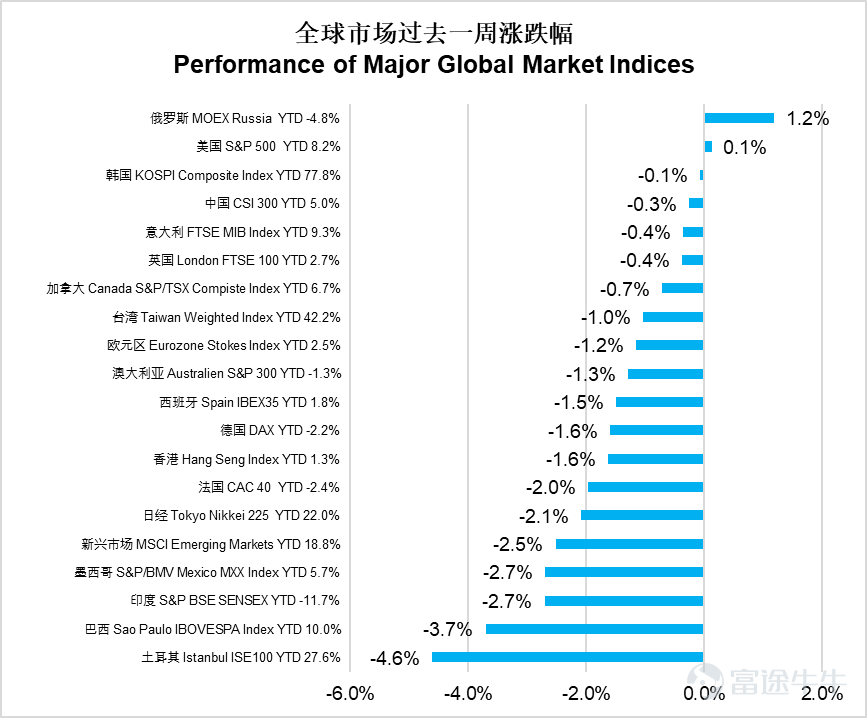
Last week, global markets generally fell, with Brazil's IBOVESPA index plunging 3.7% to lead the declines, Turkey's ISE100 down 4.6%,India's Sensex down 2.7%. Emerging markets as a whole dropped 2.5%, the Hang Seng Index fell 1.6%, and the CSI 300 edged down 0.3%. Russia's MOEX rose 1.2% against the trend, becoming the only major market to post gains. The U.S. $S&P 500 Index (.SPX.US)$ inched up 0.1%,remaining largely flat. Overall, major global indices were under pressure except for Russia.

Data source: Wind
The U.S. energy sector surged 6.8%, leading performance, while information technology and consumer staples both rose 1.2%, and healthcare increased by 1.0%.However, the consumer discretionary sector plummeted 3.1%, real estate fell 2.6%, materials dropped 2.3%, and utilities declined 2.1%. Industrials fell 1.1%, communication services dropped 0.8%, and financials edged down 0.3%.The market showed a pattern of energy rising alone, while consumer and real estate sectors led the declines.

Data source: Wind
Hong Kong's raw materials industry plummeted 9.1%, performing the worst, healthcare fell 5.5%, and non-essential consumption and the information technology sector both dropped 3.7%,The Hang Seng Tech Index fell by 3.2%. Consumer staples dropped by 3.1%. Conglomerates declined by 1.6%, the Hang Seng Index fell by 1.6%, and the industrial sector decreased by 1.2%. The real estate and construction industries fell by 0.6%, while finance and energy both slightly dropped by 0.3%. Utilities rose by 0.8%, and telecommunications increased by 0.4%, becoming one of the few sectors to rise.The market demonstrated resilience in utilities and telecommunications, while raw materials and pharmaceuticals led the declines.

Data source: Wind
In the bond market,
Global bond markets fell across the board last week, with the global aggregate index dropping by 1.52%, and the U.S. aggregate index falling by 1.14%.U.S. investment-grade corporate bonds fell by 1.04%, while high-yield corporate bonds dropped by 0.49%. The emerging markets USD-denominated bond composite index fell by 0.99%, and the China USD credit bond index declined by 0.51%.

In terms of interest rates, U.S. Treasury yields moved higher overall. The 2-year U.S. Treasury yield rose by 18 basis points to 4.07%, while the 10-year U.S. Treasury yield increased by 24 basis points to 4.59%.

Market outlook
– The core issue has shifted to unexpected inflation and rising interest rate risks, putting pressure on highly valued growth stocks.
This week’s core market issue shifted from 'AI profit realization and falling oil prices' to 'unexpected inflation and rising interest rate risks'.The dual unexpected rise in U.S. April CPI and PPI completely dispelled the market's last hopes for a rate cut within the year, pushing the probability of a rate hike to nearly 40% for the first time.The combination of the 10-year U.S. Treasury yield breaking through 4.5% and the 30-year breaking above 5.1% put direct pressure on highly valued growth stocks. The primary challenge for the new Federal Reserve Chair, Warsh, is finding a balance between Trump's pressure for rate cuts and inflation data forcing tightening – markets widely expect that the June FOMC meeting may formally abandon a dovish stance.
The positive tone from the meeting between the leaders of China and the U.S. provided short-term support to the market, but substantive trade breakthroughs were limited.The 'Trade Committee' mechanism and the $300 billion framework for mutual tariff reductions are still at the conceptual stage, with specific product lists and implementation timelines yet to be clarified. More critically, the tariff truce only extends until August, leaving policy uncertainty high before the November midterm elections.Signs of easing in the technology sector (approval for some Chinese companies to purchase NVIDIA chips) are worth noting,but the overall framework for semiconductor export controls has not changed.
The situation in the Middle East remains a 'Sword of Damocles' hanging over the market.Despite positive signals earlier this week that Iran would allow some ships to pass through the Strait of Hormuz, Friday's statement by Iran’s foreign minister expressing 'no trust in the US' caused oil prices to soar immediately, with Brent crude returning above $109. The Strait of Hormuz has been blocked for more than 75 days,and the global crude oil supply gap continues to widen (IEA forecasts demand contraction this year). Any back-and-forth in negotiations could trigger a spike in oil prices,further reinforcing expectations of 'higher for longer' or even 'higher rates'.
Key economic data and events this week
On Monday, China will release industrial production and retail sales data for April;
on Wednesday, the People's Bank of China will announce its LPR interest rate decision, while the Fed releases the minutes from the April FOMC meeting;
on Thursday, the Eurozone, the UK, and the US will publish preliminary PMI figures for May.
Disclaimer: The issuer of this report is E Fund Asset Management (Hong Kong) Co., Ltd. This report does not constitute an invitation or recommendation to invest in fund units. Fund unit subscriptions can only be made using application forms accompanied by the fund prospectus. Investment involves risks; fund prices may rise or fall, and past performance is not indicative of future results. Before investing, investors should carefully read the fund prospectus (including the 'Risk Factors' section) to understand the investment risks related to the fund. This report may only be distributed in certain jurisdictions. In any jurisdiction where distributing such information or making any invitation or recommendation is prohibited, or where distributing this report or making an invitation or recommendation to any person would be illegal, this report does not constitute such distribution or invitation or recommendation. This document has been exempted from prior review and approval by the Hong Kong Securities and Futures Commission, and has not been reviewed by the SFC. SFC approval does not imply promotion or endorsement of the plan, nor does it guarantee its commercial merits or performance, nor does it indicate suitability for all investors, or endorsement of suitability for any particular investor or category of investors. All rights reserved © 2026. E Fund Asset Management (Hong Kong) Co., Ltd.
Risk Disclaimer: The above content only represents the author's view. It does not represent any position or investment advice of Futu. Futu makes no representation or warranty.Read more

Comments
to post a comment
1
2