Trump visited China from May 13 to 15

Politician Portfolio Tracker | Trump, the "White House Trader," Q1 Moves Revealed! Top Gains Exceed 150%, Which Companies Were Involved?
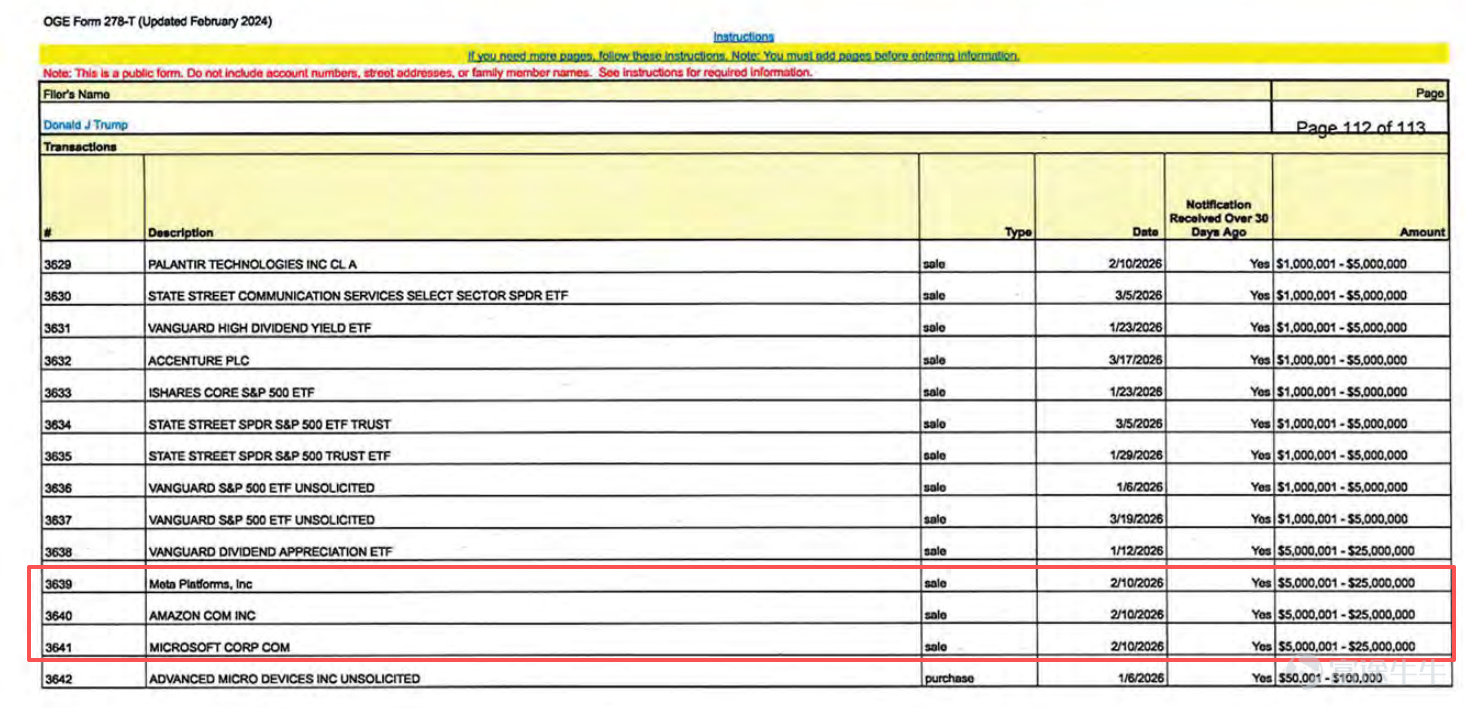
On May 14, 2026, the U.S. Office of Government Ethics (OGE) released its latest financial disclosure filing, bringing the current U.S. President Donald Trump's capital market activities during his second term into sharp focus.In just the first quarter of this year, Donald Trump executed as many as 3,642 securities transactions, with his disclosure filings totaling 113 pages.
This deal, with a total size ranging from $220 million to $750 million, rivals the position‑changing activity of a large hedge fund. Based on the disclosed data and recently released profit reports,This "White House power broker" has pursued an exceptionally active investment strategy, but this has sparked intense scrutiny over whether there are conflicts of interest between his policy agenda and his personal wealth.
At this point, many traders are probably wondering: What did Trump trade? And what is the win rate? This article will provide an in-depth analysis to help you gain a clear understanding of market positioning.
What did Trump trade?
This filing does not always clearly specify the type of security, such as whether it is a stock or a corporate bond. Nevertheless, certain transactions remain noteworthy due to their size and timing. Specifically:
1. Reducing holdings in the three tech giants—Amazon, Meta, and Microsoft.
The latest disclosed documents show that Trump significantly reduced his holdings in $Amazon (AMZN.US)$ 、 $Meta Platforms (META.US)$ And, $Microsoft (MSFT.US)$ three core technology stocks during the first quarter of this year. The sale transactions for these three companies reached the upper limit of the disclosure range (single transaction between 5 and 25 million USD), marking the most significant trading activity of the quarter.

However,The large-scale sell-off does not equate to a complete exit.The document points out that Trump still maintained small purchase actions for these three giants: In early 2026, he made multiple purchases of Meta, each ranging from 1,001 USD to 500,000 USD; the purchase sizes for Amazon and Microsoft were between 1,001 USD and 5 million USD.
This 'big sell, small buy' strategy suggests that he is not simply exiting due to bearish sentiment but rather actively managing exposure to these three stocks with flexibility.
2. Significant new positions established in the semiconductor sector, led by NVIDIA and Broadcom; concentrated buying in the software sector, including Oracle and ServiceNow.
While reducing some existing positions, Trump demonstrated a clear shift in focus in Q1: aggressively investing in the semiconductor supply chain. The documents show that $NVIDIA (NVDA.US)$ 、 $Broadcom (AVGO.US)$ both received new positions valued between 1 to 5 million USD; additionally, $Texas Instruments (TXN.US)$ and EDA giant $Synopsys (SNPS.US)$ 、 $Cadence Design Systems (CDNS.US)$ also appeared on the list of new buys at the same scale.

Consumer electronics leader $Apple (AAPL.US)$ similarly received a large increase in holdings ranging from $1 million to $5 million. Notably, the filing specifically disclosed that Apple, Microsoft, and Amazon recorded multiple 'unsolicited orders' in March—these trades were proactively initiated by brokers without receiving formal instructions, indicating active operations by intermediaries on these tech giants under specific market conditions.
Another structural layout that cannot be ignored in this disclosure is the concentrated buying of the enterprise software sector.The filing shows that $Oracle (ORCL.US)$、 $ServiceNow (NOW.US)$、 $Adobe (ADBE.US)$and $Workday (WDAY.US)$ all recorded new positions exceeding millions of dollars.
What is worth exploring is the logic behind the operations: In the first quarter of this year, the market was generally concerned that large AI models would replace traditional software vendors, coupled with decreased short-term earnings visibility, which led to significant valuation markdowns for the sector.The timing of these large purchases highly coincides with the period of sharp pullbacks in the software sector, showcasing precise positioning to accumulate during the 'AI panic'.
3. Dell, Intel — Two sensitive transactions cannot be ignored
Among the disclosures this time, two transactions have drawn extra market attention due to their unique background and timing.
First is$Dell Technologies (DELL.US)$ ,Documents show that,Trump established a position worth $1 million to $5 million as early as February 10, 2026.Notably, this move occurred well before his public endorsement of Dell hardware at a White House event in early May this year.This sequence of 'building a position first, then showing public support' has sparked heated discussions about the correlation between policy signals and personal trading.
Next is $Intel (INTC.US)$,Since early March, Trump has been continuously increasing his holdings through a series of 'non-active orders.' Considering that the US government decided to acquire a significant stake in Intel by the end of 2025, this wave of buying under the national strategic context is interpreted by the market as a deep commitment to the transformation prospects of this domestic chip leader.
What are Trump's chances of success?
According to Unusual Whales statistics, Trump has earned substantial profits, with several stocks delivering impressive paper returns.Based on the disclosed profit list, this 'presidential-level' portfolio not only boasts an extremely high success rate but also demonstrates precise timing on core hardware technology and policy direction.

Direct cashing in of policy leverage: 'White House concept stocks' become the biggest cash machines
The most controversial items on this list are those closely tied to national strategy and directly influenced by presidential executive power:
$Intel (INTC.US)$: resulting in returns as high as150.77%. Just at the end of 2025, the US government decided to acquire a significant equity stake in Intel, and Trump made six precise purchases in the first quarter of this year. This is no longer just about 'betting on domestic chips,' but has sparked strong market skepticism about leveraging policy benefits for personal gain.
$Dell Technologies (DELL.US)$:achieving67.63%in returns. He built his position in four separate transactions in February, but at a White House event in early May this year, he publicly endorsed Dell's hardware products.The timing of the purchases preceded his public endorsement, raising waves of质疑 about 'using power to drive personal investments.'
Commercial space layout: bought up to 5 times, $Intuitive Machines (LUNR.US)$ with returns of 101.99%The space economy, as a frontier strategy of the United States and a heavily invested area for Trump himself, undoubtedly sparks widespread speculation about subsequent government procurement and industrial support policies.
2. Aggressively buying 'computing infrastructure' and 'storage/edge AI'
Setting aside policy controversies, this portfolio also demonstrates top-level power’s ultimate control over the core lifelines of this technological cycle:
Top of the list $Penguin Solutions (PENG.US)$: Achieving the highest return rate through a single purchase.157.50%This AI infrastructure provider perfectly meets the hard demand for the expansion of current computing centers.
Storage and optical communication sectors dominate the rankings: $SanDisk (SNDK.US)$ 、 $Marvell Technology (MRVL.US)$ 、 $Seagate Technology (STX.US)$ Core targets in data centers and storage, such as these, have all recorded doubled growth. This shows that the team behind the operation has placed significant bets on the underlying hardware logic of AI—especially on data transmission and high-frequency storage.
Summary
The reason this holdings report quickly sparked heated market discussions is mainly due to the high resonance between 'policy directions and market fluctuations' frequently seen in the U.S. stock market during Trump’s second term.
Looking back earlier this year, the market had repeatedly captured: just before major White House policy announcements, there were often 'eerily precise' abnormal bets in options, commodity futures, and prediction markets. Such prescient operations have led to growing concerns in legal circles about insider information leaks.
More controversially, Trump himself had previously hinted in a public statement just before the adjustment of tariff policies that 'now is a good time to buy.' This move directly sparked strong criticism from Democratic lawmakers, who called for an investigation into whether there was any market manipulation behind it. Under this sensitive political and economic atmosphere, this holdings list is naturally seen by the market as an important indicator to gauge the 'policy bottom line.'
Risk Disclaimer: The above content only represents the author's view. It does not represent any position or investment advice of Futu. Futu makes no representation or warranty.Read more


Comments (29)
to post a comment
207
770