
Institutional Q2 Holdings Revealed! What Is "Smart Money" Buying?

13F Big Reveal | Google's Q1 Holdings Unveiled! Heavy Buying of CME Makes It the Top Holding, Space Duo PL and ASTS Remain in the Spotlight
As the Q1 institutional holdings reports for 2026 are gradually disclosed, the latest investment landscape of tech giant$Alphabet-A (GOOGL.US)$has surfaced.
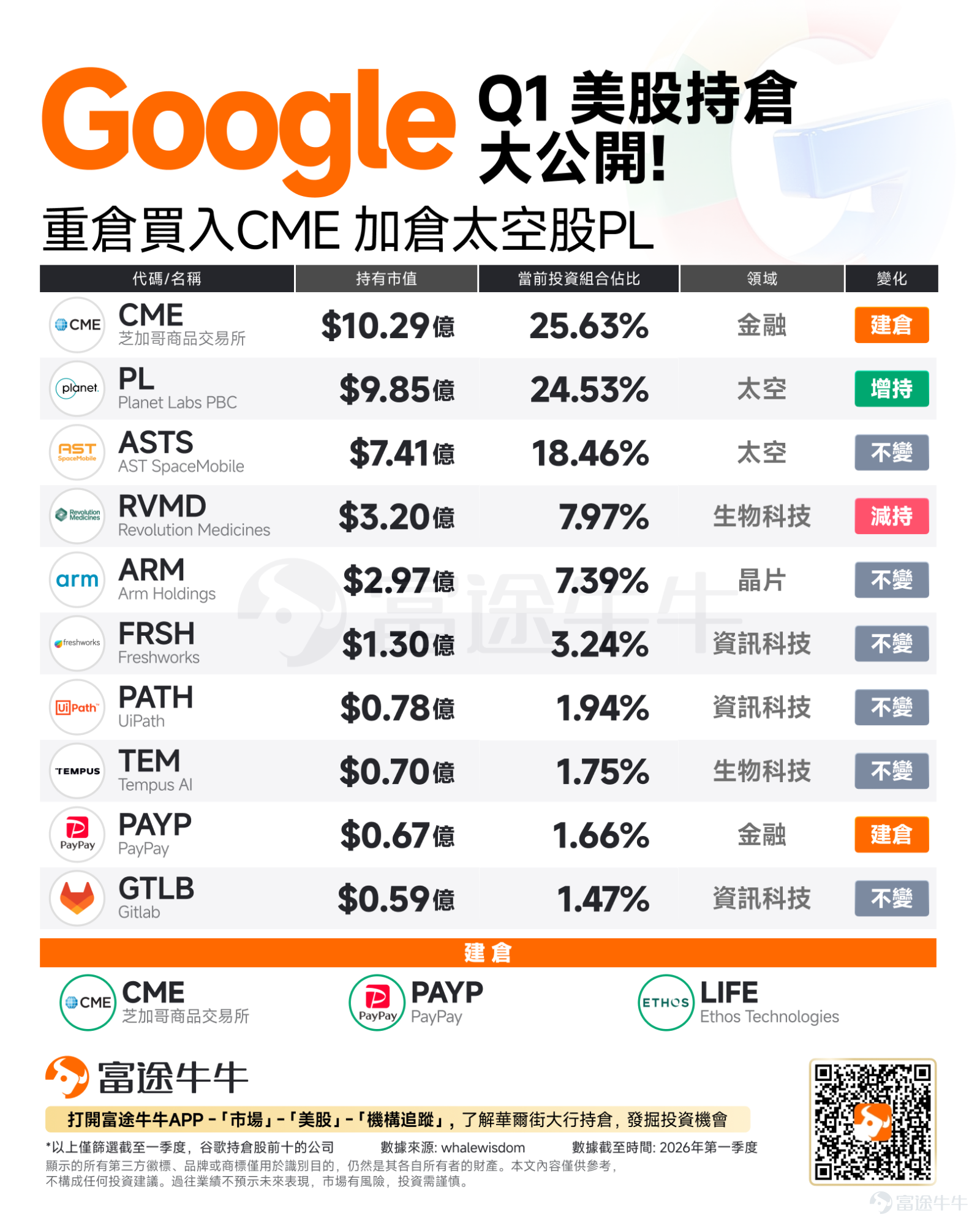
According to the latest disclosed data, there has been a dramatic structural adjustment in its portfolio during this quarter. The overall holdings show a highly concentrated characteristic, with the top three heavy positions accounting for nearly 70% of the total portfolio, showing a clear trend of capital shifting from healthcare to financial infrastructure.

Biggest highlight: CME becomes the largest holding stock
Google’s most notable move this quarter,was undoubtedly an extremely aggressive position-building in$CME Group (CME.US)$。Data shows that Google purchased more than 3.48 million shares of CME in Q1, with a year-end stock value of up to $1.029 billion.
This move allowed CME to jump directly from 'zero position' to become the largest holding in the investment portfolio,accounting for a whopping 25.63%. In fact, as early as the end of 2021, Google had made a $1 billion equity investment in CME, and in exchange, CME committed to fully migrate its core trading system, clearing system, and data services to Google Cloud over the next decade.
The underlying logic behind Google's heavy investment in CME lies in the deep integration of 'technology infrastructure' with 'financial infrastructure.' This is not only a perfect defensive financial investment—leveraging CME's counter-cyclical attributes as the world's largest derivatives exchange to hedge macroeconomic volatility—but also a highly ambitious strategic move: through equity ties, Google can secure CME’s massive cloud orders as it migrates its core systems to Google Cloud, while gaining direct access to its invaluable global macro trading data, which will feed back into Google’s own AI ecosystem.In essence, Google has acquired a 'super cash cow' with both hedging properties and AI strategic value.
Aside from CME,Google's key purchases in the first quarter also focused on the fintech sector, including newly established positions in $PayPay (PAYP.US)$ and $Ethos Technologies (LIFE.US)$ 。
PayPay, Japan’s dominant 'super financial app,' which officially listed on the US stock market in mid-March this year.The market expects that Google’s purchase of PayPay reflects confidence in its role as a 'next-generation financial consumption infrastructure' with strong growth potential.
PayPay controls vast amounts of high-frequency, real consumer transaction data and is currently in a profit-explosion phase transitioning from single payment fees to 'high-margin commissions from diversified financial services,' aligning closely with Google’s strategy for big data mining and traffic monetization.
Ethos Technologies is an innovative tech platform using AI and big data analytics to address pain points in the traditional life insurance industry. Google’s investment in Ethos essentially bets on 'AI computing power and big data driving cost reductions and efficiency improvements in traditional finance.' By leveraging technology to predict risks accurately and achieve instant pricing, Ethos fits the narrative favored by top-tier tech funds: 'using algorithms to transform ancient industries.'
Core Holdings: Stably Guarding the 'Space' Dual-Core
Setting aside the newly established CME, Google’s two other core holdings remain firmly anchored in space technology and satellite communications:
$Planet Labs PBC (PL.US)$It is currently the second-largest holding,The company is a global leader in Earth observation and satellite data, operating the largest constellation of satellites in orbit, with the unique ability to conduct full-coverage scans of global landmasses daily. This quarter, Google made minor adjustments by increasing its stake, now accounting for 24.53% of the total portfolio.
$AST SpaceMobile (ASTS.US)$ Ranked as the third-largest holding,With a market value of $741 million, representing 18.46%, this company provides the world’s first space-based cellular broadband network directly connecting smartphones. By launching high-performance satellites, it offers seamless connectivity to regions with network blind spots globally.
Reduction Actions: Healthcare Sector Suffers 'Withdrawals'
To support its massive new positions in the financial sector, Google sold some assets in the first quarter, with the healthcare sector being the primary target:
The leader in blood glucose monitoring devices, $DexCom (DXCM.US)$ Became the main stock offloaded this quarter,Google made a significant profit of up to $107 million in a single quarter.
The next four major sell targets all came from the biotechnology and precision medicine sectors: targeted oncology company$Revolution Medicines (RVMD.US)$with $5.11 million withdrawn; gene sequencing and diagnostics company$GeneDx Holdings (WGS.US)$was sold for $4.6 million; cancer screening giant$Exact Sciences (EXAS.US)$and protein degradation therapy company$Monte Rosa Therapeutics (GLUE.US)$saw outflows of $3.67 million and $1 million respectively.

Source: whalewisdom
Summary
By analyzing 13F data, we can clearly see Google's current investment focus:one hand embracing traditional financial infrastructure, the other betting on cutting-edge space technology.
While significantly selling off healthcare stocks, Google has heavily invested in CME and PayPal, indicating that it may have more confidence in financial trading infrastructures with strong cash flow and industry monopoly positions amidst the current macroeconomic environment. Meanwhile, its large holdings in Planet Labs and AST SpaceMobile remain rock solid, proving that 'low-orbit satellite communications and Earth observation data' continues to be an irreplaceable long-term strategic investment direction for Google.
 Stay updated on institutional holdings to keep up with the latest investment trends: Market > US Stocks > Institutional Tracking
Risk Disclaimer: The above content only represents the author's view. It does not represent any position or investment advice of Futu. Futu makes no representation or warranty.Read more


Comments (6)
to post a comment
41
162