
English
Back
Open Account
头豹研究院
wrote a column · May 15 14:52

Frost & Sullivan, in collaboration with Vision Medical, officially released the '2026 Blue Paper on Current Status and Future Trends of the Children and Adolescents Myopia Management Industry'

The issue of myopia among children and adolescents continues to receive widespread social attention. Myopia prevention and control have gradually evolved into a comprehensive demand encompassing early screening, risk warnings, scientific intervention, long-term follow-up, and health management. The increase in family health awareness, routine school screenings, and continuous improvement in medical service capabilities have led to a sustained rise in the demand for myopia prevention and control. The upgrading of the demand structure has also driven the industry to shift from traditional product supply towards specialized services, comprehensive management, and full-cycle intervention.
The children and adolescents myopia management industry is rapidly upgrading towards an integrated system of myopia management products. Products and technologies such as red light therapy and VR-based visual training continue to attract market attention, driving the industry's transition from single-product supply to diversified intervention solutions. The requirements for the approval, application, and management of myopia-related products are becoming increasingly detailed. Channels within the industry are also shifting towards a more standardized development model that emphasizes collaboration between medical institutions, professional optometry service providers, and grassroots screening referral systems.
On May 7, 2026, Frost & Sullivan (hereinafter referred to as 'Frost') in collaboration with Guangzhou Vision Medical Software Co., Ltd. (referred to as 'Vision Medical'), officially released the '2026 Blue Paper on the Current Status and Future Trends of the Children and Adolescents Myopia Management Industry' (hereinafter referred to as 'the Blue Paper'). The report aims to provide a comprehensive and in-depth analysis of the children and adolescents myopia management industry, examining it through various lenses such as policy regulations, industrial development, market demands, and technological innovations, exploring the driving factors behind industry development, uncovering the vast potential of the industry, and tracking future development trends.
The '2026 Blue Paper on Development and Future Trends of the Children and Adolescents Myopia Management Industry' aims to deeply focus on the disease burden and current treatment methods in the field of myopia management. Using this as a starting point, the paper conducts an in-depth analysis of the efficacy of existing therapies, regulatory policies, and market potential within the myopia management sector, tracks the evolution of technology in the industry, monitors future development trends, explores the significant growth potential of the industry, and analyzes the driving forces behind market development.
Below are excerpts from the Blue Paper; for the full content, scan the QR code to obtain the complete version:
01
Analysis of Myopia as a Health Condition
Definition and Mechanism of Myopia
According to the definition by the National Health Commission, when parallel light rays focus in front of the retina under relaxed accommodation, it is called myopia, which is a type of refractive error. The visual system includes the eyeball, optic nerve, and the visual pathways connecting different structures in the brain. The anterior structures of the eye (cornea and lens) focus light entering the eye onto the retina. On the retina, light is converted into neural impulses, which travel through the optic nerve and visual pathways to reach the visual cortex, forming vision.
Currently, research on the pathogenesis of myopia and its control mechanisms is still in the exploratory stage, with no single theory able to fully explain all phenomena; various hypotheses have inherent limitations. Notably, recent years have seen a surge in research findings, bringing hope for future theoretical breakthroughs and improvements in myopia management mechanisms.
The essence of myopia is that the focal point of distant objects falls in front of the retina. Clinically, the most common type is axial myopia, often caused by excessive growth of the eye axis during development (or strong refractive power). Eye growth is not passive but regulated by 'emmetropization': the retina can identify the direction of defocus (whether the image falls in front of or behind the retina) and adjust the rate of eye axis growth accordingly. When there is prolonged near work, insufficient accommodative response, or persistent peripheral hyperopic defocus, the retina tends to release growth-promoting signals. The choroid may experience rapid changes in thickness and perfusion, followed by structural remodeling of the sclera: decreased collagen synthesis, reduced extracellular matrix, enhanced matrix degradation, gradual thinning of the sclera, and reduced mechanical strength, ultimately leading to continued elongation of the eye axis, resulting in myopia, which can progressively worsen.
Analysis of the Disease Burden of Myopia in Children and Adolescents
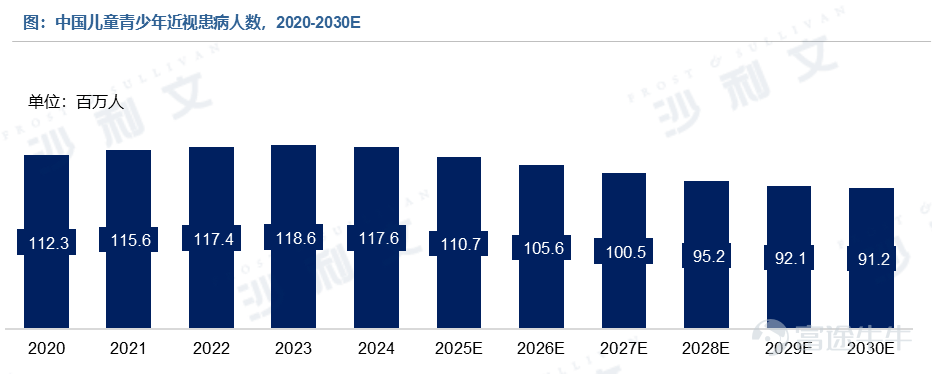
From 2020 to 2024, the number of children and adolescents with myopia in China increased from 110 million to 120 million. It is projected that by 2030, the number of children and adolescents with myopia in China will decrease to 90 million. With the implementation of the 'double reduction' policy, widespread campus vision screenings, strengthened parental management of eye use, and extensive application of various myopia prevention and control products, the onset and progression of myopia in children and adolescents has been effectively delayed.
The issue of myopia among children and adolescents continues to receive widespread social attention. Myopia prevention and control have gradually evolved into a comprehensive demand encompassing early screening, risk warnings, scientific intervention, long-term follow-up, and health management. The increase in family health awareness, routine school screenings, and continuous improvement in medical service capabilities have led to a sustained rise in the demand for myopia prevention and control. The upgrading of the demand structure has also driven the industry to shift from traditional product supply towards specialized services, comprehensive management, and full-cycle intervention. The children and adolescents myopia management industry is rapidly upgrading towards an integrated system of myopia management products. Products and technologies such as red light therapy and VR-based visual training continue to attract market attention, driving the industry's transition from single-product supply to diversified intervention solutions. The requirements for the approval, application, and management of myopia-related products are becoming increasingly detailed. Channels within the industry are also shifting towards a more standardized development model that emphasizes collaboration between medical institutions, professional optometry service providers, and grassroots screening referral systems. On May 7, 2026, Frost & Sullivan (hereinafter referred to as 'Frost') in collaboration with Guangzhou Vision Medical Software Co., Ltd. (referred to as 'Vision Medical'), officially released the '2026 Blue Paper on the Current Status and Future Trends of the Children and Adolescents Myopia Management Industry' (hereinafter referred to as 'the Blue Paper'). The report aims to provide a comprehensive and in-depth analysis of the children and adolescents myopia management industry, examining it through various lenses such as policy regulations, industrial development, market demands, technological innovation...
Source: Literature search, Frost & Sullivan analysis
From 2020 to 2024, the global number of children and adolescents with myopia steadily grew from 400 million to 470 million, showing an upward trend; this growth trend is expected to continue from 2025 to 2030, with the number increasing from 490 million to 590 million. Overall, the global prevalence of myopia in children and adolescents will continue to grow over the next decade, and the situation for prevention and control remains severe.
The issue of myopia among children and adolescents continues to receive widespread social attention. Myopia prevention and control have gradually evolved into a comprehensive demand encompassing early screening, risk warnings, scientific intervention, long-term follow-up, and health management. The increase in family health awareness, routine school screenings, and continuous improvement in medical service capabilities have led to a sustained rise in the demand for myopia prevention and control. The upgrading of the demand structure has also driven the industry to shift from traditional product supply towards specialized services, comprehensive management, and full-cycle intervention. The children and adolescents myopia management industry is rapidly upgrading towards an integrated system of myopia management products. Products and technologies such as red light therapy and VR-based visual training continue to attract market attention, driving the industry's transition from single-product supply to diversified intervention solutions. The requirements for the approval, application, and management of myopia-related products are becoming increasingly detailed. Channels within the industry are also shifting towards a more standardized development model that emphasizes collaboration between medical institutions, professional optometry service providers, and grassroots screening referral systems. On May 7, 2026, Frost & Sullivan (hereinafter referred to as 'Frost') in collaboration with Guangzhou Vision Medical Software Co., Ltd. (referred to as 'Vision Medical'), officially released the '2026 Blue Paper on the Current Status and Future Trends of the Children and Adolescents Myopia Management Industry' (hereinafter referred to as 'the Blue Paper'). The report aims to provide a comprehensive and in-depth analysis of the children and adolescents myopia management industry, examining it through various lenses such as policy regulations, industrial development, market demands, technological innovation...
Source: Literature search, Frost & Sullivan analysis
02
Market Analysis of Myopia Management
Comprehensive Analysis of Current Myopia Prevention and Control Methods
Currently, the management and intervention methods for myopia are relatively diverse. The World Society of Paediatric Ophthalmology and Strabismus (WSPOS) and the International Myopia Institute (IMI) jointly recommend interventions that mainly include lifestyle and behavioral interventions, drug treatments, optical corrections, and red light therapy. A systematic comparison of the effectiveness, safety, and rebound effects of different treatment options guides individualized selection and standardized management, thus more effectively slowing the progression of myopia and reducing the burden of long-term complications. In terms of effectiveness, different methods vary in their ability to control the progression of myopia. Regarding safety, non-invasive optical correction methods present relatively lower risks, while drugs and contact lenses require attention to specific adverse reactions or complication risks. Concerning rebound effects, after discontinuing some interventions, there may be varying degrees of regression in myopia levels and axial length.
Analysis of Market Potential in Myopia Management
From 2020 to 2024, the global retail market for myopia management medical devices showed significant growth, with its size rapidly increasing from 14.59 billion USD to 30.50 billion USD. This reflects not only the growing severity of myopia issues worldwide, particularly among adolescents, but also indicates the accelerated adoption of relevant prevention and control technologies and products. Looking ahead, as parents and society continue to place greater emphasis on vision health, coupled with ongoing technological innovations and product iterations, the market is expected to maintain strong growth momentum and reach 60.72 billion USD by 2030.
The issue of myopia among children and adolescents continues to receive widespread social attention. Myopia prevention and control have gradually evolved into a comprehensive demand encompassing early screening, risk warnings, scientific intervention, long-term follow-up, and health management. The increase in family health awareness, routine school screenings, and continuous improvement in medical service capabilities have led to a sustained rise in the demand for myopia prevention and control. The upgrading of the demand structure has also driven the industry to shift from traditional product supply towards specialized services, comprehensive management, and full-cycle intervention. The children and adolescents myopia management industry is rapidly upgrading towards an integrated system of myopia management products. Products and technologies such as red light therapy and VR-based visual training continue to attract market attention, driving the industry's transition from single-product supply to diversified intervention solutions. The requirements for the approval, application, and management of myopia-related products are becoming increasingly detailed. Channels within the industry are also shifting towards a more standardized development model that emphasizes collaboration between medical institutions, professional optometry service providers, and grassroots screening referral systems. On May 7, 2026, Frost & Sullivan (hereinafter referred to as 'Frost') in collaboration with Guangzhou Vision Medical Software Co., Ltd. (referred to as 'Vision Medical'), officially released the '2026 Blue Paper on the Current Status and Future Trends of the Children and Adolescents Myopia Management Industry' (hereinafter referred to as 'the Blue Paper'). The report aims to provide a comprehensive and in-depth analysis of the children and adolescents myopia management industry, examining it through various lenses such as policy regulations, industrial development, market demands, technological innovation...
Source: Literature search, Frost & Sullivan analysis
From 2020 to 2024, China’s retail market for myopia management medical devices has continued to expand, with the market size growing from 14.52 billion RMB to 40.73 billion RMB. The persistently high prevalence of myopia among children and adolescents in China has generated substantial demand for prevention and control. On the other hand, as parents increasingly prioritize vision health and the penetration rates of defocus lenses, orthokeratology lenses, and red light therapy devices steadily rise, the market has entered a rapid development phase. In the future, driven by factors such as the continuous implementation of national policies for myopia prevention and control, accelerated technological innovation and product iteration, and the continuous improvement of primary healthcare service capabilities, it is projected to reach 90.92 billion RMB by 2030.
The issue of myopia among children and adolescents continues to receive widespread social attention. Myopia prevention and control have gradually evolved into a comprehensive demand encompassing early screening, risk warnings, scientific intervention, long-term follow-up, and health management. The increase in family health awareness, routine school screenings, and continuous improvement in medical service capabilities have led to a sustained rise in the demand for myopia prevention and control. The upgrading of the demand structure has also driven the industry to shift from traditional product supply towards specialized services, comprehensive management, and full-cycle intervention. The children and adolescents myopia management industry is rapidly upgrading towards an integrated system of myopia management products. Products and technologies such as red light therapy and VR-based visual training continue to attract market attention, driving the industry's transition from single-product supply to diversified intervention solutions. The requirements for the approval, application, and management of myopia-related products are becoming increasingly detailed. Channels within the industry are also shifting towards a more standardized development model that emphasizes collaboration between medical institutions, professional optometry service providers, and grassroots screening referral systems. On May 7, 2026, Frost & Sullivan (hereinafter referred to as 'Frost') in collaboration with Guangzhou Vision Medical Software Co., Ltd. (referred to as 'Vision Medical'), officially released the '2026 Blue Paper on the Current Status and Future Trends of the Children and Adolescents Myopia Management Industry' (hereinafter referred to as 'the Blue Paper'). The report aims to provide a comprehensive and in-depth analysis of the children and adolescents myopia management industry, examining it through various lenses such as policy regulations, industrial development, market demands, technological innovation...
Source: Literature search, Frost & Sullivan analysis
03
Market Analysis of Red Light Therapy
Red Light Therapy Becomes a New Trend in Myopia Treatment
In 2015, the World Health Organization (WHO) released a report on myopia, clearly indicating an alarming increase in global myopia and high myopia, significantly raising the risk of vision impairment due to pathological changes associated with high myopia. As a widespread ocular disease, myopia has become a global public health issue. With further research, scientists unexpectedly discovered the prominent potential of red light therapy in myopia prevention and control: In 2022, the 'Expert Consensus on Repeated Low-Intensity Red Light Irradiation as an Adjunctive Treatment for Myopia in Children and Adolescents' was published, offering guidance on red light therapy from eight aspects; in 2025, the authoritative international organization IMI (International Myopia Institute) explicitly stated that red light therapy shows 'superior efficacy compared to any other treatment method' in one-year myopia control outcomes, marking its international recognition.
Applications of Photobiomodulation Therapy in Ophthalmology
Photobiomodulation Therapy (PBMT) is a technique that uses low-intensity, non-thermal red or near-infrared light (typically wavelengths between 600-1000 nanometers) to irradiate biological tissues to produce therapeutic effects, often employing light-emitting diodes (LEDs) or low-intensity lasers as light sources. This technology can be applied to wound healing, pain reduction, inflammation treatment, acne treatment, retinal disease treatment, auxiliary treatment of myopia, sports injury recovery, and more. Red light irradiation can activate mitochondrial function in retinal photoreceptor cells, inhibit oxidative stress, inflammation, and apoptosis in their regulatory pathways, alleviate ocular surface inflammatory responses and pain, and play a role in treating myopia, retinal-related diseases, amblyopia, and eyelid skin-related conditions.
The issue of myopia among children and adolescents continues to receive widespread social attention. Myopia prevention and control have gradually evolved into a comprehensive demand encompassing early screening, risk warnings, scientific intervention, long-term follow-up, and health management. The increase in family health awareness, routine school screenings, and continuous improvement in medical service capabilities have led to a sustained rise in the demand for myopia prevention and control. The upgrading of the demand structure has also driven the industry to shift from traditional product supply towards specialized services, comprehensive management, and full-cycle intervention. The children and adolescents myopia management industry is rapidly upgrading towards an integrated system of myopia management products. Products and technologies such as red light therapy and VR-based visual training continue to attract market attention, driving the industry's transition from single-product supply to diversified intervention solutions. The requirements for the approval, application, and management of myopia-related products are becoming increasingly detailed. Channels within the industry are also shifting towards a more standardized development model that emphasizes collaboration between medical institutions, professional optometry service providers, and grassroots screening referral systems. On May 7, 2026, Frost & Sullivan (hereinafter referred to as 'Frost') in collaboration with Guangzhou Vision Medical Software Co., Ltd. (referred to as 'Vision Medical'), officially released the '2026 Blue Paper on the Current Status and Future Trends of the Children and Adolescents Myopia Management Industry' (hereinafter referred to as 'the Blue Paper'). The report aims to provide a comprehensive and in-depth analysis of the children and adolescents myopia management industry, examining it through various lenses such as policy regulations, industrial development, market demands, technological innovation...
Source: Literature search, Frost & Sullivan analysis
Similarities and Differences Between Laser Diode (LD) Red Light and LED Red Light
In the past, lasers were considered ideal light sources for PBM due to their collimation, coherence, high monochromaticity, and high power density. Nowadays, non-coherent light sources like LEDs are becoming increasingly popular due to their high safety, suitability for home use, ability to irradiate large areas, compatibility with wearable devices, and low cost. Laser red light (Laser Diode, LD) and Light Emitting Diode (LED) red light share common core influencing factors, relying on key wavelengths of 600-900nm, parameter settings of low power and low energy density, and continuous cumulative irradiation modes. However, they also have fundamental differences, rooted in different physical principles of the light sources, compounded by variations in technical design goals and application scenarios, ultimately leading to differences in optical properties and safety.
Research shows that the biological effects of PBMT are mainly related to its wavelength and energy, and the photobiological effects of red light do not require coherence. The core difference between the two is that LD has high coherence and narrow bandwidth, with concentrated local power density, making it more suitable for precise targeted therapy. LED, as non-coherent light with wider bandwidth, can uniformly irradiate large areas without laser safety concerns and at a lower cost, making it suitable for long-term home use. Both have been proven equivalent in core biological effects, functioning independently of coherence.
The issue of myopia among children and adolescents continues to receive widespread social attention. Myopia prevention and control have gradually evolved into a comprehensive demand encompassing early screening, risk warnings, scientific intervention, long-term follow-up, and health management. The increase in family health awareness, routine school screenings, and continuous improvement in medical service capabilities have led to a sustained rise in the demand for myopia prevention and control. The upgrading of the demand structure has also driven the industry to shift from traditional product supply towards specialized services, comprehensive management, and full-cycle intervention. The children and adolescents myopia management industry is rapidly upgrading towards an integrated system of myopia management products. Products and technologies such as red light therapy and VR-based visual training continue to attract market attention, driving the industry's transition from single-product supply to diversified intervention solutions. The requirements for the approval, application, and management of myopia-related products are becoming increasingly detailed. Channels within the industry are also shifting towards a more standardized development model that emphasizes collaboration between medical institutions, professional optometry service providers, and grassroots screening referral systems. On May 7, 2026, Frost & Sullivan (hereinafter referred to as 'Frost') in collaboration with Guangzhou Vision Medical Software Co., Ltd. (referred to as 'Vision Medical'), officially released the '2026 Blue Paper on the Current Status and Future Trends of the Children and Adolescents Myopia Management Industry' (hereinafter referred to as 'the Blue Paper'). The report aims to provide a comprehensive and in-depth analysis of the children and adolescents myopia management industry, examining it through various lenses such as policy regulations, industrial development, market demands, technological innovation...
Source: Literature search, Frost & Sullivan analysis
04
Analysis of future development trends in the myopia management market
Analysis of driving factors in the myopia management market
The development foundation of the myopia management market stems from the expansion of patient scale and demand, continuous improvement of the policy environment, the enrichment of technological pathways, and the practical needs of channels and endpoints for differentiated products and services.
- Patient demand: High clinical demand for myopia, high parental attention, and strong willingness to pay
- Policy encouragement: Policies have clearly elevated eye health to the national strategic level, providing ongoing institutional support for the development of the myopia management industry.
- Technological innovation: New technologies drive product iteration and upgrades, effectively addressing clinical pain points.
- Channel requirements: Channels and terminal institutions' demand for more effective product upgrades and product differentiation.
Analysis of future development trends in the myopia management market
The myopia management industry is undergoing a systematic transformation. From previously offering only single vision correction, it has evolved into full-cycle management encompassing screening, early warning, intervention, and long-term follow-ups. Proactive prevention and control technologies such as red-light therapy and behavioral interventions are becoming mainstream in the market. Industry products are trending toward being safer, smarter, and more suitable for home use. The core drivers of market growth have shifted from past consumer upgrades to a combination of policy support, clinical evidence, and technological innovation.
The issue of myopia among children and adolescents continues to receive widespread social attention. Myopia prevention and control have gradually evolved into a comprehensive demand encompassing early screening, risk warnings, scientific intervention, long-term follow-up, and health management. The increase in family health awareness, routine school screenings, and continuous improvement in medical service capabilities have led to a sustained rise in the demand for myopia prevention and control. The upgrading of the demand structure has also driven the industry to shift from traditional product supply towards specialized services, comprehensive management, and full-cycle intervention. The children and adolescents myopia management industry is rapidly upgrading towards an integrated system of myopia management products. Products and technologies such as red light therapy and VR-based visual training continue to attract market attention, driving the industry's transition from single-product supply to diversified intervention solutions. The requirements for the approval, application, and management of myopia-related products are becoming increasingly detailed. Channels within the industry are also shifting towards a more standardized development model that emphasizes collaboration between medical institutions, professional optometry service providers, and grassroots screening referral systems. On May 7, 2026, Frost & Sullivan (hereinafter referred to as 'Frost') in collaboration with Guangzhou Vision Medical Software Co., Ltd. (referred to as 'Vision Medical'), officially released the '2026 Blue Paper on the Current Status and Future Trends of the Children and Adolescents Myopia Management Industry' (hereinafter referred to as 'the Blue Paper'). The report aims to provide a comprehensive and in-depth analysis of the children and adolescents myopia management industry, examining it through various lenses such as policy regulations, industrial development, market demands, technological innovation...
Recommended reading for this article
The issue of myopia among children and adolescents continues to receive widespread social attention. Myopia prevention and control have gradually evolved into a comprehensive demand encompassing early screening, risk warnings, scientific intervention, long-term follow-up, and health management. The increase in family health awareness, routine school screenings, and continuous improvement in medical service capabilities have led to a sustained rise in the demand for myopia prevention and control. The upgrading of the demand structure has also driven the industry to shift from traditional product supply towards specialized services, comprehensive management, and full-cycle intervention. The children and adolescents myopia management industry is rapidly upgrading towards an integrated system of myopia management products. Products and technologies such as red light therapy and VR-based visual training continue to attract market attention, driving the industry's transition from single-product supply to diversified intervention solutions. The requirements for the approval, application, and management of myopia-related products are becoming increasingly detailed. Channels within the industry are also shifting towards a more standardized development model that emphasizes collaboration between medical institutions, professional optometry service providers, and grassroots screening referral systems. On May 7, 2026, Frost & Sullivan (hereinafter referred to as 'Frost') in collaboration with Guangzhou Vision Medical Software Co., Ltd. (referred to as 'Vision Medical'), officially released the '2026 Blue Paper on the Current Status and Future Trends of the Children and Adolescents Myopia Management Industry' (hereinafter referred to as 'the Blue Paper'). The report aims to provide a comprehensive and in-depth analysis of the children and adolescents myopia management industry, examining it through various lenses such as policy regulations, industrial development, market demands, technological innovation...
Risk Disclaimer: The above content only represents the author's view. It does not represent any position or investment advice of Futu. Futu makes no representation or warranty.Read more
410 Views
Report
Comments
Write a Comment...