
PDD Holdings reported Q1 revenue of RMB 106.2 billion—has its share price already hit bottom?

With Tencent and Alibaba's earnings reports out, is it time to allocate to Hong Kong-listed technology stocks?
Fellow investors, if you've been following the Hong Kong stock market these past two days,Tencent and Alibaba's earnings reports deserve special attention.
The reason is simple: they are the most importanttech-weighted stocksin the Hong Kong market. On one side, there's Tencent, with gaming, advertising, payments, and cloud businesses continuing to contribute stable cash flow; on the other side, there’s Alibaba, whose core e-commerce business remains solid, while AI and cloud have become key factors for market revaluation.
For those who have just started paying attention to Hong Kong stocks or have not yet heavily invested, what’s more suitable now is not chasing highs all at once but ratherfirst adding Hong Kong’s core assets, tech leaders, and dividend ETFs to your watchlistand waiting for opportunities to gradually accumulate positions during pullbacks or market fluctuations.
Tencent: Solid fundamentals, AI investment becomes a new highlight
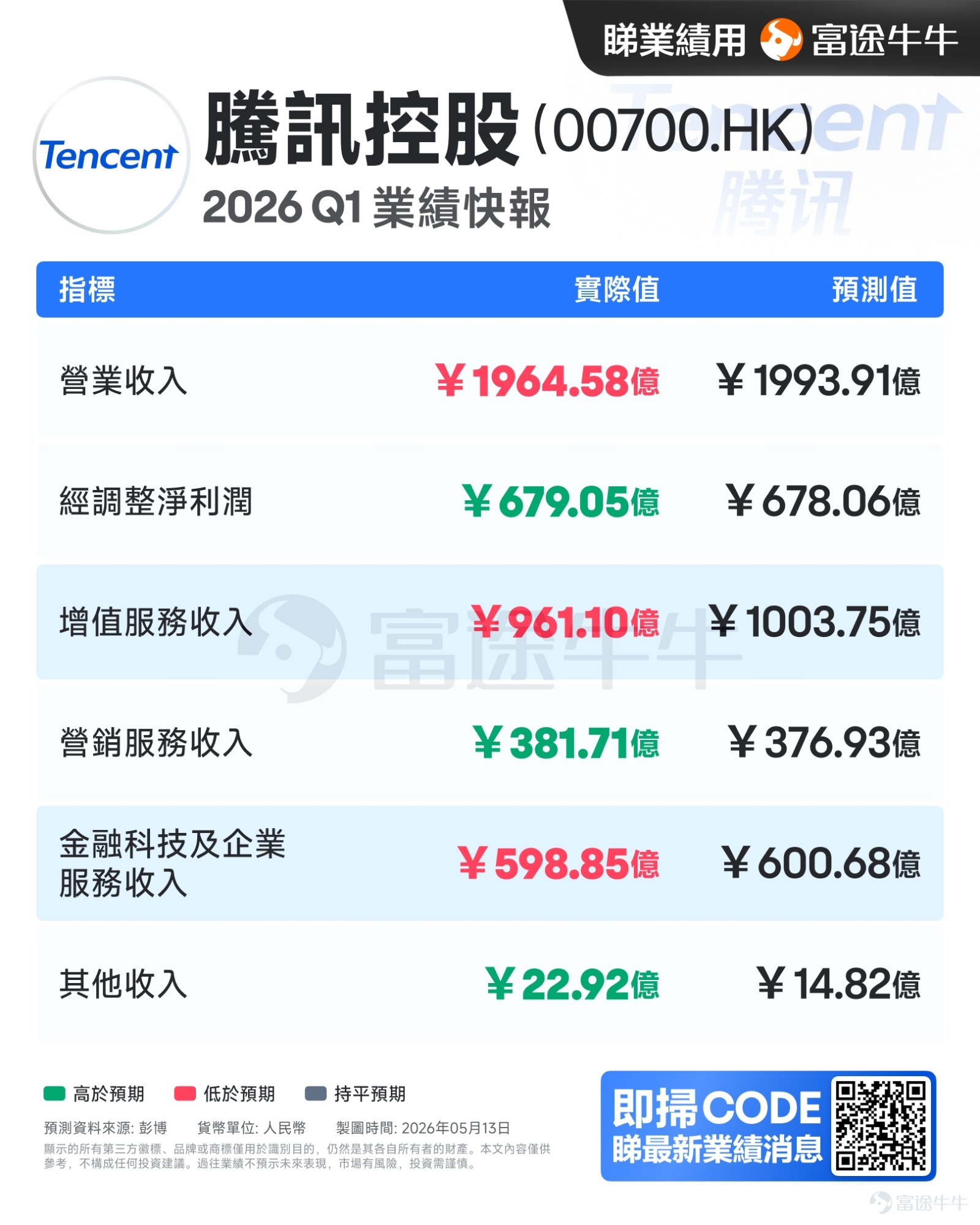
Tencent's Q1 2026 revenue reached RMB 196.458 billion, up 9% year-over-year; gross profit was RMB 111.265 billion, up 11% year-over-year; non-IFRS net profit attributable to shareholders was RMB 67.905 billion, up 11% year-over-year. The company also disclosed that its capital expenditure in Q1 was RMB 31.9 billion, up 16% year-over-year, reflecting Tencent’s continued push into AI infrastructure.

The three most noteworthy aspects of this earnings report are:
First, gaming and advertising remain stable.
Tencent's value-added services revenue was RMB 96.1 billion, a year-over-year increase of 4%; domestic gaming revenue was RMB 45.4 billion, up 6% year-over-year, while international gaming revenue was RMB 18.8 billion, increasing 13% year-over-year. Advertising business revenue was RMB 38.2 billion, up 20% year-over-year, mainly benefiting from improved WeChat ecosystem ad capabilities and optimized AI ad recommendation models.
Second, Tencent still has very strong cash flow.
Tencent's free cash flow in Q1 was RMB 56.7 billion, up 20% year-over-year; total cash was RMB 533.7 billion, with net cash at RMB 146.9 billion. This means Tencent has the ability to continue share buybacks, invest in AI, and weather short-term market volatility.
Third, AI could become a variable in Tencent's valuation recovery in the next phase.
Tencent mentioned that productivity AI Agent services like WorkBuddy have made early progress, and the Hy3 preview large model was launched in April. For ordinary investors, there is no need to overly focus on model rankings in the short term; what truly matters is whether AI can continue to enhance advertising efficiency, cloud service demand, and WeChat ecosystem monetization capabilities.
In a nutshell, Tencent is:
Tencent is more likea 'core holding' target within the Hong Kong stock technology sector,with potentially limited short-term upside, but outstanding cash flow, buyback capability, and business resilience. If the share price pulls back due to market volatility, it would be more suitable as an object for mid-to-long-term observation and phased investment.
Alibaba: Under profit pressure, but its AI cloud business offers the market room for imagination
Alibaba’s reported results are for the quarter and fiscal year ended March 31, 2026. Quarterly revenue was RMB 243.38 billion, a year-on-year increase of 3%. Excluding the impact of disposed businesses such as Sun Art Retail and Intime, comparable revenue grew by 11% year-on-year.

However, the market's renewed interest in Alibaba centers around AI and cloud.
Alibaba Cloud Intelligence Group's quarterly revenue was RMB 41.626 billion, a year-on-year increase of 38%;External customer revenue increased by 40% year-over-year; AI-related product revenue reached RMB 8.971 billion, marking the 11th consecutive quarter of triple-digit year-over-year growth.
This shows that Alibaba's current investment logic is relatively clear:
– Short-term pressure: Investments in AI, cloud infrastructure, instant retail, and Qwen user acquisition will weigh on profits;
– Mid-term highlights: Whether cloud revenue growth can continue to accelerate and whether AI products can bring higher-quality revenue;
– Long-term variables: Whether Alibaba can truly integrate AI capabilities into Taobao, Tmall, merchant tools, and enterprise cloud services.
In a nutshell, Alibaba:
Alibaba's short-term profit statement may not look good, but its AI cloud business is becoming a core reason to attract capital again. More suitable forUsers with higher risk tolerance who are willing to wait for the gradual realization of AI commercialization.。
What about Hong Kong stocks? Tech stocks still have room for recovery.
From a broader market perspective, the internal performance of tech stocks in Hong Kong this year remains differentiated. Some funds have started to refocus on AI, cloud computing, and leading internet platforms, but the market remains cautious about earnings quality, return on investment, and the macro environment.
More importantly, Hong Kong's tech stocks have not fully caught up with the global AI trend this year. Compared to US AI hardware, semiconductors, and large-cap tech stocks,Hong Kong’s leading internet companies are still in a phase of 'valuation recovery + fundamental verification'.。
This gives investors a clearer perspective: Hong Kong tech stocks are at a stage where they gradually start looking for a bottoming-out zone and valuation recovery opportunities after financial reports stabilize.
Which directions can be considered?
For users just starting to explore Hong Kong stocks, it’s better to begin with ETFs. The advantage of ETFs is that you don’t need to bet on a single company, the entry threshold is lower, and they areMore suitable for building an initial Hong Kong stock position through a phased approach.。
Core holdings for Hong Kong stock market indices: $TRACKER FUND OF HONG KONG (02800.HK)$ , suitable for those who want to track the Hang Seng Index with one click and focus on the overall recovery of Hong Kong stocks.
Leading Chinese companies allocation: $Hang Seng H-Share Index ETF (02828.HK)$ aiming to cover large Chinese financial, internet, and consumer leaders.
Hong Kong tech rebound: $CSOP Hang Seng TECH Index ETF (03033.HK)$ optimistic about the recovery of tech giants like Tencent, Alibaba, Meituan, and Xiaomi.
Hong Kong high-dividend / income: $Global X Hang Seng High Dividend Yield ETF (03110.HK)$ leaning towards stability while balancing stock price volatility and dividend income.
High-dividend selection: $Hang Seng High Dividend 30 Index ETF (03466.HK)$ , focusing on Hong Kong high-dividend assets with a medium to long-term income strategy.
Small Tips for Action: Observe first, then proceed in batches.
Step One: Add to your favorites first.
Add representative ETFs like Tencent, Alibaba, and other promising ones mentioned above to your watchlist. Observe the stock price reactions for a few days after the earnings reports.
Step Two: Start with a small position.
If you're participating in Hong Kong stocks for the first time, it's not advisable to buy all at once. You can start with a small amount of capital to get familiar with Hong Kong stock trading hours, price fluctuations, and ETF trading methods.
Step Three: Build positions in batches.
If you are optimistic about the mid-to-long-term recovery of Hong Kong stocks, you can divide your funds into several portions andgradually participate during market pullbacks, volatility, or after sentiment has settled post-earnings reports.Gradually engage.
Step Four: Combine core holdings with dividend-paying positions.
More aggressive users can consider using Hang Seng Tech ETF or Tencent, Alibaba as observation positions; more conservative users may want to focus on Hang Seng Index ETFs and high-dividend ETFs.
Further reading:
Risk Disclaimer: The above content only represents the author's view. It does not represent any position or investment advice of Futu. Futu makes no representation or warranty.Read more


Comments
to post a comment
12
2