
PDD Holdings reported Q1 revenue of RMB 106.2 billion—has its share price already hit bottom?

Alibaba retreated from its high and failed to hold a key level, as the market shifted from chasing AI to questioning support
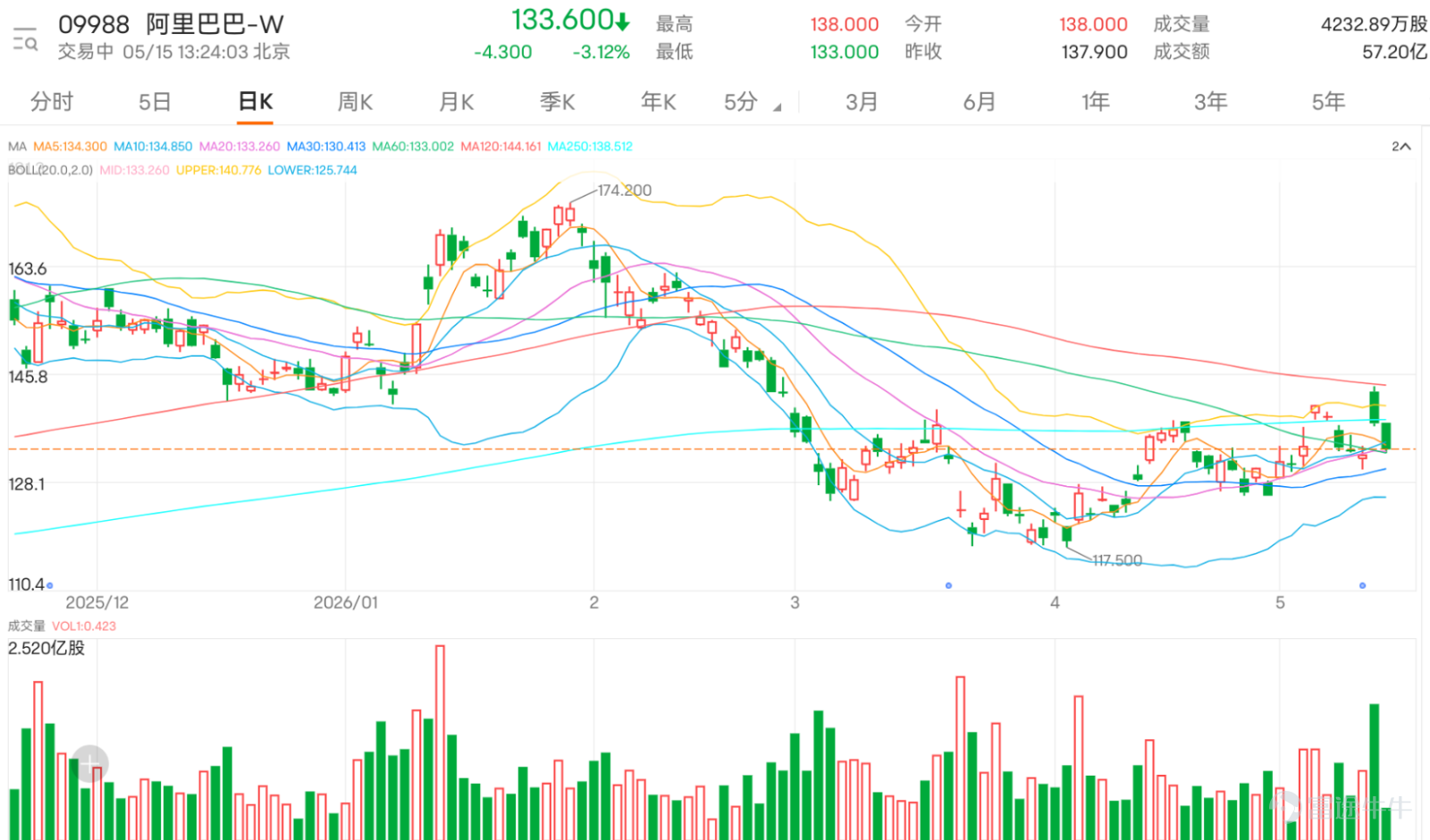
$BABA-W (09988.HK)$ The recent trend has shifted from strong to weak, and market sentiment has also seen a significant change. From investors' comments, the original bullish logic driven by AI, buybacks, and US stocks still exists, but the stock price has failed to stabilize at key levels, causing the market to shift from 'waiting for an uptrend' to 'questioning support,' and even gradually showing signs of capitulation.
The core of the bullish argument still centers on external and fundamental factors. First, there is the influence of the US stock market; some investors believe that as long as Alibaba's US shares remain strong, its Hong Kong shares should follow upward, even leading to a belief in 'blindly holding.' Second, the factor of share repurchases persists, with the market believing that continuous buybacks will support the stock price. Additionally, AI-related news serves as a significant catalyst, such as investors mentioning US approval for related firms to purchase high-end chips—a development that further strengthens the market's imagination regarding Alibaba’s role in the AI era. Overall, while the bullish logic has not disappeared, it has begun transitioning from 'certainty' to 'needing validation.'
However, at the same time, dissatisfaction with price performance is rapidly accumulating. The most direct reflection is the stock’s failure to firmly hold the 142 to 144 range. From the comments, many investors explicitly pointed out that 144 represents a short-term high and questioned whether the stock could 'even hold above 142,' indicating that the market now views this area as significant resistance. Once unable to stabilize, the previous expectation of strength begins to waver.
Bearish voices are more directly focused on the price trend itself. Some investors pointed to 'accelerated declines,' 'pump-and-dump,' and 'closing bearish,' showing that short-term funds have started shifting from being bullish to defensive or even going short. Comments also mentioned the difference between ADRs and Hong Kong shares, suggesting that the current price structure is weak and unable to effectively follow external market movements. These perspectives indicate that the market is beginning to shift focus from external factors back to local capital and actual buying power.
Another noteworthy shift is the market's evolving understanding of "major players versus retail investors." Some investors believe that retail investors are exiting, providing major players an opportunity to accumulate; however, others question whether continuous selling pressure indicates that downward pressure has not been fully released. This divergence reflects the lack of consensus on chip distribution, exacerbating short-term volatility.
Observational and sentiment-driven comments further reflect market uncertainty. Investors are generally concerned about several issues, including whether the price can return above 140, whether it’s suitable to increase positions, and whether the bottom has been reached. There are also many emotionally charged remarks, such as "Please surge," "If it doesn’t rise, half will be lost," and "Buying leads to drops," showing increasing pressure among shareholders. When the market shifts from anticipation to anxiety, it often signifies that short-term adjustments are not yet complete.
From a technical perspective, Alibaba's most critical range currently lies between 140 and 144. The 144 level is short-term resistance, which has been tested multiple times without success; 140 is psychological support, and once it breaks, market confidence will further weaken. If the stock price can stabilize above 142 again and gradually challenge 144, there is a chance to restore a short-term bullish structure. At that point, expectations around AI and buybacks could be amplified again, pushing the stock price to higher levels. Conversely, if it falls below 140, it indicates the short-term trend is weakening, and the market may further lower its targets, or even see more pronounced pullbacks.
The Relative Strength Index (RSI) has largely retreated to a neutral zone, indicating waning momentum; the Bollinger Bands have not expanded, showing that the market hasn't formed a new trend direction. This aligns with the prevalent sentiments in the comments like "wait and see," "waiting for external factors," and "waiting for U.S. stocks to lead," suggesting that capital currently lacks a clear direction.
In terms of strategy, it is not advisable at this stage to solely rely on external factors or news developments for judgment. Even if U.S. stocks perform well, without sufficient underlying support in Hong Kong stocks, upward momentum will struggle to sustain. A more reasonable approach is to observe whether 140 can hold and whether the range of 142 to 144 can be reclaimed. If stability cannot be achieved, adding positions should not be rushed; only when stability returns should one consider following the trend accordingly.
Overall, Alibaba is currently in a critical transition period from strength to weakness. The bullish logic remains, but the price hasn't kept up, causing market confidence to waver. The short-term focus isn't about predicting AI or fundamentals, but whether the price can stabilize within the key range again. Once this range is lost, sentiment could weaken further; if it stabilizes again, the market could quickly regain confidence. May 14 [HKEX Podcast] Part-2-Xiyu, Alibaba, RoboSense
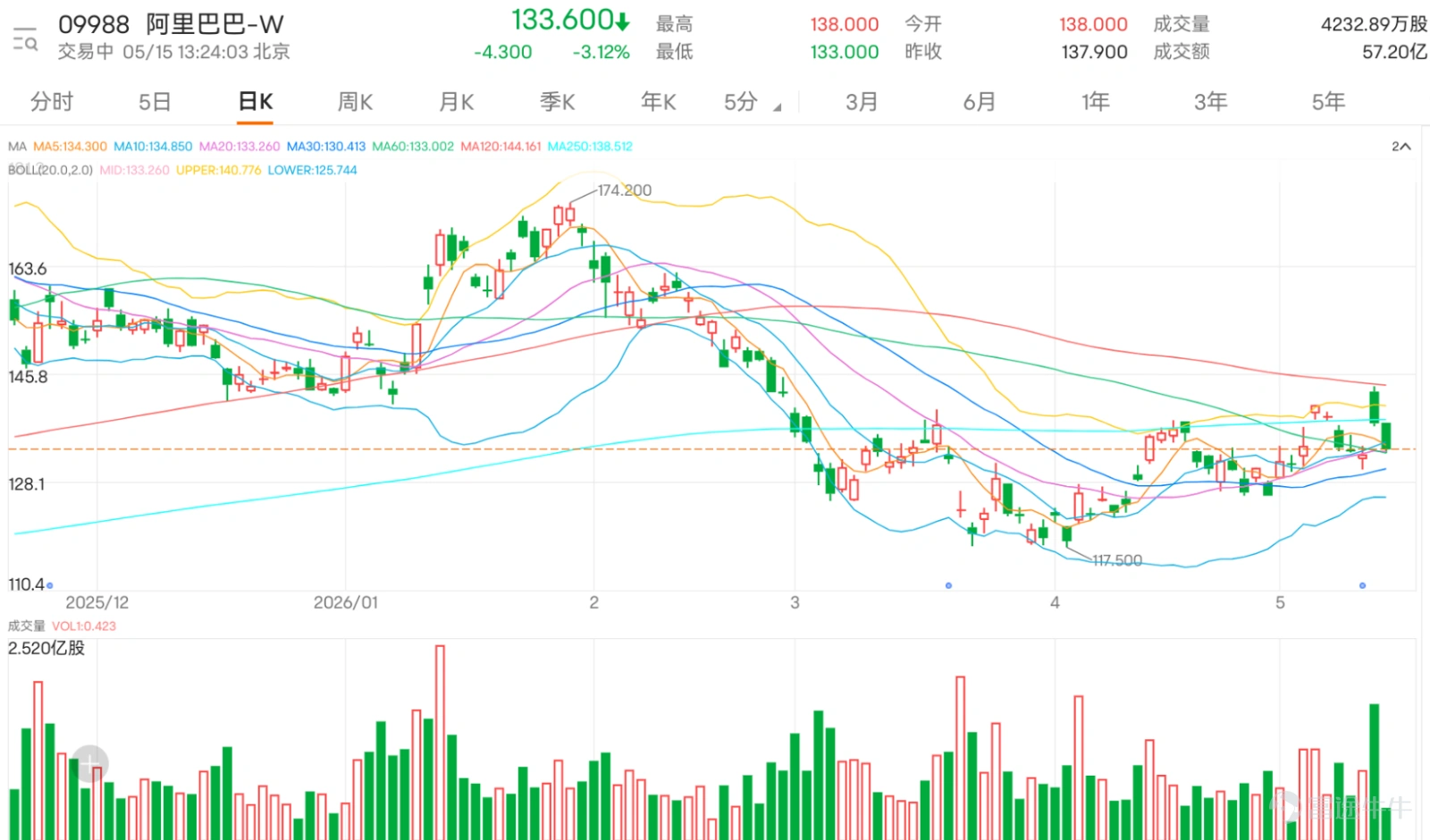
Key deployment: The current price is close to the midpoint zone, first check if it can hold above the 131 support level. If it holds, consider a rebound play with a target of 138 resistance. If it effectively breaks through 138, follow the trend; if it loses 131, expect weakness with potential retreat to the 128 area.
$HSALIBA@EC2609C.C (26578.HK)$
The strike price is 145.98 yuan. This warrant has the lowest premium and implied volatility among all call warrants, making it suitable for investors who are optimistic about Alibaba’s future and want to enter at a lower cost. Low premium and low implied volatility help reduce time value decay, enhancing the benefit of holding the warrant.
$BIALIBA@EC2612B.C (27562.HK)$
The strike price is 145.1 yuan, with relatively low implied volatility, making it suitable for a strategy expecting moderate stock price increases. Low implied volatility means the market anticipates smaller fluctuations, which is beneficial for capturing price movements when the direction is clear.
$BIALIBA@EP2609B.P (27080.HK)$
The strike price is 111.01 yuan, with both the premium and implied volatility being the lowest among put warrants. It is suitable for investors who are bearish on the future market or looking to hedge their stock-holding risks. A low premium reduces the cost of being wrong on direction, while low implied volatility reflects relatively stable pricing.
$JPALIBA@EP2609B.P (26909.HK)$
The strike price is 111.11 yuan, with relatively low implied volatility, making it suitable for a strategy expecting moderate stock price declines. The low-volatility setup helps reduce market fluctuation interference, improving defensive characteristics.
$JP#ALIBARC2611Y.C (67746.HK)$
The call price is 129 yuan. This warrant has the lowest premium and relatively high actual leverage, making it suitable for investors who are optimistic about the market. A low premium indicates that it’s closer to the current price, and the leverage effect helps amplify rebound gains, but the risk of being called should be noted.
$UB#ALIBARC2610I.C (67474.HK)$
The call price is 128 yuan, with a relatively low premium, making it suitable for investors who are optimistic about the future but want to control premium costs. The slightly lower call price compared to similar products provides a higher margin of defense.
$UB#ALIBARP2810G.P (69096.HK)$
The call price is 145 yuan. This warrant has the lowest premium and relatively high actual leverage, making it suitable for investors who expect a short-term downturn. The combination of low premium and high leverage can amplify returns in a declining market, but careful monitoring of the call price level is required.
$JP#ALIBARP2809J.P (57970.HK)$
The call price is 149 yuan, with the highest actual leverage and a relatively low premium, making it suitable for investors confident in further downside potential. High leverage can significantly enhance the effectiveness of bearish strategies, but the call price is closer to the current price, indicating a relatively higher risk.

@分批建仓deep a: Why does it keep falling? It reflects weak buying support.
@32931945: Sentiment is starting to weaken.
@28713909: Can it return to 140? 140 is a key support level.
@25582698: Is today's bottom solid? No clear bottoming signals have been observed yet.
Feel free to share your insights in the comment section. For more market analysis, stay tuned to 'HK Stock Warrants Jenny' for daily updates! $Hang Seng Index (800000.HK)$$Hang Seng TECH Index (800700.HK)$
Reminder: This article does not constitute any investment advice.
This article is for reference only and does not constitute any investment advice. Market data, opinions, and analysis contained herein may change at any time without prior notice. We are not responsible for any loss or damage caused by reliance on the information in this article. Technical analysis only shows whether certain technical conditions are met; asset performance should be comprehensively evaluated using other sources of information, and trading decisions should not be made solely based on this article. Please note that past performance is not indicative of future results.
#HKStocks #RealTimeAnalysis #WarrantPick #WarrantGuide #DerivativesHedging #HKWarrantsJenny #Alibaba #09988 #BlueChipStocks #TechnicalAnalysis
Risk Disclaimer: The above content only represents the author's view. It does not represent any position or investment advice of Futu. Futu makes no representation or warranty.Read more

Comments
to post a comment
5
1