
PDD Holdings reported Q1 revenue of RMB 106.2 billion—has its share price already hit bottom?

It's not even halfway through 2026, so why has Alibaba already released its Q4 earnings report? A must-read for beginners during earnings season.
Hello fellow investors~ If you've opened the app recently, chances are you’ve been bombarded with notifications about 'XX releases earnings' — that’s right, Hong Kong stocks are going through one of the most information-dense periods of the year:Super Earnings Week。
Yesterday, $JD-SW (09618.HK)$ / $JD.com (JD.US)$ released its latest quarterly earnings, and the market response was fairly positive. After today's Hong Kong market close, two major internet giants— $BABA-W (09988.HK)$ /$Alibaba (BABA.US)$ and $TENCENT (00700.HK)$ —will simultaneously release their latest earnings reports.
And tomorrow (May 14), the 'twin titans' of mainland China’s wafer foundry industry— $SMIC (00981.HK)$ and $HUA HONG GRACE (01347.HK)$ will soon follow, releasing its Q1 earnings report.
In just three days, five core companies—JD.com, Alibaba, Tencent, SMIC, and Hua Hong—will release their earnings reports.For investors, this is both a huge window of opportunity and a test of information overload.
Don't panic. Today, we'll help you thoroughly understand what to look for during earnings season and how to make the most of the Futubull app to stay ahead in this information storm.
What exactly is earnings season? Why do seasoned investors pay such close attention?
Simply put, earnings season is when companies collectively release their report cards. Listed companies are required to disclose their operating data to the public each quarter (or semi-annually, annually): how much money they made, how much they spent, how much cash they have on hand… These pieces of information are released in a few fixed time periods, forming what is known as“Earnings Season”。
Hong Kong-listed companies’ Q1 reports are typically concentrated around mid-May each year, while US-listed companies’ Q1 reports come out between the end of April and early May. So, at this time every year, global markets enter a state of heightened excitement.
Before the earnings are released, professional analysts form market expectations for key metrics such as revenue, net profit, and earnings per share (EPS) based on historical performance, industry trends, and company guidance. When the actual data is announced, three scenarios may occur:
Beat Expectations: Actual value higher than expected → Stock price likely to rise
In line with expectations (Inline): Basically flat → Minimal stock price volatility
Below expectations (Miss): Actual value lower than expected → Stock price may face downward pressure
This is why earnings reports are the biggest pricing events and windows of information disparity. For instance,The core reason the US stock market has recently been able to ignore geopolitical risks and surge strongly is that the earnings reports of tech giants have generally exceeded expectations, supporting stock prices with solid performance.
Many beginners have a misconception: they think that if a company makes money, its stock price will rise, and if it loses money, the stock price will fall; in fact, it's not that simple.
Fiscal year vs. calendar year: Alibaba releases 'Q4 2026' earnings report, did we time travel?
Many fellow investors who have just entered the market might be puzzled: Isn't it May 2026 now? Why is Alibaba releasing its 'Q4 2026 fiscal year' earnings report? Did we time travel?
Here, we need to clarify a knowledge point that newcomers often confuse: calendar year vs fiscal year
Calendar yearis the familiar period from January 1 to December 31.The fiscal year for most Hong Kong-listed companies (including Tencent) is the same as the calendar year, so what Tencent released today isQ1 2026 (the first quarter) earnings reports.
HoweverAlibaba's fiscal year is special—its fiscal year ends onMarch 31 each year. This means:
Alibaba's fiscal year 2026 = April 1, 2025 ~ March 31, 2026
Alibaba's Q4 of fiscal year 2026 = January 1, 2026 ~ March 31, 2026
Therefore, what Alibaba released tonight is actuallythe fourth quarter of fiscal year 2026 (i.e., Q1 of calendar year 2026) financial report.

Why does this difference exist?Different companies set their fiscal year-end dates, typically related toindustry characteristics, business cycles, and management habits.Setting the fiscal year-end in March allows Alibaba to better encompass a complete financial cycle after major e-commerce events like 'Singles' Day,' while also facilitating staggered annual planning compared to the calendar year.
For investors, the most critical aspect isWhen reading financial reports, it is crucial to clarify the 'time basis.' Don't confuse Alibaba's Q4 with Tencent's Q1, otherwise your comparative analysis will be completely off.
Comprehensive earnings analysis system
Faced with a flood of earnings reports, you may worry:With so much information, how should I read it? With so much data, how do I analyze it? What if I miss an important milestone?Futubull has built a comprehensive earnings analysis framework for you, covering the entire process before, during, and after earnings releases.
Before earnings: Identify potential risks in advance, stay informed
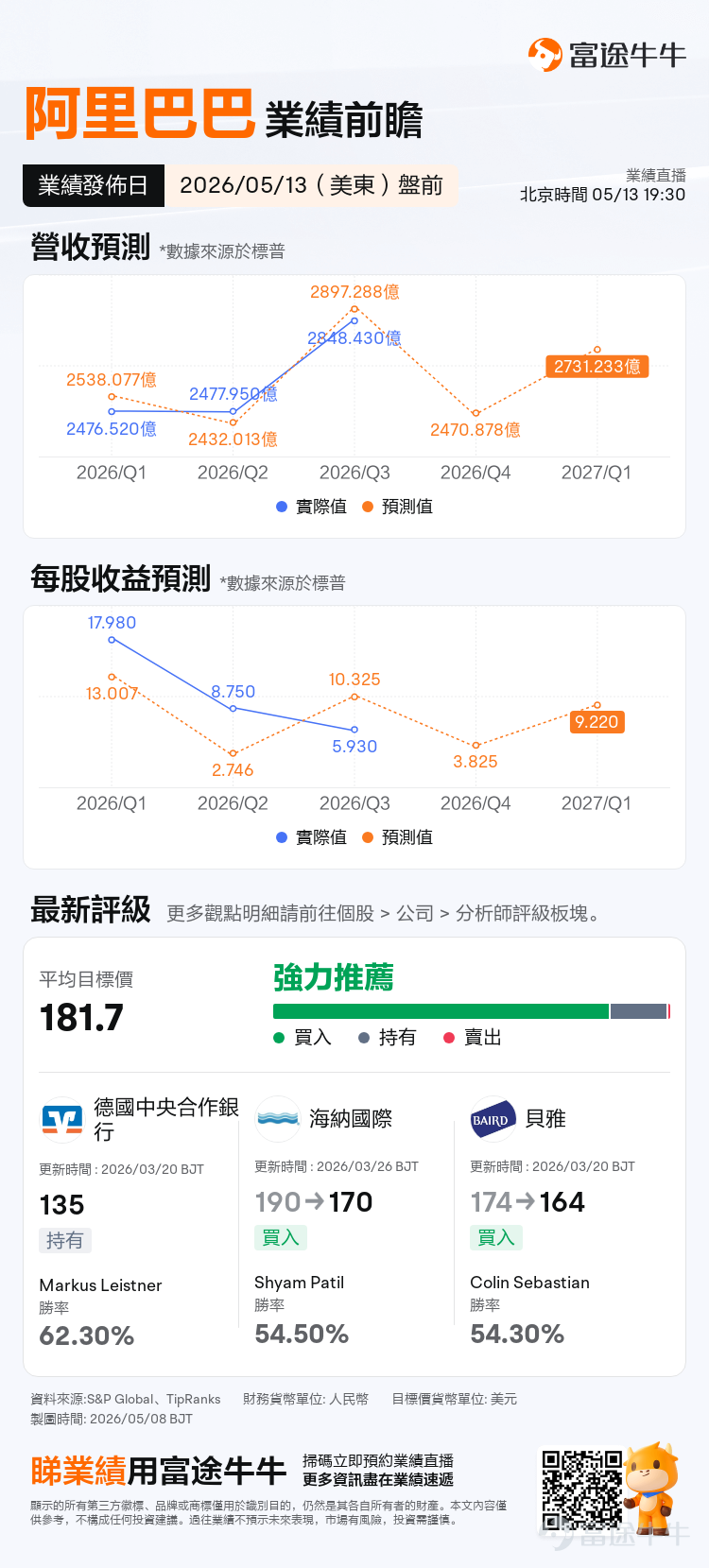
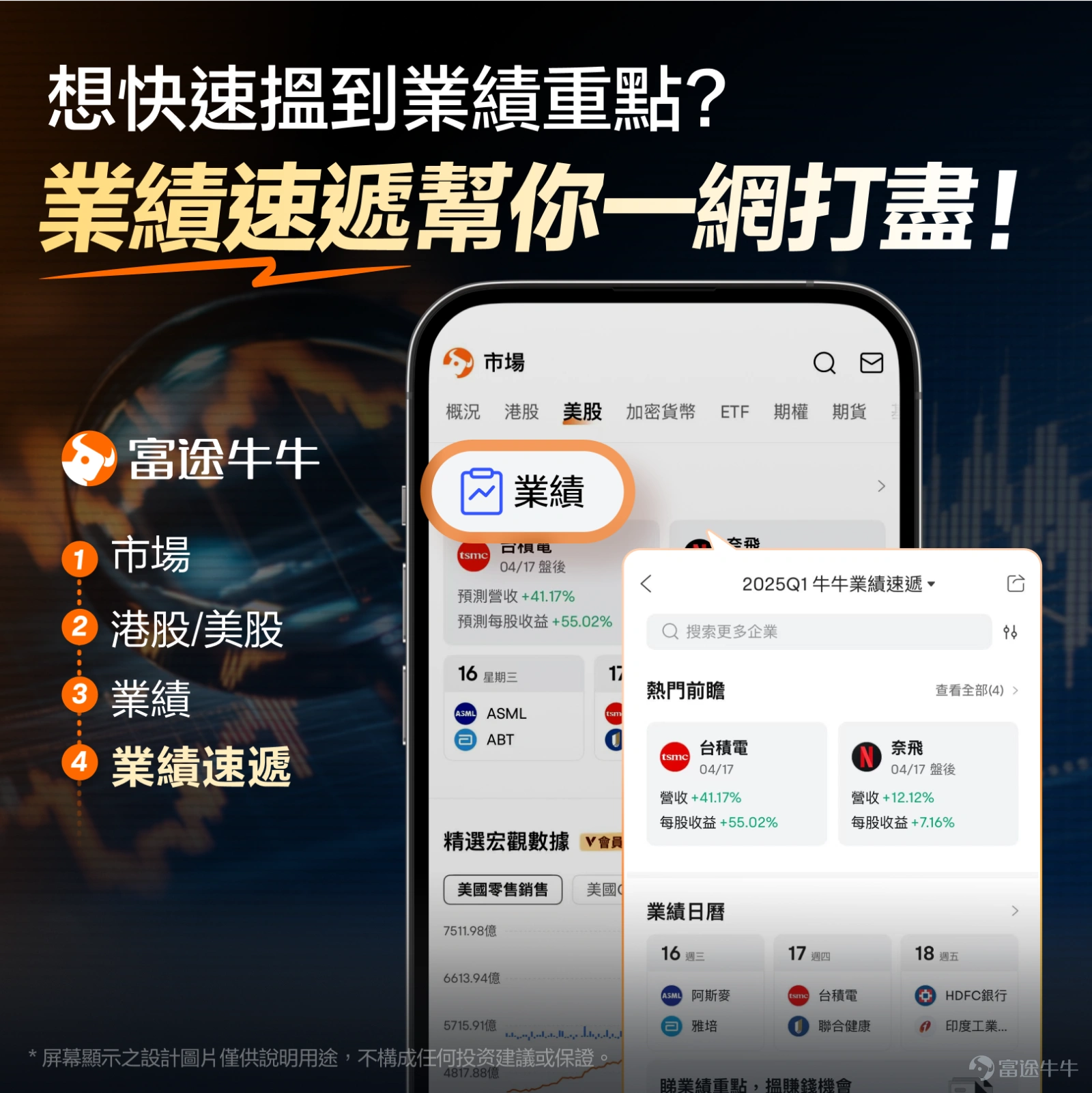
Before the earnings report is released, clickIndividual stock quote page > Company > Earnings ExpressHere, you can find:

Forward-looking dataWhat are the consensus expectations for Alibaba and Tencent's revenue and earnings per share (EPS)? How much have they grown year-over-year? These figures are clear at a glance.
Historical trend chartHow has the revenue trend been over the past few quarters? Is profit growth accelerating or slowing down? What is the contribution ratio of each business segment (such as advertising, cloud services, gaming)? Visual charts let you see through at a glance.
Futubull AI: We will analyze key points of the earnings report in advance and consider major bank opinions. Every business segment and which investment bank’s voice to focus on will be under control.
During the earnings season: Understand the financial report immediately
After the earnings report is released, Futubull’s earnings express will update the core data immediately,whether it's a beat (above expectations), miss (below expectations), or inline (in line with expectations),with colors and labels making it easy to understand at a glance. The live broadcast of the management's earnings call will also be available instantly on the Futubull app, accessible directly from the stock quote page with one click.
More importantly, Futubull AI can help automatically interpret the content of financial reports.You only need to input something like 'How is Tencent's latest earnings report?' and it will systematically analyze key financial metrics, business highlights, comparisons with expectations, and even provide factors of opportunities and risks for future outlook.
Post-earnings: Leaderboard + in-depth analysis to lock in high-quality targets
After earnings season, Futubull's 'Earnings Leaderboard' feature can help you quickly filter out high-quality companies that have 'exceeded expectations.' You can screen by market capitalization, the rate of exceeding expectations, and other criteria to instantly identify stocks with strong fundamentals.

In addition, Futubull's original content team has prepared the most down-to-earth analysis.They will translate complex financial data and business logic into plain language for you, explaining what it all means for stock prices. You don't need to be an accountant to understand the 'subtext' of earnings reports.
Today, Futubull’s senior analystTeacher Annawill bring everyone timely insights into the earnings of two major heavyweights, Tencent and Alibaba. Fellow investors who haven’t followed yet should do so quickly.

Want to get involved? You can choose between individual stocks or ETFs.
After reading the earnings analysis, you might be wondering: if I'm bullish on these companies, how can I participate?
For beginners, there are generally two options:Buy the underlying stockOrBuy ETFs。
Method one: Buy the underlying stock directly
Tencent, Alibaba, JD.com, SMIC, Hua Hong – these are all companies listed on the Hong Kong stock market. Stocks like Alibaba and JD.com are also dual-listed in the US, and can be traded directly through the Futubull app.
The advantage is that you can invest directly in the companies you favor, and the price fluctuations are entirely your choice, offering high volatility. However, individual stocks can be highly volatile, and if earnings reports fall short of expectations, there could be significant corrections. Especially around earnings report dates, stock price movements tend to be more volatile than usual, so beginners should prepare themselves mentally.
Method two: Diversify through ETFs
If you think, 'I like this group of companies, but I don't want to put all my eggs in one basket,' then ETFs are a safer option.
There are several technology-themed ETFs in the Hong Kong stock market that bundle core internet companies like Tencent, Alibaba, JD.com, and Meituan. There are also semiconductor-themed ETFs covering chip stocks like SMIC and Hua Hong. The risk of an individual stock's poor earnings report is mitigated because you're investing in the overall trend of the sector.
Another benefit of ETFs is their low entry threshold. Buying a single lot of Tencent on the Hong Kong stock exchange requires tens of thousands of Hong Kong dollars, but with ETFs, you might be able to start with just a few thousand dollars, making it more beginner-friendly for those with limited capital. Through Futubull’s ETF screener, you can easily filter out suitable ETFs.

From the uncertainties surrounding Alibaba and Tencent's earnings to the semiconductor industry barometers of SMIC and Hua Hong, every data point has the potential to trigger major market shocks. But remember, you're not alone in this fight.With Futubull's powerful arsenal – from pre-earnings data analysis, real-time interpretation during earnings releases, to post-earnings screening tools – you can make rational decisions calmly and confidently.
Risk Disclosure: This content does not constitute a research report and is for reference only. It should not be used as the basis for any investment decision. The information involved in this article is not a comprehensive description of the mentioned securities, markets, or developments. Although the source of the information is considered reliable, no guarantee is provided regarding its accuracy or completeness. Additionally, no assurance is given regarding the accuracy of any statements, opinions, or forecasts provided herein.
Risk Disclaimer: The above content only represents the author's view. It does not represent any position or investment advice of Futu. Futu makes no representation or warranty.Read more


Comments (23)
to post a comment
55
13