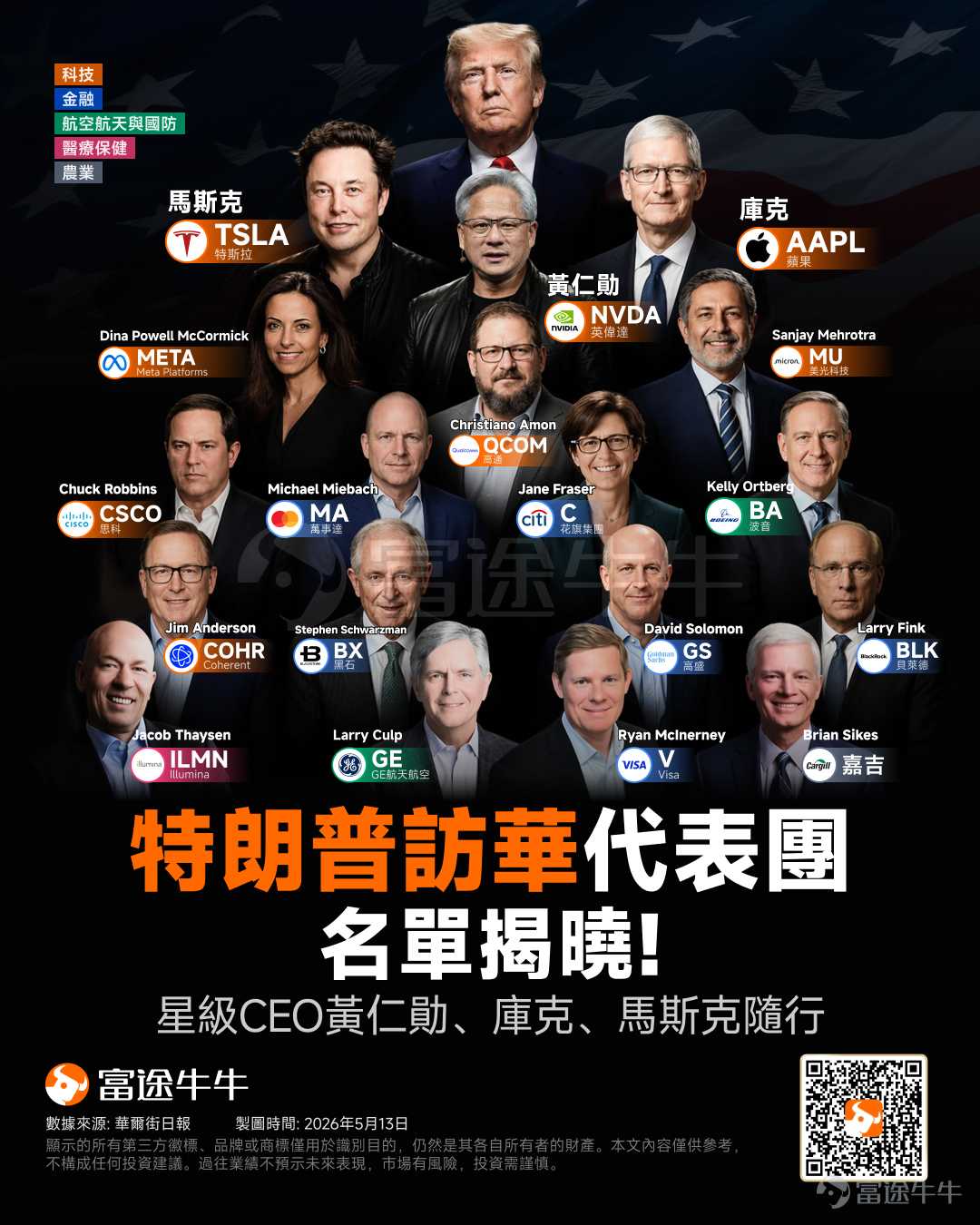

The list of Trump's delegation to China is revealed! Star CEOs Tim Cook and Elon Musk are among those accompanying him.
Trump will pay a state visit to China from May 13 to 15.
As Trump’s visit to China progresses, the latest list of accompanying business delegates disclosed by The Wall Street Journal has come to light. $Tesla (TSLA.US)$ CEO Elon Musk, $Apple (AAPL.US)$ CEO Tim Cook, $GE Aerospace (GE.US)$ CEO Larry Culp and $Boeing (BA.US)$ CEO Kelly Ortberg will attend this visit to China.
*Latest Update: According to media reports on the 13th, Trump called Huang Renxun that morning, inviting him to join the delegation visiting China. Huang Renxun immediately flew to Anchorage and boarded Air Force One when it made a scheduled stopover in Alaska.$NVIDIA (NVDA.US)$In a statement, it was mentioned that 'Jensen accepted the invitation from President Trump to attend this summit in support of the goals of the United States and the current administration.'

In addition,$Blackrock (BLK.US)$ CEO Larry Fink, $Blackstone (BX.US)$ CEO Stephen Schwarzman, $Micron Technology (MU.US)$ CEO Sanjay Mehrotra, $MasterCard (MA.US)$ CEO Michael Miebach, $Qualcomm (QCOM.US)$ CEO Cristiano Amon, and $Visa (V.US)$ CEO Ryan McInerney are also on the accompanying list.
Setting aside the macro-level noise, this is an 'all-star' lineup covering technology, finance, and traditional manufacturing. Through the itineraries of these corporate leaders, the market can clearly capture the real expectations of multinational capital for the next phase of industry trends and profit growth.
1. Technology Sector: Focus on AI Infrastructure and Deep Synergy of Global Production Capacity
The collective appearance of tech giants centers on consolidating the global consumer market foundation and streamlining the supply chain for hardware infrastructure in the AI era.
Expansion of consumer endpoints and smart ecosystems: $Apple (AAPL.US)$ Cook and $Tesla (TSLA.US)$ Musk, as leaders in hardware endpoints, their performance drivers remain inseparable from the smooth operation of global supply chains and the absorption capacity of vast consumer markets. Their presence highlights the essential business need to maintain the current network of cross-border production capacity collaboration.
Underlying computing power and the construction of 'digital major arteries': The list not only includes $Qualcomm (QCOM.US)$ 、 $Micron Technology (MU.US)$ , but also contains $Cisco (CSCO.US)$ as well as those focused on optical communication technologies, $Coherent (COHR.US)$ . This indicates that the development focus of the current technology industry is firmly locked on underlying hardware infrastructure such as semiconductor supply chains, high-bandwidth memory (HBM), and data center interconnects (DCI).
However, $Cisco (CSCO.US)$ CEO Chuck Robbins, though invited by the White House, was unable to attend due to the company’s earnings release this week, according to a company spokesperson.
II. Financial Giants: The 'Accelerator' for Cross-border Liquidity and Asset Allocation
The presence of top Wall Street investment banks, asset management institutions, and payment system leaders reflects the ongoing attention from large institutional funds to cross-border wealth management and liquidity.
Top Investment Banks and Asset Managers: $Goldman Sachs (GS.US)$ 、 $Citigroup (C.US)$ 、 $Blackrock (BLK.US)$ And, $Blackstone (BX.US)$ They represent the world's largest pool of institutional capital. Their activities objectively reflect where major financial institutions focus when assessing global asset allocation weights, measuring cross-market risks, and evaluating liquidity.
Underlying Operations of the Global Payment Network: $Visa (V.US)$ And, $MasterCard (MA.US)$ As clearing giants, their performance directly mirrors cross-border commercial activity and consumer demand. Their involvement highlights that the operational efficiency of cross-border payment systems remains a critical foundation supporting international business transactions.
III. Aerospace and Agriculture: The 'Thermometer' of Global Macro Demand
$Boeing (BA.US)$ 、 $GE Aerospace (GE.US)$ Agricultural giant Cargill represents the underlying demand in the operation of the global real economy.
Physical Manifestation of Macro Cycles: Aviation and agriculture are highly cyclical sectors that heavily rely on globalized division of labor. The movements of these traditional industry giants serve as key indicators for the market to assess the state of global logistics, essential business travel, and commodity supply chains.
Risk Disclaimer: The above content only represents the author's view. It does not represent any position or investment advice of Futu. Futu makes no representation or warranty.Read more


Comments (95)
to post a comment
232
327