
After 50x storage, Sun Yuchen is always looking forward to the next decade
Author: Lin Wanwan, Rhythm
Most people in China became familiar with Justin Sun through his bizarre stories.
He spent $30 million to have dinner with Buffett but bailed at the last minute due to a kidney stone; he paid $6.2 million for a taped banana at an auction and ate it in front of everyone during a press conference; he invested $75 million to become the largest backer of the Trump family's crypto project, earning himself a seat at a White House dinner; at the age of 35, he crossed the Karman Line, declaring himself the youngest Chinese commercial astronaut.
There were also plenty of controversies: in 2023, he was sued by the SEC for market manipulation, accused of executing over 600,000 wash trades to boost TRX prices and hiring celebrities to promote without disclosing payments; currently, he is engaged in mutual lawsuits with WLFI, a project linked to the Trump family.
These stories spread so widely that they almost overshadowed one serious fact: this man has hardly missed betting on any major trend in the secondary capital markets over the past decade.
Starting from buying BTC in late 2013, by 2016, he advised post-90s not to buy houses, but instead invest in:
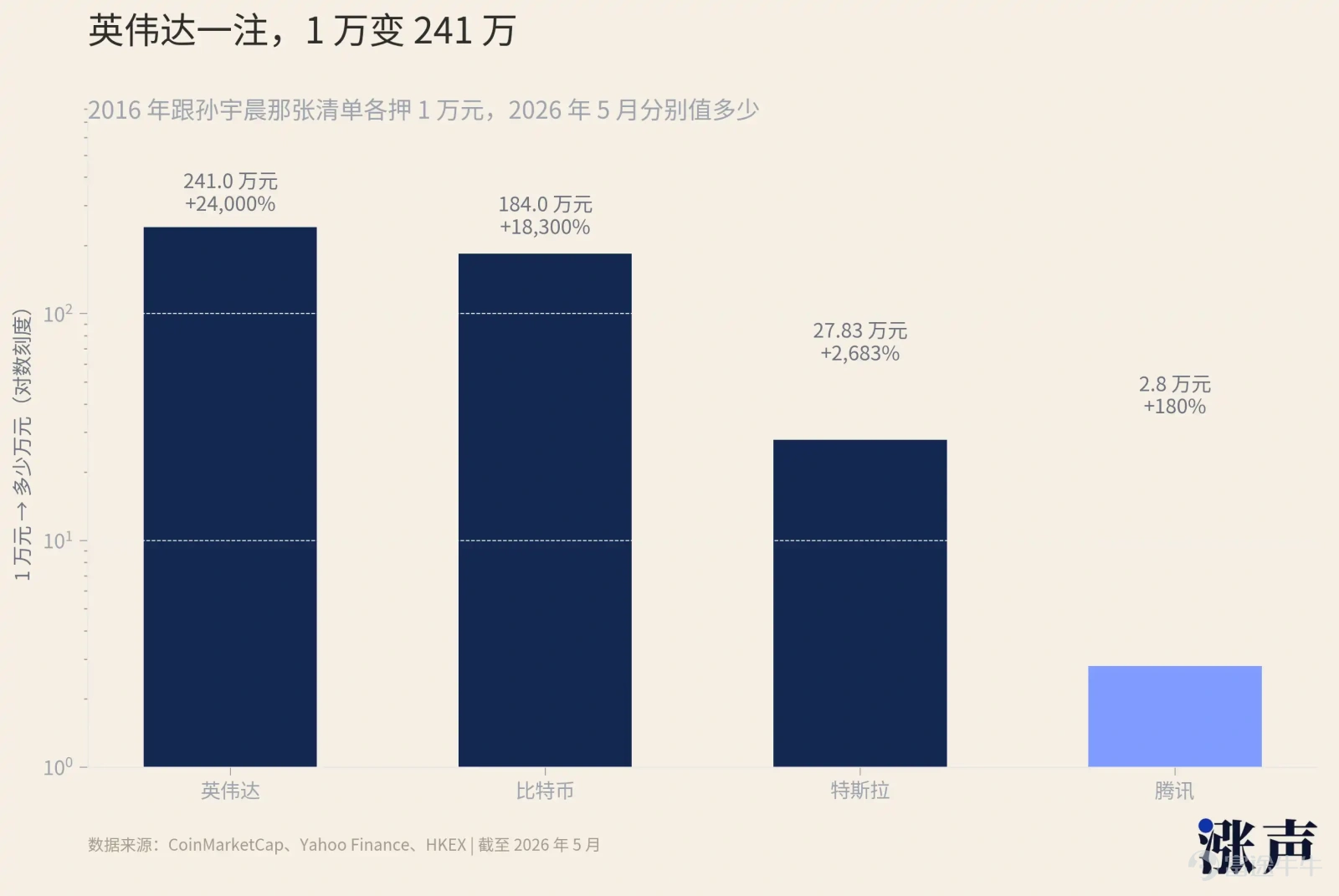
Bitcoin, NVIDIA, Tesla, Tencent.
A decade later, as of May 2026, Tesla's total return is approximately 2683%, while NVIDIA's total return is nearly 24000%.
If you had listened to him back then and invested $10,000 in NVIDIA, today it would be worth $2.4 million; $10,000 in Tesla would now be worth around $278,000. A listener who followed that list in 2016 and placed bets of 200,000 RMB on each company would have seen their investment in NVIDIA grow to approximately 48 million RMB, and their Tesla bet increase to about 5.4 million RMB, totaling just over 53 million RMB.
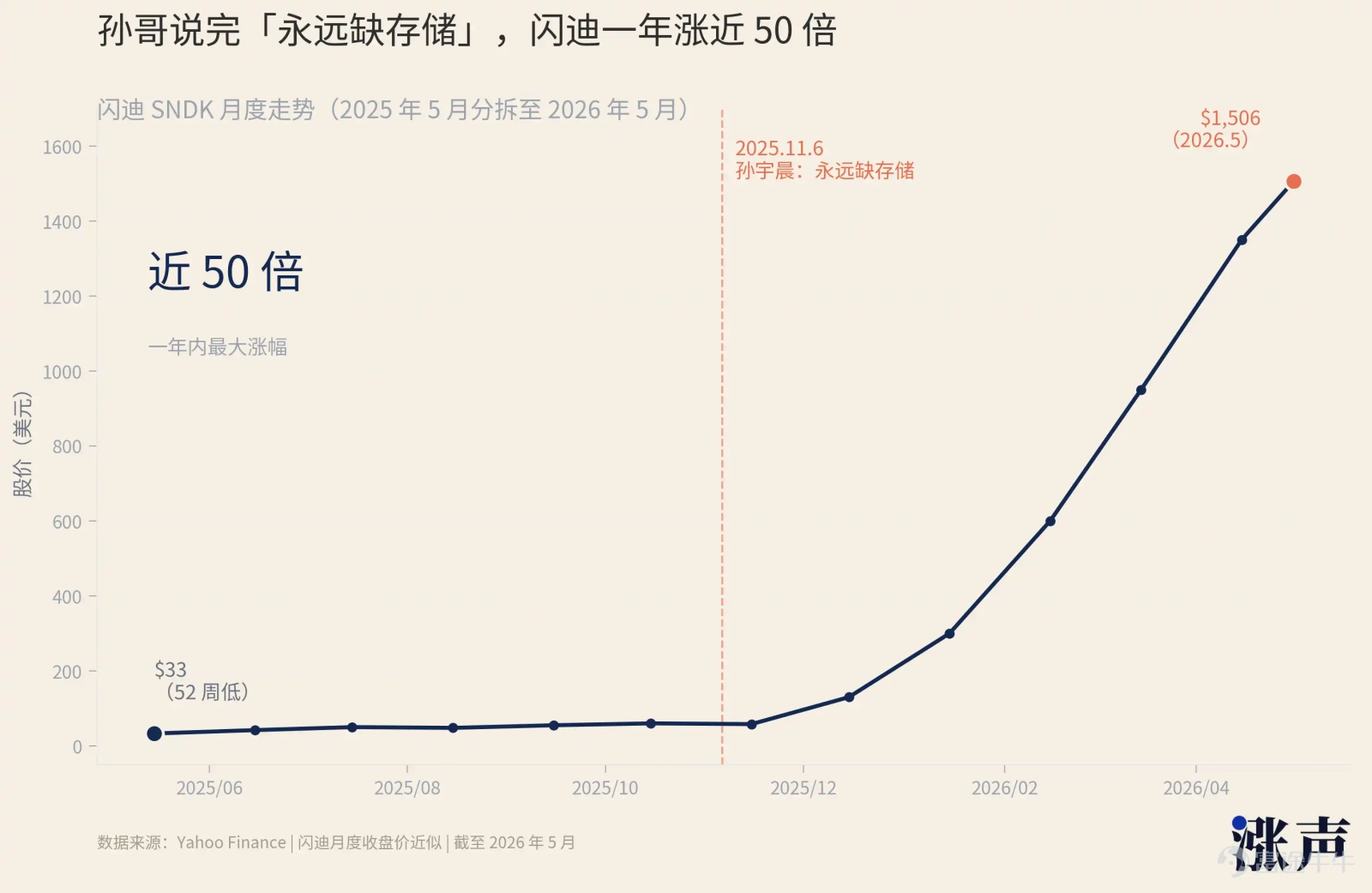
And this man continues to make moves to this day. On November 6, 2025, Sun Yuchen made a statement:
The capital market's reaction to this statement only became frenzied starting from 2026. Western Digital’s spin-off, SanDisk (SNDK), surged from a low of about $35 to $1,439 within a year, with a maximum increase of nearly 50 times.
HBM memory production capacity from Samsung, SK Hynix, and Micron has been fully booked, selling out in 2026, with orders already scheduled for 2027–2028.
While everyone was still chasing the storage concept craze, in early 2026, Sun Yuchen changed his tone again in a video.
That video originally discussed the outlook for 2026. Besides listing health as a new year's resolution—a topic more focused on wellness—he also specifically took some time to address young people's attention towards embodied intelligence, drones, spatial computing, and space exploration.
The author gathered Sun Yuchen's public statements from the past two years regarding these four directions. When viewed together, each path has already seen the emergence of its preliminary capital leader.
The first area Sun Yuchen mentioned was embodied intelligence.
The concept of robots has been discussed by humans for at least a hundred years. In 1920, Czech playwright Capek coined the term 'Robot.' Industrial robotic arms have been in use since the 1980s, and Honda’s ASIMO could climb stairs over two decades ago. However, the real bottleneck has always been in the brain aspect.
In the past two years, the entire industry has fully transitioned to VLA models—vision-language-action. In simple terms, whereas robots previously operated based on code, they now function by observing the world.
Unitree Technology shipped over 5,500 humanoid robots in 2025, ranking first globally, and submitted an application for a STAR Market IPO in March 2026. Galaxy General received $300 million (approximately RMB 2.1 billion) in a new round of financing in December 2025, with cumulative funding reaching approximately $800 million and a valuation of $3 billion (approximately RMB 21.1 billion), setting new records for both single-round and cumulative financing in the embodied intelligence track.
Sun Yuchen said he would most likely not personally enter the robot manufacturing business, but he has a keen sense of where the narrative and capital flows are heading. In an interview with Bloomberg, he once said, 'In a market where 99% of people don’t know what a wallet is, the cost of education must be factored into the business model.'
This statement, which explained stablecoins in 2018, remains equally relevant in 2026. Ninety-nine percent of Chinese people still haven't used an embodied intelligence robot, but as long as that robot can cook, carry boxes, or care for the elderly, the remaining 1% represents the next opportunity.
The second track he mentioned is drones.
While humanoid robots are still ramping up mass production, drones have already taken the lead in commercial implementation. They are naturally suited for AI-driven tasks, from autonomous navigation to swarm coordination and data collection—AI has mastered these areas. Unlike walking, flying is actually simpler than humanoid robotics.
On the battlefields of Ukraine, AI-powered drone swarms have largely taken over roles previously held by tank units; Ukraine’s annual drone production target has climbed to several million units. Above the rice fields in rural China, DJI’s agricultural drones fly overhead, with one drone replacing the work of ten farm laborers. In Shenzhen, Meituan has successfully implemented drone-based food delivery, completing orders within 15 minutes from placement to delivery.
Drones have outpaced humanoid robots. They represent the first physical-world form where AI has achieved a commercially viable closed loop.
The third area Sun Yuchen highlighted is spatial computing, which is the least mainstream among the directions he mentioned.
In 2024, Apple released the Vision Pro, and most people perceived it as an overpriced VR headset. This may be a misunderstanding.
The ambition of the Vision Pro has little to do with VR. It represents Apple's first attempt to enable AI to understand space: how big your living room is, how far the table is from you, whether the coffee cup is to the left or right of the sofa, and if you can reach it when you stretch out your hand. This may sound simple, but it’s ten times harder than training ChatGPT. Large language models only need to understand language, whereas spatial computing requires understanding the physical world.
This is precisely the common prerequisite for robots, drones, and autonomous driving—they all require a form of spatial intelligence. NVIDIA’s Cosmos platform, Google’s Genie 3 world model, and Tesla’s FSD are all working toward the same goal: transitioning AI from understanding text to understanding the world.
ChatGPT only needs to understand language, but the next generation of AI must comprehend the world itself.
For the first three tracks, Sun Yuchen merely talked about them, but when it came to space, he physically went there himself.
On August 3, 2025, he sat in the cabin of Blue Origin's 'New Shepard' NS-34 and flew past the Karman Line.
After returning to the ground, he expressed an ambition, hoping that his company would no longer be just a 'cryptocurrency exchange,' but rather an 'infrastructure service provider for the space economy,' using blockchain to address issues like ownership confirmation of space assets, satellite data trading, and cross-planet payments. It sounds no different from science fiction. But looking back ten years ago at how he promoted USDT, people thought it was just as fantastical then.

Back on Earth, he spoke more directly to young people: 'Space exploration is a shared mission for all humankind. I hope this flight inspires more young people to pursue careers in technology and innovation, helping shape humanity's interstellar future.'
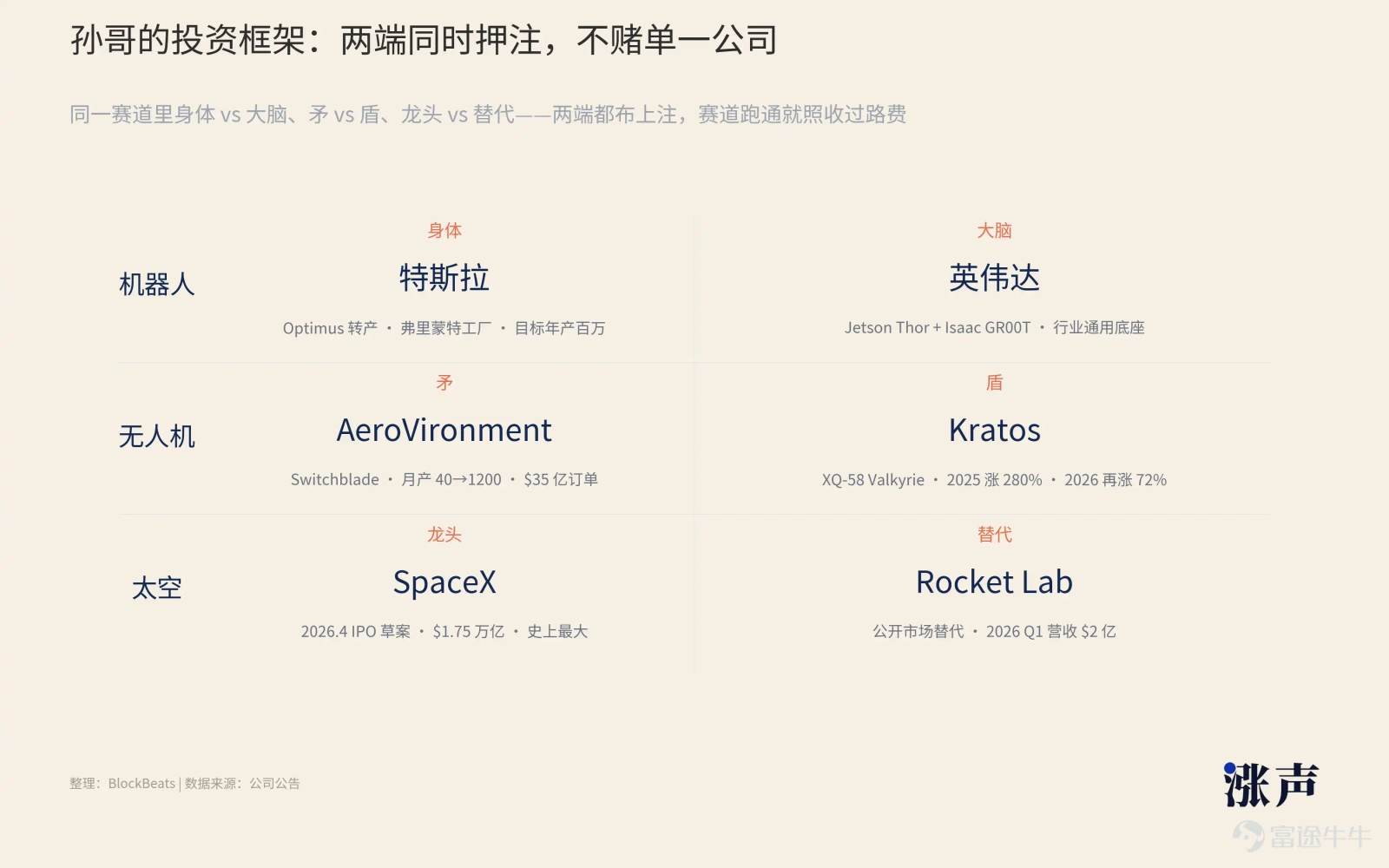
Sun Yuchen’s publicly stated investment logic is: identify tracks with clear directions and simultaneously deploy resources at both ends without betting on the execution capabilities of a single company.
In the robotics sector, his framework is to separately invest in the body and the brain.
Tesla bets on the body, announcing in early 2026 the discontinuation of Model S and Model X production, transforming the Fremont factory into an Optimus production line with a target annual output of one million units, each priced between $20,000 and $25,000; the current version of Optimus is already being used for parts handling and sorting at the Austin and Fremont factories, with Gen 3 production set to begin in summer 2026.
NVIDIA bets on the brain. Jetson Thor integrates server-grade AI inference into the robot itself, while Isaac GR00T has nearly become the industry-standard base. Jensen Huang announced at GTC that by 2035, there will be one billion humanoid robots globally.
Whether Optimus can deliver on schedule is Musk’s problem, not NVIDIA’s. As long as the track succeeds, tolls will be collected regardless.
For drones, the core judgment is that Physical AI’s deployment in military scenarios is irreversible.
AeroVironment's Switchblade loitering munitions have become an iconic weapon in Ukraine, with monthly production capacity ramping up from 40 units to 500 units, targeting 1,200 units. A $3.9 billion order has locked in revenue for the next three years; Kratos' XQ-58 Valkyrie serves as the 'loyal wingman' to the F-35. Manned aircraft carry out missions while unmanned ones cover the flanks. Priced at a fraction of fifth-generation fighters, its value is set to increase by 280% in 2025 and another 72% in 2026.
One company makes tanks uneconomical, the other renders manned fighter jets redundant, with complementary logic on both ends.
In the space sector, Justin Sun purchased a flight seat on Blue Origin in 2021 for $28 million. This amount was donated to Blue Origin's STEM charity fund and distributed among 19 non-profit organizations. On August 3, 2025, he completed a suborbital flight aboard the New Shepard NS-34 mission.
In the public market, SpaceX submitted a confidential IPO draft to the SEC in April 2026, targeting a valuation of $1.75 trillion, which would make it the largest IPO in human history. Rocket Lab's Q1 2026 revenue surpassed $200 million, making it the most direct alternative for those unable to invest in SpaceX.
Once SpaceX goes public, the entire space sector’s pricing framework will need to be rewritten.
Looking at Justin Sun's statements over the past two years, his assertion that 'AI, robotics, and blockchain have reached the iPhone moment' reflects his judgment on embodied intelligence. His prediction of 'robot armies and robotic police' highlights his vision of autonomous weaponized AI. His bet on 'the integration of AI, robotics, and spatial computing' represents his wager on the next-generation human-computer interface. And his statement 'Earth is too small; it's our home,' reflects his perspective after crossing the Kármán line.
These four elements together form the full picture of physical AI.
Over the past two decades, the internet has transformed how information flows. WeChat replaced letter writing, Taobao replaced traditional markets, and TikTok replaced television.
But the fundamental rules of the physical world haven't changed: workers are still workers, and factories are still factories.
In the next two decades, AI may change the very way the real world operates. Humanoid robots that don't need rest will stand in factories, autonomous vehicles will fill the roads, swarms of drones will roar across battlefields, and the first 'residents' to land on the Moon and Mars are likely to be advanced AI robots.
That young man who in 2016 told everyone not to buy property has now crossed the Karman Line.
As for most of us, we might still be waiting for the next Yanjiao.
Risk Disclaimer: The above content only represents the author's view. It does not represent any position or investment advice of Futu. Futu makes no representation or warranty.Read more

Comments
to post a comment
5
12