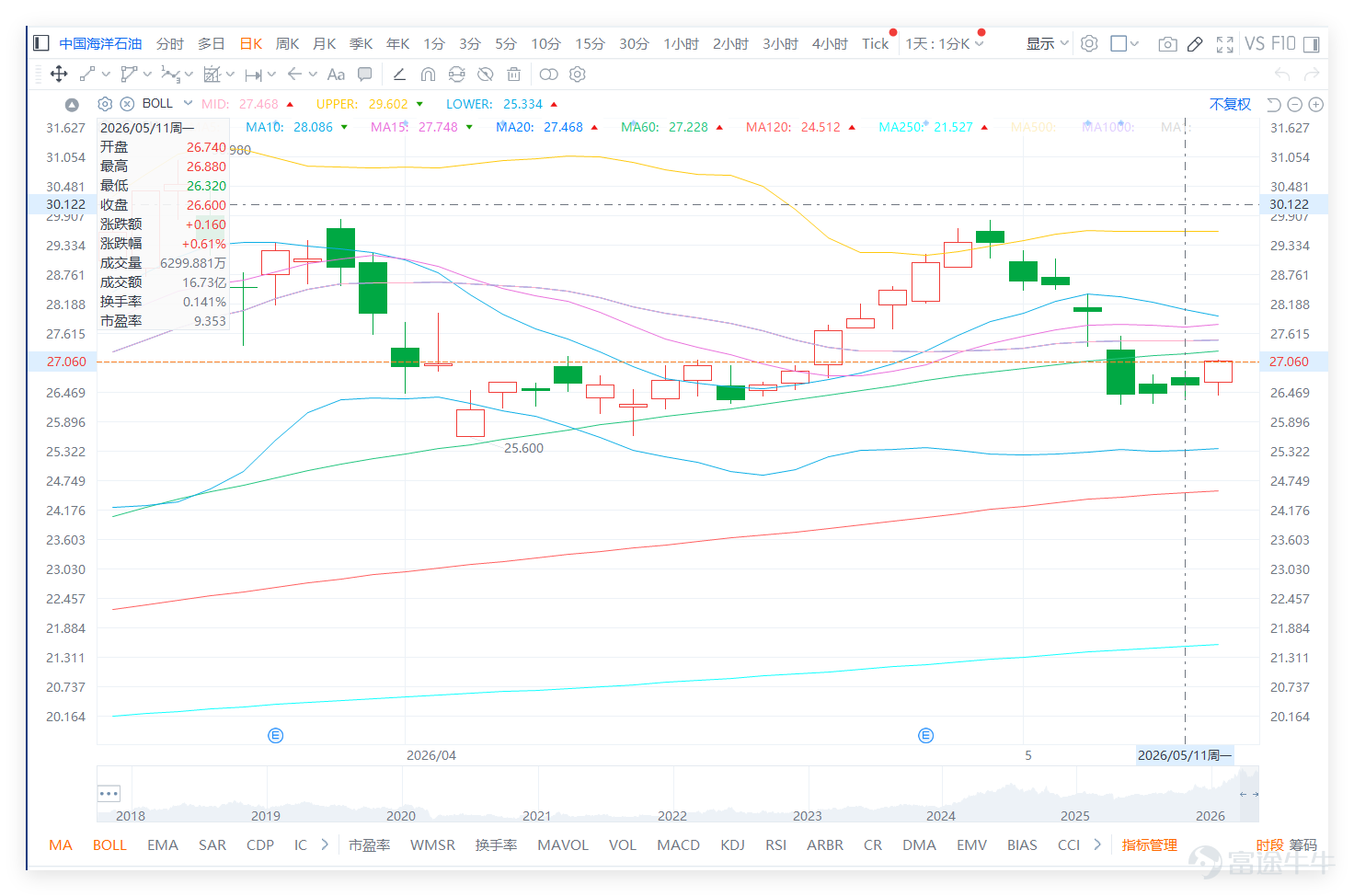

CNOOC experiences pressure in the range of 26 to 27 yuan, with oil price benefits not yet fully reflected
The previous day (August 11) closed at approximately 26.50 to 26.60, with the short-term trend moving sideways at high levels rather than showing a clear breakout. The stock price is above the 200-day moving average of around 22.23, indicating that the mid-term structure remains strong. However, the 50-day moving average at about 27.67 is still above, representing that the short-term rebound is temporarily constrained by resistance above 27. This precisely explains the core question in investors' comments: oil prices have support, but why isn't the stock price following.

CNOOC's technical signal is 'Strong Buy', with an RSI of approximately 44, which is in the neutral-to-weak range. In comparison with its peers in the 'Big Three Oil' sector, $PETROCHINA (00857.HK)$ the technical signal is 'Buy', with an RSI of approximately 45; $SINOPEC CORP (00386.HK)$ the technical signal is also 'Strong Buy', with an RSI of approximately 48. This indicates that the entire energy sector (CNOOC, PetroChina, Sinochem) is currently in a state of 'technical bullishness, but stock prices have not yet broken out'. CNOOC is not consolidating alone; it is waiting together with its peers for capital to flow back into energy stocks. Whether it can break through the 27.67 resistance depends not only on itself but also requires observing whether PetroChina and Sinochem can stabilize and rebound simultaneously, creating sector-wide synergy.

Technically, 26.60 is the current short-term watershed for CNOOC. If it can stabilize above this level, it indicates that the stock price is still consolidating at high levels and hasn't weakened. If it breaks below 26.50 and continues to retreat, then there is a need to guard against a retest of 25 or even lower levels. The immediate resistance above is between 27 and 27.67, which is the position where short-term funds need to break through. If it rises above 27.67 and stabilizes, it will have the potential to challenge 30 again. In other words, 30 is not impossible, but it cannot bypass the hurdle of 27.67.
Bullish investor comments mainly focus on phrases like 'buying the dip,' 'heading to 30,' and 'long-term bull stock,' reflecting that the market still believes in CNOOC's mid-term strength. This view is not without foundation, as the share price remains above the 200-day moving average, and energy stocks inherently offer high dividends, resource pricing power, and defensive characteristics, which continue to attract certain funds. However, with the current price nearing overhead moving average resistance, it’s not an ideal time to chase from a low position but rather to wait at higher levels for a breakout.
Bearish comments reflect another risk: the market is starting to question whether CNOOC has already peaked, with some even suggesting there should be a significant pullback. These voices don't necessarily mean the stock will plummet immediately, but they indicate that some investors are dissatisfied with the safety margin at the current price. Especially when the share price rises to higher levels, if rising oil prices fail to drive a stock breakout, investors naturally suspect whether funds are distributing or reallocating shares at these elevated levels.
The phrase 'when oil falls, it falls; when oil rises, it falls' aptly captures the current sentiment. In theory, energy stocks should benefit from oil prices, but the actual share price isn't solely determined by oil prices—it is also influenced by capital flows, valuations, dividend expectations, and broader market trends. If capital is flowing heavily into tech stocks, even with favorable oil prices, CNOOC might only move sideways instead of rallying immediately.
Observational comments clearly demonstrate market confusion. Some ask why the stock hasn’t reached HKD 27 yet, others wonder why the share price doesn’t rise despite increasing oil prices, while some note that capital has been diverted to tech stocks, and others describe the stock as treading water. The common thread in these comments is that investors aren't pessimistic about the fundamentals but are dissatisfied with the short-term share price reaction. This situation is common in high-dividend resource stocks: the fundamentals aren't bad, but there's a lack of short-term buying interest.
Therefore, the real key for China National Offshore Oil Corporation (CNOOC) right now isn’t the daily fluctuations of oil prices but whether funds will return to the energy sector. If capital continues to favor tech and high-beta sectors, CNOOC may only consolidate slowly, even if it holds steady. If the energy sector regains capital allocation, the share price could break through HKD 27.67 and move towards HKD 30.
For short-term strategies, CNOOC can be handled using a 'defend support, await breakout' approach. If it holds above HKD 26.50-26.60, it can still be seen as consolidating at higher levels. Breaking above HKD 27.67 would enhance short-term upside potential, but if it breaks below HKD 26.50 and loses support, a retest of HKD 25 should be guarded against. For those chasing upward momentum, the current price isn’t the most comfortable position since resistance is nearby and downside correction space remains.
In summary, China National Offshore Oil Corporation isn’t weakening, but oil price tailwinds haven’t translated into a share price breakout just yet. Reaching HKD 30 remains a market aspiration, but the first real step is reclaiming the range between HKD 27 and HKD 27.67.
Reply to some investors' views:
@Wave Leung:
HKD 30 can serve as an extended target, but in the short term, it needs to first break through HKD 27.67 and stabilize.
@大鼻头:
The medium-term structure remains strong, but the current price isn’t at a low level—confirmation will require breaking above HKD 27.67.
Based on the above analysis, the strategies for deployment can be divided into the following main approaches:


For more market analysis, stay tuned to Jenny's daily updates on 'Hong Kong Stock Warrants'!
Reminder: This article does not constitute any investment advice.
This article is for reference only and does not constitute any investment advice. Market data, opinions, and analysis contained herein may change at any time without prior notice. We are not responsible for any loss or damage caused by reliance on the information in this article. Technical analysis only shows whether certain technical conditions are met; asset performance should be comprehensively evaluated using other sources of information, and trading decisions should not be made solely based on this article. Please note that past performance is not indicative of future results.
#HKStocks #CNOOC #Real-TimeAnalysis #WarrantPick #WarrantGuide #DerivativesHedging #HKWarrantsJenny #Blue-ChipStocks #TechnicalAnalysis
Risk Disclaimer: The above content only represents the author's view. It does not represent any position or investment advice of Futu. Futu makes no representation or warranty.Read more

Comments
to post a comment
5
1