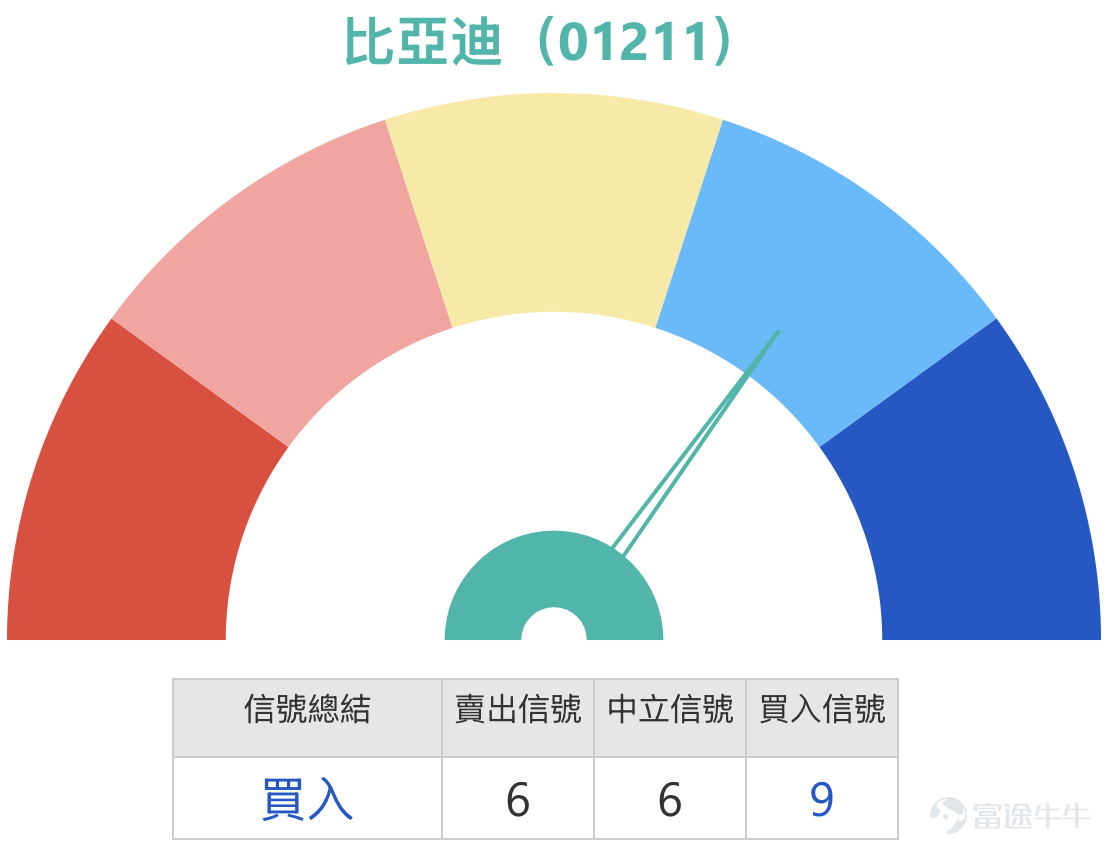

BYD (1211) investors are hoping for a turnaround, but 105 yuan is the true resistance level for a comeback
BYD shares are currently trading at around 101 yuan, down approximately 0.69%. The stock has rebounded from recent lows in the short term, but the overall trend has not fully reversed. From the daily chart perspective, the share price remains below the 10-day moving average at about 102.56 yuan, the 20-day moving average at around 105.40 yuan, and the 30-day moving average at about 105.25 yuan, indicating that the rebound is only an initial recovery and hasn't yet reclaimed key short-term moving averages. In other words, BYD isn’t showing clear strength yet; instead, it's attempting to climb back to a central position from a weak zone.
Technically, the most important short-term support is around 98 yuan. Recently, the share price dipped as low as near 98.50 yuan, and today’s low also saw buying interest near 98 yuan, reflecting that this area has been temporarily supported by buyers. If the price can hold steady above 98 yuan, there is still potential for a short-term rebound. However, if it falls below 98 yuan, it suggests that the bottoming process is incomplete and may retest the area near 96.98 yuan, which aligns with the lower Bollinger Band. A further breakdown would mean a renewed weakening of the trend.
The upper resistance is concentrated in the range between 102.56 and 105.40 yuan. The 102.56 yuan mark represents the 10-day moving average, the first level of short-term recovery. The 105.25 to 105.40 yuan range is close to both the 20-day and 30-day moving averages, making it a crucial resistance level for a strong rebound. Only breaking through and stabilizing above 105.40 yuan would indicate that BYD is transitioning from a weak rebound to structural recovery. Further resistance lies at 113.40 yuan, a previous high, but it is too early to consider this an immediate target at this stage.
In terms of investor sentiment, bullish comments mainly focus on 'reduced short selling,' 'stabilization at the bottom,' and 'potential reversal from a low point.' This reflects that the market is beginning to recognize rebound opportunities after a period of weakness, especially when the share price shows some buying interest near 98 yuan, leading investors to interpret this as a potential short-term bottom. However, bottom stabilization does not equate to a trend reversal. A real reversal will require prices to reclaim levels above 105 yuan; otherwise, it remains just a rebound from a low position.
Comments such as 'short selling has significantly decreased today' reflect that the market is observing whether downward pressure is easing. If short selling declines and the stock price rebounds, it could indeed help restore sentiment in the short term. However, a decrease in short selling only indicates that downward pressure may be slowing, not that buying power is sufficiently strong. To confirm renewed inflows of capital, we still need to see if the stock price can break through 102.56 and 105.40.

Bullish sentiment also includes more direct tones encouraging upward momentum, such as 'Go for it!' or 'Let's go up!'. These comments suggest that some investors already view today’s rebound as the start of a counterattack. However, from a technical perspective, the stock price is still suppressed by multiple moving averages, and if it fails to surpass the 105 range, upward momentum could easily be exhausted before resistance.
Bearish comments focus on phrases like 'it's about to soften again,' 'iron ceiling,' and external factor pressures. These viewpoints are not without merit, as BYD has yet to escape its short-term weak pattern, especially with the stock price fluctuating below 105, which might lead the market to question whether the rebound is temporary. As for factors like US-China relations and domestic auto policy risks, these add valuation and sentiment pressures that limit willingness to chase at higher levels.
Observational comments best reflect the current market state. Some ask 'how much will it rise?', others believe 'there’s no reversal, only stabilization,' and some mention whether oil prices might affect new energy demand. This shows investors aren’t completely bearish but remain cautious about the rebound. Especially the phrase 'the stock price isn’t moving,' indicating that even though there may be favorable factors or a rebound for BYD, there’s no strong chasing behavior—common during the early stages of a weak recovery.
BYD’s real issue now is that the stock price is still one step away from confirming a reversal. Support near 98 suggests that the short-term trend is no longer unidirectionally downward; however, heavy resistance near 105 shows that confidence has yet to fully recover. Within this range, stock prices could fluctuate easily, and a single day’s rise won’t be enough to change the overall structure.
For short-term strategy, BYD should use 98 as a defensive position and aim for a breakout above 105.40. Holding above 98 means the rebound could continue; breaking through 105.40 would increase attractiveness and allow observation of the previous high at 113.40; if it falls below 98, measures should be taken to prevent testing 96.98 or even lower. The current price of 101.70 lies between support and resistance, offering neutral attractiveness, so chasing should not be rushed.
In summary, BYD shares are not lacking a rebound, but the rebound isn’t strong enough. Investors are starting to believe there’s a bottom near 98, but the market needs to see 105 reclaimed to truly confirm a reversal.
Reply to market investor inquiries:
There is temporary support near 98, which can be seen as an initial stabilization during the short-term bottom exploration, but the reversal process is not yet complete.
A short-term rebound has occurred, but the resistance levels at 102.56 and 105.40 remain; it’s not advisable to chase highs based solely on sentiment.
For a true upward movement, first see if it can regain and stay above 105.
BYD (01211) offers a wide selection of warrants. By combining core indicators such as leverage, implied volatility, and premium, investors can match different strategies for bullish or bearish outlooks, enhancing trading efficiency and cost advantages.
For bullish positions, attention can be paid to UBS Group call warrant 25678$UB-BYD @EC2608A.C (25678.HK)$, J.P. Morgan call warrant 25526, both offering a leverage of 6.6 times with the same exercise price of 106.98. Their implied volatility is relatively low, making them suitable for capturing upside movements in the underlying stock. Regarding bull contracts, J.P. Morgan bull contract 55467 and HSBC bull contract 59877$HS#BYD RC2608Q.C (59877.HK)$ stand out with a recovery price of 90, providing actual leverage of 7.3 times and 7.4 times respectively. Their strong leverage and lower premiums allow efficient tracking of rebounds in the underlying stock.
For bearish positions, the preferred put warrant is HSBC put warrant 27631$HS-BYD @EP2611A.P (27631.HK)$, with an exercise price of 84.95, featuring the lowest premium and implied volatility, presenting a significant cost advantage; BOC put warrant 22386$BI-BYD @EP2608A.P (22386.HK)$ With a leverage of 7.1 times and a strike price of 81.83 yuan, the implied volatility is relatively low, making it suitable for betting on a pullback. For bear certificates, one can choose Societe Generale Bear Certificate 54594, with a stop-loss price of 106 yuan, offering the lowest premium and relatively higher actual leverage. HSBC Bear Certificate 54987 has the same stop-loss price with an actual leverage of 16.7 times, providing a significant leverage advantage.

Reminder: This article does not constitute any investment advice.
This article is for reference only and does not constitute any investment advice. Market data, opinions, and analyses contained herein may change at any time without prior notice. We are not responsible for any losses or damages caused by reliance on the information in this article. Technical analysis only indicates whether certain technical conditions are met and should be used alongside other data for a comprehensive assessment of asset performance; trading decisions should not be made solely based on this article. Note that past performance is not indicative of future results. Follow Jenny’s HK warrants for more professional insights. $Hang Seng Index (800000.HK)$$Hang Seng TECH Index (800700.HK)$
Risk Disclaimer: The above content only represents the author's view. It does not represent any position or investment advice of Futu. Futu makes no representation or warranty.Read more


Comments (2)
to post a comment
2