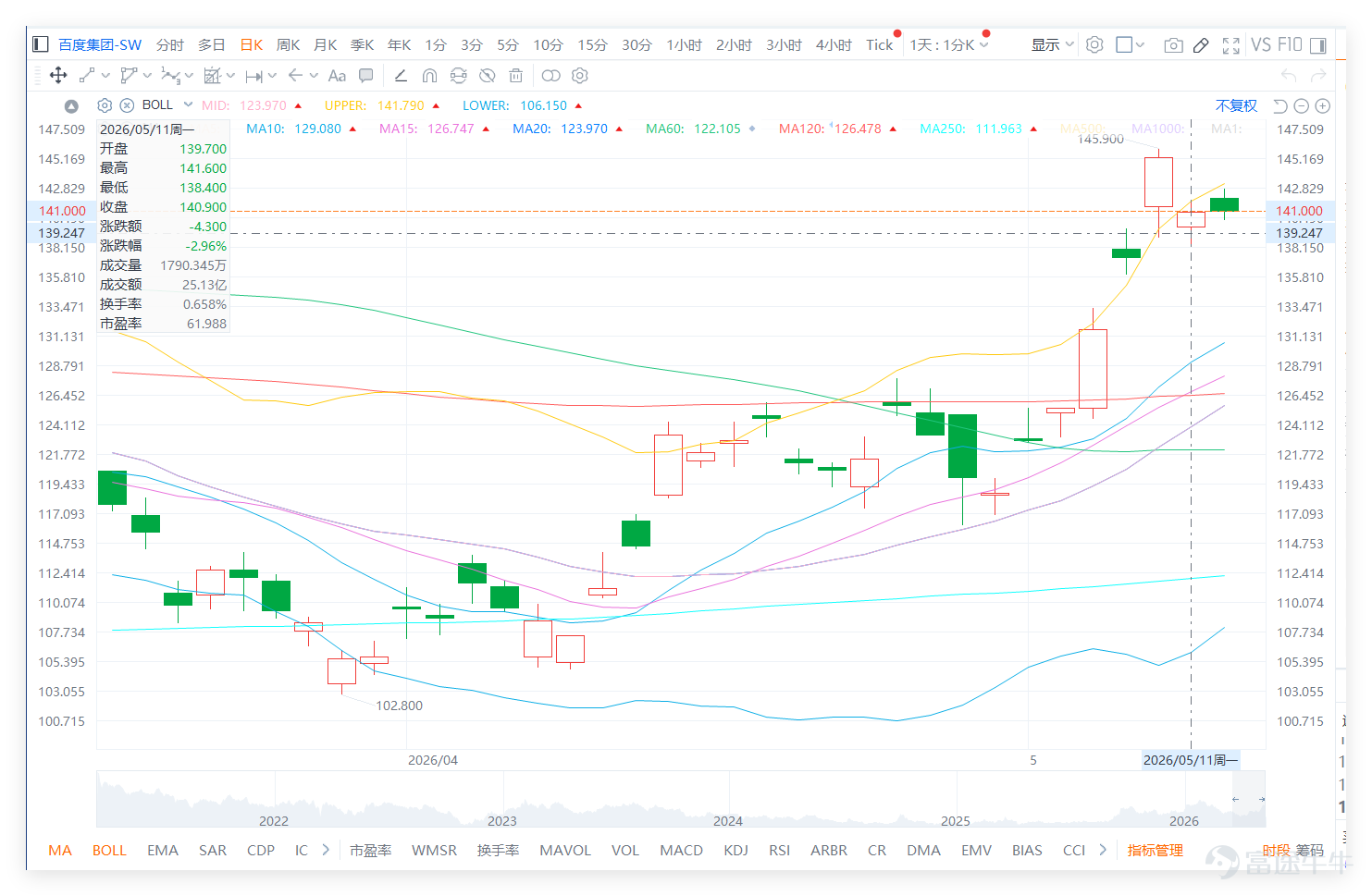

After a sharp rise, Baidu has returned to the RMB140 level; short-term strength still needs to absorb profit-taking pressure
On the previous day (the 11th), the stock closed at approximately RMB140.90, rising about 2.96% in a single day, showing an obvious strengthening in short-term momentum. After rebounding from the low of RMB102.80, the share price has once again moved above the 10-day line at around RMB129.08, the 20-day line at RMB123.97, and the 30-day line at RMB118.96, reflecting that the medium- and short-term structure has shifted from weak to strong. This round of rebound is not just an ordinary sideways recovery but has been significantly driven by capital inflows, especially with recent trading volumes expanding, indicating renewed market attention on Baidu.

Baidu’s technical signal is 'Strong Sell,' with an RSI of around 70, already entering the traditionally overbought zone. Compared with peers in the technology sector, $TENCENT (00700.HK)$ the technical signal is 'Buy' and the RSI is only 38, clearly in an oversold state; $BABA-W (09988.HK)$ And, $NTES-S (09999.HK)$ The signals are all 'neutral'; and $KUAISHOU-W (01024.HK)$ 、 $MEITUAN-W (03690.HK)$ Others are 'sell'. This indicates that Baidu's strong surge occurred in an environment where the sector’s overall technical outlook is weak, with most peers either oversold or neutral, marking a rare independent rally. Its 'strong sell' signal diverges sharply from its own price action, highlighting significant risks of profit-taking and technical corrections in the short term. The sustainability of its rebound depends not only on digesting its profit-taking pressure but also on whether the sector as a whole (especially leading players like Tencent and Alibaba) can stabilize to provide support.

However, Baidu’s last closing price at 140.90 is already near the upper Bollinger Band around 141.79, while also approaching the recent high range of 143.60 to 145.20, indicating that the stock has entered a short-term resistance zone. In other words, Baidu is not just starting out now, but rather has surged quickly to a position where digestion is needed. If the stock price can break through 141.79 and stabilize, it will have the conditions to challenge 143.60 and 145.20 next; if it faces resistance in this area, it may pull back first for consolidation.
Technically, the 137 to 138 yuan range is currently the first support zone. This area is close to the retest position after the recent breakout and is also the key defensive zone mentioned by investors who entered at 139. If Baidu can hold steady between 137 and 138 yuan, the short-term uptrend remains intact; if it breaks below 137 yuan, one must be cautious about a potential retest of around 129.08, which is near the 10-day moving average. Further below, the important support is near 123.97, around the 20-day moving average.
The Relative Strength Index (RSI) is around 70, already in the overbought zone, reflecting strong short-term momentum but also representing increased risk for chasing prices. Such price action tends to lead to two scenarios: if capital continues to chase in, the price can break upward along the resistance; but if buying weakens slightly, profit-taking will quickly emerge. Therefore, at this stage, it’s not simply about being bullish or bearish, but whether the 141.8 to 145 range can truly be broken through.
Investor bullish comments focus on two directions:
First, there is increased acceptance of prices above 140 yuan, with some believing that levels above 140 yuan are acceptable, while others did not exit even at 145 yuan. This reflects that some investors are no longer viewing Baidu purely from a low-level rebound perspective, but are starting to reassess its upside potential. This sentiment supports the stock price because the market's willingness to accept higher prices suggests a valuation reassessment is underway.
Second, there is anticipation regarding the potential value of spin-offs such as Kunlun Chip. These comments indicate that the market is not only trading the short-term technical rebound but is also beginning to look for fundamental or asset revaluation reasons. If the market believes that AI chips, cloud services, or related assets have room for repricing, Baidu’s rally may not just be short-term speculation but could carry mid-term valuation recovery implications. However, these positives ultimately need to be confirmed through earnings and guidance, otherwise chasing prices at highs may easily turn into speculative expectations followed by waiting for realization.
Bearish comments mainly focus on cautionary voices such as 'main force distribution,' 'HK shares trading higher than US shares is unreasonable,' and 'patsy buyers.' This is not surprising because Baidu’s short-term gains have been substantial, and the current price is already near the upper Bollinger Band. When a stock surges quickly into a resistance zone, the market naturally suspects whether some funds might be exiting at highs. Especially if the stock fails to stabilize after breaking through or pulls back after a high open, concerns about distribution will quickly rise.
Questions about the price difference between HK and US shares also reflect that some investors are reluctant to chase HK shares at high levels. This sentiment limits short-term buying power, especially when the stock price has already risen to the 141 to 145 range, prompting more careful comparisons of valuations, premiums, and external trends. If the performance of US shares does not align, Baidu’s HK shares’ short-term upside will face more pressure.
Observational comments are equally important. Some entered at 139, others asked if momentum would only pick up at 3 PM, some mentioned the inflow of Southbound funds, while others paid attention to the upcoming earnings announcement and the rotation between new and old tech stocks. These voices indicate that Baidu’s current price action is not purely driven by retail sentiment but is instead propelled by capital flows, earnings expectations, and sector rotation. In particular, if the inflow of Southbound funds continues, it will provide support for the stock price; however, volatility is expected to increase significantly around the earnings announcement period.
The 'rotation between new and old tech stocks' is a critical backdrop for Baidu right now. The market has recently been repricing AI, semiconductors, and tech platform stocks. If Baidu can use the AI narrative to attract capital again, its stock price may continue to recover. However, if funds are merely rotating short-term among different tech stocks, Baidu's upward trend will require stronger trading volume and earnings support, otherwise, a pullback after a rally is likely.
For short-term strategies, Baidu should use 141.79 as the breakout confirmation level, and the range of 137 to 138 as the short-term defensive zone. A breakout above 141.79 with stability would open targets at 143.60 and 145.20. If it breaks above 145.20, the market will have grounds to discuss higher targets. Conversely, if it falls below 137, it indicates profit-taking after the rapid rise, and the stock may retest near 129 for support.
To summarize, Baidu’s current strength is real, but the position is no longer low. Bulls believe there’s still value above 140, while bears suspect distribution at higher levels. The real answer does not lie in sentiment but in whether Baidu can break through 141.8 to 145 and hold above 137.
Reply to some investors' views:
@範式智能300蚊:
Above 140 is acceptable, but the current price is already close to the resistance zone of 141.8 to 145. It’s best to see if it can stabilize before making further judgments.
@被動投資:
If the spin-off of Kunlun Chip can unlock value, it will indeed benefit shareholders, but in the short term, we still need to see if it can break through 141.8.
@23775361:
The current trend is on the stronger side, but it cannot rely solely on confidence. To be considered stable, it needs to hold above 137 to 138.
Based on the above analysis, the strategies for deployment can be divided into the following main approaches:


For more market analysis, stay tuned to Jenny's daily updates on 'Hong Kong Stock Warrants'!
Reminder: This article does not constitute any investment advice.
This article is for reference only and does not constitute any investment advice. Market data, opinions, and analysis contained herein may change at any time without prior notice. We are not responsible for any loss or damage caused by reliance on the information in this article. Technical analysis only shows whether certain technical conditions are met; asset performance should be comprehensively evaluated using other sources of information, and trading decisions should not be made solely based on this article. Please note that past performance is not indicative of future results.
#HKStocks #Baidu #Real-TimeAnalysis #WarrantSelection #WarrantGuide #DerivativesHedging #HKWarrantsJenny #Blue-ChipStocks #TechnicalAnalysis
Risk Disclaimer: The above content only represents the author's view. It does not represent any position or investment advice of Futu. Futu makes no representation or warranty.Read more

Comment (1)
to post a comment
1