
PDD Holdings reported Q1 revenue of RMB 106.2 billion—has its share price already hit bottom?

Earnings Options Strategy | Balancing AI Investment Effectiveness and Profit Bottom Line, How Will Alibaba's Earnings Report Shape Up?
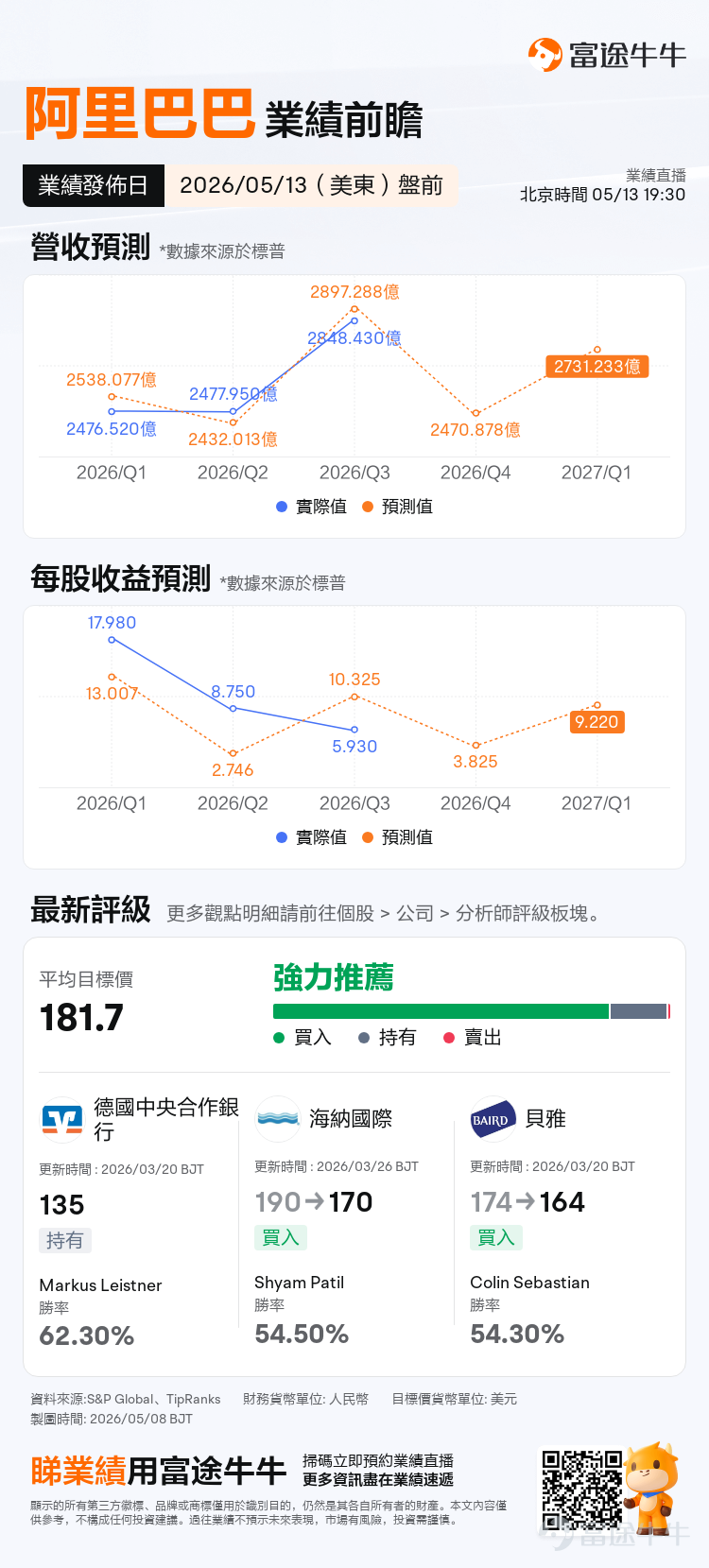
This week, the Hong Kong stock market will see earnings releases from several heavyweight companies, among which $BABA-W (09988.HK)$ /$Alibaba (BABA.US)$is scheduled to release its fiscal fourth-quarter 2026 (corresponding to Q1 of the calendar year 2026) earnings report before the US stock market opens on May 13.
The current market expects revenue to be 247.088 billion yuan (RMB, hereinafter), a year-on-year increase of 4.5%; net profit to be 8.87 billion, a year-on-year decrease of 28.36%; and adjusted EBITA is expected to decline even more significantly. Several of Alibaba's businesses (such as Qwen, Flash Purchase, etc.) are still in the investment phase, and the market has already anticipated the decline in profits.
Despite significant short-term profit pressure, based on optimism about long-term growth in the cloud business and potential cost reductions in instant retail, most institutions have maintained positive ratings ahead of the earnings report.
Key highlights of the earnings report
Alibaba's AI narrative is at a critical validation stage, representing the most complete layout and clearest narrative in China’s internet sector across the full AI stack (chips, models, cloud, applications). Investors are eagerly awaiting hard data that the company can disclose to verify its capabilities and progress in AI commercialization.Additionally, whether the impact of last year’s 'food delivery war' has subsided and whether the cost reduction path for the instant retail business can reassure the market are also core points of focus.
(1) Cloud and AI: The decisive factor for revaluation space
The Cloud Intelligence Group is currently the most market-anticipated business segment of Alibaba, and also the key to whether it can be repriced from an 'e-commerce company' to an 'AI infrastructure company.'
In the previous fiscal quarter (Q3 of fiscal year 2026), Alibaba Cloud's revenue increased by 36% year-over-year to RMB 43.284 billion, with AI-related product revenue achieving triple-digit growth for the 10th consecutive quarter.Alibaba Cloud's business in Q4 is expected to maintain high growth, with a projected increase of over 40%. If the growth rate exceeds expectations, it will directly drive a reevaluation of its valuation framework.
Alibaba has significantly increased its capital expenditure on AI and cloud infrastructure. Management previously announced an ambitious vision of 'achieving over USD 100 billion in external revenue from cloud and AI within the next five years.' The disclosure of future capital expenditure plans during this earnings call will directly influence the market's assessment of the intensity and return cycle of AI investments.
If management can clearly articulate the investment in AI and the path to future monetization (such as the commercialization of Qwen and MaaS revenue), the market will interpret it as 'strategic spending' rather than loss of control.
(2) Instant retail: Taobao Flash Purchase’s path to reducing losses
Since the middle of last year, aside from AI, Alibaba's most notable strategic move has been its large-scale investment in instant retail — launching Taobao Flash Purchase with subsidies reaching hundreds of billions, aiming to capture market share in instant retail.
Data from the previous quarter showed that revenue from instant retail business surged 56% year-over-year, with an additional 150 million annual active buyers.The market needs to see continued validation of the logic of trading short-term losses for long-term growth.The company disclosed its goal of improving the unit economic model (UE) through increasing order value and optimizing structure, planning to halve losses each subsequent year and achieve profitability in fiscal year 2029.
(3) E-commerce foundation: Can GMV stabilize and rebound?
Taobao and Tmall Group (domestic e-commerce) is the core profit source for Alibaba, but it has faced competitive pressures from multiple players such as PDD Holdings, Douyin, and Kuaishou over the past two years, leading to continued pressure on GMV growth. In the last quarter, revenue from Alibaba's China e-commerce division grew approximately 6% year-over-year, with customer management revenue (CMR) showing a slight increase, delivering relatively stable but not outstanding performance.
Institutions expect its gross merchandise value (GMV) to remain robust, growing in line with the overall national e-commerce market.However, due to changes in accounting treatment (some marketing expenses offsetting revenue), the reported growth rate of customer management revenue (CMR) may appear lower.
Investors may focus on whether the company discloses 'comparable CMR' (excluding the impact of accounting reclassification). If disclosed and the growth rate returns to 5-7%,then there may be certain trading opportunities based on potential misinterpretations of the 'poor numbers'.
(4) International Business and Shareholder Returns
The overseas e-commerce business (AliExpress, Lazada) faces fierce competition against Temu ($PDD Holdings (PDD.US)$going global), Shopee ($Sea (SE.US)$), and TikTok Shop.The improvement in profitability of the international e-commerce business in Q1 will influence market expectations regarding overall profit margins.
At the same time, the market is expected to focus on whether management will further increase the intensity of capital allocation or announce a new share repurchase plan. Continuous 'real money' is an important tool for solidifying investor confidence.
Technical analysis and options strategy
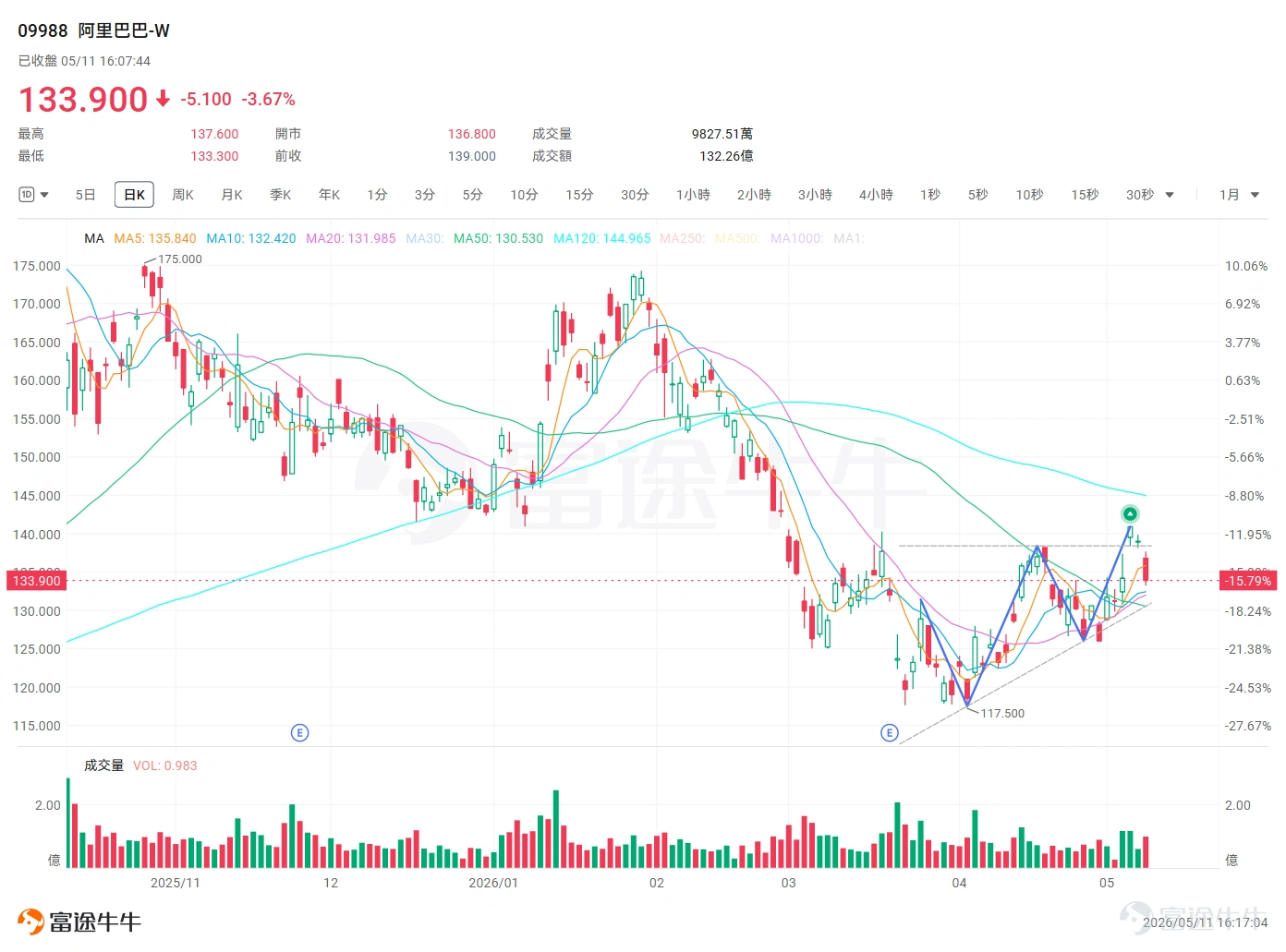
Alibaba's Hong Kong shares fell more than 3% today (May 11), ending a short-term rally after the May Day holiday. This reflects the divergent market trend as global markets chase AI hardware-related funds.
The system previously identified a 'bullish continuation triangle' pattern,but today, with a pullback to the MA60 line accompanied by heavy selling volume and significant outflow of major funds, the current situation is still in the mid-term rebound trend's correction confirmation phase.
Fellow investors need to be reminded that although Hong Kong stock options can be traded, there are some objective limitations:There are relatively fewer market makers for Hong Kong stock options, and bid-ask spreads tend to be wider. Especially during periods of increased volatility such as earnings reports, liquidity for deep out-of-the-money or longer-dated contracts may be insufficient.
In contrast, Alibaba’s US-listed options market is one of the most active Chinese stock options globally, with enormous daily trading volumes, robust competition among market makers, tight pricing, and excellent liquidity, allowing for smoother large fund movements. Particularly during periods when 'volatility drops sharply after earnings releases,' high liquidity means it is easier to close positions or adjust at reasonable prices.Therefore, the following options strategies will use BABA (US ADR) as an example for demonstration:

Based on options trading data, the current put/call ratio is only 0.36, significantly below the neutral level of 1.This indicates that market participants are showing a clear bullish tendency.
The current implied volatility (IV) is 49.58%, while the historical volatility (HV) is only 37.50%, resulting in a premium of approximately 12 percentage points. This suggests that the options market has already priced in higher uncertainty for the upcoming earnings report event – option sellers are demanding more compensation, and buyers are also willing to pay higher premiums.
In terms of percentiles, the IV percentile is at 77%, meaning the current IV is higher than 77% of the time over the past year.It is at a moderately high level but has not yet reached an extreme zone.Reviewing the trend, the IV once dropped to around 40% after the March earnings release, then climbed again to near 50% as the May earnings approached, showing a typical pre-earnings IV buildup pattern.
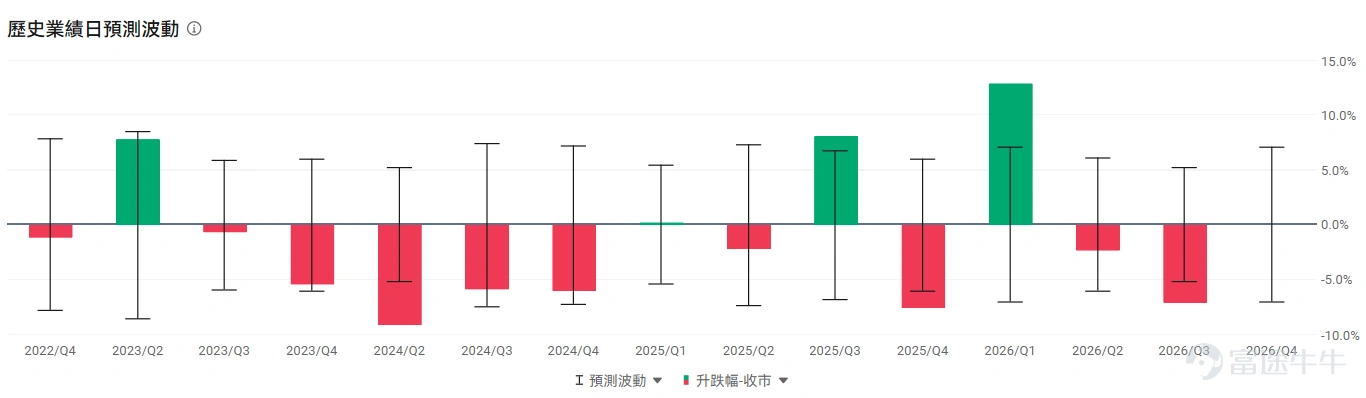
The historical earnings day forecast volatility chart clearly shows that Alibaba's performance on earnings days over the past 12 quarters presents a clear "more declines than gains" pattern – most quarterly earnings days closed with red bars (indicating declines), with only a few quarters showing green bars (indicating gains). However, it is worth noting that the magnitude of gains during positive movements was often larger.For this Q4 2026 earnings report, the options market implies a forecasted volatility of ±7.03%, significantly higher than the previous two quarters.
This reflects two signals:
First, the market acknowledges greater uncertainty in this earnings report – multiple variables such as cloud AI growth validation, inflection points in flash purchase losses, and capex guidance, where any variable surpassing or falling below expectations could trigger significant reactions.
Second,The actual volatility in the last quarter broke through the predicted range at that time; option pricers learned from the lesson of “underestimating volatility” and provided a wider expected volatility range this time.
Based on the above analysis, the following strategy ideas are provided for reference according to different market perspectives:
(1) Strongly optimistic about earnings exceeding expectations - Long Call
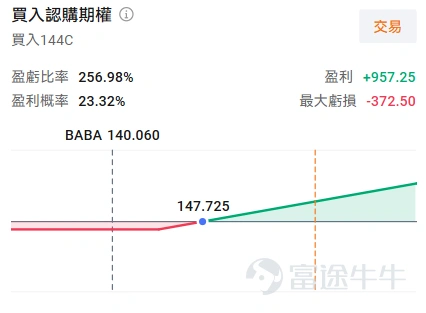
(The design images displayed on the screen are for demonstration purposes only and do not constitute any investment advice or guarantee; market movements are frequent, and the illustrated option prices do not represent actual conditions)
This strategy is suitable for investors with a strongly positive outlook on this earnings report. If cloud growth significantly exceeds expectations and flash purchase losses narrow noticeably, the stock price could experience a repeat of the dramatic single-day surge seen in Q1 of 2026. The advantage of a Long Call lies in its high leverage effect and limited downside risk (maximum loss being the premium). However, it should be noted that the implied volatility (IV) is relatively high, making the option price expensive. Even if the directional judgment is correct, insufficient gains may result in profits being eroded by IV Crush after the earnings release.
(2) Moderately bullish - Bull Call Spread
If optimistic about the earnings outcome and expecting a moderate rise in the stock price but concerned about the high IV before the earnings release, a Bull Call Spread could be considered. This involves buying a call option with a lower strike price while simultaneously selling a call option with a higher strike price (same expiration date). Compared to a Long Call, this strategy has lower net premium costs since the sold option generates partial income, but the maximum profit is also capped.
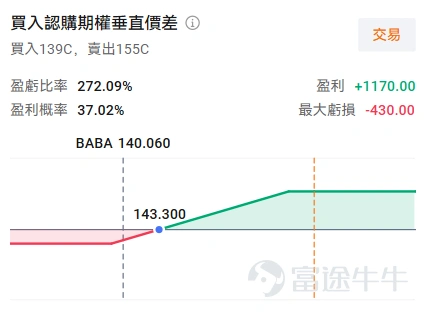
(The design images displayed on the screen are for demonstration purposes only and do not constitute any investment advice or guarantee; market movements are frequent, and the illustrated option prices do not represent actual conditions)
(3) Moderately bearish - Bear Put Spread
Not optimistic about the earnings report's ability to 'wow the market' under high implied volatility, believing that the stock price may decline and that favorable factors have already been priced in by the market. Consider buying a put option with a higher strike price while simultaneously selling a put option with a lower strike price (same expiration date). This strategy shares the same logic as the Bull Call Spread but operates in the opposite direction.
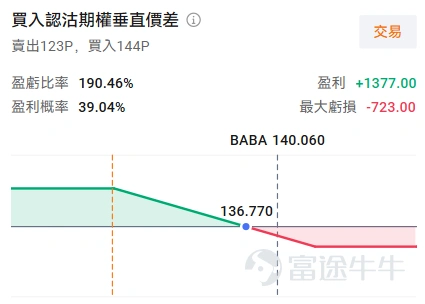
(The design images displayed on the screen are for demonstration purposes only and do not constitute any investment advice or guarantee; market movements are frequent, and the illustrated option prices do not represent actual conditions)
The earnings report that Alibaba will release on May 13 will be one of the most crucial validation points. Its performance not only determines its positioning in the AI era but also serves as a key window for observing whether the overall valuation of China's internet sector can shift from a 'low recovery' to a 'value reevaluation.' Investors using options tools must thoroughly understand core focus areas such as cloud AI growth rates, e-commerce stabilization, and flash purchase profitability, and choose appropriate strategies based on their own risk preferences.
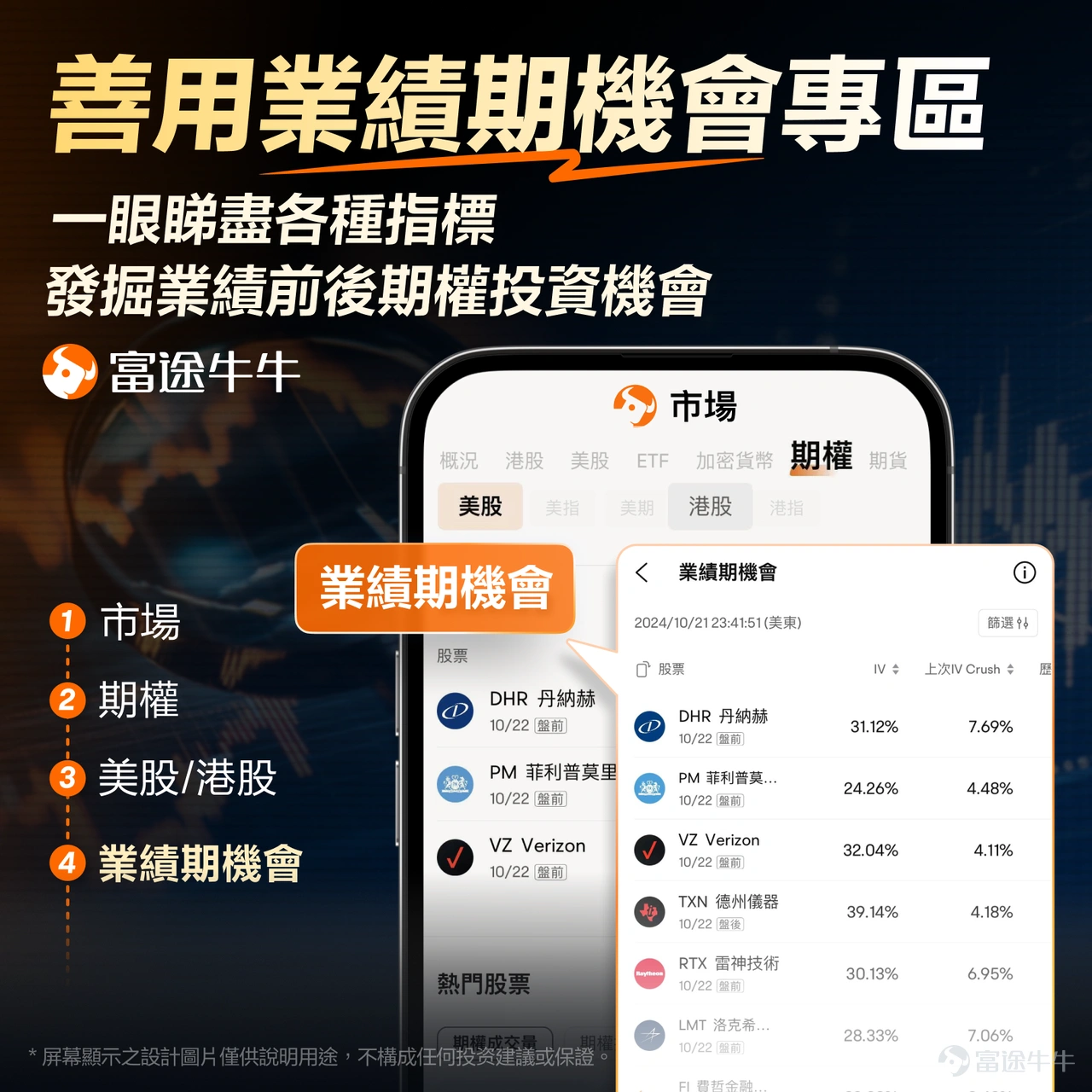
Finally, here's a small perk for fellow Futubull investors, welcome to claim it.Options Beginner Pack
*This event is exclusive to invited HK users. Click to learn more.Detailed event rules>>
Disclaimer
This content does not constitute any offer, solicitation, recommendation, opinion, or guarantee for any securities, financial products, or instruments. The risk of loss in trading options can be substantial. In some cases, your losses may exceed the initial margin amount deposited. Even if you have set contingent orders, such as 'stop-loss' or 'limit' orders, they may not necessarily prevent losses. Market conditions may render these orders unexecutable. You may be required to deposit additional margin within a short period. If you fail to provide the required amount within the specified time, your open positions may be liquidated. However, you will still be responsible for any deficit balance in your account. Therefore, before trading, you should study and understand options and carefully consider whether such trading is suitable for you based on your financial situation and investment objectives. If you trade options, you should be familiar with the procedures upon exercising options and at expiration, as well as your rights and obligations when exercising options and at expiration.
Risk Disclaimer: The above content only represents the author's view. It does not represent any position or investment advice of Futu. Futu makes no representation or warranty.Read more

Comment (1)
to post a comment
19
57