
From 'Plain Text' to 'Full Interactivity': The Dimensionality Reduction Impact of HTML on Markdown in the AI Agent Era
Author and source of the article: 0x9999in1, ME News
Core paradigm shiftAI interaction has shifted from 'conversational search' to 'productivity collaboration.' Markdown excels in structured text, but HTML has inherent advantages in hosting interactive components, SVG animations, and complex logic, making it the primary medium for Agent deliverables.
HTML's 'Renaissance'Tools like Claude Artifacts and Openclaw, representing Agent solutions, have achieved a leap from 'delivering results' to 'providing finished products' by rendering HTML/React code in real-time on the browser side.
Valuation and financing trendsAlthough Markdown and HTML are open-source standards, platforms supporting these standards (such as OpenAI, Anthropic, Vercel, etc.) have seen their valuations repeatedly hit new highs, reflecting the market's strong optimism about 'AI-generated UI' capabilities.
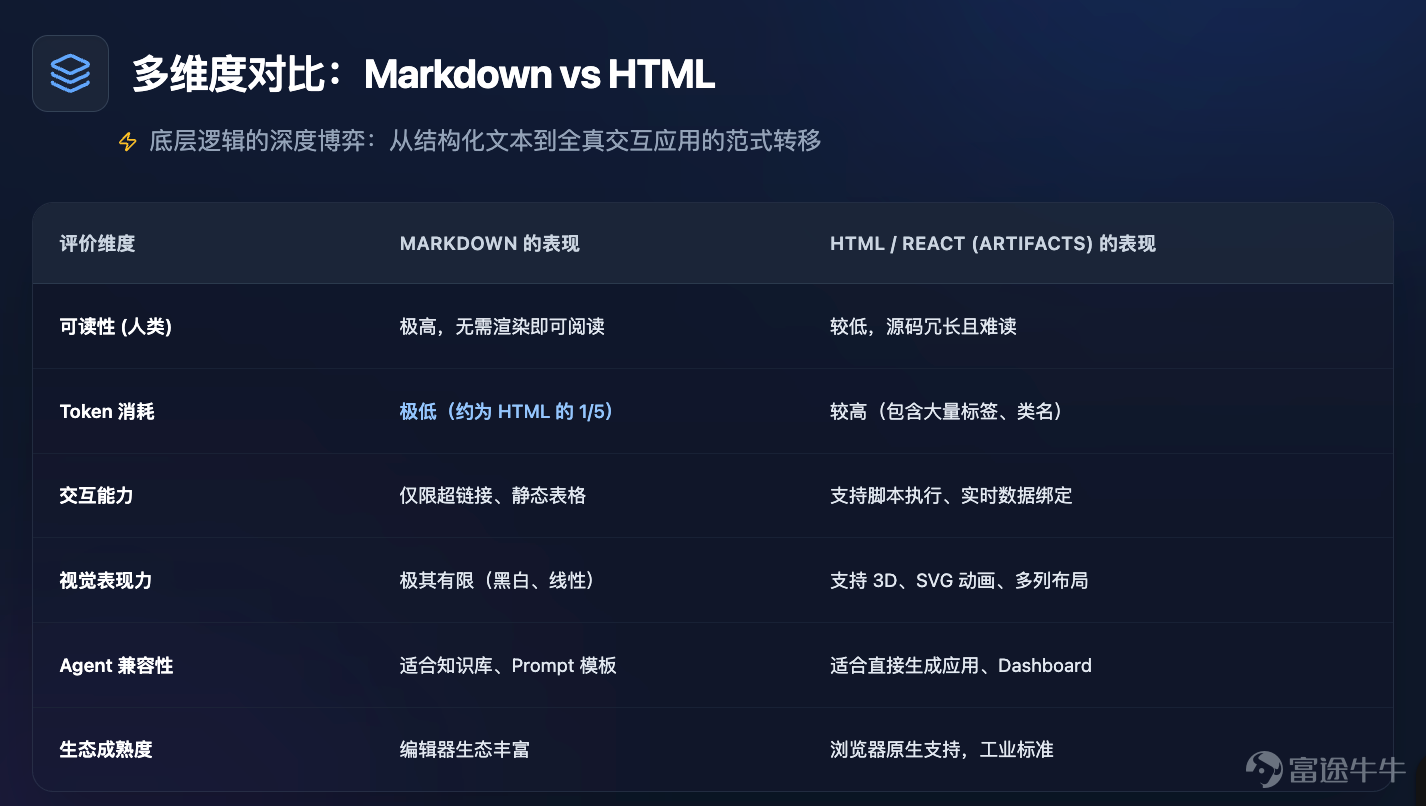
Token efficiency comparisonMarkdown dominates the input end (Prompt) due to its extremely low token usage; however, at the output end, although HTML incurs higher token costs, the interactive value it brings far outweighs the incremental costs.
Future Trend ForecastMarkdown will retreat to become AI's 'thinking draft' and 'internal protocol,' while HTML/JSX will emerge as the 'standard delivery protocol' for AI facing human users. The rise of 'Vibe Coding' will further strengthen HTML's dominance in the Agent era.
Over the past fifteen years, Markdown has almost been the 'bible' for developers, writers, and researchers. It balances human readability with machine parsing efficiency through minimalist syntax (#Representative title,*(Representational list) strikes a balance between human readability and machine‑parse efficiency. However, as we step into 2026—the so‑called "Year One of Agents"—we suddenly find that this once‑prized simplicity is now becoming a constraint on the explosive growth of AI productivity.
In our long-term tracking of the intersection between Web3 and AI, we have found that user expectations for AI have undergone a qualitative change. Early versions of ChatGPT only needed to provide clear text responses, which Markdown handled easily. But now, users expect Claude to help them design a dashboard with complex animations, demand Openclaw to automatically generate a real-time Dashboard for viewing gold prices and forex fluctuations, or even require Hemers to deliver executable video editing logic directly.
Against this backdrop, Markdown, with its 'static, flat, non-interactive' format, appears pale and powerless when facing containers like HTML/React/SVG, which are 'dynamic, multidimensional, and executable.' The sharp decline in Markdown's reputation is not because it is inherently flawed, but because it cannot carry the 'final assets' that Agents want to deliver to humans.
Although Markdown faces challenges on the display front, it remains an unshakable king at the input end of AI. The core value of Markdown lies in its extremely high 'information density/token ratio.'
For large language models (LLMs), processing every token comes at a cost. Markdown's ability to use minimal characters to mark structure allows the model to leave more of the context window (Context Window) for core logic rather than formatting codes when comprehending lengthy documents.
The advantage of HTML lies in its comprehensiveness. HTML is not just text; it is a DOM tree and a container that can mount scripts (JavaScript) and styles (CSS).
When Anthropic launched Claude Artifacts, the industry experienced a major shock. Users discovered that AI was no longer just chatting with them in a sidebar—it directly popped up an interactive React component in the right-hand window. Behind this component was standard HTML/Tailwind CSS code. This 'what you see is what you get' delivery method marks the transition of AI from 'content generation' into the 'software generation' era.

Table 1: Multi-dimensional Comparison of Markdown and HTML in AI Interaction
In a series of updates by Anthropic from late 2024 to 2025, Artifacts took center stage. According to market research data we obtained, since the launch of the Artifacts feature, Claude's monthly active user retention rate increased by approximately 22%.
Developers no longer need to copy AI-generated code to run locally. As long as the AI outputs a piece of code compliant with HTML/React standards, the browser will render it in real time. This strong psychological suggestion of 'delivering results directly' makes users perceive that AI has evolved from an 'assistant' to an 'engineer'.
The recently viral open-source project Openclaw boasts its core selling point as 'multi-modal real-time feedback.' When handling tasks such as financial statements and physics simulations, it enforces the priority use of HTML/Canvas for data visualization over textual descriptions.
Data shows that in handling tasks involving 'complex logic explanations,' responses containing interactive HTML components received 3.5 times more positive user feedback than those with plain Markdown. This trend has directly led developers to abandon Markdown renderers on a large scale when building Agent frameworks, opting instead to integrate fully functional Webviews.
Although both Markdown and HTML are public standards, whoever can better generate, optimize, and host these HTML deliverables will control the gateway to the AI era.
Anthropic: As the leader of the HTML delivery paradigm, Anthropic completed a new round of funding in 2025 led by Amazon and Google, with its valuation surpassing $40 billion. Its core business narrative is 'AI Agent-driven enterprise productivity,' and Artifacts is the strongest support for this narrative.
OpenAI: Although OpenAI still maintains strong Markdown performance in GPT-4o, its recently launched 'Canvas' feature clearly aims to compete with Artifacts. After completing a $6.6 billion funding round in 2024, OpenAI's valuation reached $157 billion. The market generally believes that the maturity of its Canvas feature will determine whether it can continue to capture market share in the enterprise sector (B2B).
Vercel: As the dominant player in the HTML/React hosting space, Vercel is also a direct beneficiary of this trend. With the explosion of AI-generated code, Vercel's valuation had stabilized at $3.5 billion by early 2026. Its introduction of v0.dev (a generative UI tool) essentially converts natural language into highly accurate HTML/Tailwind code.
Replit: As an AI-integrated online IDE, Replit’s Ghostwriter function also relies heavily on deep optimization within the HTML ecosystem. Replit, currently valued at over $1.2 billion, has become a benchmark in the 'AI-native development' field.

Table 2: Key Manufacturers and Valuation Status in the AI UI Interaction Ecosystem (as of Q2 2026)
Why is Markdown starting to fall out of favor? Because in the commercial logic of AI, Token is no longer the only limiting factor.
In 2023, the price of GPT-4's Tokens was extremely high, and developers would repeatedly optimize Prompts just to save 10 Tokens. But by 2026, with the widespread adoption of cost-effective models like DeepSeek V4 and Llama 4, inference costs have dropped by over 90%.
This means that the cost difference between generating a lengthy HTML code (containing 2000 Tokens) and a concise Markdown (containing 200 Tokens) has shrunk from several cents to a negligible level.
So-called 'Vibe Coding' refers to developers no longer focusing on implementation details but continuously refining the visual effects and interaction logic of programs through ongoing dialogue with AI. The flexibility of HTML/CSS offers immense space for such 'refinement.'
When a user says 'make this button look more cyberpunk,' Markdown is helpless, but AI can instantly modify the Class name in HTML, using Tailwind CSS to achieve neon light effects and frosted glass textures (Glassmorphism). This 'emotional value' and 'aesthetic premium' are something Markdown can never provide.

Table 3: Top 10 AI Agent Interaction Preferences Survey (2026)
As for the question of 'which will become more popular in the future,' the perspective is:Markdown will collapse towards the 'protocol layer,' while HTML will expand towards the 'presentation layer.' They will no longer be competitors but will form a 'front-end and back-end' relationship.
In multi-agent collaboration (Multi-Agent Systems), Markdown remains the best communication language. This is because agents do not require flashy UIs; they only need to quickly and accurately transmit structured information.
Future Markdown will no longer be written for users to read but will serve as an index for RAG (Retrieval-Augmented Generation) systems, a template for prompts, and a record of AI thought processes (Chain of Thought). It will become the 'capillaries' of the internet, responsible for transporting the purest form of knowledge.
Any interface involving human interaction, display, operation, or transactions will fully shift towards HTML (and its derivative frameworks).
With the maturation of WebGPU and WebAssembly (WASM), AI-generated HTML will no longer be limited to flat web pages. We are already seeing some agents capable of directly delivering 3D model previews with physics engines, all built on the HTML5 standard.
We are witnessing traditional Markdown powerhouses like Notion and Obsidian aggressively integrating runnable code blocks (Code Sandbox). This indicates that even these 'established forces' realize that relying solely on Markdown cannot retain users. Users need the ability to directly run AI-generated calculators, Gantt charts, or data dashboards within their documents.
In the AI era, the evolution of the technology stack will no longer be judged by 'who is simpler' but by 'who can unleash the creative potential of computing power.'
Markdown is not dead; it has simply returned to where it belongs — as an underlying, efficient structured text protocol. The 'crazy recommendation' of HTML essentially reflects humanity's increasing demand for the quality of AI outputs. We are no longer satisfied with AI providing us a piece of text about 'how to implement a login interface'; we now require AI to directly generate that 'login interface' and make it functional for us to interact with.
the infrastructure layerIf your product still uses an outdated Markdown rendering engine, upgrade as soon as possible to an architecture that supports dynamic components (such as MDX or full-featured Webview).
On the talent reserve levelThe value of front-end engineers is shifting from 'building pages' to 'defining UI standards for AI.' Understanding how to make LLMs produce high-quality, high-performance HTML code will become a core competency.
On the business decision-making levelPay attention to startups with deep expertise in the 'AI-generated UI' domain. The resurgence of HTML represents a redistribution of web interaction rights.
Anthropic Official Blog (2024.06): "Introducing Artifacts: A New Way to Use Claude".
OpenAI Newsroom (2024.10): "Introducing Canvas: A New Interface for Working with ChatGPT on Writing and Code".
Vercel Annual Report 2025: "The Shift from Static Sites to Generative UI Interfaces".
Stanford University (2026.04): "Vibe Coding: The First Academic Study on Prompt-Driven Software Architecture".
GitHub State of the Octoverse (2025): "Programming Languages Trend: The Resurgence of HTML and CSS in the Age of Copilot".
TechCrunch (2026.02): "The Billion-Dollar Agent: Why VC funding is pivoting towards Interactive Output Platforms".
Risk Disclaimer: The above content only represents the author's view. It does not represent any position or investment advice of Futu. Futu makes no representation or warranty.Read more
Comments
to post a comment