
AI Boom vs. Tight Liquidity: Will the US Stock Rally Continue?

Gaozhan Weekly Interest Rate Analysis | Oil Prices Reaching Previous Highs, Brewing a Rate Hike Storm?!
Issue 202608
In the previous column, we discussedFed Chair Nominee Warshthe 'debut' at the congressional hearing and its "balance sheet reductionandInterest rate cut" dual-pronged policy stance, as well as the impact of rising oil prices driven by escalating tensions in the Middle East. In this issue, we will further analyze the breakdown of US-Iran peace talks,Non-farmand the severe swing in the Fed's policy path under unexpected dual shocks.
Last week, the US April non-farm payroll data surged by an unexpected 115,000 jobs, significantly weakening expectations for rate cuts; meanwhile, US-Iran peace talks broke down again—Trump rejected Iran’s peace proposal, causing WTI crude oil to open 3% higher. The divide between doves and hawks within the Federal Reserve has widened sharply: Chicago Fed President Goolsbee explicitly stated that "a rate hike is also on the table," while Fed Governor Mester believed that "lowering interest rates would be appropriate." Currently, the CME sees rate hike expectations as having completely dissipated, but market expectations for the Fed's next move have shifted from “rate cut speculation” to “rate hike risk”—bond traders are now betting that the probability of the Fed raising rates before April next year exceeds 50%.
This sharp reversal in policy expectations was not driven by a single factor, but ratherNon-farmThe result of multiple factors resonating, including data exceeding expectations, fluctuations in the US-Iran situation, volatility in commodity prices, and diverging policies from global central banks. This article will analyzeNon-farmfrom four dimensions: data breakdown, internal divisions within the Fed, developments in the US-Iran situation, and movements among global central banks to systematically assessInterest rate hikethe underlying logic behind the rise in risks.
▌FedWatch Data Quick View
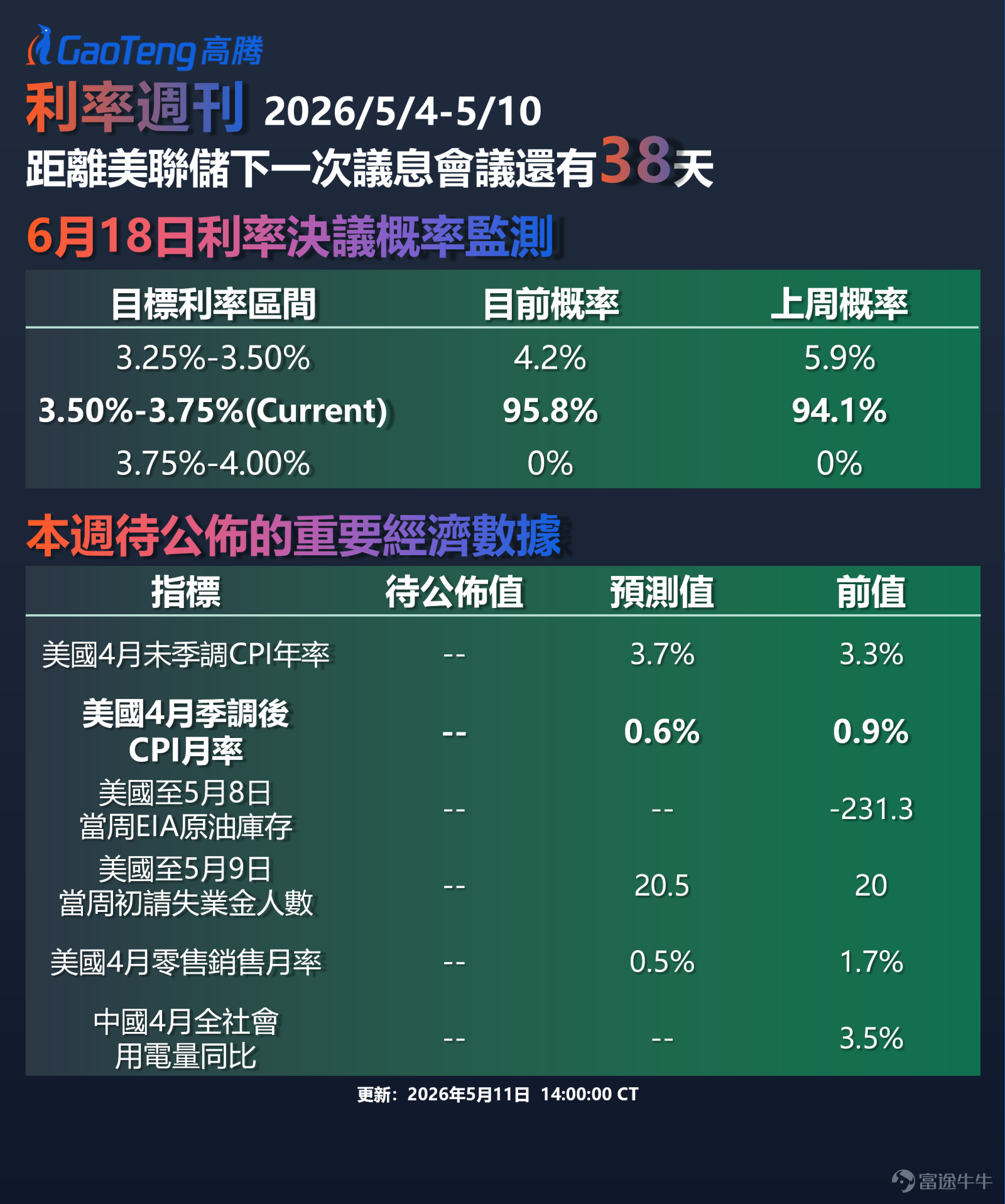
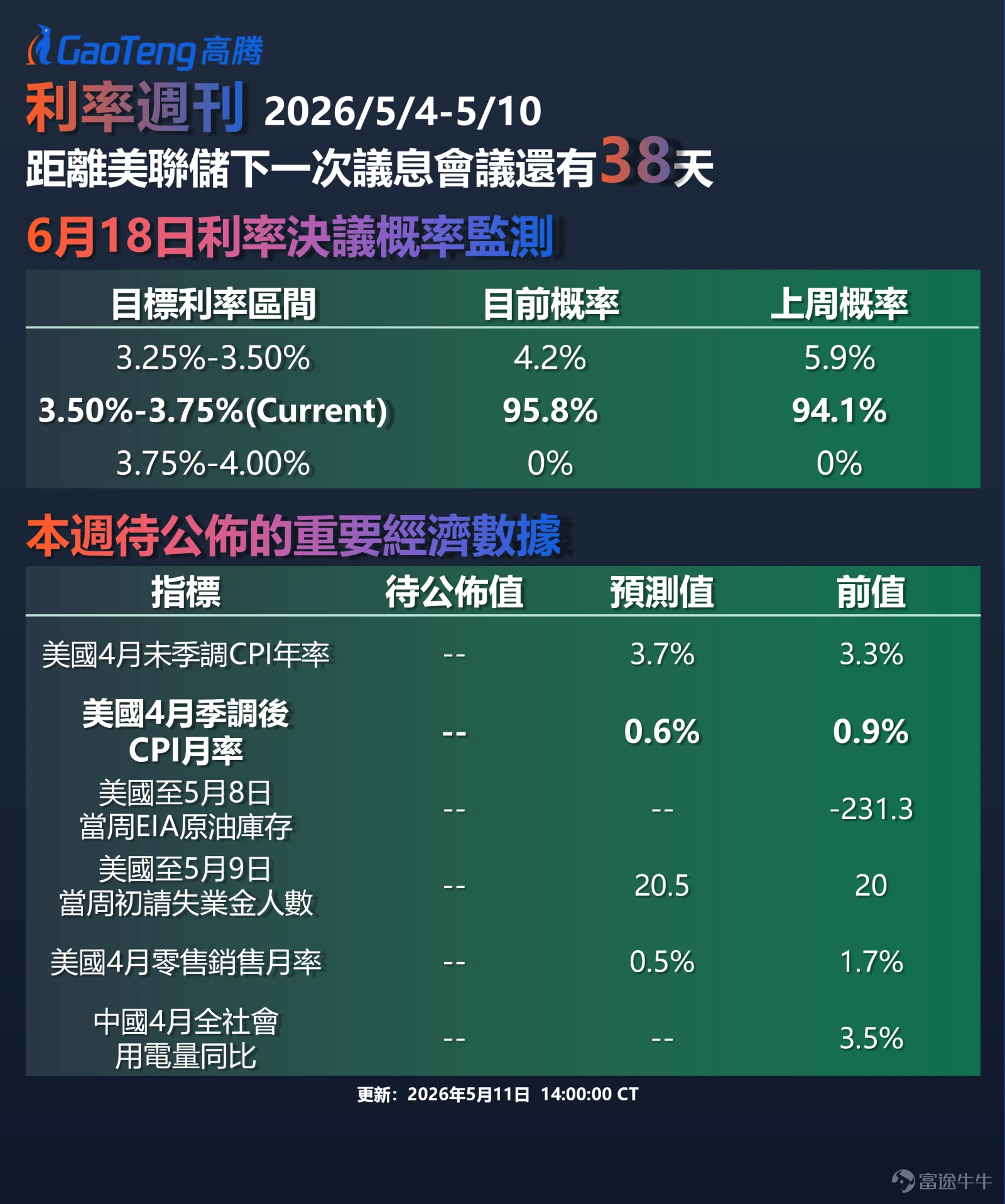
According toCME FedWatchData, days until next decision:FOMCmeeting still38 daysCurrently, the market expects that the probability of maintaining interest rates3.50%-3.75%unchanged in the Fed’s next rate decision is95.8%,Interest rate cutto3.25%-3.50%with a probability of4.2%。
Compared to one day ago, the probability of unchanged rates remains at 93.4%, with a rate cut probability of 6.6%, reflecting a slight decline in rate cut expectations; compared to a week ago, the probability of unchanged rates stands at 94.1%, with a rate cut probability of 5.9%, showing a minor rebound followed by another decline; compared to a month ago, the probability of unchanged rates is 96.1%, with a 2.0% chance of a rate hike to 3.75%-4.00%,CME now believes that expectations for a rate hike have completely faded.
The core driving factor behind the data change isNon-farmExceeding expectations causedInterest rate cutExpectations to cool, but ongoing tensions between the US and Iran could push upInflationExpectations, leaving the market in a dilemma of "eitherInterest rate cutWeakness orInterest rate hikeReluctance".
▌ US-Iran talks break down again: Oil price risks reignite
US-Iran talks took a critical turn last week.TrumpatMay 10publicly rejected Iran's latestCeasefireproposal, calling it 'completely unacceptable'; Iran quickly retaliated, stating that 'the proposal was not drafted to please Trump.'Israeli Prime Minister Netanyahuannounced that 'military action is not over,' with over 40 countries urgently convening to prepare forStrait of Hormuzescort missions.
In the proposal, Iran demanded that the US lift oil sales sanctions against Iran within 30 days,sanctions,unfreeze frozen assets, lift the maritime blockade, and emphasized Iran's sovereignty overStrait of Hormuz. Trump insisted that Iran must dismantle nuclear facilities and remove enriched uranium. The two sides' core demands reflect fundamental differences—Iran wants an immediate ceasefire and a return to normalcy; the US demands that Iran completely abandon its nuclear capabilities.
In terms of market impact, if no agreement is reached between the US and Iran, oil prices may return to$110The above has driven globalInflationexpectations.BarclaysAnalysts pointed out that for every $10 increase in oil prices,Inflationexpectations are that it will add approximately 0.3 to 0.5 percentage points.Goldman SachsThey believe that ifStrait of Hormuzcontinues to face resistance, a reduction of around 3 million barrels per day in global oil supply could push oil prices above120 US dollars。Capital Economicshas warned that the persistent risk premium from geopolitical tensions will make central banks more cautious in combatingInflationissues.
▌ Fed Dynamics: Internal Divisions Sharply Widen
Last week, Fed officials made密集表态, with positions ranging fromDovishuntilHawkishshowing clear divergence, reflecting unprecedented uncertainty in the current policy path.White House National Economic Council Director Hassettstated that there are no signs ofInflationrunaway inflation, and the Fed does not need toInterest rate hike, adding that 'because of Warsh, some believe we will seeInterest rate cut」。
Dovish
Federal Reserve Governor Milansuggests that cutting interest rates is appropriate, and forward guidance should be reduced to make policy more flexible. He also mentioned that Powell's reappointment would help ensure a smooth transition for the Fed chair.
New York Fed President Williamsindicated no immediate need,Interest rate hikeand has not yet seenInflationsigns of spreading to underlying trends. In the long term, the federal funds rate may be around3%, and the neutral interest rate (R-star) could be higher than recent low readings.
Dalyis committed to bringingInflationback to2%target; current monetary policy is 'slightly tight.' If the US-Iran conflict is resolved, it will put downward pressure onInflation; there are no signs that the spike in energy prices is pushing up medium- to long-termInflationexpectations.
Hawkish
Chicago Fed President GoolsbeeFrom the 'past'Dovish' to shift towardsHawkish, clearly indicating that monetary policymakers are keeping all options on the table regarding interest rates, and cannot considerInterest rate cutas the only viable policy option — 'otherInterest rate hikeoptions are also on the table.' He pointed out that the US-Iran war and AI are two majorInterest rate hikerisks.
St. Louis Fed President MoserstatedInflationSignificantly higher than2%the target, risks are tilting more towardsInflationthis direction rather than the employment side. There is significant uncertainty regarding the outlook for the U.S. economy and monetary policy.
Minneapolis Fed President Kashkari's stance is concise and clear - InflationIt remains too high.
Currently,FOMCThe distribution of voting members shows that the mainstream consensus still supports keeping interest rates unchanged, butHawkishVoices are gaining momentum — Goolsbee's shift in stance is symbolic, as he has long been regarded as aDovishrepresentative figure.
▌ April Non-Farm Payrolls Exceed Expectations: Labor Market Resilience Remains Unchanged
Bureau of Labor Statistics(BLS) released data onMay 9AprilNon-farmshowing an increase in employed population of115,000 people., much higher than the previous Dow Jones forecast of55,000 people, with an excess range of109%. In March,Non-farmthe number of employed people was revised up from the initially announcedby 178,000 peopleto185,000 people. As one of the most watched U.S. economic indicators last week, the AprilNon-farmdata significantly exceeded expectations, substantially weakening market expectations for the Fed's short-term actionsInterest rate cutby 2026 has been fully priced in.
Number of job openings in the U.S. in March6.866 million, indicating that labor market demand remains solid.ISMThe services payment price index remained flat at70.7, though lower than expected, a level above 70 still reflects ongoing pricing pressure in the services sector.ISMThe non-manufacturing index fell in April to53.6, slightly below expectations but still within the expansionary range.
▌ Historical Perspective: Market Reaction Patterns After Unexpected Nonfarm Payroll Data
Looking back at history,Non-farmBetter-than-expected employment data often triggers rapid adjustments in interest rate expectations. In July 2023,Non-farmwhen it exceeded expectations by 187,000 people, the market reacted to the likelihood ofInterest rate cutThe expectation plummeted from 50% to 20%. January 2024Non-farmAfter surpassing expectations by 353,000 people, US Treasury yields soared 15 basis points in a single day, and the interest rate futures market repriced the entire year overnight.Interest rate cutmagnitude.
Historical experience shows that stronger-than-expected resilience in employment data is often the biggest risk of the market overpricingInterest rate cut— 'Strong jobs mean rate cuts will be delayed.'Interest rate cutThe market has fully anticipated this, but if the coming months’Non-farmdata continues to exceed expectations, internal discussions at the FedInterest rate hikemay escalate from 'individual remarks' to 'formal agenda.'
▌ Scenario Analysis: Expectations for Policy Paths Under Different Scenarios
Scenario One
US-Iran agreement reached + Non-farmGradual decline: Oil prices dropped below $90,InflationExpectations cooling, the Fed may restartInterest rate cutdiscussions,Interest rate cutProbability rises to 15-20%.GoldRisk premium retreats, dollar slightly weakens.
Scenario Two
US-Iran stalemate + Non-farmContinued strength: Oil prices remain$100nearby,InflationPressure persists as the Fed maintains interest rates unchanged for a longer period, or evenInterest rate hikeProbability increased from 0% to 5-10%.GoldRange-bound trading continues with coexisting safe-haven demand and strong dollar constraints.
Scene Three
Escalation of US-Iran conflict + Economic slowdown: Oil prices break out$110, rising stagflation risks put the Fed in a policy dilemma — needing to fightInflationwhile also stabilizing growth. Keeping rates unchanged remains the most likely scenario, with asset volatility surging.
▌ Quick Snapshot of Market Sentiment
Investors are currently caught in a "double bind": On one hand,Inflationstubborn inflation and strong employment meanInterest rate cutbecomes out of reach,Interest rate hikerisks loom; on the other hand, the US-Iran situation continues to drive up risk aversion sentiment,Goldstill finds support. The market is caught between 'Inflationconcerns' and 'geopolitical risk panic,' asset volatility is expected to remain high.
▌ Other major central bank activities
People's Bank of China:May 9Conducted500 million yuan7-day tenorReverse repooperation, keeping the interest rate unchanged1.40%unchanged, consecutively18 monthsIncrease holdingGold, at the end of AprilGoldreserves were74.64 million ouncesIn April, the central bank's open market operations resulted in a net injection of government bonds40 billion yuan, guiding the price of funds to reasonably return to the central level.
ECB: Council member Nagel stated that if the situation in the Middle East does not significantly ease, there may be a rate hike in JuneInterest rate hike. Council member Kohler mentioned that ifInflationthe situation does not improve, they will consider taking action in the coming monthsInterest rate hike. Executive board member Schnabel said that if the energy shock expands, the ECB will have to take further measuresInterest rate hike. The money market has already lowered its December deposit rate expectations from2.71%the previous forecast2.62%, traders scaled back bets on the European Central BankInterest rate hike.
Bank of England: According to the Overnight Index Swap (OIS) curve, traders reduced their bets onBank of England interest rate hike, expectinga 49-basis-point interest rate hike by the end of the year.。
Bank of Japan: The meeting minutes showed that several committee members believed it was appropriate to keep policy rates at0.75%, fearing that rising oil prices could lead toInflationan increase again. Japanese households' long-termInflationinflation expectations rose to the highest level in at least 20 years.
The Reserve Bank of Australia:May 5Announcedby 25 basis pointsto4.35%(Previous value4.10%), to curb the rising pressure from the situation in the Middle East.InflationPressure.The Reserve Bank of AustraliaThe second quarter is expected toCPIbe 4.8%, and the fourth quarter at 4.0%.
▌ Market Reaction: Risk-off sentiment dominates
Last week, the commodities market showed a divergence between 'falling crude oil' and 'strengtheningGold': $Brent Last Day Financial Futures Current Contract (AUG6) (BZcurrent.US)$ Closing at$100.49, weekly decline7.66%, after a surge of 15.25% the previous week; $Crude Oil Futures (AUG6) (CLmain.US)$ closed at $94.68, weekly decline7.63%; $Gold Futures (AUG6) (GCmain.US)$ Closing at4,723.7 dollars, weekly increase 2.12%, intraday high reached $4,775.2.
In terms of gold: Safe-haven demand supports gold prices to rise, but after Trump rejected Iran's peace talksUS Dollar IndexOpened higher, Spot goldopened lower by nearly20 US dollars。GoldThe negative correlation logic with the US dollar remains valid in risk-off mode, but the volatility of both has retreated compared to earlier.
On the crude oil front:WTI Crude OilAfter posting a single-week gain of 12.95%, a technical pullback occurred last week. However, the breakdown of US-Iran talks prompted WTI to surge nearly3%, the prior weekBrent crude oilfrom the high of115.25 US dollarsPull back to$100Key levels, with both bulls and bears fiercely battling at$100Integer positions. If the negotiations remain deadlocked, oil prices may return to$110Above.
Interest rate market: Bond traders increase bets that the Federal Reserve's next move will beInterest rate hikeRather thanInterest rate cut, Swap contracts linked to the central bank’s interest rate decisions indicate over 50% probability ofInterest rate cutPreviouslyInterest rate hikeThe U.S. interest rate futures market slightly lowered its expected probability forInterest rate hikebefore 2026. The usage scale of the Federal Reserve's OvernightReverse repoReverse Repo facility (RRP) remained low,May 8at $787 million, indicating ample liquidity conditions.
Summary and Outlook
Investors should closely monitor the following key catalysts: 1)May 13US AprilCPIdata——InflationWhether the data exceeds expectations will directly impact June'sFOMCdecision-making path; 2)May 13-15Trump’s visit to China——New developments in US-China relations may alter market risk appetite; 3) Follow-up progress in US-Iran negotiations——Strait of HormuzThe status of navigation will determine the medium-term trend of oil prices and the globalInflationoutlook.
Risk Disclaimer: The above content only represents the author's view. It does not represent any position or investment advice of Futu. Futu makes no representation or warranty.Read more

Comments
to post a comment
1
1