English
Back
Open Account
The S&P 500 has risen for seven consecutive weeks—should you chase the rally or take profits?

慢慢变富的牛牛
joined discussion · ·

A Defensive Choice for Global Asset Allocation? A Comprehensive Review of US Bond ETFs, In-Depth Analysis of Mainstream Products

With frequent stock market fluctuations and the unpredictable rise and fall of equity assets, stabilizing an investment portfolio can be challenging. However, there is a solution suited to the vast majority of investors — US Bond ETFs. These ETFs have low entry barriers, flexible trading options, and ample liquidity, making them accessible for both ordinary individual investors and high-net-worth investors seeking steady growth.
But faced with a dizzying array of US Bond ETF options, many fellow investors likely want to understand:What are the mainstream US Bond ETF products on the market? What are the differences between various US Bond ETFs? What allocation strategies work best for US Bond ETFs? What are the core investment values and potential risks of US Bond ETFs?
Based on this, this article will comprehensively dissect the investment logic behind US Bond ETFs, helping readers clarify their thinking, avoid common pitfalls, and optimize overseas fixed-income allocation.
1. Mainstream US Bond ETFs: Categorized by Duration, Tailored to Different Return Objectives
US Bond ETFs are primarily classified by duration (remaining maturity), with significant differences in interest rate sensitivity, return stability, and volatility across different durations. They can be divided into four categories, covering all demand scenarios from cash alternatives to high-elasticity returns.
With frequent stock market fluctuations and the unpredictable rise and fall of equity assets, stabilizing an investment portfolio can be challenging. However, there is a solution suited to the vast majority of investors — US Bond ETFs. These ETFs have low entry barriers, flexible trading options, and ample liquidity, making them accessible for both ordinary individual investors and high-net-worth investors seeking steady growth. But faced with a dizzying array of US Bond ETF options, many fellow investors likely want to understand:What are the mainstream US Bond ETF products on the market? What are the differences between various US Bond ETFs? What allocation strategies work best for US Bond ETFs? What are the core investment values and potential risks of US Bond ETFs? Based on this, this article will comprehensively dissect the investment logic behind US Bond ETFs, helping readers clarify their thinking, avoid common pitfalls, and optimize overseas fixed-income allocation. 1. Mainstream US Bond ETFs: Categorized by Duration, Tailored to Different Return Objectives US Bond ETFs are primarily classified by duration (remaining maturity), with significant differences in interest rate sensitivity, return stability, and volatility across different durations. They can be divided into four categories, covering all demand scenarios from cash alternatives to high-elasticity returns. (1) Short-Term US Bond ETFs (Duration ≤3 years, Cash Alternatives, Low Volatility) These ETFs invest in 0-3 year US Treasury bonds, offering short duration, minimal interest rate risk, and stable dividends. They serve as a quality alternative to dollar cash or money market funds, ideal for short-term parking of funds and liquidity management. The top five largest underlying assets include: $iShares 0-3 Month Treasury Bond ETF (SGOV.US)$、 ��...
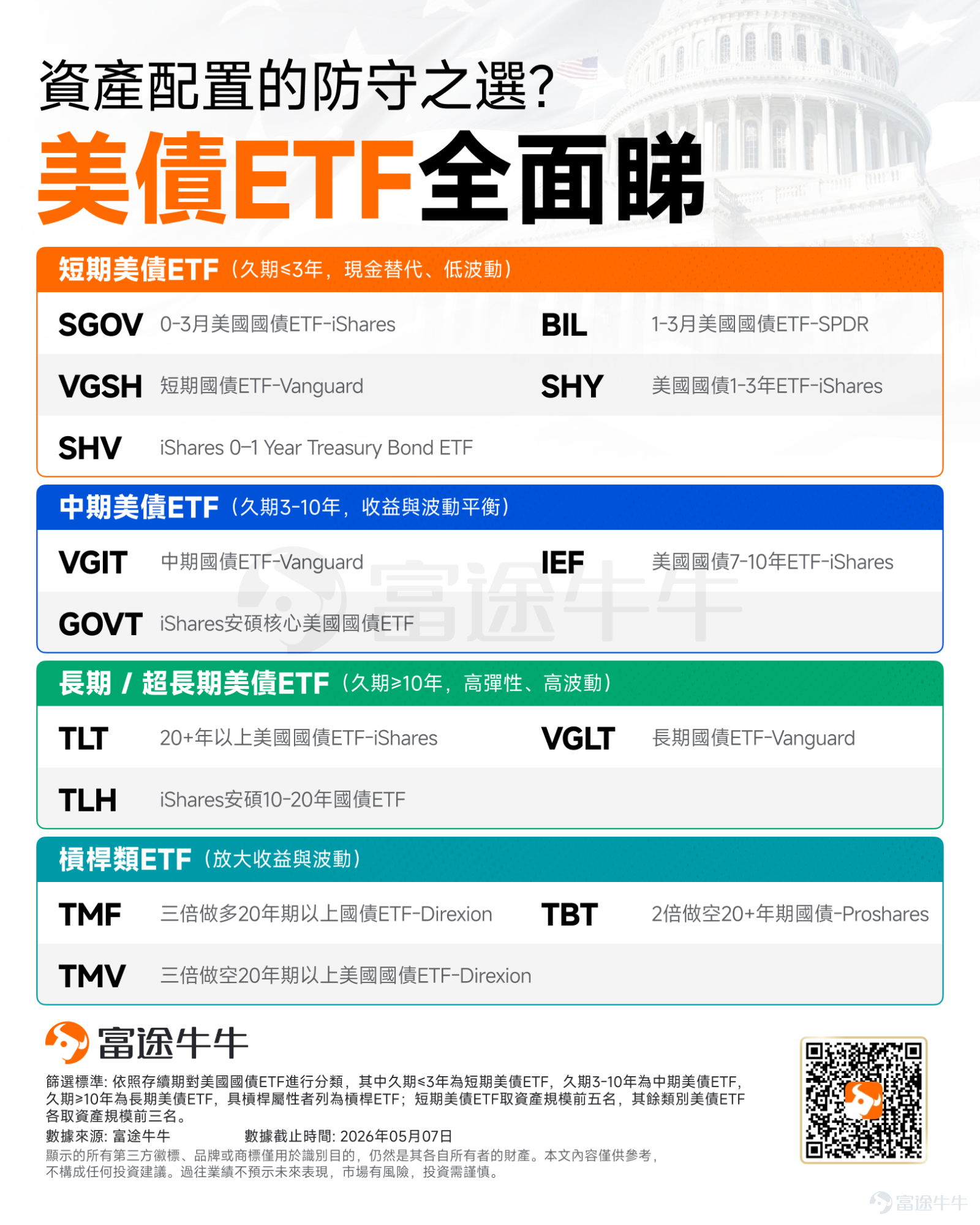
(1) Short-Term US Bond ETFs (Duration ≤3 years, Cash Alternatives, Low Volatility)
These ETFs invest in 0-3 year US Treasury bonds, offering short duration, minimal interest rate risk, and stable dividends. They serve as a quality alternative to dollar cash or money market funds, ideal for short-term parking of funds and liquidity management.
The top five largest underlying assets include:
Among these, SGOV, BIL, and SHV can serve as 'cash equivalents.'These three ETFs focus on holding short-term US Treasury bonds maturing within three months, essentially equivalent to holding cash, but with interest rates higher than demand deposits. The interest is almost unaffected by fluctuations in interest rates. The yield curve is extremely smooth, with minimal risk of losses.
SGOV has a low fee, the largest asset base, and better liquidity. BIL is one of the oldest short-term Treasury ETFs, established in 2007, and although its fees are slightly higher, its market position is solid. SHV holds Treasury bonds maturing within one year, with a slightly longer duration compared to the other two ETFs.
With frequent stock market fluctuations and the unpredictable rise and fall of equity assets, stabilizing an investment portfolio can be challenging. However, there is a solution suited to the vast majority of investors — US Bond ETFs. These ETFs have low entry barriers, flexible trading options, and ample liquidity, making them accessible for both ordinary individual investors and high-net-worth investors seeking steady growth. But faced with a dizzying array of US Bond ETF options, many fellow investors likely want to understand:What are the mainstream US Bond ETF products on the market? What are the differences between various US Bond ETFs? What allocation strategies work best for US Bond ETFs? What are the core investment values and potential risks of US Bond ETFs? Based on this, this article will comprehensively dissect the investment logic behind US Bond ETFs, helping readers clarify their thinking, avoid common pitfalls, and optimize overseas fixed-income allocation. 1. Mainstream US Bond ETFs: Categorized by Duration, Tailored to Different Return Objectives US Bond ETFs are primarily classified by duration (remaining maturity), with significant differences in interest rate sensitivity, return stability, and volatility across different durations. They can be divided into four categories, covering all demand scenarios from cash alternatives to high-elasticity returns. (1) Short-Term US Bond ETFs (Duration ≤3 years, Cash Alternatives, Low Volatility) These ETFs invest in 0-3 year US Treasury bonds, offering short duration, minimal interest rate risk, and stable dividends. They serve as a quality alternative to dollar cash or money market funds, ideal for short-term parking of funds and liquidity management. The top five largest underlying assets include: $iShares 0-3 Month Treasury Bond ETF (SGOV.US)$、 ��...
VGSH and SHY can be considered 'short-term income-generating assets,' investing in Treasury bonds maturing in 1-3 years, accepting some predictable volatility risks for higher yields.Both have durations of around 1.9 years, meaning that if market interest rates rise by 1%, their prices may fall by approximately 1.9%. VGSH has the lowest fee (0.03%), making it the cheapest choice among the five short-term US Treasury ETFs, while SHY's fee is 0.15%.
With frequent stock market fluctuations and the unpredictable rise and fall of equity assets, stabilizing an investment portfolio can be challenging. However, there is a solution suited to the vast majority of investors — US Bond ETFs. These ETFs have low entry barriers, flexible trading options, and ample liquidity, making them accessible for both ordinary individual investors and high-net-worth investors seeking steady growth. But faced with a dizzying array of US Bond ETF options, many fellow investors likely want to understand:What are the mainstream US Bond ETF products on the market? What are the differences between various US Bond ETFs? What allocation strategies work best for US Bond ETFs? What are the core investment values and potential risks of US Bond ETFs? Based on this, this article will comprehensively dissect the investment logic behind US Bond ETFs, helping readers clarify their thinking, avoid common pitfalls, and optimize overseas fixed-income allocation. 1. Mainstream US Bond ETFs: Categorized by Duration, Tailored to Different Return Objectives US Bond ETFs are primarily classified by duration (remaining maturity), with significant differences in interest rate sensitivity, return stability, and volatility across different durations. They can be divided into four categories, covering all demand scenarios from cash alternatives to high-elasticity returns. (1) Short-Term US Bond ETFs (Duration ≤3 years, Cash Alternatives, Low Volatility) These ETFs invest in 0-3 year US Treasury bonds, offering short duration, minimal interest rate risk, and stable dividends. They serve as a quality alternative to dollar cash or money market funds, ideal for short-term parking of funds and liquidity management. The top five largest underlying assets include: $iShares 0-3 Month Treasury Bond ETF (SGOV.US)$、 ��...
(II) Medium-term US Treasury ETFs (duration 3-10 years, balancing returns and volatility)
As the core mainstay of US Treasury ETFs, medium-term US Treasury ETFs have moderate durations, mild interest rate sensitivity, and balance coupon income with price stability, suitable for neutral interest rate environments, forming the cornerstone of a stable allocation strategy.
The top three largest funds include:
Among them, VGIT and IEF invest purely in medium-term US Treasury bonds, making them ideal tools for constructing 'barbell' or 'bullet' strategies on the yield curve.
VGIT invests in Treasury bonds with maturities of 3-10 years, has the lowest fee (0.03%), and is the cheapest option among the three. For long-term core positions, this represents a significant cost advantage.Suitable for investors seeking mid-term US Treasury exposure at the lowest cost as part of their asset allocation.
With frequent stock market fluctuations and the unpredictable rise and fall of equity assets, stabilizing an investment portfolio can be challenging. However, there is a solution suited to the vast majority of investors — US Bond ETFs. These ETFs have low entry barriers, flexible trading options, and ample liquidity, making them accessible for both ordinary individual investors and high-net-worth investors seeking steady growth. But faced with a dizzying array of US Bond ETF options, many fellow investors likely want to understand:What are the mainstream US Bond ETF products on the market? What are the differences between various US Bond ETFs? What allocation strategies work best for US Bond ETFs? What are the core investment values and potential risks of US Bond ETFs? Based on this, this article will comprehensively dissect the investment logic behind US Bond ETFs, helping readers clarify their thinking, avoid common pitfalls, and optimize overseas fixed-income allocation. 1. Mainstream US Bond ETFs: Categorized by Duration, Tailored to Different Return Objectives US Bond ETFs are primarily classified by duration (remaining maturity), with significant differences in interest rate sensitivity, return stability, and volatility across different durations. They can be divided into four categories, covering all demand scenarios from cash alternatives to high-elasticity returns. (1) Short-Term US Bond ETFs (Duration ≤3 years, Cash Alternatives, Low Volatility) These ETFs invest in 0-3 year US Treasury bonds, offering short duration, minimal interest rate risk, and stable dividends. They serve as a quality alternative to dollar cash or money market funds, ideal for short-term parking of funds and liquidity management. The top five largest underlying assets include: $iShares 0-3 Month Treasury Bond ETF (SGOV.US)$、 ��...
IEF specifically invests in 7-10 year Treasuries, with a longer duration than VGIT.This means it is more sensitive to interest rate changes. If interest rates decline, IEF will rise more than VGIT; but if interest rates increase, IEF will fall more than VGIT. Suitable for investors who want precise yield curve forecasts and actively manage duration.
With frequent stock market fluctuations and the unpredictable rise and fall of equity assets, stabilizing an investment portfolio can be challenging. However, there is a solution suited to the vast majority of investors — US Bond ETFs. These ETFs have low entry barriers, flexible trading options, and ample liquidity, making them accessible for both ordinary individual investors and high-net-worth investors seeking steady growth. But faced with a dizzying array of US Bond ETF options, many fellow investors likely want to understand:What are the mainstream US Bond ETF products on the market? What are the differences between various US Bond ETFs? What allocation strategies work best for US Bond ETFs? What are the core investment values and potential risks of US Bond ETFs? Based on this, this article will comprehensively dissect the investment logic behind US Bond ETFs, helping readers clarify their thinking, avoid common pitfalls, and optimize overseas fixed-income allocation. 1. Mainstream US Bond ETFs: Categorized by Duration, Tailored to Different Return Objectives US Bond ETFs are primarily classified by duration (remaining maturity), with significant differences in interest rate sensitivity, return stability, and volatility across different durations. They can be divided into four categories, covering all demand scenarios from cash alternatives to high-elasticity returns. (1) Short-Term US Bond ETFs (Duration ≤3 years, Cash Alternatives, Low Volatility) These ETFs invest in 0-3 year US Treasury bonds, offering short duration, minimal interest rate risk, and stable dividends. They serve as a quality alternative to dollar cash or money market funds, ideal for short-term parking of funds and liquidity management. The top five largest underlying assets include: $iShares 0-3 Month Treasury Bond ETF (SGOV.US)$、 ��...
GOVT's holdings cover Treasury bonds ranging from 1 year to over 30 years, serving as a microcosm of the entire US Treasury market.It is not concentrated in 3-10 years like VGIT, nor in 7-10 years like IEF. It holds some short-term bonds (to reduce duration/risk) and some long-term bonds (to increase yield), so its duration and yield are between VGIT and IEF. Suitable for investors looking to 'one-click allocate' across the entire US Treasury market without worrying about duration selection.
(III) Long/ultra-long US Treasury ETFs (Duration ≥ 10 years, high elasticity, high volatility)
Long/ultra-long US Treasury ETFsFocuses on Treasuries with maturities over 10 years, characterized by long durations and extreme sensitivity to interest rate changes. It can generate substantial capital gains during rate-cutting cycles but may experience significant drawdowns during rate-hiking cycles. Suitable for capturing interest rate inflection points or enhancing portfolio elasticity.
The top three largest funds include:
TLT is the largest and most liquid product among long-term US Treasury ETFs, exclusively holding US long-term Treasuries with remaining maturities of no less than 20 years, targeting only the far end of the yield curve.This means it is the most sensitive to interest rate changes – significant gains during rate-cutting cycles and larger declines during rate-hiking cycles.Suitable for investors seeking pure exposure to ultra-long-term government bonds, actively betting on substantial interest rate declines, and also the preferred instrument for intraday trading and options strategies.
With frequent stock market fluctuations and the unpredictable rise and fall of equity assets, stabilizing an investment portfolio can be challenging. However, there is a solution suited to the vast majority of investors — US Bond ETFs. These ETFs have low entry barriers, flexible trading options, and ample liquidity, making them accessible for both ordinary individual investors and high-net-worth investors seeking steady growth. But faced with a dizzying array of US Bond ETF options, many fellow investors likely want to understand:What are the mainstream US Bond ETF products on the market? What are the differences between various US Bond ETFs? What allocation strategies work best for US Bond ETFs? What are the core investment values and potential risks of US Bond ETFs? Based on this, this article will comprehensively dissect the investment logic behind US Bond ETFs, helping readers clarify their thinking, avoid common pitfalls, and optimize overseas fixed-income allocation. 1. Mainstream US Bond ETFs: Categorized by Duration, Tailored to Different Return Objectives US Bond ETFs are primarily classified by duration (remaining maturity), with significant differences in interest rate sensitivity, return stability, and volatility across different durations. They can be divided into four categories, covering all demand scenarios from cash alternatives to high-elasticity returns. (1) Short-Term US Bond ETFs (Duration ≤3 years, Cash Alternatives, Low Volatility) These ETFs invest in 0-3 year US Treasury bonds, offering short duration, minimal interest rate risk, and stable dividends. They serve as a quality alternative to dollar cash or money market funds, ideal for short-term parking of funds and liquidity management. The top five largest underlying assets include: $iShares 0-3 Month Treasury Bond ETF (SGOV.US)$、 ��...
VGLT covers all long-term government bonds with maturities of 10 years or more, offering a broader range than TLT.Because it includes relatively 'shorter' long-term bonds (10-20 years), its effective duration is slightly lower than TLT (with slightly less interest rate risk).The biggest advantage of VGLT is its expense ratio of only 0.04%, the lowest among the three. Its compounding benefit from long-term holding is the most pronounced.Suitable for investors who want exposure to long-term government bonds but are concerned about extreme duration risk, as well as long-term holders who prioritize expense ratios.
With frequent stock market fluctuations and the unpredictable rise and fall of equity assets, stabilizing an investment portfolio can be challenging. However, there is a solution suited to the vast majority of investors — US Bond ETFs. These ETFs have low entry barriers, flexible trading options, and ample liquidity, making them accessible for both ordinary individual investors and high-net-worth investors seeking steady growth. But faced with a dizzying array of US Bond ETF options, many fellow investors likely want to understand:What are the mainstream US Bond ETF products on the market? What are the differences between various US Bond ETFs? What allocation strategies work best for US Bond ETFs? What are the core investment values and potential risks of US Bond ETFs? Based on this, this article will comprehensively dissect the investment logic behind US Bond ETFs, helping readers clarify their thinking, avoid common pitfalls, and optimize overseas fixed-income allocation. 1. Mainstream US Bond ETFs: Categorized by Duration, Tailored to Different Return Objectives US Bond ETFs are primarily classified by duration (remaining maturity), with significant differences in interest rate sensitivity, return stability, and volatility across different durations. They can be divided into four categories, covering all demand scenarios from cash alternatives to high-elasticity returns. (1) Short-Term US Bond ETFs (Duration ≤3 years, Cash Alternatives, Low Volatility) These ETFs invest in 0-3 year US Treasury bonds, offering short duration, minimal interest rate risk, and stable dividends. They serve as a quality alternative to dollar cash or money market funds, ideal for short-term parking of funds and liquidity management. The top five largest underlying assets include: $iShares 0-3 Month Treasury Bond ETF (SGOV.US)$、 ��...
TLH focuses on government bonds maturing in 10-20 years, showing the lowest sensitivity to interest rates among the three.During periods of rising interest rates, its drawdown is typically slightly smaller than the other two; however, during periods of declining interest rates, its gains also lag behind. It suits defensive investors who believe long-term interest rates may rise but still wish to allocate to long-term bonds.
With frequent stock market fluctuations and the unpredictable rise and fall of equity assets, stabilizing an investment portfolio can be challenging. However, there is a solution suited to the vast majority of investors — US Bond ETFs. These ETFs have low entry barriers, flexible trading options, and ample liquidity, making them accessible for both ordinary individual investors and high-net-worth investors seeking steady growth. But faced with a dizzying array of US Bond ETF options, many fellow investors likely want to understand:What are the mainstream US Bond ETF products on the market? What are the differences between various US Bond ETFs? What allocation strategies work best for US Bond ETFs? What are the core investment values and potential risks of US Bond ETFs? Based on this, this article will comprehensively dissect the investment logic behind US Bond ETFs, helping readers clarify their thinking, avoid common pitfalls, and optimize overseas fixed-income allocation. 1. Mainstream US Bond ETFs: Categorized by Duration, Tailored to Different Return Objectives US Bond ETFs are primarily classified by duration (remaining maturity), with significant differences in interest rate sensitivity, return stability, and volatility across different durations. They can be divided into four categories, covering all demand scenarios from cash alternatives to high-elasticity returns. (1) Short-Term US Bond ETFs (Duration ≤3 years, Cash Alternatives, Low Volatility) These ETFs invest in 0-3 year US Treasury bonds, offering short duration, minimal interest rate risk, and stable dividends. They serve as a quality alternative to dollar cash or money market funds, ideal for short-term parking of funds and liquidity management. The top five largest underlying assets include: $iShares 0-3 Month Treasury Bond ETF (SGOV.US)$、 ��...
(IV) Leveraged US Bond ETFs (High elasticity, high volatility)
Leveraged US bonds amplify both the returns and volatility of long-term bonds, making them suitable only for short-term trading and not for long-term allocation.Since leveraged US Treasury ETFs track the daily leveraged returns rather than long-term performance, this means that in volatile markets, you may incur losses even if the price ultimately remains unchanged.
Here's a specific example:
- Day 1: Long-term US Treasuries rise by 5% → 2x leveraged ETF should increase by 10%
- Day 2: Long-term US Treasuries fall by 4.76% → 2x leveraged ETF should drop by 9.52%
- After two days, the price of US Treasuries returns to its starting point, but the net asset value of the 2x leveraged ETF falls by approximately 0.47%
This is what's known as 'volatility decay' or 'path dependency' – leveraged ETFs naturally erode in volatile markets, and the probability of losses from long-term holding increases.Moreover, the long-term US Treasuries held by leveraged US Treasury ETFs are among the most interest rate-sensitive instruments; with leverage, daily fluctuations can reach 10%-20%. If the directional judgment is wrong, significant losses may occur in a short period. Therefore, such products are only suitable for experienced short-term traders and not for buy-and-hold strategies.
The top three largest funds include:
Among them, TMF is a long tool,which trades on the rise of US Treasury prices (i.e., falling yields), offering 3x daily positive returns. If long-term US Treasury prices increase by 1%, TMF should rise by about 3%.It suits leveraged traders expecting interest rates to decline and wanting to go long on US Treasuries.
With frequent stock market fluctuations and the unpredictable rise and fall of equity assets, stabilizing an investment portfolio can be challenging. However, there is a solution suited to the vast majority of investors — US Bond ETFs. These ETFs have low entry barriers, flexible trading options, and ample liquidity, making them accessible for both ordinary individual investors and high-net-worth investors seeking steady growth. But faced with a dizzying array of US Bond ETF options, many fellow investors likely want to understand:What are the mainstream US Bond ETF products on the market? What are the differences between various US Bond ETFs? What allocation strategies work best for US Bond ETFs? What are the core investment values and potential risks of US Bond ETFs? Based on this, this article will comprehensively dissect the investment logic behind US Bond ETFs, helping readers clarify their thinking, avoid common pitfalls, and optimize overseas fixed-income allocation. 1. Mainstream US Bond ETFs: Categorized by Duration, Tailored to Different Return Objectives US Bond ETFs are primarily classified by duration (remaining maturity), with significant differences in interest rate sensitivity, return stability, and volatility across different durations. They can be divided into four categories, covering all demand scenarios from cash alternatives to high-elasticity returns. (1) Short-Term US Bond ETFs (Duration ≤3 years, Cash Alternatives, Low Volatility) These ETFs invest in 0-3 year US Treasury bonds, offering short duration, minimal interest rate risk, and stable dividends. They serve as a quality alternative to dollar cash or money market funds, ideal for short-term parking of funds and liquidity management. The top five largest underlying assets include: $iShares 0-3 Month Treasury Bond ETF (SGOV.US)$、 ��...
TBT and TMV are short-selling tools that bet on a decline in U.S. Treasury prices (i.e., rising yields). Among them, TMV is the most aggressive shorting choice.It provides three times the inverse daily return. If long-term U.S. Treasury prices fall by 1%, TMV should rise by approximately 3%. With the highest leverage, TMV offers the greatest potential returns but also carries the highest risk, making it suitable for highly confident, risk-tolerant short-term traders expecting a sharp rise in interest rates in the near term.
TBT is a relatively moderate short-selling choice, offering two times the inverse daily return.If long-term U.S. Treasury prices fall by 1%, TBT should rise by about 2%. With lower leverage, TBT exhibits less volatility compared to TMV, making it suitable for traders who believe interest rates will rise but want to avoid the extreme fluctuations of triple leverage.
With frequent stock market fluctuations and the unpredictable rise and fall of equity assets, stabilizing an investment portfolio can be challenging. However, there is a solution suited to the vast majority of investors — US Bond ETFs. These ETFs have low entry barriers, flexible trading options, and ample liquidity, making them accessible for both ordinary individual investors and high-net-worth investors seeking steady growth. But faced with a dizzying array of US Bond ETF options, many fellow investors likely want to understand:What are the mainstream US Bond ETF products on the market? What are the differences between various US Bond ETFs? What allocation strategies work best for US Bond ETFs? What are the core investment values and potential risks of US Bond ETFs? Based on this, this article will comprehensively dissect the investment logic behind US Bond ETFs, helping readers clarify their thinking, avoid common pitfalls, and optimize overseas fixed-income allocation. 1. Mainstream US Bond ETFs: Categorized by Duration, Tailored to Different Return Objectives US Bond ETFs are primarily classified by duration (remaining maturity), with significant differences in interest rate sensitivity, return stability, and volatility across different durations. They can be divided into four categories, covering all demand scenarios from cash alternatives to high-elasticity returns. (1) Short-Term US Bond ETFs (Duration ≤3 years, Cash Alternatives, Low Volatility) These ETFs invest in 0-3 year US Treasury bonds, offering short duration, minimal interest rate risk, and stable dividends. They serve as a quality alternative to dollar cash or money market funds, ideal for short-term parking of funds and liquidity management. The top five largest underlying assets include: $iShares 0-3 Month Treasury Bond ETF (SGOV.US)$、 ��...
II. Core + Satellite Allocation Strategy: Balancing Risk and Return
The 'Core + Satellite' strategy is a classic approach for U.S. Treasury ETF allocation. The core position focuses on stability, while the satellite position enhances returns, locking in baseline profits while capturing excess returns. It suits different risk appetites, is simple to execute, and easy to maintain over the long term.
Core logic of the strategy:
Core position (70%-80%): Allocate to short- and medium-term U.S. Treasury ETFs, emphasizingstable coupon payments, low volatility, and high liquidity., serving as the 'ballast' of the portfolio, resisting interest rate fluctuation impacts and providing continuous cash flow.
Satellite allocation (20%-30%): Allocate long-term US Treasury ETFs + leveraged ETFs, focusing onflexible returns and risk hedging, capturing capital gains during the rate-cutting cycle, while hedging against inflation and downside risks in the equity market.
Clients with different risk appetites can flexibly adjust their allocation ratios.Conservative clients may consider increasing the proportion of core positions, prioritizing low-volatility assets, avoiding leveraged ETFs, and strictly controlling drawdowns. Balanced clients may consider mid-term instruments as the main focus, supplemented by long-term bonds, balancing returns and volatility. Aggressive clients may trade leveraged ETFs based on their interest rate outlook.
III. The Core Role of Allocating US Treasury ETFs: Diversified Value, Empowering Portfolios
US Treasury ETFs are far from being a simple fixed-income tool; they play four key roles in global asset allocation: stabilizing returns, mitigating volatility, guarding against inflation, and enhancing diversification, making them an essential piece for high-net-worth client portfolios.
In the current high-interest-rate environment under the Federal Reserve, $U.S. 30-Year Treasury Bonds Yield (US30Y.BD)$ The yield is approaching 5%, with the annualized dividend rate of medium- to short-term US Treasury ETFs reaching 4%-5%. These ETFs offer stable dividends and pay out monthly or quarterly, serving as a supplement to cash flow.
With frequent stock market fluctuations and the unpredictable rise and fall of equity assets, stabilizing an investment portfolio can be challenging. However, there is a solution suited to the vast majority of investors — US Bond ETFs. These ETFs have low entry barriers, flexible trading options, and ample liquidity, making them accessible for both ordinary individual investors and high-net-worth investors seeking steady growth. But faced with a dizzying array of US Bond ETF options, many fellow investors likely want to understand:What are the mainstream US Bond ETF products on the market? What are the differences between various US Bond ETFs? What allocation strategies work best for US Bond ETFs? What are the core investment values and potential risks of US Bond ETFs? Based on this, this article will comprehensively dissect the investment logic behind US Bond ETFs, helping readers clarify their thinking, avoid common pitfalls, and optimize overseas fixed-income allocation. 1. Mainstream US Bond ETFs: Categorized by Duration, Tailored to Different Return Objectives US Bond ETFs are primarily classified by duration (remaining maturity), with significant differences in interest rate sensitivity, return stability, and volatility across different durations. They can be divided into four categories, covering all demand scenarios from cash alternatives to high-elasticity returns. (1) Short-Term US Bond ETFs (Duration ≤3 years, Cash Alternatives, Low Volatility) These ETFs invest in 0-3 year US Treasury bonds, offering short duration, minimal interest rate risk, and stable dividends. They serve as a quality alternative to dollar cash or money market funds, ideal for short-term parking of funds and liquidity management. The top five largest underlying assets include: $iShares 0-3 Month Treasury Bond ETF (SGOV.US)$、 ��...
US Treasuries have a low correlation with US stocks. When the equity market experiences significant declines, the price of US Treasuries is likely to rise, providing a hedge against stock drawdowns, reducing overall portfolio volatility, and enhancing risk resistance.Investing solely in stocks can make one susceptible to domestic economic cycles and policy fluctuations. Allocating to US Treasury ETFs allows access to the world's largest fixed-income market, diversifying geographic risks and reducing reliance on a single market.
Short-term US Treasury ETFs can serve as an alternative to USD demand deposits, allowing for buying and selling at any time without a lock-up period, meeting the needs for short-term parking of large funds and liquidity buffering.
US Treasury ETFs are also suitable for long-term allocation.Interest rates follow a cyclical pattern of 'rate hikes - rate cuts,' making short-term fluctuations difficult to predict. However, over the long term, the coupon yield of US Treasury ETFs can cover most price volatility. Holding for more than three years significantly improves the stability of annualized returns, avoiding frequent timing errors.
IV. Main Risks of US Treasury ETFs: Rational Understanding, Strict Control of Risk Exposure
Although US Treasury ETFs are known for their stability, they are not risk-free assets, and the following risks should be noted when allocating them.
1. Interest Rate Risk (the most critical risk)
Bond prices and market interest ratesInverse movement: When interest rates rise, the attractiveness of existing bonds decreases, prices fall, and ETF net value retraces; when interest rates decline, prices increase, generating capital gains. The longer the duration, the higher the interest rate sensitivity, and the greater the volatility.
2. Exchange rate risk (specific risk for RMB investors)
US bond ETFs are denominated in USD, and RMB investors must bear the risk of USD exchange rate fluctuations: when the USD falls, RMB-denominated returns are eroded; when the USD rises, additional exchange rate gains are earned. Short-term exchange rate fluctuations may offset coupon returns, while long-term risks need to be smoothed out through phased position building or hedging tools.
3. Volatility risk (specific risk for long-duration assets)
The volatility of long-term US bond ETFs is close to that of stocks, and they are prone to consecutive declines during interest rate hike cycles. Aggressive allocations require strict position control to avoid excessive concentration in a single asset.
4. Liquidity risk (risk specific to niche assets)
Niche US bond ETFs have small scales and low average daily trading volumes, leading to wide bid-ask spreads during large transactions, often resulting in 'expensive buys and cheap sells.' In extreme market conditions, it may be difficult to liquidate positions promptly.It is advisable to prioritize assets with larger scales and active average daily trading volumes.
5. Leverage risk
Leveraged ETFs amplify long-term volatility, and holding them long-term may lead to losses.
Fifth, Summary
US bond ETFs are the 'stabilizer' of global asset allocation. In the short term, they can serve as a cash alternative, offering high-yield liquidity. In the medium term, they balance returns with volatility and hedge against equity risks. Mainstream US bond ETFs cover short, medium, and long durations as well as leveraged ETFs. The 'core + satellite' strategy is simple to implement and suitable for investors with different risk appetites.

Fellow investors, do you have the habit of allocating US bond ETFs? What type of US bonds do you mainly allocate?
How to find your ideal US bond ETF? Open the NiuNiu App and make good use of the thematic ETF feature!
Path guidance: Market > ETF > Thematic ETF > US Treasury ETF. Check out over 60 ETFs now!
With frequent stock market fluctuations and the unpredictable rise and fall of equity assets, stabilizing an investment portfolio can be challenging. However, there is a solution suited to the vast majority of investors — US Bond ETFs. These ETFs have low entry barriers, flexible trading options, and ample liquidity, making them accessible for both ordinary individual investors and high-net-worth investors seeking steady growth. But faced with a dizzying array of US Bond ETF options, many fellow investors likely want to understand:What are the mainstream US Bond ETF products on the market? What are the differences between various US Bond ETFs? What allocation strategies work best for US Bond ETFs? What are the core investment values and potential risks of US Bond ETFs? Based on this, this article will comprehensively dissect the investment logic behind US Bond ETFs, helping readers clarify their thinking, avoid common pitfalls, and optimize overseas fixed-income allocation. 1. Mainstream US Bond ETFs: Categorized by Duration, Tailored to Different Return Objectives US Bond ETFs are primarily classified by duration (remaining maturity), with significant differences in interest rate sensitivity, return stability, and volatility across different durations. They can be divided into four categories, covering all demand scenarios from cash alternatives to high-elasticity returns. (1) Short-Term US Bond ETFs (Duration ≤3 years, Cash Alternatives, Low Volatility) These ETFs invest in 0-3 year US Treasury bonds, offering short duration, minimal interest rate risk, and stable dividends. They serve as a quality alternative to dollar cash or money market funds, ideal for short-term parking of funds and liquidity management. The top five largest underlying assets include: $iShares 0-3 Month Treasury Bond ETF (SGOV.US)$、 ��...
Disclaimer
This content does not constitute any offer, solicitation, recommendation, opinion, or guarantee regarding any securities, financial products, or tools.
Editor/Doris
Risk Disclaimer: The above content only represents the author's view. It does not represent any position or investment advice of Futu. Futu makes no representation or warranty.Read more
Emm
2
Thumbs Up
47
Heart
1
229K Views
Report
Comments (7)
Write a Comment...
7
50
90