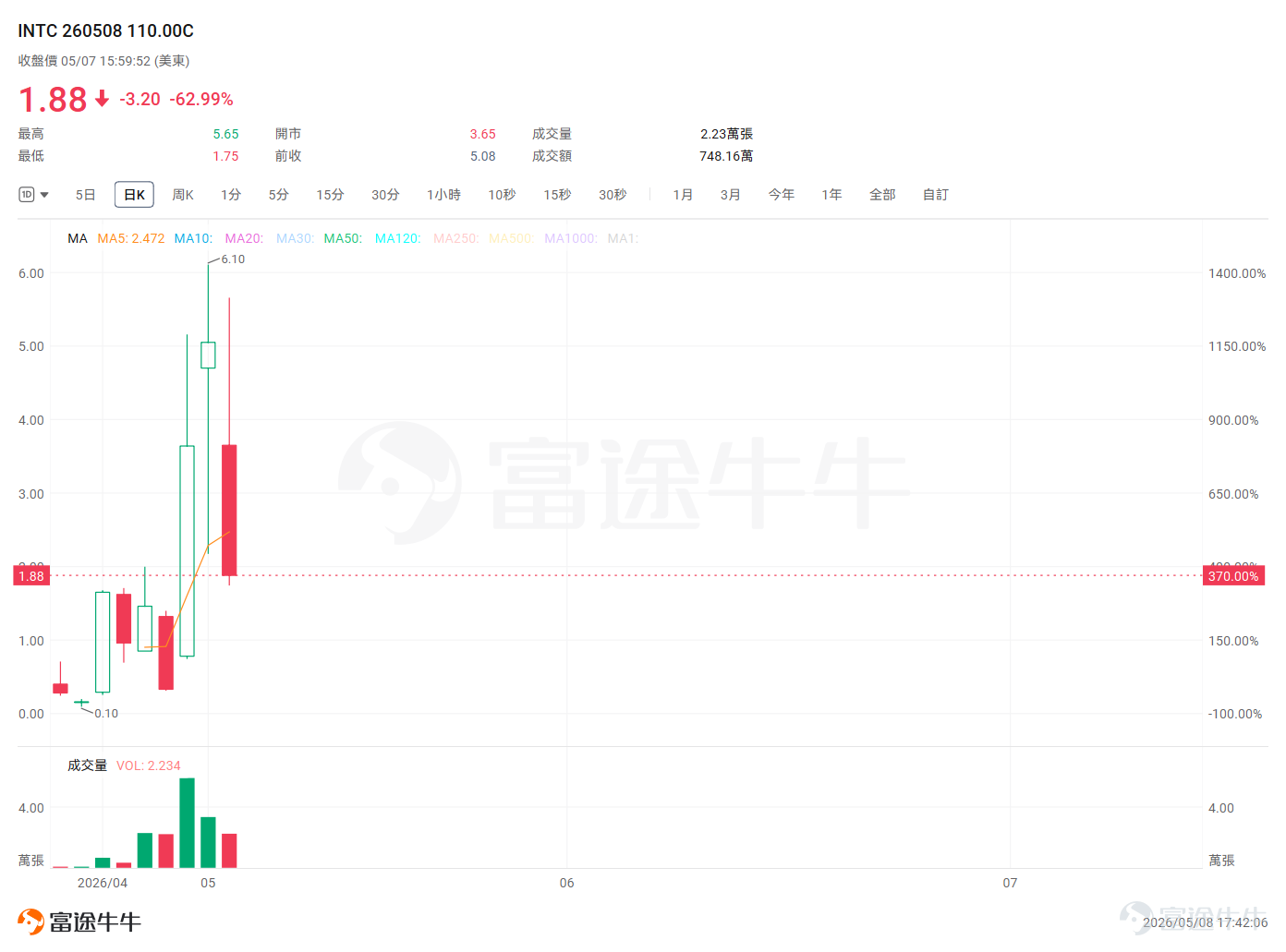

Lip-Bu Tan declared that Intel aims to grow tenfold in 5–10 years! Will Intel keep rising?

Hundred-dollar Options Recap | CPU Titans Surge Collectively! Intel Breaks $100 Mark, AMD Reports Stellar Earnings
The biggest theme of the semiconductor sector this week has been nothing but the CPU renaissance. In the past, almost all the spotlight in AI-related developments was on GPUs, but this year the script has completely flipped.
On May 1st, Intel — the former giant once written off by the market — officially broke through the $100 mark, hitting a record high and surpassing a market cap of $500 billion. Right after, AMD released its Q1 2026 earnings report post-market on May 5th, blowing away expectations across the board, resulting in a nearly 20% surge following the earnings announcement.
We’ve already reviewed the logic behind this several times, let’s go over the key points again~
The continued explosive performance of the two CPU giants can be attributed to just one core reason:In the era of Agentic AI, the value of CPUs has been severely underestimated. As AI shifts from training to inference and task execution, every AI agent relies on CPUs when invoking tools, running software, and processing logic. You could say that GPUs are the brain of AI, while CPUs are the hands — no matter how smart the brain is, without hands, it can’t get the job done.
$Intel (INTC.US)$ : The old giant turns around, an extreme 60x performance rally
Once considered a dinosaur on the verge of extinction, Intel has now transformed into a national asset in AI infrastructure. This is perhaps the most fantastical turnaround story.
Catalysts keep coming: Apple is negotiating with Intel for chip foundry cooperation; Tesla confirmed the adoption of Intel’s most advanced 14A (1.4nm) process for manufacturing autonomous driving chips; the 18A process node has entered mass production, attracting strong interest from multiple giants. Many institutions have aggressively raised their target prices, with some even calling it a 'Renaissance'.
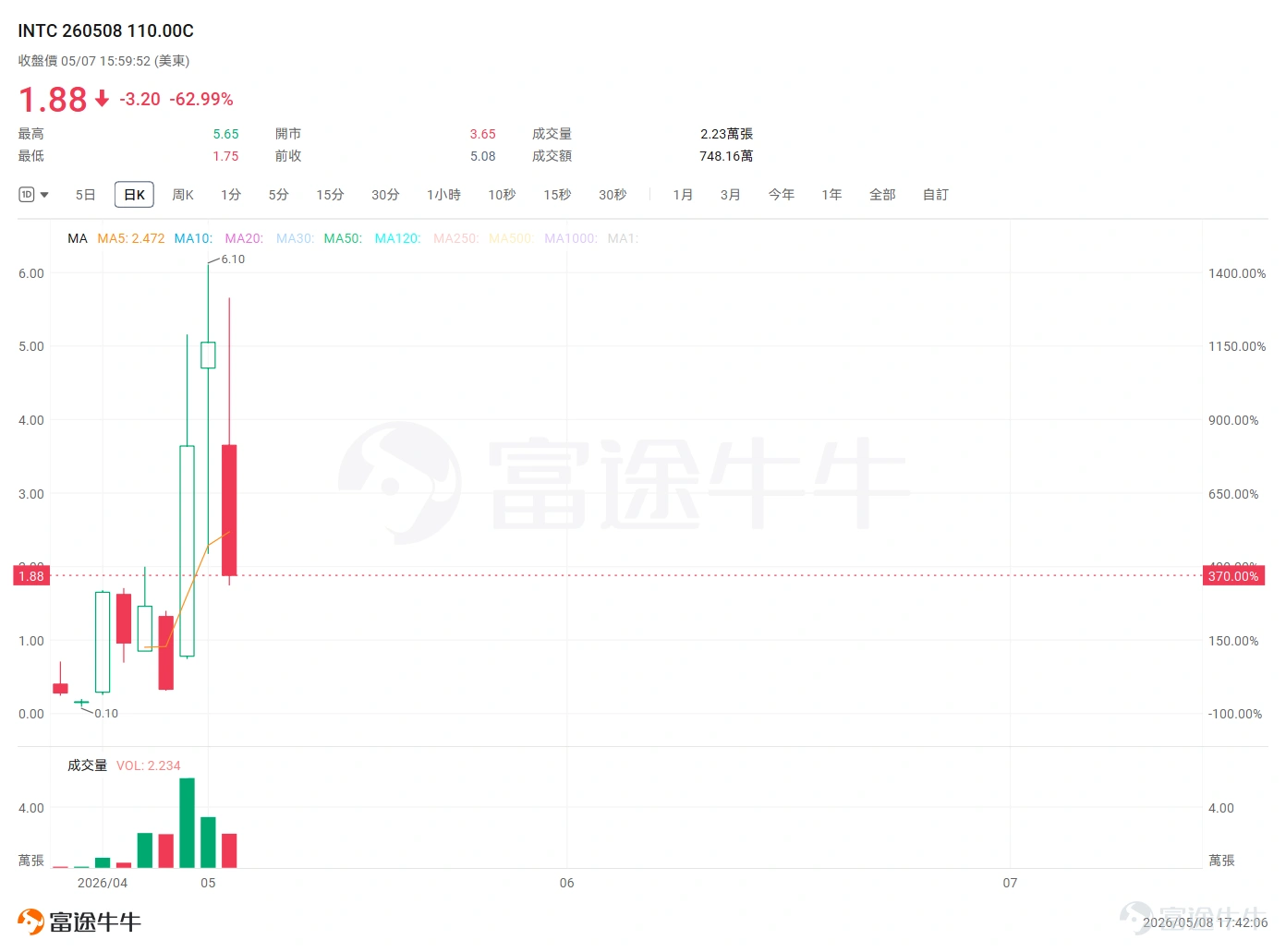
(The design images displayed on the screen are for demonstration purposes only and do not constitute any investment advice or guarantee; market movements are frequent, and the option prices shown do not represent actual conditions. The filtering criterion is options with an initial price below $3 per unit.)
On April 28, the unit price was $0.10 — a contract cost only $10. The strike price was $110, while Intel was still hovering around $80 at that time.This call option seemed like pure waste paper to most people; the underlying stock would need to rise by nearly 40% for it to have intrinsic value. The earnings report on the 24th had already caused a surge, so how could it go higher?
But Intel's price rose nonetheless.From the low $60s before the earnings report, it broke through $100, and then surged past $110. This 'worthless paper' skyrocketed from $0.10 to $6.10 —60 times.。
However, on May 7, the underlying stock retreated from its high, causing this call option to plummet 63% in a single day, dropping from $5.08 to $1.88. And it expires today.
But if you entered at $0.10, selling now would still yield an 18-fold profit. The key question is: did you enter at $0.10, or did you chase it at $5.00? Your entry price determines whether this contract results in a windfall or a massive loss for you.
The closer to expiration, the more volatile options near the underlying stock price become.Imagine a switch: when the underlying stock moves between $109 and $111 — just a $2 difference — for an end-of-life call option with a strike price of $110, this is the difference between being worthless and having value. Therefore, the price of such near-expiration options can double or be cut in half within hours.
This INTC call option saw a trading volume of 22,300 contracts, indicating that a large number of traders were participating in this gamble. Good liquidity makes entering and exiting easy — but the cost is that today’s closing will determine life or death for these positions.
$Advanced Micro Devices (AMD.US)$ : Earnings report continues to soar
The afterglow of Intel's breakthrough above 100 hasn't faded yet, and AMD has already fanned the flames even higher. After the US stock market closed on Monday, May 5, AMD released its Q1 2026 earnings report, with revenue, profits, and guidance all surpassing expectations.
Data center revenue surged 57% year-over-year, driven by dual engines: EPYC server CPUs and Instinct GPUs. Management also revealed that CPU revenue in Q2 is expected to grow by over 70% — the pull from AI agents on CPUs is no longer a story of the future, but an order that is being fulfilled.
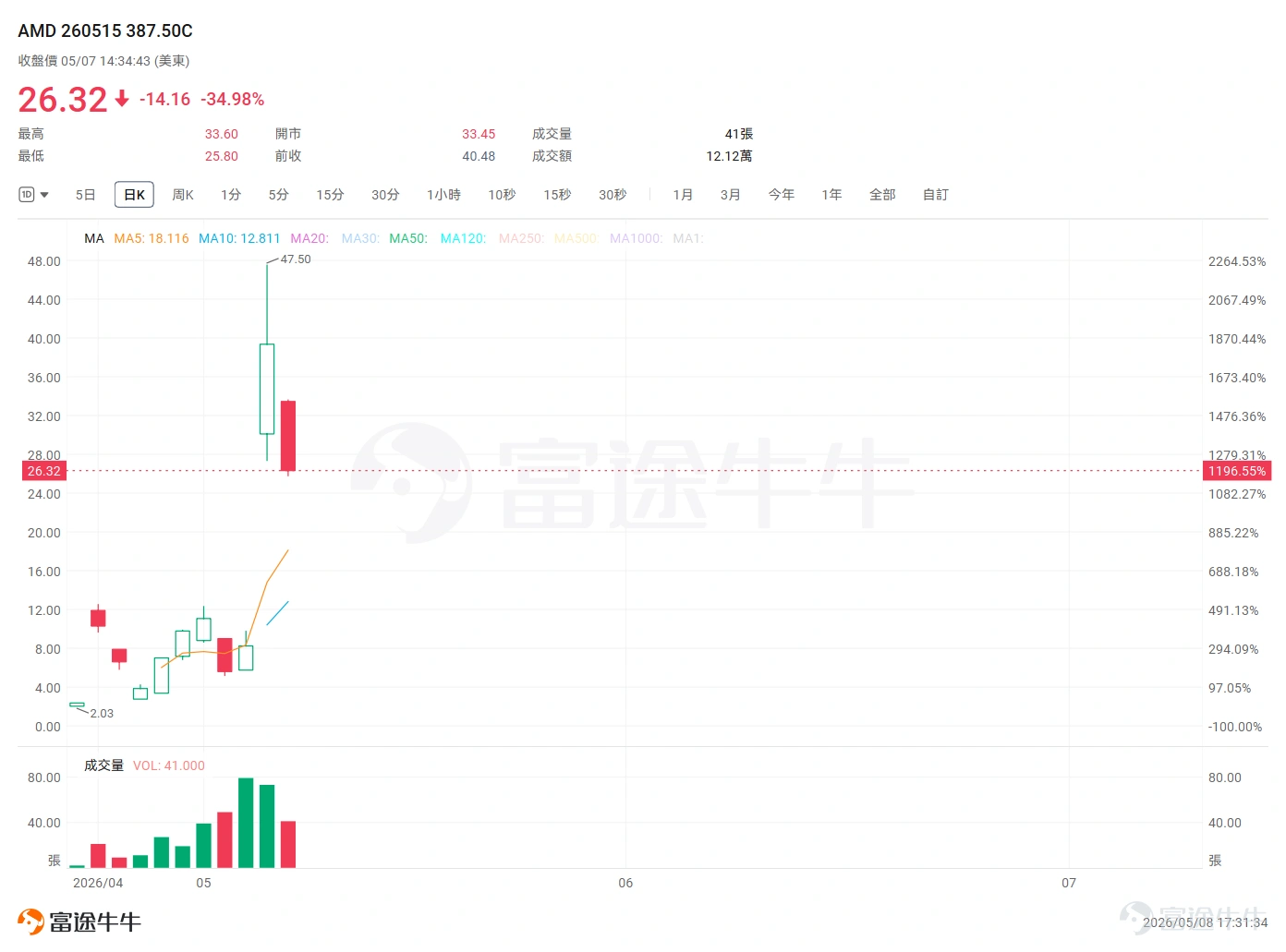
(The design images displayed on the screen are for demonstration purposes only and do not constitute any investment advice or guarantee; market movements are frequent, and the option prices shown do not represent actual conditions. The filtering criterion is options with an initial price below $3 per unit.)
Before the earnings report, AMD shares were hovering around $355, making this call option with a strike price of $387.50 out-of-the-money — the underlying stock would need to rise more than 9% to become in-the-money. Hence, its price once dropped as low as $2.03, with a contract costing just $203.
After the explosive earnings report, AMD jumped to over $400 in after-hours trading, turning this call from 'possibly worthless paper' into 'definitely valuable', surging to a high of $47.50 — a more than 23-fold increase from its low point.Entering at $203, at its peak, one contract was worth $4,750.
Many believe that if earnings are good, they should hold on indefinitely. But in reality:The jump from the earnings announcement that night to the opening the next day often represents the largest chunk of profit.Even if the underlying stock continues to rise afterward, the implied volatility (IV) of options will quickly decline due to the elimination of uncertainty — this is known as IV Crush.
This call fell from $47.50 to $26; part of the drop was due to the underlying stock retreating, while another part was the contraction in IV eroding your time value.
If the earnings report options have surged more than fivefold during after-hours or at the next day's opening, at least close half of your position to lock in profits and hold the rest as a free lottery ticket.
Rule of thumb: If the earnings report options have surged more than fivefold during after-hours or at the next day's opening, at least close half of your position to lock in profits and hold the rest as a free lottery ticket.
Two contracts, two styles: INTC is an ultra-low-cost, high-payout end-of-days lottery ticket, while AMD is a moderate-cost, moderately high-payout earnings play. Their common point is ——Both are riding the main theme of the CPU renaissance.
Entering with hundreds of dollars and earning thousands in return – options indeed provide the possibility for small capital to leverage big opportunities. Of course, high payouts never come easy; choosing the right direction, timing, and managing positions are all essential. In each review session, we help clarify these three aspects for everyone. Understand first, then act; get the rhythm right, and there will always be opportunities. See you at our next review.
Finally, here's a small perk for fellow Futubull investors, welcome to claim it.Options Beginner Pack *This event is only open to invited HK users, click to learn more.Detailed event rules>>

Disclaimer
This content does not constitute any offer, solicitation, recommendation, opinion, or any guarantee of any securities, financial products, or instruments. The risk of loss in trading options can be substantial. In some cases, your losses may exceed the initial margin deposited. Even if you set contingent orders, such as stop-loss or limit orders, they may not necessarily prevent losses. Market conditions may cause these orders to be unexecuted. You might be required to deposit additional margin within a short period. If you fail to provide the required amount within the specified time, your open positions may be liquidated. However, you will still be responsible for any deficit in your account as a result. Therefore, before trading, you should study and understand options and carefully consider whether such trading is suitable for you based on your financial situation and investment objectives. If you trade options, you should be familiar with the procedures when exercising options and upon their expiration, as well as your rights and obligations when exercising options and at expiration.
Risk Disclaimer: The above content only represents the author's view. It does not represent any position or investment advice of Futu. Futu makes no representation or warranty.Read more


Comments (3)
to post a comment
45
138