Is the food delivery war coming to an end? Meituan's Q2 profits exceed expectations

Earnings season for Chinese tech stocks kicks off! JD.com, Tencent, and Alibaba to release results next week—what kind of AI 'report card' will they deliver?
In mid-to-late May, a new earnings season for Chinese tech stocks will officially kick off.
$JD.com (JD.US)$ / $JD-SW (09618.HK)$ 、$TENCENT (00700.HK)$、 $BABA-W (09988.HK)$ / $Alibaba (BABA.US)$Next week, the first of the latest quarterly earnings reports will be released. $Baidu (BIDU.US)$ / $BIDU-W (09888.HK)$、 $Bilibili (BILI.US)$ / $BILIBILI-W (09626.HK)$、 $XIAOMI-W (01810.HK)$ 、 $KUAISHOU-W (01024.HK)$ 、 $MEITUAN-W (03690.HK)$ 、 $PDD Holdings (PDD.US)$ Other Chinese tech stocks will also gradually disclose their latest quarterly performance reports.
In the first three months of this year, stocks represented by technology shares $Hang Seng TECH Index (800700.HK)$Continued to weaken amid volatility, with a cumulative decline of over 15%. Driven by the 'recovery in Middle Eastern external risk appetite' and the 'strengthening AI commercial momentum within China,' the Technology Index has recently rebounded amidst fluctuations. Following the earnings releases of tech giants like Tencent, Alibaba, and JD.com,Key areas of focus for the market during this earnings season will include the proportion of revenue from AI businesses, the scale of AI capital investment, and progress on reducing losses in e-commerce retail.
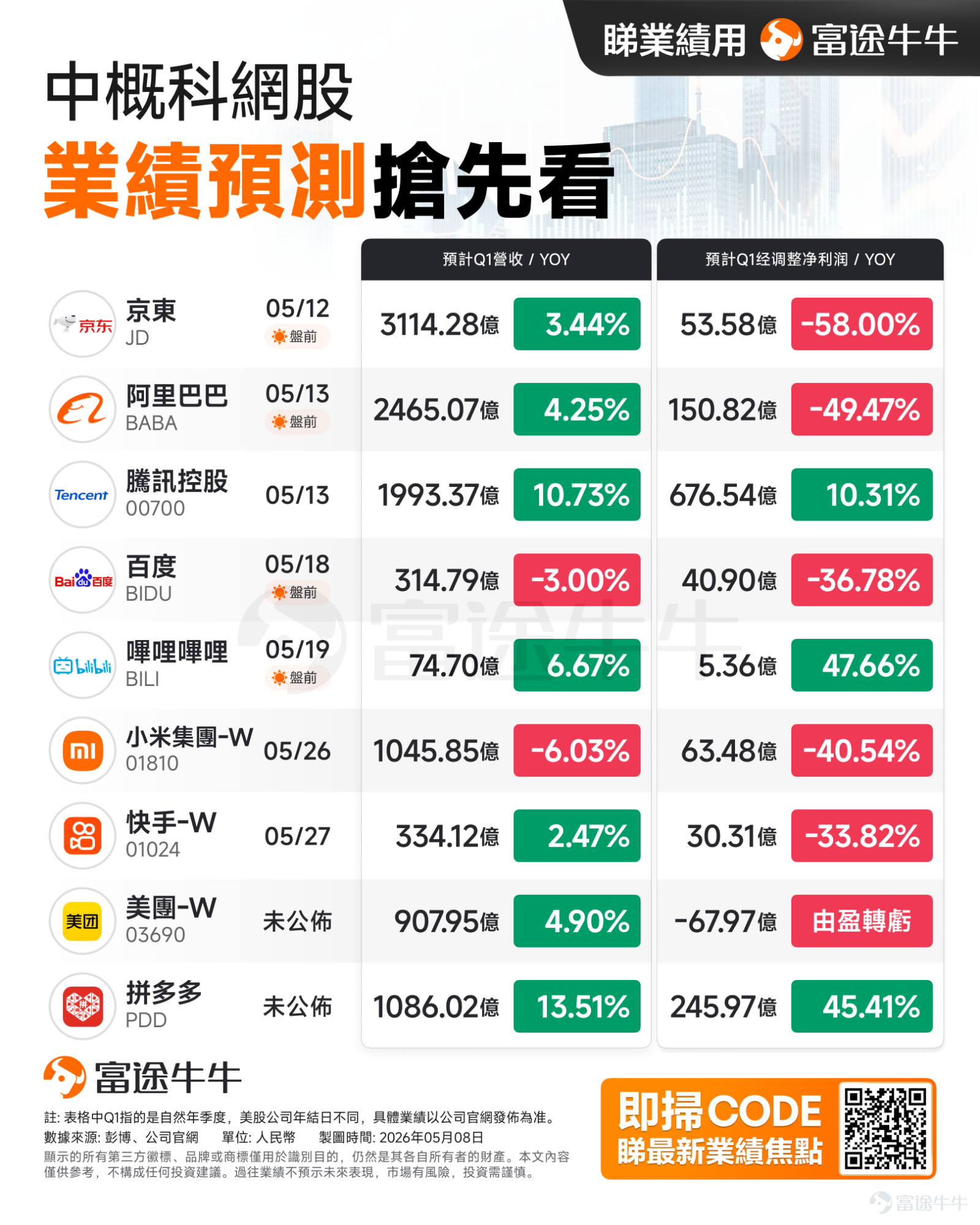
Based on market expectations, Futu News has compiled earnings forecasts for some popular US-listed Chinese tech stocks for investors’ reference.

Next week, tech giants Tencent and Alibaba are both scheduled to release their latest quarterly results on Wednesday (May 13), while JD.com’s results will be announced on Tuesday (May 12).
According to Bloomberg consensus estimates,$TENCENT (00700.HK)$ Q1 revenue is expected to reach 199.337 billion yuan, representing a year-on-year increase of 10.73%; adjusted net profit is forecast at 67.654 billion yuan, up 10.31% compared to last year.
In terms of gaming, driven by seasonal factors related to the Lunar New Year and strong performance from evergreen games such as Honor of Kings and Peacekeeper Elite, Nomura expects Tencent's gaming revenue to grow by 12% year-over-year to 66.3 billion yuan in Q1, with overseas gaming revenue projected to rise by 18%, outperforming the domestic market growth rate of 9%.
For the advertising business, Nomura anticipates a year-over-year growth of 21% to 38.5 billion yuan, significantly accelerating from the 17.5% growth in Q4 2025, primarily benefiting from the potential unlocked by video accounts and search ads.
Regarding AI operations, Nomura believes that Tencent's self-developed model 'HunYuan (HY)' currently lags behind ByteDance's 'DouBao' and Alibaba's 'Tongyi Qianwen', mainly due to insufficient investment prior to 2025. In the second half of 2025, Tencent adjusted its AI strategy, forming a new team led by former core members of OpenAI who were newly recruited, and released HunYuan 3.0 in April 2026. Due to the substantial increase in strategic investment in AI talent and infrastructure starting from 2026, Tencent's operating profit margin (OPM) for Q1 is expected to slightly decrease by 0.5 percentage points year-over-year to 38%.
$BABA-W (09988.HK)$ / $Alibaba (BABA.US)$Revenue for the fourth fiscal quarter is expected to reach 246.507 billion yuan, reflecting a year-over-year increase of 4.25%; adjusted net profit is anticipated to be 15.082 billion yuan, down approximately 49% compared to last year.
Multiple institutions predict that Alibaba Cloud's Q4 2026 revenue will grow by 40% year-over-year, reaching about 42.2 billion yuan, further increasing from the previous quarter's 36% growth rate, potentially becoming the only business segment within Alibaba to maintain high-speed growth this quarter.
Alibaba's AI assistant app, Tongyi App, conducted a '3 Billion Free Giveaway' campaign during the Spring Festival period. The continuous expenditures on Tongyi have become a major drag on Alibaba's profits this quarter. Additionally, Alibaba continues to intensify its investments in model training, technology R&D, and commercial promotion; the Tongyi Lab has been upgraded to the Tongyi Large Model Division, and Pingtouge's self-developed GPUs are now being mass-produced to support AI computing needs.
The instant retail segment remains the primary source of losses for Alibaba, with the market forecasting Taobao's flash purchase revenue to grow by 58% year-over-year this quarter, making it Alibaba's fastest-growing business segment. However, a loss of RMB 17.8-18 billion is still anticipated during the same period. Although the scale of the loss has narrowed, it continues to significantly weigh on the overall EBITA performance of core e-commerce.
$JD.com (JD.US)$ / $JD-SW (09618.HK)$Question 1Expected revenue stands at RMB 311.428 billion, marking a year-over-year increase of 33.44%. Expected adjusted net profit is53.58billion yuan, representing a year-over-year decrease of approximately 58%.
In major banks' forward-looking assessments of JD.com’s Q1 performance, high-margin businesses such as daily necessities and platform services have demonstrated stronger-than-expected growth momentum. According to Barclays' industry research, the year-over-year growth rate of daily necessities revenue in Q1 is expected to rise from the previously forecasted 12% to 12.5%, while the revenue growth rate for platform and marketing services has been revised upward from 13.5% to 15.5%.
Regarding new business initiatives, JPMorgan believes that regulatory bodies have sent multiple rounds of signals opposing irrational competition. Subsidies in the domestic food delivery market have shown signs of cooling down, prompting the bank to narrow its forecasted losses for new businesses in 2026 from RMB 45 billion to around RMB 35 billion (an improvement of about RMB 10 billion compared to consensus market expectations).
Goldman Sachs’ research report points out that the fundamental pricing logic of China’s internet industry has undergone a significant shift,officially entering an era driven by two parallel themes: 'AI computing power' and 'anti-internal competition reshaping the landscape.'On one side, there is the entirely new growth curve brought by AI computing power, while on the other, there is improved profitability quality stemming from traditional businesses’ 'anti-internal competition.' These two forces together form the core basis for the current market revaluation of internet companies.
Nowadays,The market is no longer solely buying into the narrative of 'user growth,' instead beginning to reprice internet companies based on 'computing power consumption' and 'profitability quality.'Based on Goldman Sachs’ perspective, the following types of internet companies are considered most likely to achieve profitability first or witness a significant turning point in profits:
– E-commerce and Local Life: 'Anti-Internal Competition' and Landscape Restructuring
With increasing regulatory attention on destructive price wars, as well as companies proactively adjusting their own strategies, the profit recovery path for enterprises in this sector has become increasingly clear.
Goldman Sachs pointed out that with the State Administration for Market Regulation's emphasis on 'anti-internal competition,' the subsidy war in the food delivery industry will gradually return to rationality. The improvement in competitive dynamics means $MEITUAN-W (03690.HK)$ the path to improving unit economics (UE) in food delivery is relatively clear, with its losses expected to gradually narrow starting from 2026.
Goldman Sachs stated that$BABA-W (09988.HK)$ / $Alibaba (BABA.US)$a target of achieving profitability within three years has been set for the instant retail business (such as Taobao Flash Purchase), providing the market with clear guidance on expectations. The easing of competition in the food delivery industry will lead to a narrowing of losses, coupled with robust growth in cloud services driven by AI, which together will drive Alibaba's profit recovery.
Goldman Sachs believes that$JD.com (JD.US)$ / $JD-SW (09618.HK)$JD.com is an undervalued differentiated company in China's internet space. Currently, JD.com's retail business profitability has reached a record high, and its logistics segment shows strong guidance (with revenue growth projected to exceed 20% by 2026, and profits growing even faster). The losses from JD.com’s food delivery business are continuously narrowing, and the application of AI technology in areas like ad placement and supply chain management provides a margin of safety for overall profitability.
– Cloud Computing and Data Centers: Explosive Growth in Token Demand Driven by AI
Goldman Sachs prioritizes cloud computing and data centers as key investment directions,This is mainly due to the explosive growth in demand for tokens driven by AI.As the number of enterprises and AI agents increases, along with the widespread adoption of AI assistants on the consumer side, the demand for AI tokens continues to expand, leading to enhanced pricing power for cloud services and tokens.
The core investment target shares involved by Goldman Sachs include $GDS Holdings (GDS.US)$ / $GDS-SW (09698.HK)$ 、 $21Vianet (VNET.US)$ 、 $BABA-W (09988.HK)$ / $Alibaba (BABA.US)$and$Kingsoft Cloud (KC.US)$ / $KINGSOFT CLOUD (03896.HK)$ 。
Data shows that China's daily average token consumption for AI has grown more than 1,000 times in less than two years. The competitive logic of cloud vendors has shifted from previous price wars to an increase in pricing power driven by strong demand. Goldman Sachs expects Alibaba Cloud's revenue growth this quarter to accelerate from 36% in the previous quarter to 40%.
From a capital expenditure perspective, Goldman Sachs estimates that China’s hyperscale cloud service providers allocate approximately 58% of their operating cash flow to capital expenditures, compared to an average of 89% for similar companies in the US. Goldman Sachs predicts that Alibaba’s capital expenditure in fiscal year 2027 will reach RMB 180 billion, representing a 34% year-over-year increase.$TENCENT (00700.HK)$ Capital expenditure for fiscal year 2026 is expected to reach approximately RMB 100 billion, reflecting a 25% year-over-year increase.
 AI-driven earnings highlights, establish in three stepsOptions Strategy! Open Futubull > Stock Page > Click [Company] >Earnings Express
Risk Disclaimer: The above content only represents the author's view. It does not represent any position or investment advice of Futu. Futu makes no representation or warranty.Read more


Comments
to post a comment
11
1