Poor liquidity in Hong Kong stock ETFs? Stop being deceived by 'surface trading'!

(Image generated by AI)
With the recent market recovery, many investors have started paying attention to Hong Kong stock ETFs again. But when they open their trading platforms, some ETFs show only a few million Hong Kong dollars in daily trading volume, prompting doubts: 'Isn't this liquidity too low? What if I can't sell after buying?'
Today, China Merchants Securities Asset Management (Hong Kong) will explain the 'hidden truths' about ETF liquidity. What you see might just be the tip of the iceberg.
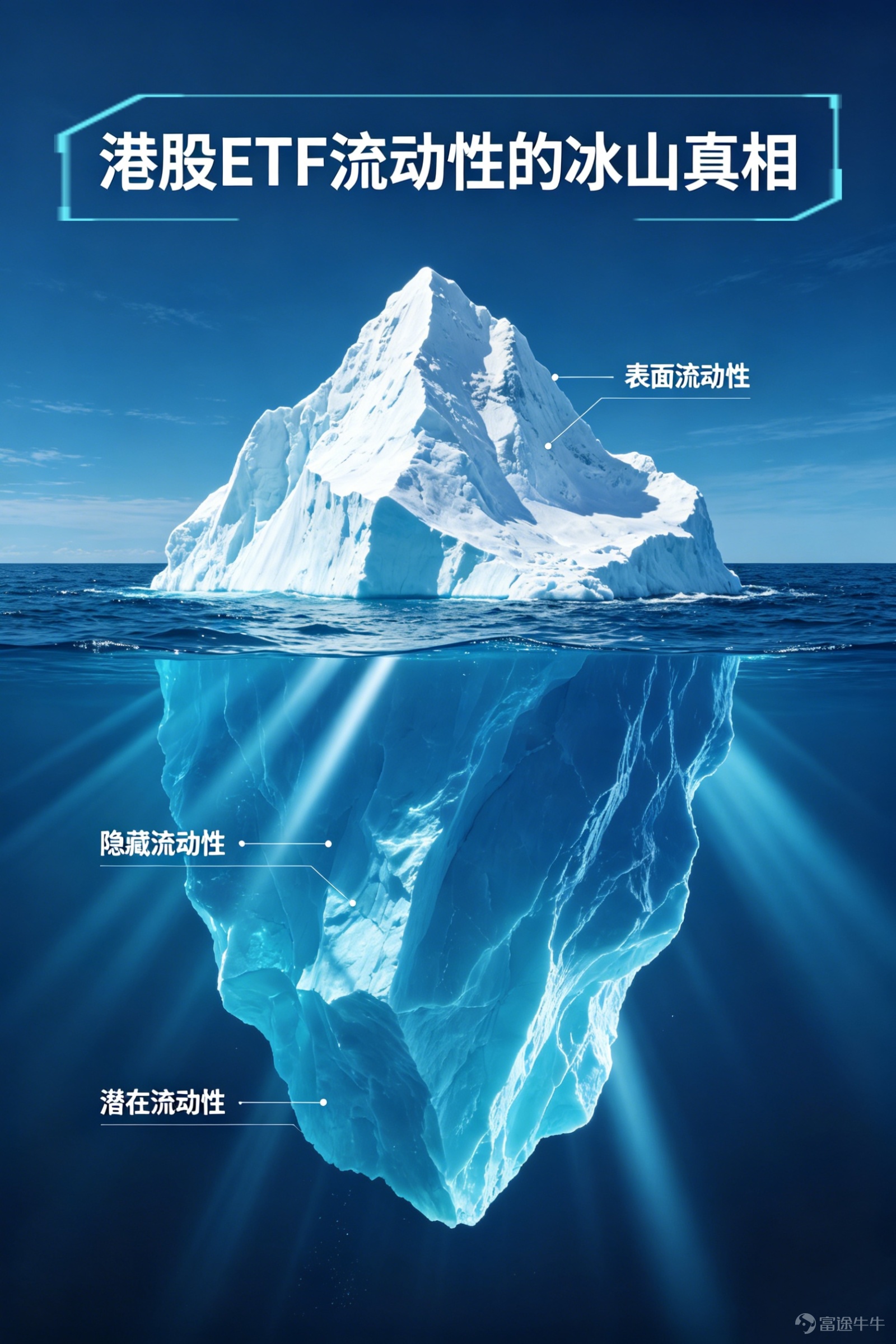
Surface Liquidity: You're Only Seeing the Tip of the Iceberg
That’s right, the 'trading volume' you see on your trading platform is what we call 'surface liquidity.' It only represents the trading volume that has occurred on the secondary market over a recent period.
But this is like judging an entire city's consumer spending ability based solely on the foot traffic outside a convenience store—too one-sided. For products like ETFs, true liquidity lies beneath the surface.
Hidden Liquidity: The Market Maker’s 'Invisible Inventory'
The Hong Kong stock market has a very important system - the Market Maker system. Generally speaking, every compliant ETF needs to have a market maker providing liquidity.
Market makers act as the 'reservoir' for ETFs. To ensure there are always buy and sell orders in the market, they hold a certain number of ETF shares as inventory. When your purchase volume exceeds the day's average trading volume, the market maker can tap into their 'hidden inventory' to meet your demand.
So, even if the trading activity looks quiet, there might be powerful 'invisible buyers' and 'invisible sellers' standing by at all times.
Potential Liquidity: Sharing the 'vast ocean' of underlying assets
This is the true ace up the sleeve for ETF liquidity - 'potential liquidity'.
ETFs have a magical 'creation and redemption' mechanism. When demand in the secondary market is strong, Authorized Participants (APs) can buy a basket of stocks and convert them into new ETF shares with the fund company, which are then released into the market. Conversely, when selling is required, ETF shares can also be redeemed for a basket of stocks.
What does this mean? It means that the liquidity of an ETF is theoretically linked to the liquidity of all its underlying stocks!
For example, for an ETF tracking the Hang Seng Tech Index, its potential liquidity is determined by the combined liquidity of dozens of giant listed companies like Tencent, Alibaba, and Meituan. The capacity of this 'reservoir' could reach billions or even tens of billions of Hong Kong dollars, far surpassing the daily trading volume of just a few million on the surface.
In simple terms:
Surface Liquidity: Represents transactions that have already occurred.
Hidden Liquidity: Refers to the inventory that market makers are ready to trade at any time.
Potential liquidity: It is the vast ocean of the entire underlying stock market and serves as the ultimate guarantee for ETF liquidity.
Decoding the Deep Support Behind Hong Kong Stock ETFs
At China Merchants Securities Asset Management (Hong Kong), we deeply understand that liquidity is the lifeline of investor experience. Our ETF products not only strictly adhere to the Hong Kong Stock Exchange’s market maker system, ensuring continuous quotations and narrow spreads, but also leverage our strong cross-border service capabilities and deep market resources to collaborate closely with authorized participants, committed to ensuring ample potential liquidity for our products.
Therefore, next time you see low daily trading volume for a Hong Kong stock ETF, please don’t hastily label it as having “poor liquidity.” Instead, ask further: Who is its market maker? What is the liquidity of its underlying assets?
The breadth of investment vision determines the world you can see. China Merchants Securities Asset Management (Hong Kong) is committed to helping you cut through the fog and discover true value.
Investing involves risks. The secondary market trading price of an ETF may trade at a premium or discount to its net asset value. Investors should carefully read relevant offering documents and consult professional advisors before making investment decisions. Past performance is not indicative of future results.

$CMS Hang Seng Tech Index ETF (03423.HK)$ $BABA-W (09988.HK)$ $TENCENT (00700.HK)$ $XIAOMI-W (01810.HK)$ $NTES-S (09999.HK)$ $MEITUAN-W (03690.HK)$ $KUAISHOU-W (01024.HK)$ $SMIC (00981.HK)$ $BYD COMPANY (01211.HK)$ $JD-SW (09618.HK)$ $LI AUTO-W (02015.HK)$ $TRIP.COM-S (09961.HK)$ $XPENG-W (09868.HK)$ $BIDU-SW (09888.HK)$ $LENOVO GROUP (00992.HK)$ $HAIER SMARTHOME (06690.HK)$ $JD HEALTH (06618.HK)$ $KINGDEE INT'L (00268.HK)$ $SUNNY OPTICAL (02382.HK)$ $BILIBILI-W (09626.HK)$ $MIDEA GROUP (00300.HK)$ $SENSETIME-W (00020.HK)$ $KINGSOFT (03888.HK)$ $ALI HEALTH (00241.HK)$ $HUA HONG GRACE (01347.HK)$ $TONGCHENGTRAVEL (00780.HK)$ $BYD ELECTRONIC (00285.HK)$ $ASMPT (00522.HK)$ $NIO-SW (09866.HK)$ $HORIZONROBOT-W (09660.HK)$ $TME-SW (01698.HK)$
Risk Disclaimer: The above content only represents the author's view. It does not represent any position or investment advice of Futu. Futu makes no representation or warranty.Read more


Comment (1)
to post a comment
7
3