
Hong Kong stocks pull back—how will they perform in the second half of the year?

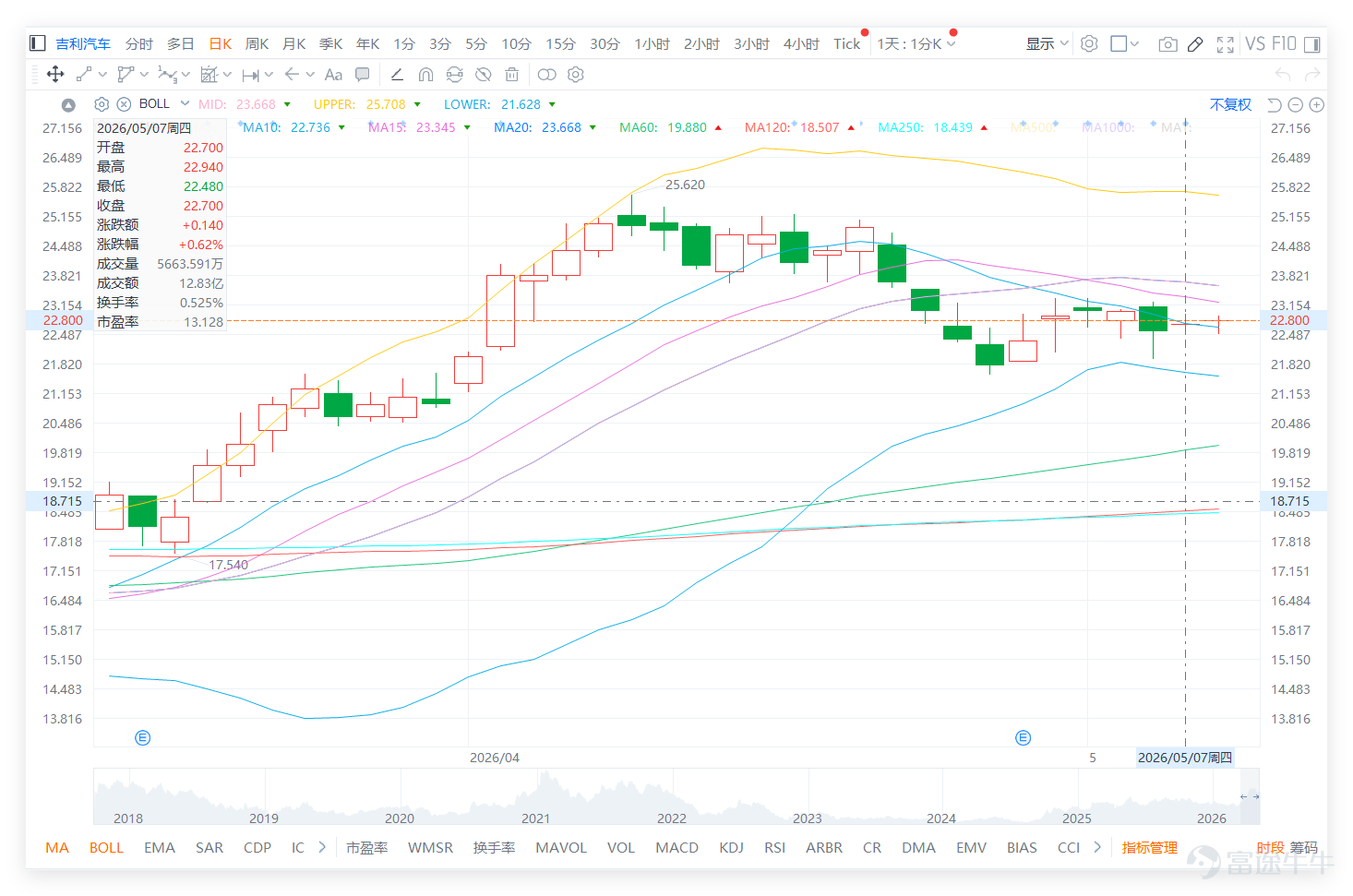
Geely Auto's rebound at 22.7 is weak, and the short-term watershed remains below 23.668.
The closing price the other day (on the 7th) was 22.700, and the short-term trend remains weak. The stock price is below the 10-day, 20-day, and 30-day moving averages, reflecting that after retreating from its highs, it has temporarily been unable to restore its key moving average structure. Although the previous day’s closing price was still above the lower Bollinger Band at 21.628, which isn’t entirely bearish, until it breaks above 22.954 and 23.668, any rebound can only be considered a technical correction within consolidation.

Geely Auto (00175) has a technical signal of 'Buy,' compared with peers in the automobile sector, $XPENG-W (09868.HK)$ And, $NIO-SW (09866.HK)$ the technical signals are also predominantly positive ('Strong Buy'/'Buy'), indicating that both new energy and traditional automakers are receiving capital attention; $LI AUTO-W (02015.HK)$ it also maintains a 'Buy' rating. In contrast, $GWMOTOR (02333.HK)$ the technical signal for some stocks is 'Sell,' showing a clear divergence. This means that Geely’s current 'Buy' signal essentially reflects a 'following recovery' status within an overall bullish environment for the sector—it hasn’t weakened like Great Wall Motor, but it also hasn’t demonstrated leading momentum surpassing peers (such as XPeng's 'Strong Buy'). Whether it can break through 23.668 will determine whether it transitions from being a 'sector-wide follower' to becoming an 'independently strong stock.'

Investor comments reflect significant market divergence. Some investors remain optimistic about the medium to long term, believing that the stock has been bottoming for years and could potentially see a major rally, with some even targeting a rise to 30 yuan. However, more short-term comments focus on resistance, insufficient trading volume, and erratic movements. For instance, some investors pointed out that 22.8 is a key resistance level, while others believe 23.3 cannot be surpassed. Additionally, remarks such as 'too little trading volume' and 'when there is a big rise, it falls instead,' suggest weak confidence in entering the market at this stage.
Common market questions mainly revolve around whether Geely has already bottomed out and whether it can break through the 22.8 to 23.3 range. From a technical perspective, the area near 22.8 is close to the 10-day moving average at 22.736 and the 30-day moving average at 22.954, making it the first short-term resistance level; while 23.668 represents the 20-day moving average and the middle line of the Bollinger Bands, which is an even more important watershed. In other words, even if the stock price rebounds in the short term, it must first regain 22.954 and then break through 23.668 to confirm structural improvement.
Regarding trading volume, the current rebound lacks sufficient support, indicating that capital inflow remains sluggish. The Relative Strength Index (RSI) is approximately 43.828, showing weak momentum without clear signs of strengthening. If the stock price continues to be constrained by the 22.954 to 23.668 range, the short-term trend may remain in a weak consolidation phase. A break below 21.628 would indicate a loss of the lower Bollinger Band, potentially leading to further weakness.
Overall, Geely Auto currently has a relatively low reward-to-risk ratio. The bullish side needs to wait for the stock price to rise back above 22.954 and 23.668 before there will be a clearer signal of strengthening; before a breakout occurs, it is not advisable to assume too early that a major upward trend has already begun.
Reply to some investors' views:
@gardenlau0The area around 22.8 is indeed short-term resistance because it is close to both the 10-day and 30-day moving averages; before breaking through, the rebound strength remains limited.
@帳號重生了For a true short-term takeoff, it needs to first rise above 22.954, then break through 23.668; otherwise, it will remain in a weak consolidation phase.
@231825001Low trading volume is the key issue; without sufficient volume supporting a rebound, the reward-to-risk ratio for chasing the stock would be relatively low.
Based on the above analysis, the strategies for deployment can be divided into the following main approaches:

For more market analysis, stay tuned to Jenny's daily updates on 'Hong Kong Stock Warrants'!
Reminder: This article does not constitute any investment advice.
This article is for reference only and does not constitute any investment advice. Market data, opinions, and analysis contained herein may change at any time without prior notice. We are not responsible for any loss or damage caused by reliance on the information in this article. Technical analysis only shows whether certain technical conditions are met; asset performance should be comprehensively evaluated using other sources of information, and trading decisions should not be made solely based on this article. Please note that past performance is not indicative of future results.
#Hong Kong Stocks #Geely Auto #Real-time Analysis #Warrants Selection #Warrants Strategy #Derivatives Hedging #Hong Kong Warrants Jenny #Blue Chips #Technical Analysis
Risk Disclaimer: The above content only represents the author's view. It does not represent any position or investment advice of Futu. Futu makes no representation or warranty.Read more

Comments
to post a comment
2