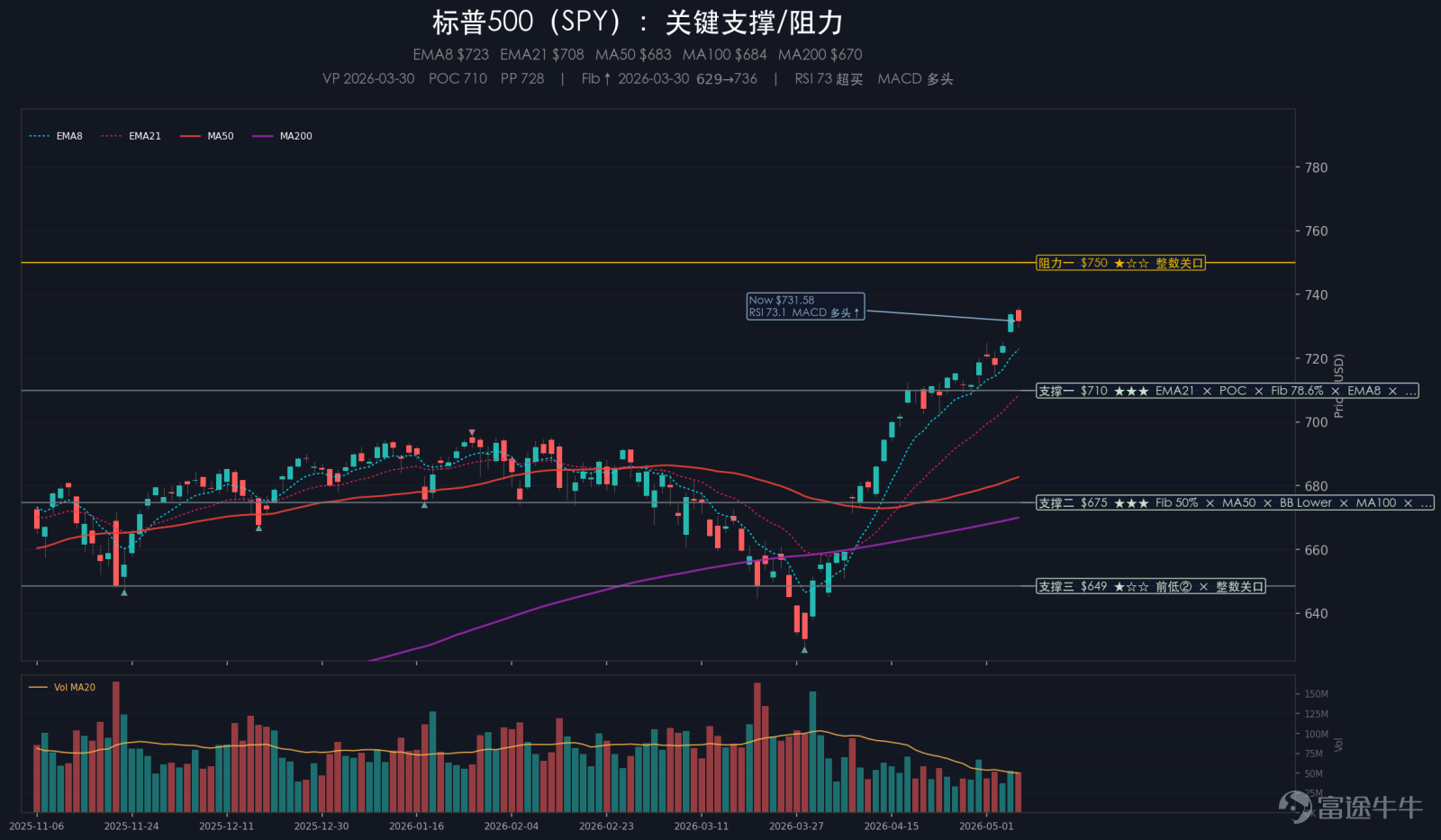

The S&P 500 has risen for seven consecutive weeks—should you chase the rally or take profits?

Wall Street Daily (May 8): US stocks diverged at highs on Thursday, sentiment did not show clear panic but profit-taking and structural contraction emerged; small-cap stocks were notably pressured while software and cybersecurity sectors strengthened against the trend
Summary: US stocks retreated from highs on Thursday, with the S&P 500 down 0.38%, Nasdaq down 0.13%, Dow Jones down 0.63%, and Russell 2000 down 1.63%. The four major indices experienced mild pullbacks, but the market internals contracted significantly, with notable pressure on small caps as funds exited high-beta and cyclical sectors ahead of the non-farm payroll data. VIX fell to 17.08, declining 1.78% in a day. Sentiment did not reflect obvious panic, appearing more like profit-taking at highs and structural contraction. The most significant pricing changes of the day included: first, the US-Iran framework was not officially implemented, leading the market to reassess oil prices and peace expectations; second, initial jobless claims data remained robust, suppressing short-term rate cut speculation. Sector-wise, software and cybersecurity outperformed, while energy, industrials, and materials weakened. Chinese concept stocks and crypto-related chains faced notable pressure. In broader asset classes, the dollar index rose 0.26%, gold fell 0.12%, crude oil gained 1.51%, and Bitcoin dropped 1.75%.

I. Major Events
1. The US-Iran framework has not been finalized, prompting the market to shift from chasing gains to cautious observation
US stocks retreated after hitting new highs during the session, as the market began reevaluating whether optimism over the US-Iran framework was excessive. Iran did not explicitly accept the US proposal, and the issue regarding the restoration of the Strait of Hormuz remains unresolved. Risk assets shifted from unilateral expansion the previous day to consolidation near highs. Index declines were modest, but high-beta and cyclical sectors weakened first.
2. Initial jobless claims remain stable, limiting further opening of rate-cut expectations
Initial jobless claims last week rose to 200,000, but still came in below expectations, showing that the low layoff trend persists. With no evident loss of momentum in the labor market, it is difficult for the market to interpret the day's pullback as a 'pre-nonfarm payroll rate-cut trade rehearsal.' Higher sensitivity sectors and small caps bore heavier pressure, suggesting growing concerns about growth, but without increased bets on policy easing.
DDOG and FTNT led a strong performance in software and cybersecurity against the market trend
DDOG raised its full-year outlook, surging 31.33%; FTNT's results and guidance also showed significant strength, rising 20.03%. This indicates that corporate spending remains robust in areas such as cloud security, cybersecurity, and AI infrastructure. Even amid a broad market pullback, related software and security assets continued to attract capital, with IGV rising 3.45%, CIBR up 4.23%, and PLTR gaining 2.44%.
II. Major Trends
The tech sector remains the main focus, but internal styles are narrowing. Over a two-week period, QQQ rose 6.68%, significantly higher than SPY's 3.26% and DIA's 0.58%; over a three-month horizon, QQQ gained 14.13%, while DIA fell by -0.64%. On Thursday, the Nasdaq dropped only 0.13%, continuing to outperform the Dow and Russell significantly.
The breadth issue remains prominent. Over a three-month period, SPY rose 6.22%, while RSP increased by only 1.06%; over a two-week period, SPY gained 3.26%, whereas RSP rose just 0.54%. When indices fluctuate at high levels, internal support remains narrow.
Growth style continues to dominate. SPYG rose 10.78% over three months, significantly higher than SPYV's 1.13%; even on a pullback day, capital remained prioritized in growth and technology sectors rather than shifting entirely back to value. Internally, the tech sector further concentrated toward leading names. MAGS gained 9.16% over three months, higher than XMAG’s 3.44%; the two-week change accelerated from 3.04% to 5.45%, indicating that the current trend is not evenly diffused but rather a continued strengthening of抱团 (tight clustering).
III. Market Sentiment
The VIX closed at 17.08, down 1.78% in a single day. The index pulled back, but volatility declined instead, suggesting that the day’s move was not a typical panic-driven drop but more like profit-taking at elevated levels and structural contraction. The CNN Fear & Greed Index stood at 68, down from the previous reading of 69, still in a relatively greedy range but without further increases. Market sentiment did not deteriorate significantly; it merely shifted from the previous day’s strong expansionary phase to consolidation.
The options market began to re-establish protection. As of the Cboe snapshot at 15:15 CT on the same day, the total Put/Call ratio was 0.65, the index options Put/Call ratio was 1.03, and the equity options Put/Call ratio was 0.53. Risk appetite at the stock level has not weakened entirely, but the index options Put/Call ratio moving above 1 suggests institutions have started increasing index protection. Considering the VIX, CNN Fear & Greed Index, and Put/Call ratios, the current market resembles 'overall sentiment remaining warm, but positioning structure turning cautious again.'
IV. Market Scan
1. Index ETFs:Index ETFs pulled back overall, with QQQ falling 0.12% showing relative strength, while IWM dropped 1.58%, clearly the weakest. The broader market underwent only mild consolidation, but high-beta sectors came under pressure early, as the market began repricing uncertainty ahead of the non-farm payroll data.
2. Industry sectors:In terms of industry sectors, XLC edged up 0.03% to barely close in positive territory, while XLB fell 1.93%, XLE dropped 1.84%, and XLI declined 1.62%, lagging behind. The market shifted from the previous day’s pro-cyclical expansion back to defensive and cash-flow-stable directions, with energy, materials, and industrial chains weakening together. Among specific sub-sectors, cybersecurity (CIBR) gained 4.23% and software (IGV) rose 3.45%, the strongest performers, while healthcare services (XHE) also held up relatively well. On the other hand, oilfield services (OIH) fell 3.44%, uranium (URA) dropped 3.43%, and semiconductors (SMH) declined 1.76%. The truly sustained strong trends were concentrated in software and cybersecurity, while previously high-elasticity resource and manufacturing chains saw noticeable pullbacks.
3. Seven major tech companies:Within the Magnificent Seven tech stocks, divergence continued. TSLA surged 3.28% to lead gains, MSFT rose 1.65%, NVDA gained 1.77%, and AAPL fell just 0.02%. The tech heavyweights did not weaken collectively but instead demonstrated a structure where a few strong performers continued to provide support, while weaker ones maintained sideways consolidation.
4. Chinese concept stocks:There is a clear divergence within Chinese concept stocks. BABA fell by 0.31%, relatively the strongest, while FUTU plummeted by 13.76% and TME dropped by 4.14%. Brokerage firms and high-elasticity platforms faced heavier pressure, indicating that overseas funds' risk appetite for Chinese concepts is also contracting in tandem.
5. Cryptocurrencies:Bitcoin fell by 1.75%, MSTR dropped by 3.74%, CRCL plunged by 7.02%, while PLTR rose by 2.44%. High-elasticity assets have significantly cooled internally, with capital preferring to stay in software and security chains supported by performance rather than continuing to chase cryptocurrency and stablecoin concepts.
$S&P 500 Index (.SPX.US)$ $SPDR S&P 500 ETF (SPY.US)$ $NASDAQ 100 Index (.NDX.US)$ $Invesco QQQ Trust (QQQ.US)$ $Dow Jones Industrial Average (.DJI.US)$ $State Street® SPDR® Dow Jones Industrial Average® ETF Trust (DIA.US)$ $Russell 2000 Index (.RUT.US)$ $iShares Russell 2000 ETF (IWM.US)$ $Roundhill Magnificent Seven ETF (MAGS.US)$ $USD (USDindex.FX)$ $U.S. 10-Year Treasury Notes Yield (US10Y.BD)$ $iShares 20+ Year Treasury Bond ETF (TLT.US)$ $XAU/USD (XAUUSD.CFD)$ $Bitcoin (BTC.CC)$ $Ethereum (ETH.CC)$ $SPDR Gold ETF (GLD.US)$ $CBOE Volatility S&P 500 Index (.VIX.US)$ $NVIDIA (NVDA.US)$ $Tesla (TSLA.US)$ $Meta Platforms (META.US)$ $Amazon (AMZN.US)$ $Alphabet-C (GOOG.US)$ $Microsoft (MSFT.US)$ $Apple (AAPL.US)$
Risk Disclaimer: The above content only represents the author's view. It does not represent any position or investment advice of Futu. Futu makes no representation or warranty.Read more


Comments
to post a comment
7