
AI Boom vs. Tight Liquidity: Will the US Stock Rally Continue?

Option Sir Breaks Down Hot Topics | On the Eve of Non-Farm Payrolls, Gold Returns to $4,700; Is It Re-Entering the 'Strike Zone'?
Gold has come back into focus. Overnight, $XAU/USD (XAUUSD.CFD)$ a strong upward movement occurred, with spot gold prices climbing back near $4,700 after a rise of about 3% on Wednesday, marking the largest one-day gain since early April.In the short term, gold has clearly recovered from the previous sharp decline, but it remains far from its early-year highs. In other words, gold is showing signs of a comeback, but bulls have yet to fully regain control.
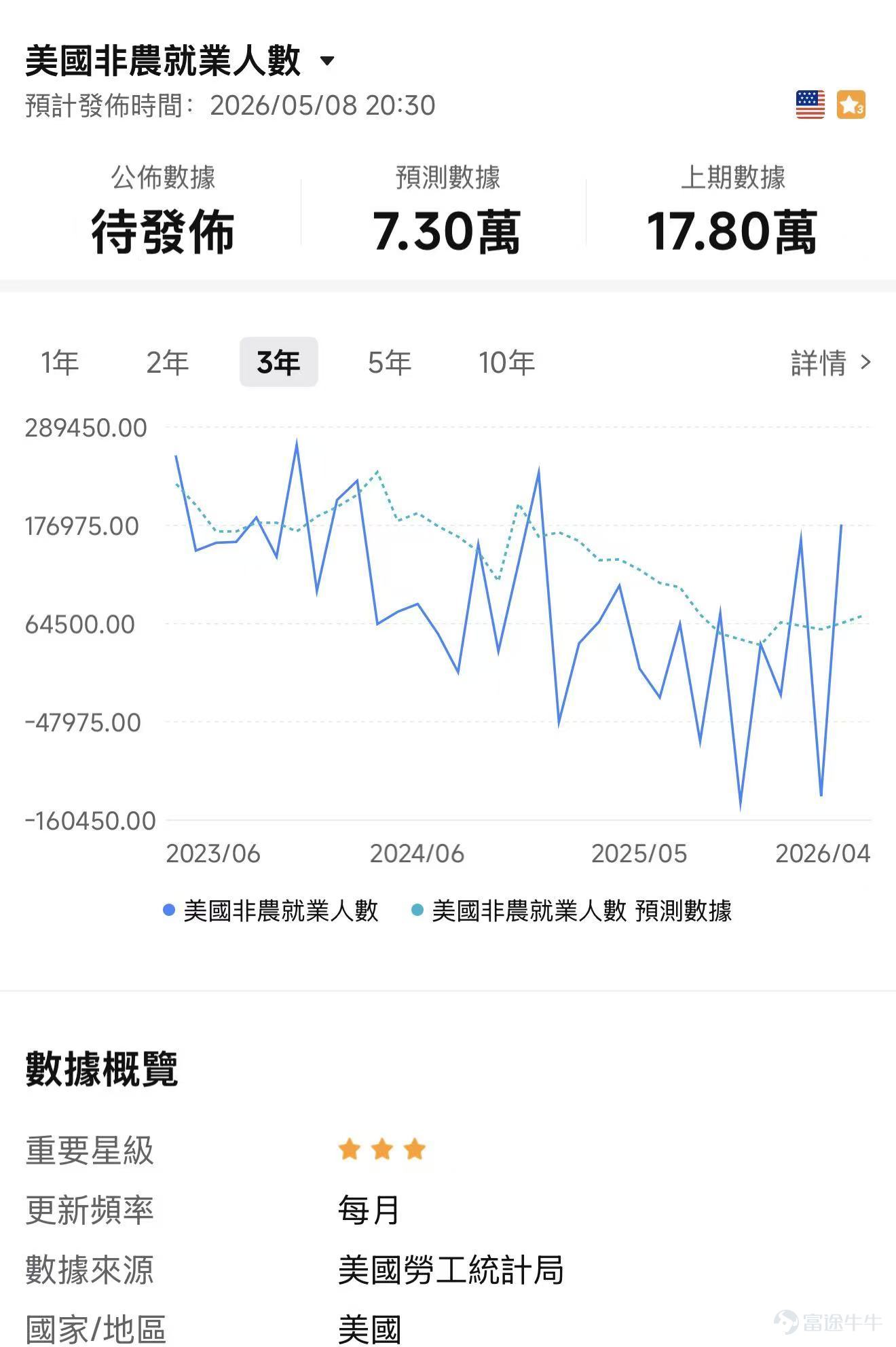
The most important variable for the market going forward is the US April non-farm payroll report. The US Bureau of Labor Statistics schedule shows that the April employment situation report will be released at 8:30 AM EST on May 8.
The most direct catalyst: rising expectations of a US-Iran peace agreement
Yesterday, gold surged significantly,driven by a chain reaction of easing US-Iran tensions → falling oil prices → easing inflation pressure → weakening US Treasury yields and the dollar → gold regaining pricing support.This entire chain was re-traded by the market.
The most direct catalyst is the possibility that the US and Iran are nearing a peace agreement. This news has led markets to believe that the likelihood of further escalation in the Middle East is decreasing, with risks in the Strait of Hormuz somewhat easing, causing oil prices to drop noticeably.
This is actually positive for gold. The reason is that during the earlier decline in gold, the market was concerned about 'rising oil prices leading to a second wave of inflation, forcing the Fed to maintain higher interest rates.'Once oil prices retreat and inflationary pressures ease, market concerns over the Fed's subsequent policies will decline, thereby alleviating pressure on gold.
The simultaneous weakening of the US dollar and US Treasury yields boosted gold. The weakening of the US dollar and the decline in the 10-year US Treasury yield this week provided support for gold; a weaker dollar also makes gold priced in dollars cheaper for non-dollar buyers.
Additionally, as selling pressure had already been released, gold is more prone to a technical rebound.Gold had previously fallen from its highs, releasing some crowded positions. A Goldman Sachs report mentioned that net speculative positions in gold have dropped to around the 41st percentile, and the crowding of bullish options has also been significantly cleared. In other words, the bullish bubble in the market is not as thick as it was at the beginning of the year, and once prices encounter favorable factors like a weaker dollar and lower interest rates, they are more likely to recover quickly.
Consensus among major banks: cautious in the short term, still optimistic in the medium term
The views of major banks have given the market medium-term confidence. While the conclusions of recent reports from major banks are not entirely the same, their direction is quite consistent: gold will continue to fluctuate in the short term, but the medium-term bullish logic remains intact.
Goldman Sachs' statement was the most direct: structurally bullish on gold, tactically cautiousGoldman Sachs continues to predict that gold prices will reach $5,400 per ounce by the end of 2026, citing reasons such as the continuation of central bank reserve diversification, speculative positions remaining relatively low, and the possibility of the Fed cutting interest rates by 50 basis points within the year. At the same time, they reminded that if disturbances in the Strait of Hormuz persist, combined with further adjustments in bonds or stocks, gold may still face additional liquidity selling pressure.
JPMorgan's perspective leans more towards structural factors. Its report argues that gold is indeed 'expensive' under traditional quantitative models. However, JPMorgan also emphasized that these traditional models are becoming less effective because they struggle to capture political risks, fiscal risks, de-dollarization, concerns about central bank independence, and the declining defensive attributes of the 60/40 portfolio, all of which contribute to a long-term premium. In other words, gold is currently expensive, but it’s expensive for a logical reason.
UBS Group places greater emphasis on timing. Their assessment is that gold may continue to experience volatility in the short term, with potential psychological support forming around $4,500.Official sector buying continues to support the bottom for gold. Data from the World Gold Council (WGC) shows that central banks and other official institutions net purchased 244 tons of gold in the first quarter, a 3% increase year-on-year, alleviating market concerns over large-scale official sector gold selling.Some of the most active buyers (such as Poland and Turkey in recent years) may have slowed their pace of purchases, but institutions that have been inactive for a long time (such as some Middle Eastern countries) have the potential to increase their buying. If there is further short-term pullback, it can instead be viewed as an opportunity to gradually build positions.
The next important variable is the US April non-farm payroll report.
The schedule from the US Bureau of Labor Statistics shows that the April employment situation report will be released at 8:30 AM EST on May 8.
ADP data released on Wednesday showed that private sector employment increased by 109,000 in April, surpassing economists' expectations of 99,000 and marking a significant acceleration from the downwardly revised 61,000 in March. This is the fastest growth since January 2025. While ADP data was stronger than expected, it should not be simply equated with a strong non-farm payroll report, as ADP only covers the private sector and excludes government employment. Moreover, deviations between ADP and the official BLS non-farm payroll figures are common.
The key focus of this non-farm payroll report is not just the number of new jobs added. The market will also be closely watching the unemployment rate, average hourly earnings, labor force participation rate, and revisions to previous figures. If employment weakens significantly while wages remain sticky, the market will lean more towards a 'stagflation defense' trade; if both employment and wages are strong, US Treasury yields and the dollar may rise again, putting short-term pressure on gold; if employment weakens and wage growth cools, rate-cutting trades will flow more smoothly, with gold supported by declining real interest rates.
JPMorgan noted in its report that a combination favorable for gold would be when economic momentum starts to ease but inflationary pressures do not quickly dissipate.This scenario lowers real growth expectations, weakens risk appetite for equities and credit assets, and casts doubt on the effectiveness of bonds as a safe-haven asset. Middle East conflicts and their impact on energy prices could create a macro backdrop of 'higher inflation, lower growth,' which has historically been an environment where gold performs well. The report also highlights that the true signal will be when gold decouples again from stocks, rising even as equities fall, indicating it is being viewed once more as an inflation hedge and portfolio defense asset, rather than a typical risk asset.

Options Strategy
After gold prices regain a foothold above $4,600, bullish momentum clearly recovers, with the strength of the rebound continuing to improve.The current key short-term resistance level is at $4,750.Once this level is effectively breached, the market could potentially explore further upside toward the $4,800–$4,850 range.
From a trading perspective, it is important to distinguish between 'the medium-term logic holds' and 'a suitable short-term buying opportunity.' Further upward movement in the short term requires additional catalysts, such as a significant weakening in US employment data, a continued decline in real US Treasury yields, or a further drop in the US Dollar Index.
As of May 6, $SPDR Gold ETF (GLD.US)$the implied volatility (IV) was 26.14%, with its historical percentile reaching 69%. The volume put-call ratio (PCR) is extremely low, indicating active bullish trading, with the volume PCR as low as 0.35. Despite a large total number of open interest contracts (approximately 4.8718 million), the structure also reflects a bullish bias.
(1) For clients who wish to buy GLD but feel uncomfortable chasing at the current level
they can consider usingCash-Secured Putstrategy, which means selling Puts to wait for opportunities to buy at lower prices.
Specifically, one can choose to sell Puts expiring in 2-4 weeks with strike prices one level below the current price. If GLD does not fall to the strike price, investors can collect the premium; if GLD pulls back and gets exercised, it would be equivalent to buying GLD at a lower price.
It should be emphasized that selling Puts is not purely a strategy to earn premiums; essentially, it sets a price at which one is willing to take delivery. This strategy is only suitable for those who are fundamentally willing to buy GLD at that price.
(The figure below illustrates the simulated profit and loss scenario of this strategy on the expiration date. The design image displayed on the screen is for demonstration purposes only and does not constitute any investment advice or guarantee; market conditions fluctuate frequently, and the prices shown do not represent actual values.)

(2) For clients who already hold GLD or gold-related assets and believe that GLD will enter a short-term consolidation phase
they can consider overlaying on their existing positionsCovered Callstrategy.
The specific approach is to continue holding GLD spot while selling out-of-the-money Call options with a slightly higher strike price than the current level, expiring in 1 to 3 weeks. This way, if GLD remains range-bound or rises moderately in the short term, the client can collect premiums to reduce the cost of holding the position. If GLD continues to rise, the spot position will still gain some upside, though the gains will be capped by the sold Call.
This strategy is suitable for investors who already hold a core position and do not have a strong expectation of a significant short-term breakout. If subsequent US data weakens significantly, the dollar declines rapidly, and gold enters an accelerated upward phase, it would not be advisable to sell excessive Calls so as not to limit potential gains on the position.
(The figure below illustrates the simulated profit and loss scenario of this strategy on the expiration date. The design image displayed on the screen is for demonstration purposes only and does not constitute any investment advice or guarantee; market conditions fluctuate frequently, and the prices shown do not represent actual values.)

Finally, Option Sir brings a small perk for fellow investors, welcome to claim it.Options Beginner Pack
*This event is exclusive to invited HK users. Click to learn more.Detailed event rules>>
Market conditions are complex and volatile,Options StrategyOverwhelmed by choices? Futubull helps you build a portfolio in three steps.Options Strategymaking investing simple and efficient!

Option Risk Warning:An option is a contract that grants the holder the right, but not the obligation, to buy or sell an asset at a fixed price on a specific date or at any time before that date. The price of an option is influenced by various factors, including the current price of the underlying asset, the strike price, time to expiration, and implied volatility. Implied volatility reflects the market’s expectations for the level of volatility in the option over a future period. It is a data point derived inversely from the Black-Scholes option pricing model and is generally regarded as an indicator of market sentiment. When investors anticipate greater volatility, they may be more willing to pay a higher price for options to hedge risks, resulting in higher implied volatility. Traders and investors use implied volatility to assess the attractiveness of option prices, identify potential mispricings, and manage risk exposure.
Disclaimer:This content does not constitute any offer, solicitation, recommendation, opinion, or guarantee of any securities, financial products, or tools. The risk of loss in trading options can be substantial. In some cases, losses may exceed the initial margin deposited. Even if you set contingent orders such as 'stop-loss' or 'limit' orders, these may not prevent losses. Market conditions may make such orders unexecutable. You may be required to deposit additional margin within a short period. If you fail to provide the required amount within the specified time, your open positions may be liquidated. However, you will still be responsible for any shortfall in your account. Therefore, before trading, you should study and understand options and carefully consider whether such trading is suitable for you based on your financial situation and investment objectives. If you trade options, you should be familiar with the procedures for exercising options and the rights and obligations upon exercise and expiration. Options trading carries extremely high risks and is not suitable for all investors. Investors should carefully readCharacteristics and Risks of Standardized Options。
Risk Disclaimer: The above content only represents the author's view. It does not represent any position or investment advice of Futu. Futu makes no representation or warranty.Read more


Comments (6)
to post a comment
38
57