Jensen Huang signals at shareholder meeting: The era of 'AI factories' has arrived

Follow Jensen Huang's strategy! NVIDIA heavily invests in Corning, the strongest dark horse in the AI investment landscape surges 350%
$NVIDIA (NVDA.US)$is extending the competition for AI infrastructure from chips to fiber optics.
On May 6, NVIDIA and Corning announced a multi-year commercial and technology partnership. Under the agreement, Corning will build three advanced manufacturing plants in North Carolina and Texas dedicated to producing optical connectivity solutions for NVIDIA, creating over 3,000 high-paying jobs.
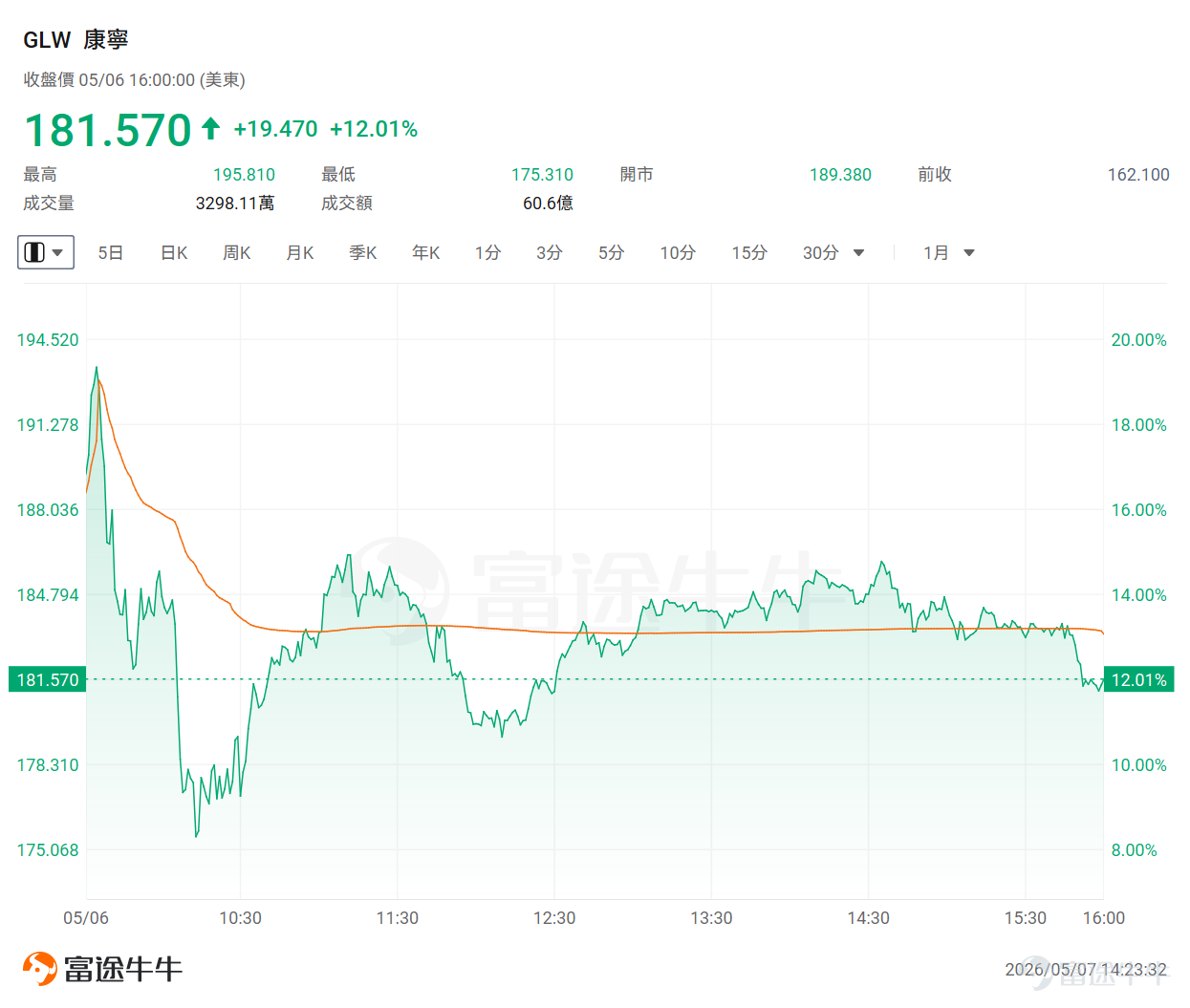
NVIDIA invested $500 million to secure$Corning (GLW.US)$equity subscription rights,Corning's stock price soared over 12% overnight after the company received two immediately exercisable warrants (to purchase up to 3 million shares at $0.0001 per share and up to 15 million shares at $180 per share).

--
--
--
This is not a one-off bet by NVIDIA, but rather a long-planned industry acquisition spree:
In just a few months, NVIDIA has invested $2 billion each in Lumentum and Coherent, securing core production capacity for photonic chips and optical modules. Similarly, Meta previously committed up to $6 billion to support Corning’s expansion. This concentrated push by tech giants sends a very clear signal:The capital race around 'optical communications' is undergoing a qualitative leap!
By now, astute fellow investors must already sense an opportunity:
🎯In-depth Analysis:Why is NVIDIA making such a big bet on Corning?
🗺️Investment Landscape: Who’s in NVIDIA’s ‘circle of friends’?
📈Win Rate Review: How impressive has the performance of these companies been after being 'chosen' by NVIDIA?
Why is NVIDIA betting on Corning?
NVIDIA announced a $500 million investment in Corning to acquire subscription rights for 18 million shares. Meanwhile, Corning will increase its domestic optical connectivity production capacity in the U.S. tenfold and boost fiber optic output by more than 50%, building three advanced manufacturing plants dedicated to NVIDIA in North Carolina and Texas.
Behind this hefty investment lies NVIDIA’s profound strategic layout for the underlying infrastructure of AI.
I. Industry Logic: A paradigm shift from 'compute-intensive' to 'optical interconnect-intensive'
The evolution of AI clusters has reached a critical juncture. As GPU scales expand from thousands to tens of thousands, or even hundreds of thousands of cards within super-nodes, individual computing power is no longer the sole core focus. Data transmission bottlenecks between nodes are shifting system constraints from 'individual computing' to 'photon transmission.' To break through this 'memory wall' and interconnect limits, optical communication has become an inevitable solution.
II. Strategic Logic: Completing the 'Iron Triangle,' gaining absolute sovereignty over optical interconnects
NVIDIA's capital deployment in the optical communication sector reveals a clear and highly centralized strategy. Partnering with Corning marks the final piece of its optical domain puzzle.
Front-end and mid-tier (chip/module):In March 2025, NVIDIA made a bold $4 billion investment (split into two $2 billion portions). $Coherent (COHR.US)$ and $Lumentum (LITE.US)$ , binding the capacity of photonic chips, modulators, and optoelectronic conversion modules until 2030.
Back-end (transmission medium):This investment in Corning secures solutions for long-distance and low-loss fiber optic connections all at once.
Thus, the 'photonic chip - optical module - optical fiber' iron triangle is officially closed. NVIDIA is taking hold of the entire optical interconnect lifeline from the bottom up, refusing to let third parties dominate the optical side design of GPU clusters.
Three, competitive logic: Giants enter the field comprehensively, co-packaged optics becomes a battleground.
The technical focus of this 'light battle' points directly at CPO (Co-Packaged Optics) technology. As early as 2025, NVIDIA had already released network switches using CPO technology, which encapsulates optical engines directly with switch chips, greatly reducing signal distance and lowering energy consumption.
This is not NVIDIA’s solo show — Broadcom and Marvell Technology have quickly followed up with related products, while Intel is also fully developing CPO solutions. The silicon photonics war over underlying data transmission has become the next core battleground for tech giants.
In fact, Nomura sees NVIDIA's proactive cooperation with Corning as having profound signaling significance.
Optical demands in AI data centers are expanding multidimensionally: Fiber and cable needs continue to rise in scale-out scenarios; in scale-up directions, the requirements for high-speed interconnection within racks for optical connection solutions are becoming increasingly stringent; in DCI directions, bandwidth transmission demands across data centers are simultaneously amplifying (this also echoes NVIDIA's investment in Nokia, which is a key participant and technological leader in the global DCI field).Multiple scenario resonances lead NVIDIA to judge it necessary to lock in core suppliers strategically to ensure capacity guarantees for many years to come.
Nomura pointed out that it is precisely this long-term demand expectation that has driven NVIDIA to proactively establish a cooperative relationship with Corning.
Who are the key players in NVIDIA's investment portfolio?
previouslyUnveiling NVIDIA’s "AI Empire"! Where exactly is Jensen Huang placing his bets?It was noted that transitioning from being the dominant GPU player to becoming the "kingmaker" of the entire industry chain, a look into NVIDIA’s investment blueprint reveals a massive AI empire already taking shape. Its capital reach has precisely covered five core dimensions:

--
--
--
1. Strengthening foundational infrastructure: Overcoming the 'weakest link' bottleneck in computing power and transmission
As AI cluster sizes expand to the tens of thousands of cards level, bottlenecks in data transmission and foundational design are becoming increasingly prominent. NVIDIA's investments aim to ensure maximum stability across the entire hardware supply chain and secure a technological edge.
Chip manufacturing and design: Investing in the leading EDA software company $Synopsys (SNPS.US)$ , with the goal of leveraging AI to assist in the design of next-generation GPUs, significantly shortening R&D cycles; entering the $Intel (INTC.US)$ is about seeking strategic backup plans for advanced packaging and foundry capacity outside of Taiwan Semiconductor.
Optical communications and network interconnects: This is a highly predictable track in AI infrastructure. Strategically invest in optical communication giants $Lumentum (LITE.US)$ And, $Coherent (COHR.US)$, ensuring the underlying capacity for 800G and future 1.6T CPO; betting on fiber optic giant Corning to secure capacity; while also tying up with network chip leaderMarvell Technology and Enfabrica, which specializes in new I/O chips,to ensure efficient transmission of massive data between servers.
AI inference chips: Heavily bet on AI inference chip startups Groq, demonstrating early positioning in edge computing and specific high-speed inference scenarios to guard against potential technological disruptions.
II. GPU computing power cloud and data centers: Hold absolute authority in allocating computing resources
Traditional large cloud service providers (the Big Three cloud providers) are both NVIDIA's largest customers and active developers of proprietary AI chips, making them potential competitors. To mitigate the risk of being 'piped', NVIDIA is actively fostering its exclusive computing power ecosystem.
Pure GPU cloud provider: heavily invested in the leading pure GPU cloud company in North America $CoreWeave (CRWV.US)$, granting priority access to top-tier chips. At the same time, expanding into the European market through $NEBIUS (NBIS.US)$ and focusing on the developer market via NscaleandLambda Labs. The rise of these new computing power players will force traditional cloud giants to continue purchasing NVIDIA GPUs to maintain competitiveness.
Green computing infrastructure: Energy bottlenecks have become a widely acknowledged pain point for AI development. Investing in Crusoe (using flare gas from oil fields to power data centers) indicates that NVIDIA has begun to develop green energy solutions for data centers, suggesting that 'AI + Energy' will be a key focus for the market moving forward.
III. Frontier Technology: Exploring the Vast Potential of Computing Power
To maximize the value of computing power, NVIDIA is turning its attention to cutting-edge scientific fields that could bring about transformative changes in human society.
AI Drug Discovery: By leveraging GPU computing power to disrupt the traditional new drug development cycle, this is a highly scalable sector. NVIDIA has partnered with pharmaceutical giants $Eli Lilly and Co (LLY.US)$ and established $Recursion Pharmaceuticals (RXRX.US)$ as a benchmark for its BioNeMo platform, while also investing in chemical space exploration companies such asTerray, accelerating AI's implementation in biopharmaceuticals across the board.
Nuclear Fusion: Participated in investment in commercial nuclear fusion companiesCommonwealth Fusion Systems, further demonstrating its grand ambition to explore the ultimate clean energy for humanity and support the endless demand for AI computing power in the future.
4. Physical AI and Edge Computing: Cultivating the Next Generation of Computing Power Consumption Engines
As the training of large language models (LLMs) gradually converges, the enormous future demand for inference computing power will be supported by the physical world.
Telecommunications Infrastructure: Invest in telecom giants $Nokia Oyj (NOK.US)$ , aiming to push powerful AI inference capabilities to the edge of 5G/6G networks.
Humanoid robots: Physical AI is the next breakout point. Investing in leading humanoid robotics companiesFigure AI, indicating that future sensors, machine vision, and mechanical control technologies will experience massive demand.
Autonomous Driving:Investing in the rising star of end-to-end autonomous drivingWayve, promoting the application of pure data-driven AI models in real-world traffic scenarios.
5. Foundational large models and generative AI: Strengthening the CUDA software ecosystem moat
The leading advantage in hardware ultimately needs to be solidified through an impregnable software ecosystem.
Foundational large model giants: From participating inOpenAI's investments, to betting on Musk'sxAI, to open-source and enterprise-level model giantMistral AIandCohereNVIDIA, through its capital ties, ensures that the world's top large models continue to rely on the CUDA ecosystem for underlying training and inference optimization.
AI application layer and multimodal:Strategic positioning in AI search enginesPerplexityand leading AI video generation.RunwayParticularly, video generation and multimodal technologies demand far more computing power and memory bandwidth than pure text, which is the most favorable scenario for NVIDIA to generate high premiums from computational consumption.
How impressive has the performance of the companies 'chosen' by NVIDIA been?
What kind of explosive growth potential do the companies 'selected' by NVIDIA have?A review of historical data shows that NVIDIA’s investment success rate and driving effect serve as a market benchmark.
According to the latest statistics, among NVIDIA's recent core investment targets, several companies have experienced a major upward movement after announcing share purchases or capital increases:

--
--
--
Value Reassessment of Chip Manufacturing and Infrastructure Giants: Long-established giant $Intel (INTC.US)$ Since its investment in September 2025, it has surged an astonishing353.86%; communications infrastructure giant $Nokia Oyj (NOK.US)$ has also achieved about110%a double in gains.
Collective Surge in the Optical Communications Sector: As a core track in solving AI computing bottlenecks, $Marvell Technology (MRVL.US)$ has surged significantly since its investment.96.15%; and just received investment this March $Lumentum (LITE.US)$ and $Coherent (COHR.US)$ also recorded an increase of more than 30%; the latest $Corning (GLW.US)$ contributed in a single day to 12% growth.
The rise of Neocloud's computing power: In the pure GPU cloud provider track, $NEBIUS (NBIS.US)$ and $CoreWeave (CRWV.US)$ since receiving additional investment in the first quarter of this year, surged respectively by 102%and48%, demonstrating strong market recognition for the computing power rental business model.
Summary
Overall, the market’s enthusiasm for 'NVIDIA concept stocks' remains high. Within this vast investment blueprint, whether seeking a turnaround in performance from traditional giants or new stars leading technological change in silicon photonics and Neocloud, there are abundant short-term and long-term opportunities.
Fellow investors, in this 'AI Empire Blueprint,' which细分赛道 do you think has the most potential for future explosive growth? Feel free to share your thoughts in the comments!
Risk Disclaimer: The above content only represents the author's view. It does not represent any position or investment advice of Futu. Futu makes no representation or warranty.Read more


Comments (7)
to post a comment
123
437