Nasdaq hits new highs, AMD market cap surpasses $1 trillion! Is the market trading on the AI Agent n

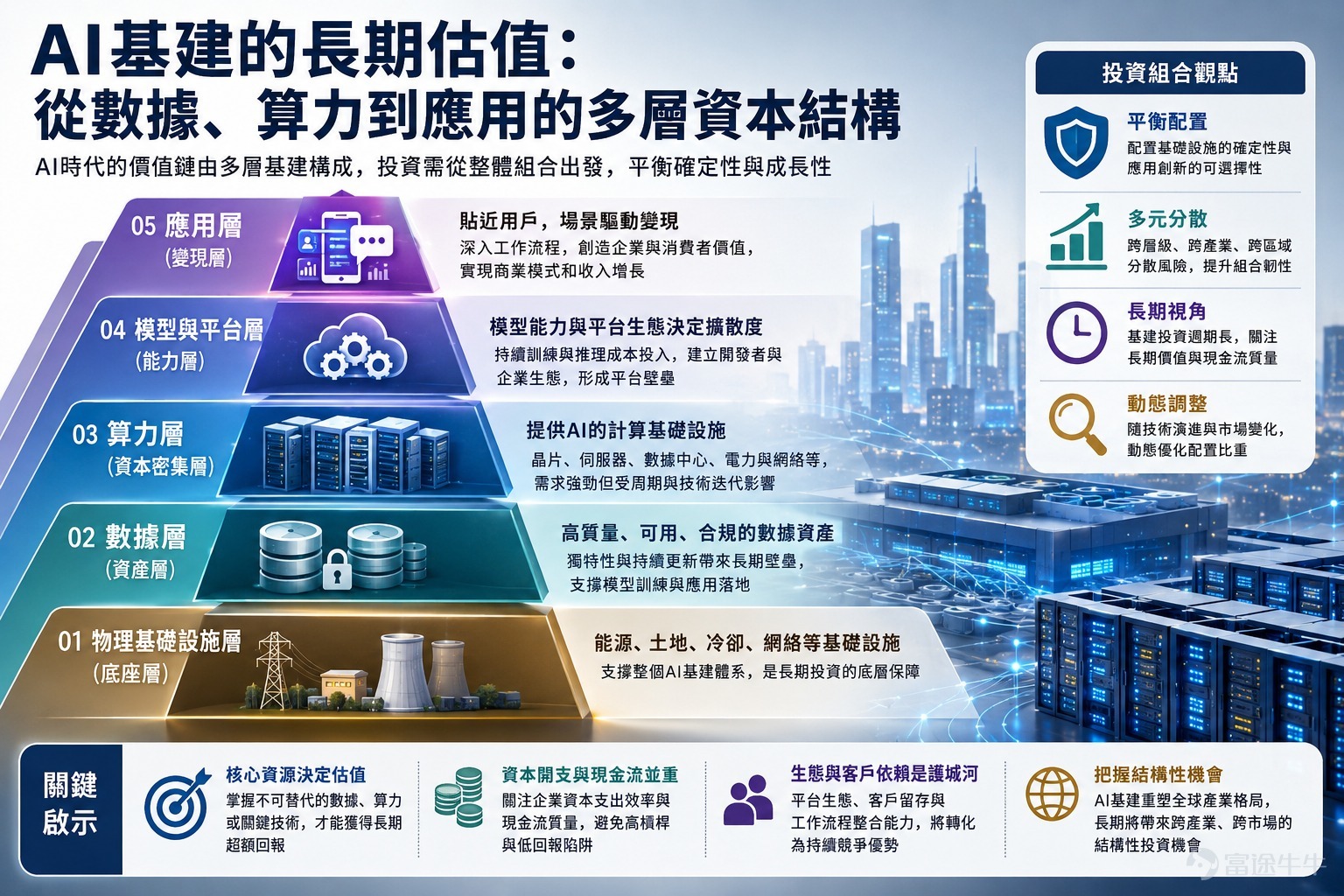
Multi-layer capital structure from data, computing power to applications
The investment boom in artificial intelligence appears on the surface to be a competition of model capabilities, but at a deeper level, it is a reassessment of infrastructure capital. In the past, markets were accustomed to understanding technology companies through the logic of internet platforms: whoever controlled traffic and could monetize users had a higher valuation. However, the value chain in the AI era is more complex; it is not just an application story but a multi-layered capital structure composed of data, computing power, models, cloud platforms, energy, networks, and end-user applications. Investors who only chase the most dazzling application companies may easily overlook the longer-cycle, heavier-asset, and more pricing-powerful infrastructure components.
First, data is the most easily underestimated layer in AI infrastructure. Model training relies on large amounts of data, but what truly holds value is not simply 'large volume'—it's the uniqueness, accuracy, traceability, and legal usage rights of the data. Public data will gradually become commoditized; internal corporate data, specialized industry data, and high-quality data in fields like healthcare, finance, and law are what might form lasting barriers. One of the core questions for future AI valuations is not whether a company 'uses AI,' but whether it possesses data assets that can be sustainably updated, legally accessed, and transformed into product capabilities. This allows some traditional industry leaders to be repriced as well, since their accumulated data may serve as the foundation for training vertical models and providing intelligent services.
Secondly, computing power is where AI capital expenditure is most concentrated, and also where the market is most prone to forming bubbles and divergences. Chips, servers, data centers, cooling systems, power supply, and high-speed networks together constitute the AI computing power layer. The characteristics of this layer are strong demand certainty, but long supply cycles, rapid depreciation, and high technological replacement risk. Investors need to distinguish between two types of companies: those with core technologies and scarce supply capabilities upstream, and those expanding computing power assets with high leverage but limited pricing power, capital-intensive firms. The former enjoy excess returns brought by technological barriers and supply-demand tensions, while the latter may face valuation compression during oversupply or rent declines.
The third layer is models and platforms. Large foundational models seem closest to the center of the AI revolution, but their business models are still evolving. Model companies need to continuously invest in training and inference costs, while facing competition from open-source models, cloud platform dependencies, and price wars. In the long run, a single model capability may not be enough to support permanent high valuations; what truly matters is whether the model can become a platform relied upon by developers, ecosystem partners, and enterprise clients. In other words, the valuation of the model layer should not focus solely on one test score but rather on customer retention, API call scale, toolchain integration, enterprise deployment capabilities, and whether technical advantages can be converted into stable cash flow.
AI infrastructure is not about betting on a single link
Finally, there is the application layer. This layer is closest to users and has the potential for explosive growth, but it also faces the fiercest competition. AI applications that merely repackage general models into chat interfaces often lack sufficient barriers to entry; those that can deeply integrate into workflows, transforming enterprise decision-making, software usage, content creation, or customer service, have the potential to create real business value. Notably, the winners in AI applications are not necessarily all startups. Established software companies with strong customer relationships, distribution channels, and industry-specific scenarios may be better positioned to quickly monetize AI capabilities.
Therefore, the long-term valuation of AI infrastructure should be considered from the perspective of an overall investment portfolio rather than betting on a single segment. The data layer provides long-term barriers, the computing power layer reflects capital cycles, the model platform layer determines the pace of technology diffusion, and the application layer is responsible for final monetization. The risk-reward characteristics vary across layers: upstream hardware may benefit from short-term supply-demand imbalances but is more cyclical; data and software platforms grow more slowly but may exhibit higher stickiness; application companies offer the highest upside but also carry the highest failure rates. A mature AI investment portfolio should balance 'the certainty of infrastructure' with 'the optionality of application innovation'.
(Chip and Computing Power Series, Part 55)

Risk Disclaimer: The above content only represents the author's view. It does not represent any position or investment advice of Futu. Futu makes no representation or warranty.Read more
Comments
to post a comment