
Meta makes a huge bet! Is it still worth positioning in the 'AI pickaxe sellers'?

The Hardware Foundation Behind High-Frequency Trading and Intelligent Risk Control
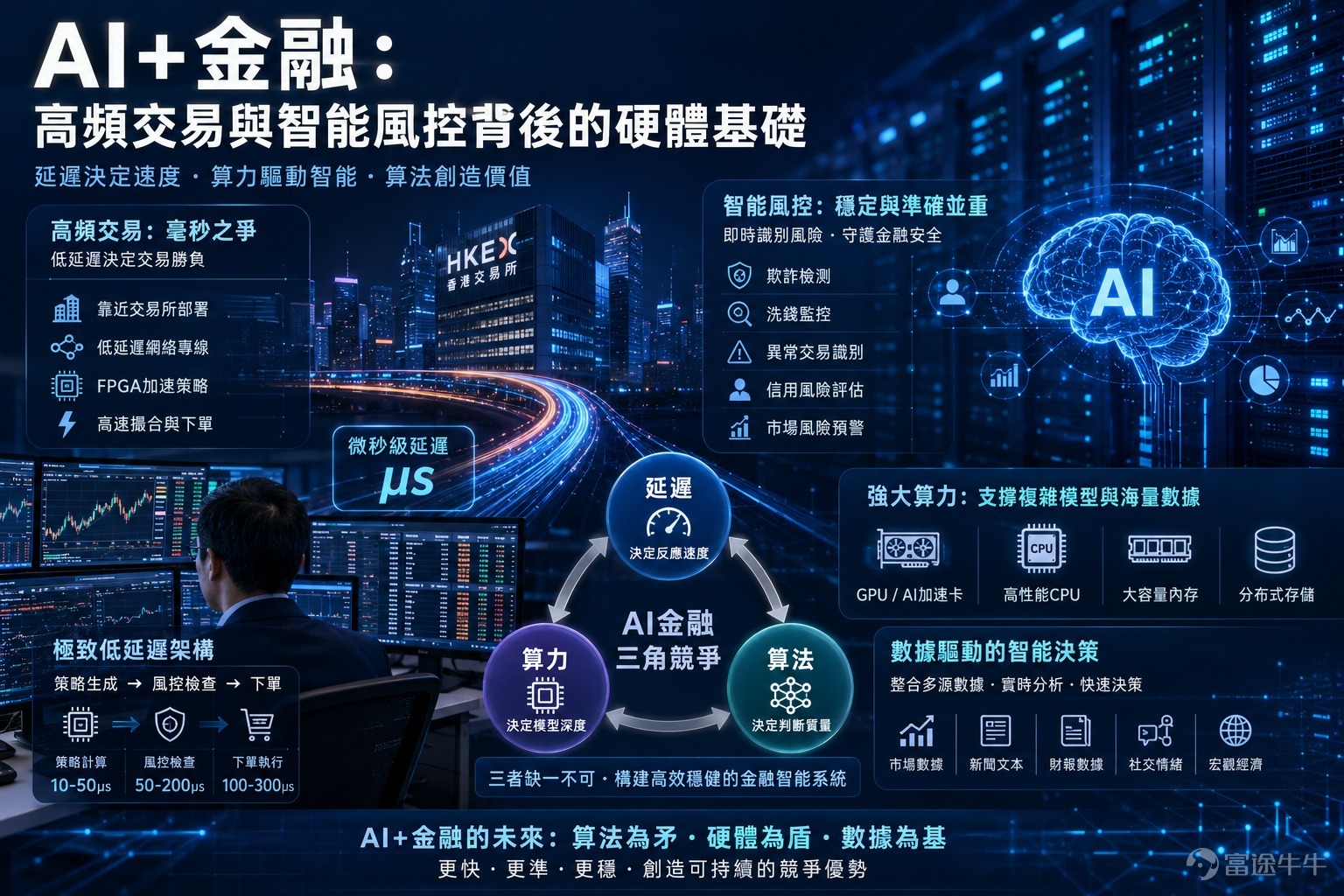
When the financial industry discusses artificial intelligence, the market tends to focus on models, algorithms, and data, as if having smarter trading strategies, larger historical datasets, and more complex deep learning models alone can provide an advantage in the capital markets. However, in real fintech competition, algorithms are only the tip of the iceberg. Beneath the surface, the critical factor is the hardware foundation: servers, chips, networking equipment, data center architecture, and the entire system capable of supporting low latency, high throughput, and high reliability computing. Particularly in the two major scenarios of high-frequency trading and intelligent risk control, hardware often plays a decisive role rather than being merely a supporting actor.
The essence of high-frequency trading lies in capturing market price changes within extremely short timeframes and executing orders, canceling them, and performing risk checks faster than competitors. The term 'fast' here does not refer to the seconds that ordinary investors might think of but instead involves competition at the millisecond, microsecond, or even nanosecond level. When different institutions use similar market data and closely related statistical models, what truly sets them apart is often the network latency between the trading system and the exchange, the computation speed before order matching, and whether the hardware can handle massive order messages stably. In other words, in the world of high-frequency trading, algorithms determine direction, but hardware decides whether one reaches the finish line first.
The Triangular Competition of Latency, Computing Power, and Algorithms
Latency is one of the most sensitive metrics in high-frequency trading. Every step from generating trading instructions in the strategy system, to review by the risk control module, and then transmission via the network to the exchange can potentially cause time loss. Therefore, financial institutions place their servers in data centers close to exchanges, utilizing low-latency network cards, high-speed switches, and dedicated lines to reduce physical distance and transmission time. Some trading systems even adopt programmable hardware such as FPGAs, embedding part of the strategy logic directly into the hardware layer to minimize delays caused by software processing. This demonstrates that competition in fintech isn't just about writing code in offices; it’s also about fighting for every inch of distance and every microsecond of time in server rooms.
But speed is not the only answer. As AI enters the financial markets, trading strategies and risk control models are becoming increasingly complex, and the importance of computing power is rising in tandem. Traditional quantitative models may rely on statistical arbitrage, mean reversion, or factor models, while AI models may need to process news text, earnings semantics, social media sentiment, macro data, and market microstructure signals. These data sources differ in format, frequency, and contain significant noise, so without GPUs, AI accelerator cards, high-performance CPUs, and large-capacity memory working together, a model that is theoretically feasible would struggle to operate in real-time in live markets. Financial institutions are not just pursuing the training of an elegant model; they want the model to complete inference and decision-making while the market is still relevant.
The hardware requirements for intelligent risk control have different characteristics. It may not pursue ultra-low latency like high-frequency trading, but places more emphasis on stability, accuracy, and scalability. Banks, brokerages, payment platforms, and insurance companies handle massive amounts of transactions, loan applications, transfers, and customer behavior data daily. AI risk control systems need to instantly identify fraud, money laundering, abnormal transactions, credit deterioration, and market risk transmission. Such tasks require the system to run continuously in high-concurrency environments, avoiding missed judgments due to insufficient computing power or slowing down normal operations due to overly complex models. For financial institutions, a single system delay could mean transaction losses, while a risk control error might escalate into a compliance and reputational crisis.
Therefore, the core competition in AI finance is forming a triangular structure: latency determines response speed, computing power determines model depth, and algorithms determine judgment quality. None of these three elements can be missing. Having only algorithms without hardware results in impractical theories; having only hardware without models is merely an expensive investment in server rooms; and having speed without risk control could amplify incorrect decisions into systemic risks. A truly mature fintech platform integrates trading, risk control, data governance, and infrastructure into a closed-loop system, making AI not just an analytical tool but also a real-time decision-making engine embedded in financial business processes.
From an industry perspective, this also explains why, under the AI wave, financial institutions need not only data scientists but also chip, cloud computing, network engineering, and cybersecurity talents. The advantage in future financial markets may no longer belong solely to those who best understand asset pricing, but also to teams that excel at deploying models into low-latency, highly reliable hardware environments. As AI models become easier to replicate, what will truly be difficult to duplicate is the system capability formed through the long-term integration of data, algorithms, and hardware architecture.
(Chip and Computing Power Series, Part 54)

Risk Disclaimer: The above content only represents the author's view. It does not represent any position or investment advice of Futu. Futu makes no representation or warranty.Read more
Comments
to post a comment