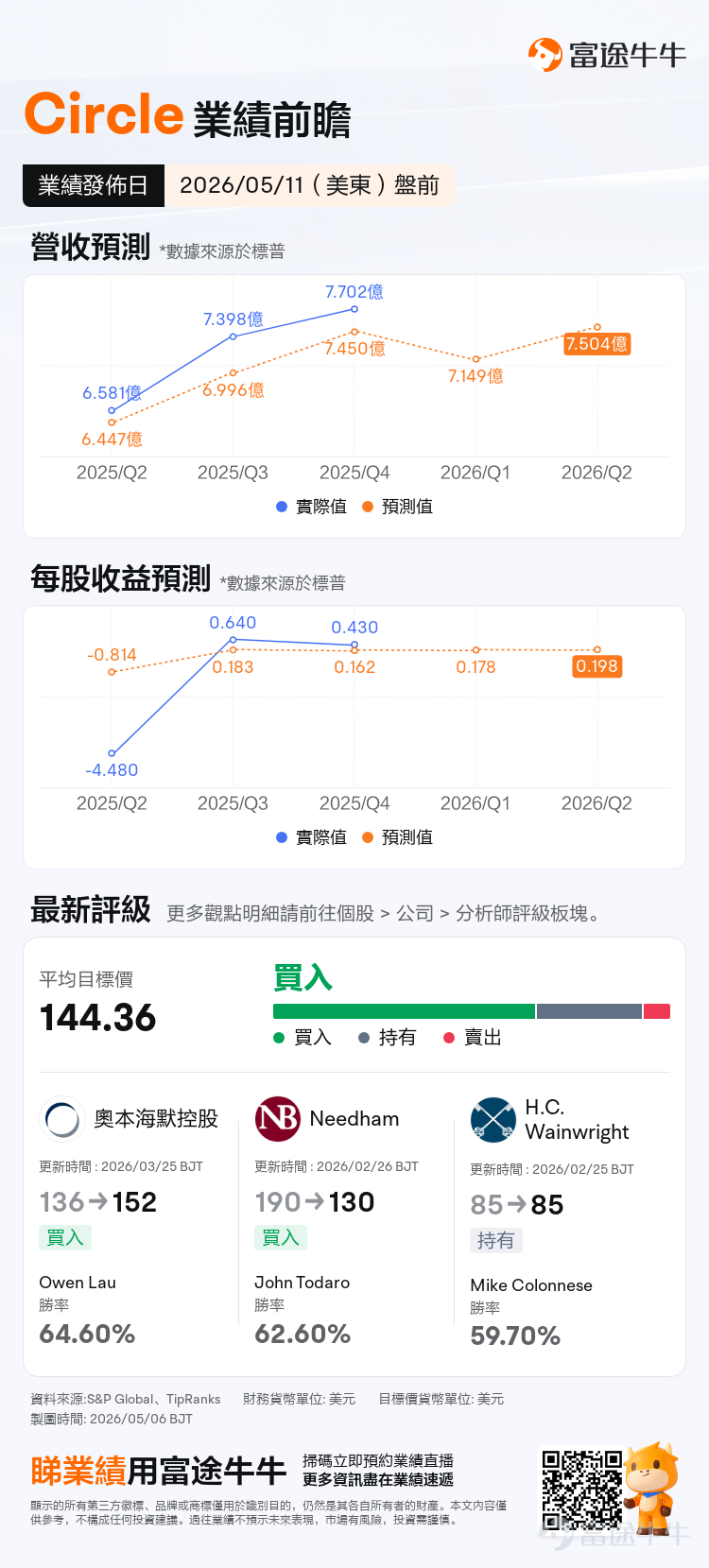

Circle's performance fell short of expectations. What is your take on this?

Earnings Options Strategy | Regulatory tailwinds gather momentum, USDC returns to growth. What changes will Circle's earnings report bring?
$Circle (CRCL.US)$ Circle will release its earnings report pre-market on May 11 EST. Institutional forecasts expect revenue of $715 million for Q1 2026, with an estimated earnings per share of $0.178.
Looking at the situation ahead of the earnings report, the recovery in USDC scale, the improvement in risk appetite in the crypto market, and better regulatory expectations have all created a relatively favorable backdrop for this earnings release. In this report, Circle needs to demonstrate that it is not merely a beneficiary of the high-interest-rate cycle. The market is focused on whether USDC’s growth is sufficiently stable, whether other revenue streams are beginning to pick up, whether regulatory clarity can drive institutional adoption, and whether distribution costs might erode profit margins.

The recent recovery in the crypto market has provided Circle with a better external environment.
Based on recent market trends, Circle is facing a more favorable external environment for this earnings report compared to the last one.Bitcoin is currently around $81,400, having reclaimed the $80,000 level, indicating that risk appetite for crypto assets has recovered from the lows of Q1. CRCL shares are trading near $114, still showing significant intraday volatility, with heightened sensitivity to earnings and regulatory catalysts.

The scale of USDC has also rebounded somewhat. Data from the third-party platform CoinGecko shows that USDC's market cap is currently around $78 billion, higher than $75.3 billion at the end of Q4 last year.This trend is positive, but the magnitude is not particularly exaggerated. In other words, the rebound in the crypto market has indeed alleviated the redemption pressure on USDC, but it hasn't reached a point where the market can be unconditionally optimistic.
The market doesn't just look at the end-of-period USDC balance; it also pays attention to the average circulation scale in the first quarter. This is especially true given that USDC experienced a pullback at the beginning of the first quarter and short-term interest rates marginally declined.If the average scale steadily increases, it indicates that the recovery in demand for USDC is genuine; if only the quarter-end figures look good, the market might consider the growth insufficiently robust.
Therefore, what this earnings report needs to verify is whether the recovery in the crypto market has truly translated into net inflows for USDC. If the circulation scale of USDC and its on-chain activity improve simultaneously, Circle’s revenue base will be more stable; if Bitcoin rebounds but USDC growth remains limited, the market will reassess the strength of the transmission between Circle and the overall health of the crypto market.
Reserve yields are an unavoidable pressure point in this earnings report.
Circle's largest source of income, accounting for approximately 95%, still comes from the interest generated by USDC reserve assets. This model means it is highly sensitive to the interest rate environment.
At the end of April, the Federal Reserve continued to maintain the federal funds rate target range at 3.5%—3.75%, with the 3-month Treasury bill rate in April at approximately 3.61%. Although this interest rate level is still not low, it is already below the high-rate phase seen in the previous two years.
This means that Circle's future revenue growth cannot rely solely on 'earning interest from high rates'.The USDC balance determines how much principal Circle has to generate interest, while short-term rates determine how much interest can be generated per dollar of principal. The key focus of this earnings report is whether the combination of the two can continue to support revenue growth.The scale of USDC needs to continue growing to offset the pressure from declining yields on reserves per USDC unit.If management provides clear guidance on reserve yields, average USDC scale, and future interest rate sensitivity in the earnings report, it will directly impact the market’s adjustments to profit forecasts.
Regulatory progress may have a greater impact on stock sentiment than single-quarter profits.
Another core variable for Circle is regulation. Recently, there has been new compromise progress regarding stablecoin provisions in the CLARITY Act.
Although the CLARITY Act had already passed in the House of Representatives, it was stalled in the Senate due to controversies over stablecoin interest payments. The latest proposal generally moves in this direction: restricting passive income akin to bank deposit interest but allowing reward mechanisms based on real usage behavior. This change alleviates market concerns about a blanket ban on stablecoin incentives and has also driven a rebound in related crypto stocks. $Circle (CRCL.US)$ 、 $Coinbase (COIN.US)$ such as Coinbase.
This is crucial for Circle. The long-term advantage of USDC lies in its compliance. If the U.S. stablecoin regulatory framework becomes clearer, institutional funds, payment companies, and fintech platforms will face fewer obstacles to adopting USDC. In the short term, detailed regulations might impose constraints; however, in the medium to long term, clear rules are beneficial for compliant leaders to expand their market share.
Therefore, in this earnings call, the management's comments on regulatory developments will be crucial. The market is focused on how USDC can expand its usage in payment, institutional settlement, tokenized assets, and cross-border transfer scenarios after the regulations are implemented.
Whether 'other revenue' can continue to exceed expectations is the key to whether the valuation can reach the next level.
Since interest income from reserve assets can basically be considered public data, the main area that could create a difference in expectations is other revenue.In the fourth quarter, Circle’s other revenue reached 37 million US dollars, showing a sequential growth of 29%Although this portion of revenue is still small, accounting for less than 5%, it represents progress in businesses such as payments, Web3 software services, enterprise services, and on-chain infrastructure.
The importance of this business lies in determining how the market should value Circle. If Circle continues to rely primarily on interest earned from USDC reserves, the market may easily view it as more of a financial company, with its valuation flexibility constrained by interest rate cycles. However, if other businesses gradually increase in scale, Circle’s narrative would move closer to being a 'payment infrastructure platform on the blockchain,' which would open up greater valuation potential.
Recently, the company has launched CPN Managed Payments, aiming to allow payment service providers, fintech companies, banks, and global platforms to use stablecoin settlements without directly managing digital assets. While this direction may contribute limited revenue in the short term, it is critical to Circle’s long-term positioning.
The pressure from Coinbase revenue sharing still depends on whether the gross margin can be maintained.
On the expenditure side, the main operational cost within Circle is employee compensation, while external costs are primarily channel commissions and transaction fees, which account for 60% of revenue, with the majority going to Coinbase. Platforms like Coinbase control a large user base, transaction scenarios, and stablecoin balances. They help USDC gain traffic and usage scenarios but also take a portion of the reserve income. For Circle, this is the channel cost of expanding the ecosystem.
In the previous earnings report, the market was originally concerned that Coinbase's commission might drag down profit margins, but Circle stabilized and even improved its gross margin by increasing the proportion of self-held USDC and through the growth of high-margin new businesses. The gross margin in Q4 reached 40%, an increase of 50 basis points。
This earnings report needs to focus on two things: whether distribution costs have risen further and whether other high-margin businesses can offset channel commission pressure. Revenue growth is important, but if most of the growth is captured by the channel, the stock price reaction may not be positive.
Options Strategy
As of May 5, 2026, the options market predicts a fluctuation of ±15.13% on CRCL's earnings day, marking the highest forecasted volatility since its listing.

After a sharp rise in the share price over the past few days, multiple short-term technical indicators have entered the overbought zone. The current implied volatility (IV) is high at 98.19%, placing it at the 74th percentile historically. High IV indicates expensive option prices, and the market expects significant future stock price fluctuations. The Put/Call Ratio is only 0.32, indicating that overall sentiment among options traders remains bullish.

In terms of options strategies,
(1) If you are optimistic about Circle in the long term but do not want to chase the price at this level,
this strategy suits investors willing to buy CRCL during a post-earnings pullback. Consider selling put options, leveraging high IV to collect higher premiums. If CRCL does not fall below the strike price after earnings, the option will likely benefit from time decay and IV contraction. If the stock price pulls back to the target range, it would effectively allow buying at a lower price. It’s worth noting that CRCL's expected volatility is relatively high. Selling puts further out-of-the-money provides a larger margin of safety but comes with lower returns.
(The figure below illustrates the simulated profit and loss scenario of this strategy on the expiration date. The design image displayed on the screen is for demonstration purposes only and does not constitute any investment advice or guarantee; market conditions fluctuate frequently, and the prices shown do not represent actual values.)

(2) If you are optimistic about CRCL's earnings report but want to avoid the high premium cost
Suitable for investors who are lightly positioned or have no positions and want to participate in the post-earnings upside. Consider a Bull Call Spread, a bullish options strategy. Buying naked Calls or Puts before earnings essentially involves betting on both direction and volatility. With current implied volatility (IV) already high, the probability of success will be significantly reduced.
The core of this structure is using the premium from selling a higher strike Call to offset the cost of buying a Call. This type of strategy works well when optimistic about the earnings report and expecting an upward breakout in stock price. If CRCL only sees a small rise after the earnings release, the impact of IV contraction on a Bull Call Spread will be less severe compared to buying a naked Call.
(The figure below illustrates the simulated profit and loss scenario of this strategy on the expiration date. The design image displayed on the screen is for demonstration purposes only and does not constitute any investment advice or guarantee; market conditions fluctuate frequently, and the prices shown do not represent actual values.)

(3) If the client already holds CRCL shares and has substantial unrealized gains
Suitable for shareholders who are concerned about a sharp pullback after earnings but do not want to sell their shares directly. Consider a long collar strategy. This strategy locks in some of the extreme downside risk after earnings while using the premium from selling a Call to offset the cost of buying a Put. The choice of the Put's strike price depends on where you want to set your downside floor, and the Call's strike price determines where you're willing to cap your upside. The trade-off is that if CRCL surges after earnings, some potential gains will be forfeited. This is more suitable for clients who have already captured a portion of the move and do not want to give back their profits overnight.
(The figure below illustrates the simulated profit and loss scenario of this strategy on the expiration date. The design image displayed on the screen is for demonstration purposes only and does not constitute any investment advice or guarantee; market conditions fluctuate frequently, and the prices shown do not represent actual values.)

Finally, Option Sir brings a small perk for fellow investors, welcome to claim it.Options Beginner Pack
*This event is exclusive to invited HK users. Click to learn more.Detailed event rules>>
Market conditions are complex and volatile,Options StrategyOverwhelmed by choices? Futubull helps you build a portfolio in three steps.Options Strategymaking investing simple and efficient!

Option Risk Warning:An option is a contract that grants the holder the right, but not the obligation, to buy or sell an asset at a fixed price on a specific date or at any time before that date. The price of an option is influenced by various factors, including the current price of the underlying asset, the strike price, time to expiration, and implied volatility. Implied volatility reflects the market’s expectations for the level of volatility in the option over a future period. It is a data point derived inversely from the Black-Scholes option pricing model and is generally regarded as an indicator of market sentiment. When investors anticipate greater volatility, they may be more willing to pay a higher price for options to hedge risks, resulting in higher implied volatility. Traders and investors use implied volatility to assess the attractiveness of option prices, identify potential mispricings, and manage risk exposure.
Disclaimer:This content does not constitute any offer, solicitation, recommendation, opinion, or guarantee of any securities, financial products, or tools. The risk of loss in trading options can be substantial. In some cases, losses may exceed the initial margin deposited. Even if you set contingent orders such as 'stop-loss' or 'limit' orders, these may not prevent losses. Market conditions may make such orders unexecutable. You may be required to deposit additional margin within a short period. If you fail to provide the required amount within the specified time, your open positions may be liquidated. However, you will still be responsible for any shortfall in your account. Therefore, before trading, you should study and understand options and carefully consider whether such trading is suitable for you based on your financial situation and investment objectives. If you trade options, you should be familiar with the procedures for exercising options and the rights and obligations upon exercise and expiration. Options trading carries extremely high risks and is not suitable for all investors. Investors should carefully readCharacteristics and Risks of Standardized Options。
Risk Disclaimer: The above content only represents the author's view. It does not represent any position or investment advice of Futu. Futu makes no representation or warranty.Read more


Comments (7)
to post a comment
27
61