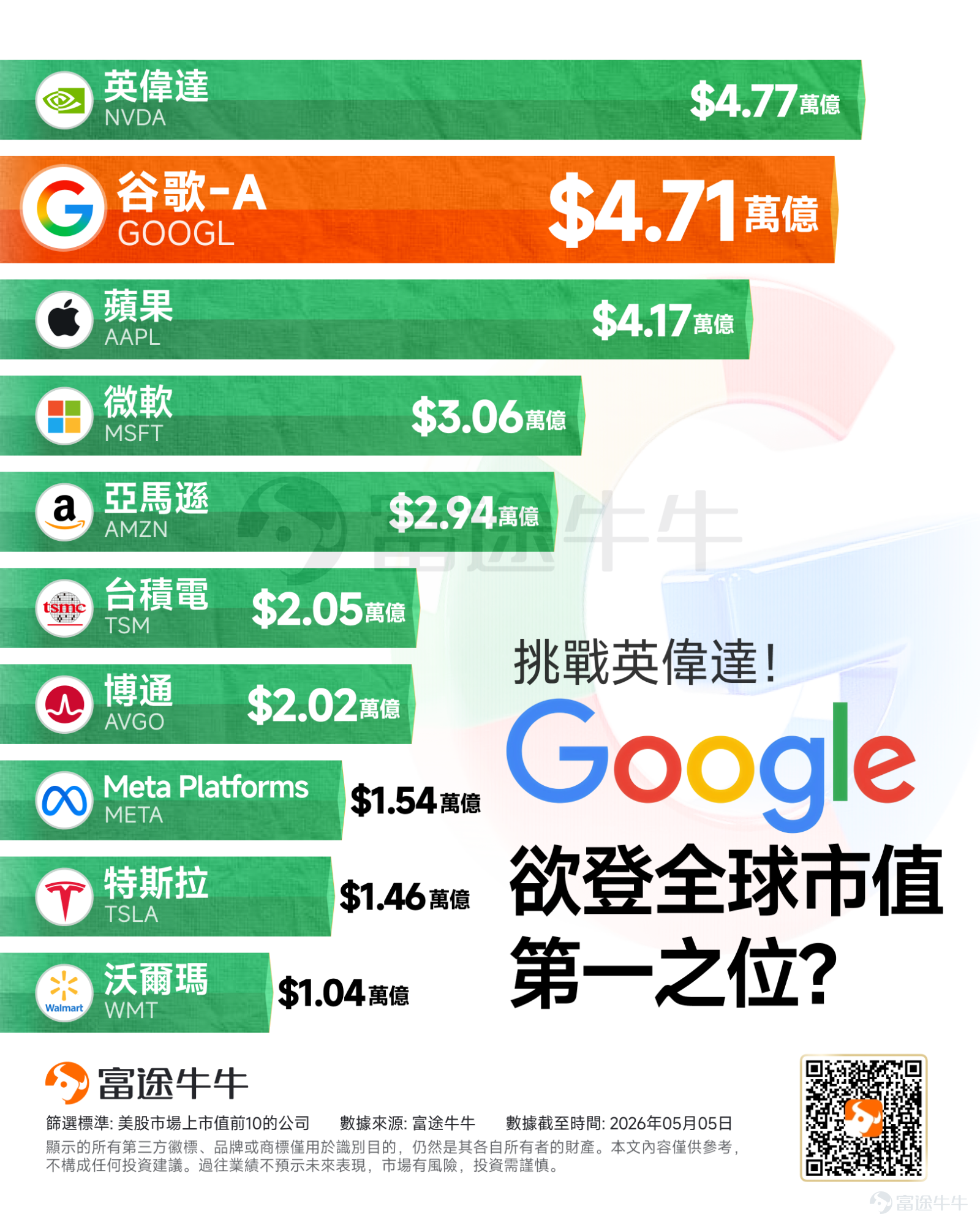

Entering the Agent-driven era! Google's market cap targets $5 trillion

Challenging NVIDIA! Google is poised to claim the top spot as the world's most valuable company—be sure to keep this "Google Ecosystem" investment map handy.
Since releasing its latest earnings results, $Alphabet-A (GOOGL.US)$ the stock price has surged by 11%, bringing its current market cap to $4.71 trillion, quietly approaching the $5 trillion mark.
This strong momentum positions Google to surpass the "pick-and-shovel" players of the AI era, $NVIDIA (NVDA.US)$ potentially rising to become the world’s most valuable company. If successful, this would mark Google’s return to the top of the global market cap leaderboard for the first time in a decade since briefly surpassing Apple in February 2016.

In the face of such a fierce rally, the market can't help but focus:What exactly triggered Google's recent surge? Which companies in the supply chain are expected to benefit?
What is the core reason behind Google's explosive rise?
1. Impressive earnings data, cloud business shows explosive growth
First, the trigger for Google’s recent surge was an impressive quarterly earnings report.Google Cloud's single-quarter revenue growth reached 63%, leaving a deep impression on investors. The operating profit margin of the cloud business expanded significantly from 17.8% a year ago to 32.9%. Management attributed this to more efficient technological infrastructure and process innovation.
2. Deep partnership with Anthropic secures massive long-term orders
The latest news shows,Anthropic has committed to spending approximately $200 billion on Google Cloud over the next five years,accounting for more than 40% of Google Cloud's total revenue backlog. Together, Anthropic and OpenAI’s cloud computing contracts make up nearly half of the four major cloud providers’ roughly $2 trillion in long-term contracts.

The fundamental reason Google Cloud was able to secure such a large order lies in the fact that the vast majority of Anthropic's external API service interfaces (i.e., the entry point for developers to access Claude) run on Google Cloud. This is not only the lifeline of Anthropic’s business,but also directly explains the source of Google Cloud’s 63% rapid growth momentum.
Another key factor is the advantage in computing power at the hardware level. The massive computing power Google provides to Anthropic mainly relies on its self-developed dedicated AI chips (TPUs), rather than renting expensive GPUs from NVIDIA. Although Google needs to pay part of the fees to its chip partner Broadcom, the overall 'economic calculation' is far more cost-effective than subleasing NVIDIA chips, giving Google a larger profit margin.
Third, official collaboration endorsement actively strengthens the AI safety defense line.
On the policy and compliance front, the U.S. National Institute of Standards and Technology (NIST) announced on Tuesday that Google, Microsoft, and xAI will share their unreleased AI model versions with the U.S. government to jointly combat cybersecurity threats.
This collaboration not only highlights Google’s leading position in the AI technology field but also further solidifies investors’ confidence in its development prospects during the era of AI regulation.
Which companies in the industry chain are expected to benefit?
Looking ahead within the month, the annual event Google I/O 2026 Developer Conference will take place at 10:00 AM U.S. time on May 19 (1:00 AM Beijing time on May 20).
This conference is expected to bring three major announcements:A significant update to the Gemini model, as well as progress on the Android XR platform and the new Aluminum OS operating system.This series of actions is expected to further打通 'application-compute power-hardware' commercial positive cycle, adding significant strength to Google's AI competitive advantage.
In early December last year'The Rise of the Google AI Empire! What Are the Gold Mining Opportunities in the Industrial Chain?'also outlined a diagram of Google's related industrial chain as follows:

1. Chip Segment - The Core Computing Brain
First,Within Google's technical system, $Broadcom (AVGO.US)$plays an irreplaceable core pillar role.Its three key technologies — high-speed SerDes, switching ASICs, and optical switching chips supporting the Jupiter network — collectively form the physical foundation of the TPU ultra-large-scale cluster, analogous respectively to the cluster’s 'blood vessels,' 'nervous system,' and 'main highways.' Without this set of foundational chips, Google's TPU clusters and optical networks could not achieve their current scale and performance. Therefore, as long as Google continues to develop its dedicated accelerator route, Broadcom will remain an indispensable core supplier.
In terms of packaging, $Taiwan Semiconductor (TSM.US)$、 $Amkor Technology (AMKR.US)$and$ASE Technology (ASX.US)$constitutes an indispensable 'iron triangle.'The deep reliance of TPU v7 on advanced 3nm/2nm processes, HBM stacking, and high-density Chiplet packaging clearly defines its division of labor: Taiwan Semiconductor sets the upper limit of computing power, while Amkor and ASE Group become key enablers of high-bandwidth implementation through cutting-edge packaging technologies. As the market expects Google’s TPU to become the globally dominant custom ASIC by 2026, the technological synergy among these three companies has become an indispensable foundation for iterative advancements in computational capability.
Additionally, Google requires $Cadence Design Systems (CDNS.US)$ and $Synopsys (SNPS.US)$software tools;
At the same time, Google's Axion CPU is developed based on the $Arm Holdings (ARM.US)$architecture, marking a decisive victory for Arm architecture in the data center field (compared to traditional x86), with Arm set to gain substantial IP licensing and royalty revenues.
2. Connectivity Technology - The Highway of Data Transmission
AI computing bottlenecks often lie in data transmission speeds, making this area the fastest-evolving in terms of technological upgrades. This layer of connectivity technology does not handle computation but instead addresses signal integrity issues when data moves at high speed between chips and servers. Among them,
$Astera Labs (ALAB.US)$: Market leader in PCIe and CXL Retimers, solving high-speed interconnect issues between chips inside AI servers.
$Credo Technology (CRDO.US)$: Specializes in SerDes technology and AEC (Active Cable) chips, addressing short-distance external interconnections for servers.
$Marvell Technology (MRVL.US)$: Giant in optical communication DSPs and switch chips.
$Rambus (RMBS.US)$: Provides high-speed memory interface IP (HBM/DDR interface) and CXL solutions.
$SiTime (SITM.US)$: MEMS timing components to ensure synchronized transmission frequencies.
3. Memory and Storage Segment
With the rise of Google's seventh-generation TPU, demand in the HBM market may continue to grow.
According to reports by South Korea's Chosun Ilbo and other media, Samsung Electronics ($CSOP Samsung Electronics Daily (2x) Leveraged Product (07747.HK)$) and SK Hynix ($CSOP SK Hynix Daily (2x) Leveraged Product (07709.HK)$) have become key participants in Google’s TPU supply chain. Among them, SK Hynix is likely to be the preferred supplier of 8-layer HBM3E chips for Google’s seventh-generation TPU and will exclusively provide 12-layer HBM3E chips for the improved version (TPU 7e), enabling higher energy efficiency.
Moreover, the Mizuho analyst team believes that Micron Technology, the U.S. memory giant, will also be one of the biggest beneficiaries of Google’s accelerated expansion of AI computing clusters. After all, whether it is Google’s massive TPU AI computing cluster or its large-scale procurement of NVIDIA AI GPU computing clusters, both rely on fully integrated AI chip-mounted HBM storage systems. Additionally, Google’s accelerated construction or expansion of AI data centers necessitates the large-scale purchase of server-grade high-performance DDR5 memory devices and enterprise-grade high-performance SSDs.And$Micron Technology (MU.US)$It just so happens that Micron Technology is positioned across these three areas: HBM, server DRAM (including DDR5/LPDDR5X), and high-end data center SSDs, making it one of the most direct beneficiaries of the 'AI memory + storage stack.'
In addition,$Western Digital (WDC.US)$and $Seagate Technology (STX.US)$ Provides massive data cold storage.
4. Optical communication and physical connection aspects
Google's next-generation TPU chip, Ironwood. The new generation of Ironwood super nodes consists of 9,216 Ironwood chips interconnected via OCS optical switching at the cabinet level, further strengthening the critical role of OCS optical switching in Google’s network connectivity.
Optical Circuit Switching (OCS) is a technology that enables direct switching of optical signals between fiber ports without optical-electrical/optical conversion. Google has introduced OCS technology into TPU interconnections to build TPU super nodes consisting of multiple cabinets, supporting a 3D Torus topology architecture.
Founder Securities stated that, according to Cignal AI forecasts, by 2029, the total potential market size for OCS optical switching will exceed $1.6 billion. As Google’s large-scale models progress, the OCS industry chain is expected to benefit from the ongoing advancement of Google’s AI initiatives.
Among them,Optical components include $Lumentum (LITE.US)$、 $Coherent (COHR.US)$。Lumentum is one of the biggest winners from Google’s AI boom, primarily because it specializes in the indispensable optical interconnects within the 'high-performance network infrastructure system' that is deeply tied to Google’s TPU AI computing clusters — namely OCS (optical circuit switch) + high-speed optical devices. With every order-of-magnitude increase in TPUs, its shipments multiply accordingly.
Optical module manufacturing and assembly includes $Fabrinet (FN.US)$、 $FIT HON TENG (06088.HK)$。Fabrinet is the 'king of optical communication module manufacturing,' assembling high-precision modules for Lumentum and Coherent optical manufacturers. Foxconn Interconnect Technology has become a core supplier to Google in the data center hardware sector, providing key components such as optical communication modules, co-packaged optics (CPO) solutions, and high-speed connectors.
Fiber optics, cables, and connectorsIncludes $Amphenol (APH.US)$ 、 $Corning (GLW.US)$ 、 $YOFC (06869.HK)$ 、 $TIME INTERCON (01729.HK)$ 、 $Luna Innovations (LUNA.US)$ 。
5. Network hardware and system equipment
$Arista Networks (ANET.US)$ : The core switch supplier for Google's data centers.
$Ciena (CIEN.US)$ : Long-distance optical transmission systems (DCI), responsible for connecting different data centers.
6. Assembly and PCB stages
Responsible for assembling all parts into server racks.
$Celestica (CLS.US)$ : Specializes in switch and AI server assembly.
$TTM Technologies (TTMI.US)$ : Provides high-layer count PCBs for servers and networking equipment.
7. Power, cooling, and infrastructure
$Vicor (VICR.US)$ :Vertical power module, specifically addressing the high-density power delivery challenges for AI chips (such as TPUs) in the final stage.
$Vertiv Holdings (VRT.US)$ : Thermal management (liquid cooling/air cooling) and power protection systems.
$nVent Electric (NVT.US)$ : Liquid cooling cabinet and connectivity solutions.
$Parker Hannifin (PH.US)$ : Quick connectors and fluid components for liquid cooling systems.
$TeraWulf (WULF.US)$ / $Cipher Digital (CIFR.US)$ : Hosting providers offering power and facility infrastructure.
Summary
Overall, Google is aggressively reshaping its dominance in the global AI arena by leveraging a deeply closed loop of 'self-developed computing power + cloud services + large model ecosystem.' The upcoming Google I/O conference is undoubtedly the strongest near-term market catalyst. From core TPU chip manufacturing and CPO optical communication interconnects to backend liquid cooling and power infrastructure, the 'Google Chain' is beginning to reveal its profit logic across related sectors.
However, gains and losses share the same origin—high growth expectations also harbor underlying challenges. While investors seize this wave of dividends, they must remain highly vigilant against three major potential risks:
1. Valuation and sentiment risk: The valuations of current AI-focused stocks are generally at high levels; investors should be cautious about potential sharp fluctuations in the sector caused by overly optimistic market expectations or profit-taking by institutional investors.
2. Technology iteration risk: The rapid evolution of AI and hardware architecture (e.g., advanced packaging, optical switching technologies) could lead to constant shifts in supply chain technology roadmaps, potentially causing a reshuffle of orders and market shares.
3. Policy and regulatory risks: As AI technology becomes more deeply integrated, global scrutiny over data privacy, model security, and antitrust regulations on tech giants is tightening, which could become sudden variables disrupting market sentiment.
In the face of this AI-driven boom, investors are advised to track market trends while returning to the fundamental logic of the industry chain and managing their positions effectively, ensuring steady progress amid coexisting opportunities and risks.
Risk Disclaimer: The above content only represents the author's view. It does not represent any position or investment advice of Futu. Futu makes no representation or warranty.Read more


Comments (20)
to post a comment
230
828