Nasdaq hits new high! Is the market trading around the AI Agent theme?

Alibaba holds above dual support levels, short-term rebound structure expected to continue
$BABA-W (09988.HK)$ Latest price at 134.800, up 2.74%. Judging from investor comments, market sentiment towards Alibaba is not just bearish, but clearly fatigued. Many investors are most dissatisfied not with sharp declines in Alibaba, but with its prolonged inability to rally, quick drops, and lack of excitement. Some question whether Alibaba is really that bad, others complain that U.S. tech stocks and semiconductor stocks hit record highs daily while Chinese tech stocks and Hong Kong shares remain stagnant; some even remarked that Alibaba's annual gains are less than Micron or Western Digital’s single-day rise. These comments reflect disappointment not in fundamental collapse but in capital efficiency.
The biggest contradiction for Alibaba right now is that the company has multiple storylines such as AI, cloud computing, e-commerce, food delivery, buybacks, and earnings expectations, yet its stock performance remains lacking in momentum. The market doesn't completely ignore these narratives, but has started to question whether they can actually translate into share price growth. This is why phrases like 'terrible experience holding Chinese tech stocks,' 'no upside participation,' 'only volatility without gains,' and 'missing out on the bull market' frequently appear in comments.
This sentiment is highly valuable because when investors stop being excited about Alibaba’s stories and instead begin complaining that it’s boring, slow, and wasting opportunities, it indicates that market expectations have risen. Alibaba can no longer rely solely on being 'cheap,' 'China’s AI leader,' or 'cloud service growth' to attract funds—it needs a true breakout in its stock price to restore confidence.
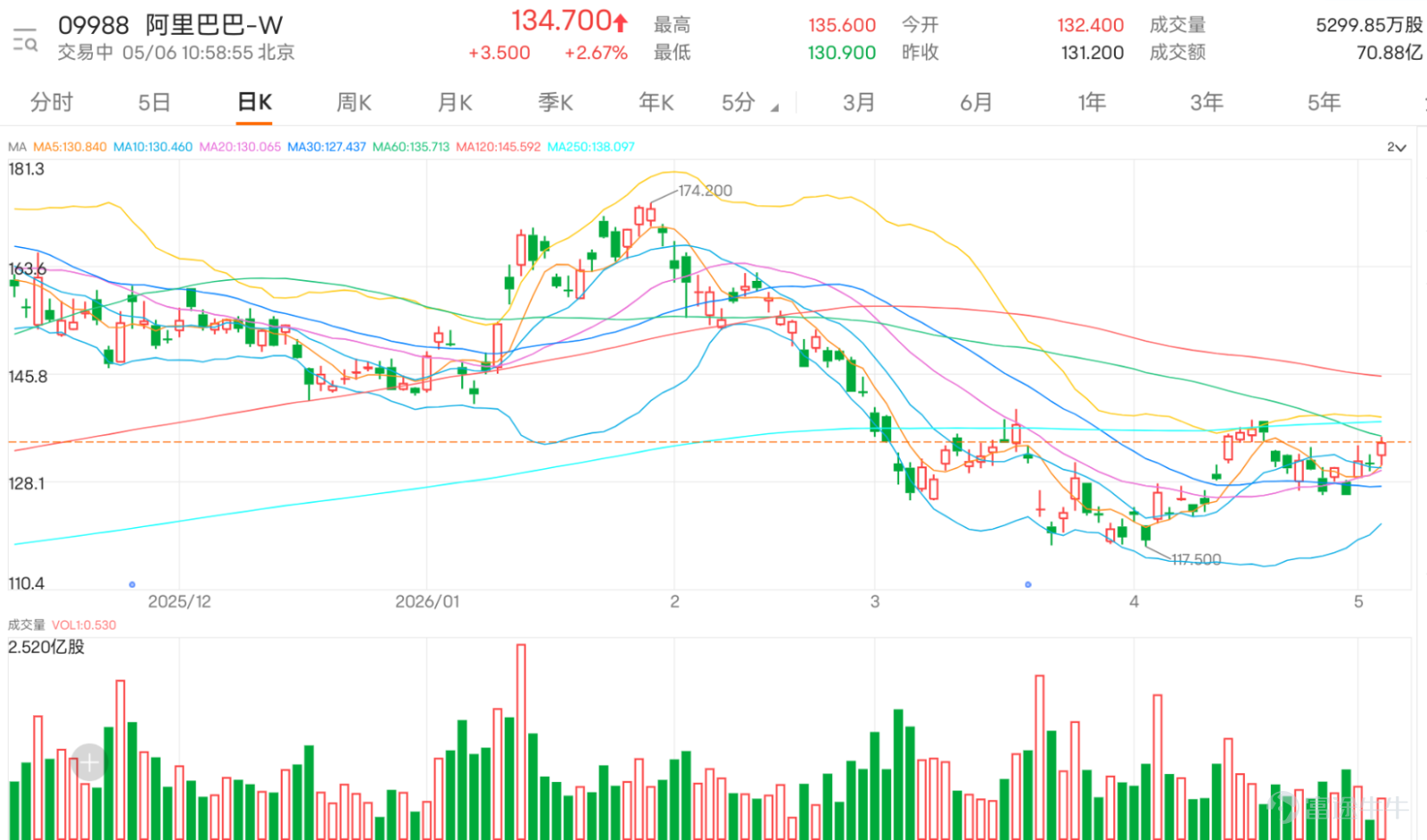
Technically, Alibaba's current price at 134.800 is above the Bollinger Band midline at 129.255, the 10-day moving average at 130.620, and the 30-day moving average at 127.347, showing a slight improvement in the short-term rebound structure. This is important because although market sentiment feels dull, the stock price has not broken down weakly. As long as support at 129.255 and 130.620 holds, Alibaba can maintain conditions for continuing its short-term rebound.
However, improvement does not equate to strength. The current price is still below the upper Bollinger Band at 139.098, and recent trading volume has been relatively stable, without a noticeable surge for a breakout. This explains why investors feel that Alibaba 'has movement but no explosion.' The price is recovering, but there’s no significant capital inflow; the chart isn’t bad, but the trading volume isn’t strong enough.
Another clear focus in the comments is southbound capital and trading volume. Many mentioned the lack of southbound capital and unusually low trading volume, while some worry that when the southbound capital returns, there might be an initial wave of selling. This reflects the market's lack of confidence in Alibaba's short-term support. In other words, investors are not just looking at the stock price, but are very concerned about whether this upward trend is supported by real capital.
This is also Alibaba's most critical trading signal right now. If, after the return of southbound capital, Alibaba can hold above 129.255 and 130.620, it would indicate stronger underlying support than the market expects. Conversely, if it breaks below 129.255, concerns about 127.347 or even 119.412 will resurface.
The bullish argument mainly focuses on pre-earnings optimism, AI investments, cloud services, improvements in food delivery competition, and valuation recovery. Some targets mentioned are 135, 140, 150, 180, or even higher. These targets aren't entirely unimaginable, but the issue is, Alibaba's first short-term hurdle isn't 150 or 180, but 139.098. Only by breaking through 139.098 will the market have a technical basis for imagining a mid-term rebound.
The bearish side believes every rebound in Alibaba is a chance to exit, as the price may rise before earnings but could drop afterward. Such views gain traction because Alibaba has repeatedly shown patterns of rising first and then falling, with rebounds lacking continuity. As these memories accumulate, investors naturally hesitate to aggressively chase rebounds early on.
Therefore, Alibaba's two biggest misjudgments now are as follows.
The bullish side is wrong for prematurely treating earnings and AI optimism as confirmation of a breakout. The bearish side is mistaken for directly considering the sideways, dull movement as weakness or failure. In fact, Alibaba's current state is more accurately described as undergoing short-term recovery, but it hasn't yet broken out.
The Relative Strength Index (RSI) is around 53.638, showing slight improvement in momentum, but not yet indicating strength. This number closely mirrors Alibaba's current market status: not weak, but not strong enough; there's a rebound, but no explosion; there's a story, but trading volume hasn't caught up.
In terms of short-term strategy, Alibaba should use 129.255 and 130.620 as defensive zones. As long as it holds steady around this range, there's still a chance for a short-term test of 139.098. Breaking above 139.098 would significantly improve the risk-reward ratio, giving discussions about reaching 135, 140, or even higher levels a more solid foundation.
Conversely, if it falls below 129.255, the rebound structure will weaken, and the stock price may need to retest 127.347. If 127.347 is also lost, the market will refocus on 119.412, and at that point, voices claiming 'the rebound is just an escape' will increase again.
Overall, Alibaba currently has opportunities, but it still lacks a genuine breakout with strong trading volume. Investors' impatience is understandable since compared to US AI and semiconductor stocks, Alibaba’s capital efficiency is indeed lower. However, short-term trading shouldn’t rely solely on sentiment; price positioning remains key.

The conclusion is that for Alibaba, the focus isn’t on whether it can reach $150 or $180, but rather on whether it can hold above $129.255 and $130.620 first, then whether it can break through $139.098. As long as $139.098 isn’t breached, Alibaba’s rebound is improving but hasn’t confirmed strength yet; however, unless $129.255 is lost, it’s too early to declare the rebound a failure.
Strategy One | Hold above 129.255 for a rebound play
$SGALIBA@EC2607A.C (26765.HK)$ | 137.09 | 8.6x leverage | Close to resistance zone, suitable for capturing early momentum near a rebound to 139 $UBALIBA@EC2607E.C (26541.HK)$ | 137.09 | 8.6x leverage | Balanced leverage, suitable for steady follow-up after holding support firmly $CTALIBA@EC2607B.C (26693.HK)$ | 136.89 | 9.1x leverage | Higher leverage, suitable for enhancing momentum deployment after confirming rebound
Strategy Two | Buy above 139.098 for a test
$UBALIBA@EC2609B.C (26544.HK)$ | 145.98 | 6.0x leverage | Corresponds to upside potential after breakout, suitable for following the trend$BPALIBA@EC2609C.C (26771.HK)$ | 145.95 | 6.0x leverage | Balanced leverage, suitable for medium-short term holding$CIALIBA@EC2609B.C (24388.HK)$ | 145.88 | 5.8x leverage | Slightly farther target, suitable for expecting an extended upward move
Strategy Three | Sell if it breaks below 129.255, watch for support at 127.347 and 119.412
$UBALIBA@EP2607A.P (20367.HK)$ | 130.00 | 6.6x leverage | Close to lower support, ideal for catching early weakness after breakdown$CIALIBA@EP2607A.P (24526.HK)$ | 127.38 | 6.0x leverage | Corresponds to next support zone, suitable for planning further downside$UBALIBA@EP2607B.P (24646.HK)$ | 122.78 | 6.3x leverage | Farther out, suitable for expecting a broader pullback
Feel free to share your insights in the comment section. For more market analysis, please continue following ‘Hong Kong Stock Warrants Jenny’ for daily updates!
Reminder: This article does not constitute any investment advice.
This article is for reference only and does not constitute any investment advice. Market data, opinions, and analysis contained herein may change at any time without prior notice. We are not responsible for any loss or damage caused by reliance on the information in this article. Technical analysis only shows whether certain technical conditions are met; asset performance should be comprehensively evaluated using other sources of information, and trading decisions should not be made solely based on this article. Please note that past performance is not indicative of future results.
#HKStocks #RealTimeAnalysis #WarrantPick #WarrantGuide #DerivativesHedging #HKWarrantsJenny #HangSengIndex #Alibaba #BlueChipStocks #TechnicalAnalysis$Hang Seng Index (800000.HK)$$Hang Seng TECH Index (800700.HK)$
Risk Disclaimer: The above content only represents the author's view. It does not represent any position or investment advice of Futu. Futu makes no representation or warranty.Read more

Comment (1)
to post a comment
4
1