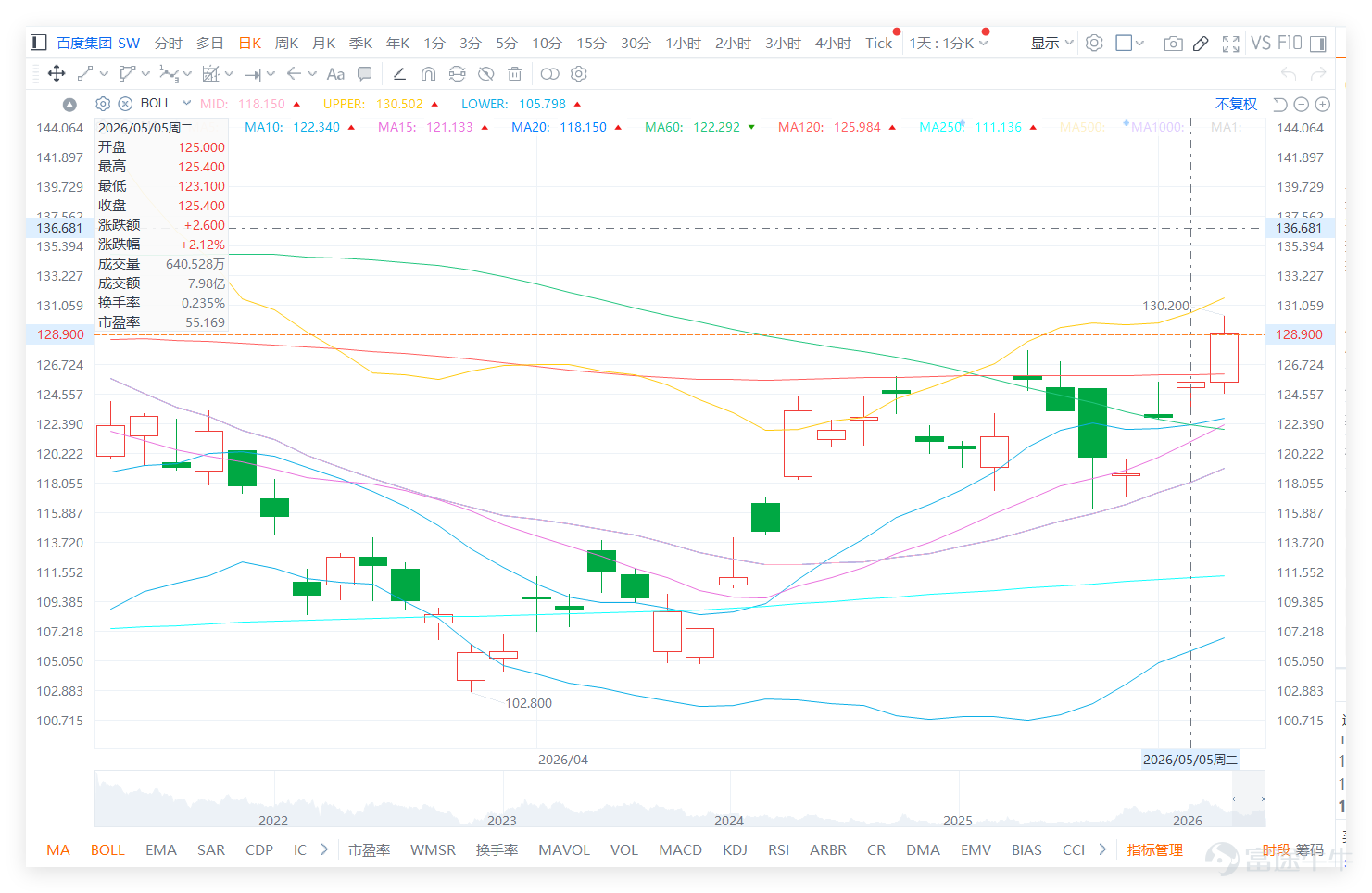

Baidu's sharp rise triggered a systematic 'strong sell' signal, with 130.5 yuan becoming a key resistance level; a short-term breakout still needs confirmation.
Looking at peers in the technology sector, the market performance was mixed on the previous day (the 5th). $BIDU-SW (09888.HK)$
Up 2.12%, outperforming the industry average, while $JD-SW (09618.HK)$ it slightly fell by 0.51%. Technical signals are turning cautious: Baidu's technical indicator summary signal is 'neutral', and its moving average system has issued a 'strong sell' signal.
Compared with large-cap tech stocks, $TENCENT (00700.HK)$and$MEITUAN-W (03690.HK)$ the technical pattern remains in a weak range. Tencent closed at HKD 472.2 (-0.17%), constrained by multiple moving averages, while Meituan closed at HKD 83.55 (-1.07%) consolidating near lows.
This indicates that Baidu’s strong rebound occurred amidst overall sector caution, where leading stocks (Tencent/Meituan) have yet to stabilize. Its 'neutral' signal contrasts with market enthusiasm for AI stories, suggesting that the technical side has not fully confirmed its revaluation logic. For the stock price to effectively break through the resistance level of 130.502, stronger momentum and capital consensus will be required to reverse the lagging state of technical indicators.
Baidu Group closed at 125.400 on the previous day (5th), rising 2.12% in a single day. Judging from investor comments, market sentiment is notably more positive than other large-cap tech stocks. Many people have started including Baidu in trading themes such as AI, chips, the upcoming listing of Kunlun chips, and rotation among Hong Kong-listed tech stocks. Some see a target of 130, others 150, and some even believe it can break 200 this year. This reflects that the market no longer views Baidu merely as an old internet stock but is attempting to reprice it based on AI and chip concepts.

However, the biggest issue here is that while Baidu’s story is gaining momentum, its stock price has yet to truly complete a breakout.
Baidu closed at 125.400 on the previous day, which is indeed above the 10-day line at 122.340, the 30-day line at 115.650, and the middle Bollinger Band axis at 118.150. The short-term rebound structure has improved. This is better than stocks like Tencent, Meituan, and BYD, which remain in weak ranges. In other words, Baidu is not currently a weak stock but has already shown initial signs of recovery.
However, recovery does not equal a breakout. The current price is still below the upper Bollinger Band at 130.502, and investors’ repeated mentions of targets like 130, 150, and 200 indicate that the market has set 130 as the short-term sentiment threshold. Unless 130.502 is surpassed, all discussions about 150 and 200 remain speculative and cannot be confirmed by price action.
The most representative view in the comments is that the 'Kunlun Chip's IPO' will bring revaluation. Some investors believe that once Kunlun Chip becomes clear, Baidu should no longer be valued solely on traditional search or advertising businesses but should be re-evaluated based on AI chips and cloud computing logic. This is where Baidu currently draws the most speculative interest and also why it has been able to outperform recently.
However, a common market mistake is to directly equate 'potential IPO' with 'certain revaluation.' Any revaluation requires stock price cooperation. If Baidu cannot break through 130.502, it indicates that funds are still unwilling to chase prices above resistance. Even if it breaks through but lacks trading volume support, it could just be a short-term spike. Therefore, Kunlun Chip is a catalyst, not an entry signal itself.
Another type of comment expresses skepticism. Some point out that markets tend to correct when they get too hot, while others believe that failing to make a real breakthrough after four weeks indicates significant overhead pressure. These views deserve attention because Baidu’s latest trading volume has contracted, showing that although there is price performance in the rebound, there is no obvious increase in trading activity. Whether the price can rise is one thing; whether there is continued funding support is another.
Baidu's current technical structure reflects this contradiction. The Relative Strength Index (RSI) is around 65.055, indicating strong momentum, but it is approaching resistance, making the risk-reward ratio for chasing the price less attractive than at lower levels. This suggests that while the stock still has room to test higher levels, chasing at the current price carries more risk than reward.
In the short term, the key levels to watch are whether 122.340 can hold and whether 130.502 can be broken. If Baidu holds steady above 122.340 and 118.150, it means the rebound structure remains intact, and there is potential to test 130.502 in the short term. Breaking through 130.502 would provide a technical basis for the market's imagination of reaching 150 and could lead to further improvement in the trend.
Conversely, if Baidu falls below 122.340, the strength of the rebound will begin to weaken; breaking below 118.150 would mean losing the middle Bollinger Band, causing the market's enthusiasm for AI revaluation to cool significantly, with the next focus being a retest of 115.650.
Overall, Baidu is not a weak stock at this stage, but it is not yet at a level where blind chasing is advisable. It's positive that the market is starting to believe in Baidu's AI and chip revaluation story again; however, short-term trading cannot rely solely on stories—it still depends on whether 130.502 can be effectively broken.
In conclusion, Baidu is not currently looking at 150 or 200, but rather focusing first on 130.502. Until 130.502 is breached, Baidu remains in a rebound improvement phase rather than a confirmed breakout. If it can break through with trading volume support, the market’s confidence in AI revaluation will truly translate into upward momentum.
Based on the above analysis, the strategies for deployment can be divided into the following main approaches:

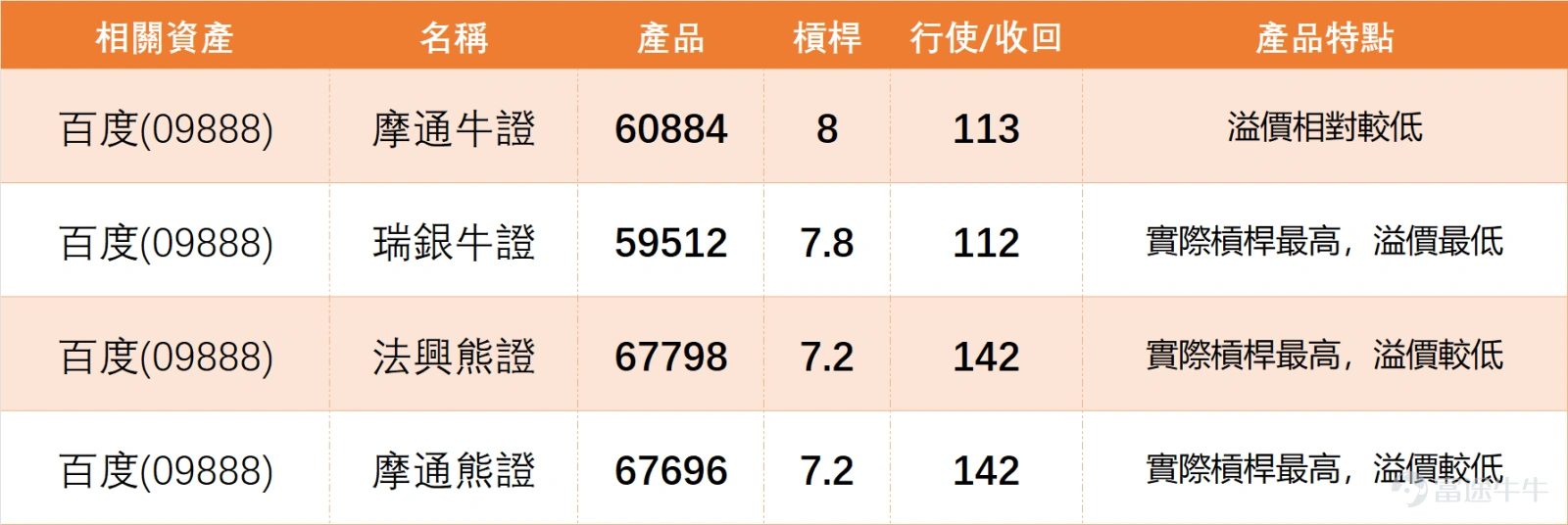
For more market analysis, stay tuned to Jenny's daily updates on 'Hong Kong Stock Warrants'!
Reminder: This article does not constitute any investment advice.
This article is for reference only and does not constitute any investment advice. Market data, opinions, and analysis contained herein may change at any time without prior notice. We are not responsible for any loss or damage caused by reliance on the information in this article. Technical analysis only shows whether certain technical conditions are met; asset performance should be comprehensively evaluated using other sources of information, and trading decisions should not be made solely based on this article. Please note that past performance is not indicative of future results.
#HKStocks #Baidu #Real-TimeAnalysis #WarrantSelection #WarrantGuide #DerivativesHedging #HKWarrantsJenny #Blue-ChipStocks #TechnicalAnalysis
Risk Disclaimer: The above content only represents the author's view. It does not represent any position or investment advice of Futu. Futu makes no representation or warranty.Read more

Comment (1)
to post a comment
4
1