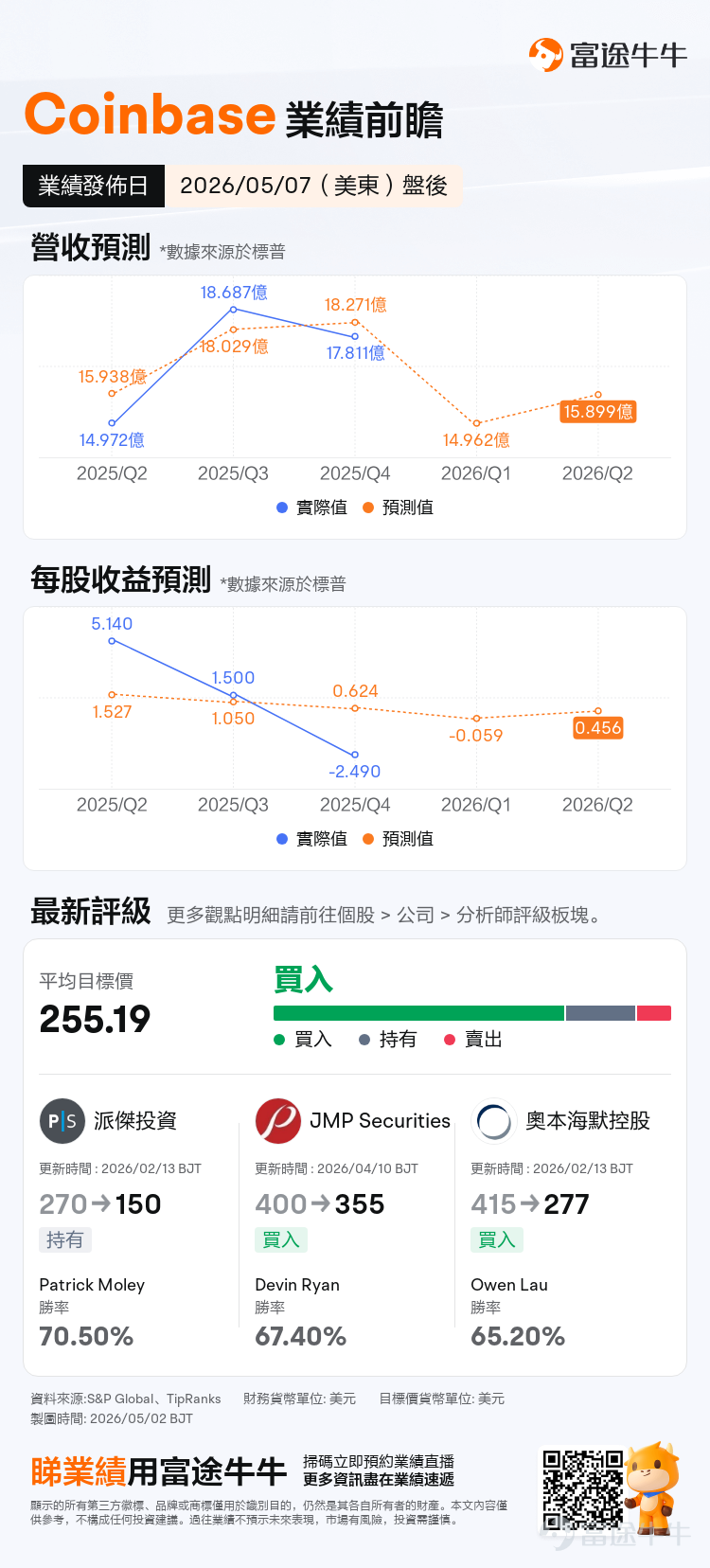

Earnings Options Strategy | After a six-month slump in the crypto market, can Coinbase demonstrate earnings resilience?
$Coinbase (COIN.US)$ will release a new round of earnings reports after the market closes on May 7th (Thursday).Institutional expectations for Coinbase's Q1 2026 revenue stand at $1.496 billion, a year-on-year decrease of 26.45%; expected earnings per share are -$0.059, shifting from profit to loss year-on-year.

When discussing cryptocurrency concept companies, an unavoidable topic is$Bitcoin (BTC.CC)$the overall trend of the cryptocurrency market led by Bitcoin. We can also observe thatCoinbase's stock price shows a high correlation with the price of Bitcoin.In October 2025, when the Bitcoin price fell from its peak, the cryptocurrency market entered a relatively sluggish phase, leading to decreased investor trading activity and driving down the share prices of related companies.

Let's now look at Coinbase’s current revenue composition. From Coinbase's previous earnings report, we can seeThe company's main revenue comes from trading income, including retail trading (accounting for approximately 43% of total revenue), institutional trading (6%), other trading (3%); and subscription and service income (approximately 47%, including USDC income, staking/on-chain rewards, custody and institutional services, financing interest income, and Coinbase One subscription services).
Retail trading: Low retail investor activity, spot market awaits stronger support.
As the crypto market remains sluggish, retail users' trading interest and behavior have declined.According to Barclays estimates, Coinbase's trading volume in March will be the lowest since September 2024.Overall Q1 trading volume fell by about 30% quarter-on-quarter from Q4, with daily average trading volume declining between 20-25%. This scenario will directly impact the company’s largest business segment — retail trading — and affect its performance.
Future trends in the retail business still depend on Bitcoin's performance. From a recent technical perspective, Bitcoin stabilized at the $60,000 bottom and recently rebounded above $80,000, but the upward momentum lacks further trust endorsement — as clarity around the Clarity Act is still pending final resolution.

Institutional/Subscription Services: Demonstrating resilience, though diversified layout results still need performance validation.
Although retail business is weak, institutional business and subscription services showed resilience in previous quarterly reports.
 Institutions and Derivatives (Deribit): The acquisition of Deribit (the global leader in cryptocurrency options with ~80% market share) in August 2025 continues to contribute, with institutional trading surging 21% in Q3 2025, and up 3.7% in Q4. It demonstrated resilience during the bear market and is expected to partially offset the decline in retail.New category (Everything Exchange): US stock / ETF trading fully launched in February, with Q1 predicting record highs in market and precious metals trading, alongside the crypto cycleLow correlation, starting to contribute incremental growth.Non-trading income: The Q4 performance indicates that despite a sluggish market during Q4, USDC reserves remained high (approximately USD 76 billion in Q4), with stablecoin revenue and on-chain income continuing steady growth; in other revenue categories, the company disclosed nearly 1 million Coinbase One subscribers during Q4nearly 1 million, with annual fees and cashback models enhancing retention.
Risks and concerns:
1. Whether other services can offset the decline in retail business revenue;
2. Expectations of a Fed rate cut combined with the decline in crypto assets have led to a reduction in USDC interest income and on-chain staking rewards.
3. Operating expenses: 25Q4 operating costs were $1.419 billion, up 2.23% quarter-over-quarter. In a bear market environment, can the company make timely adjustments to reduce costs and increase efficiency?
Options signals: What does the market think?
Recently, Coinbase announced that 'terms for stablecoin yields have been agreed upon,' leading to a rise in cryptocurrency-related stocks. On May 4, Coinbase rose by 6.14%. $Circle (CRCL.US)$ Up 19.89%. The put/call ratio for Coinbase is 0.55, with an open interest ratio of 0.69, indicating a neutral short-term sentiment leaning slightly bullish. Implied volatility (IV) was at a high before earnings, standing at 79.33%.

Currently, Coinbase's implied volatility is relatively high, which is advantageous for option sellers. Additionally, due to the impact of the first quarter's crypto market performance, expectations for Coinbase are leaning towards neutrality. In this scenario:
1. If you believe Coinbase will perform neutrally and won't experience significant gains or losses post-earnings,
then you can act as the option seller usinga short straddle or a short strangle strategy.Once the implied volatility of options decreases after the earnings release, leading to an 'IV Crush' phenomenon, you can profit from the decay in the time value of the options.

If you are concerned that the above two strategies carry higher risks and may lead to significant losses in the event of a sharp rise or fall in stock prices, you can alsoadd two protective legs on both sidesto cap the maximum loss of the strategy.

2. If you believe that after the implementation of regulations related to stablecoins, stablecoin-related stocks will be promising in the long run
then you canbuy long-term call options (LEAPS Call) expiring in 6 months to 1 year.These options have the characteristic of minimal time decay and allow tracking part of the upward movement of the underlying stock at a price lower than the stock itself.

If you are still worried about time decay, you can sell a call option above your long position to hedge against some of the time decay, forming abull call spread, but at the cost of limiting the strategy's maximum profit, making it a relatively moderate risk-reward strategy.

Risk Disclaimer: The above content only represents the author's view. It does not represent any position or investment advice of Futu. Futu makes no representation or warranty.Read more


Comments
to post a comment
14
10