
The Big Four's performance diverges after results! Who is the real winner in AI?

A whopping $725 billion! The AI spending war among the four US tech giants intensifies. Which sectors will emerge as the ultimate winners?
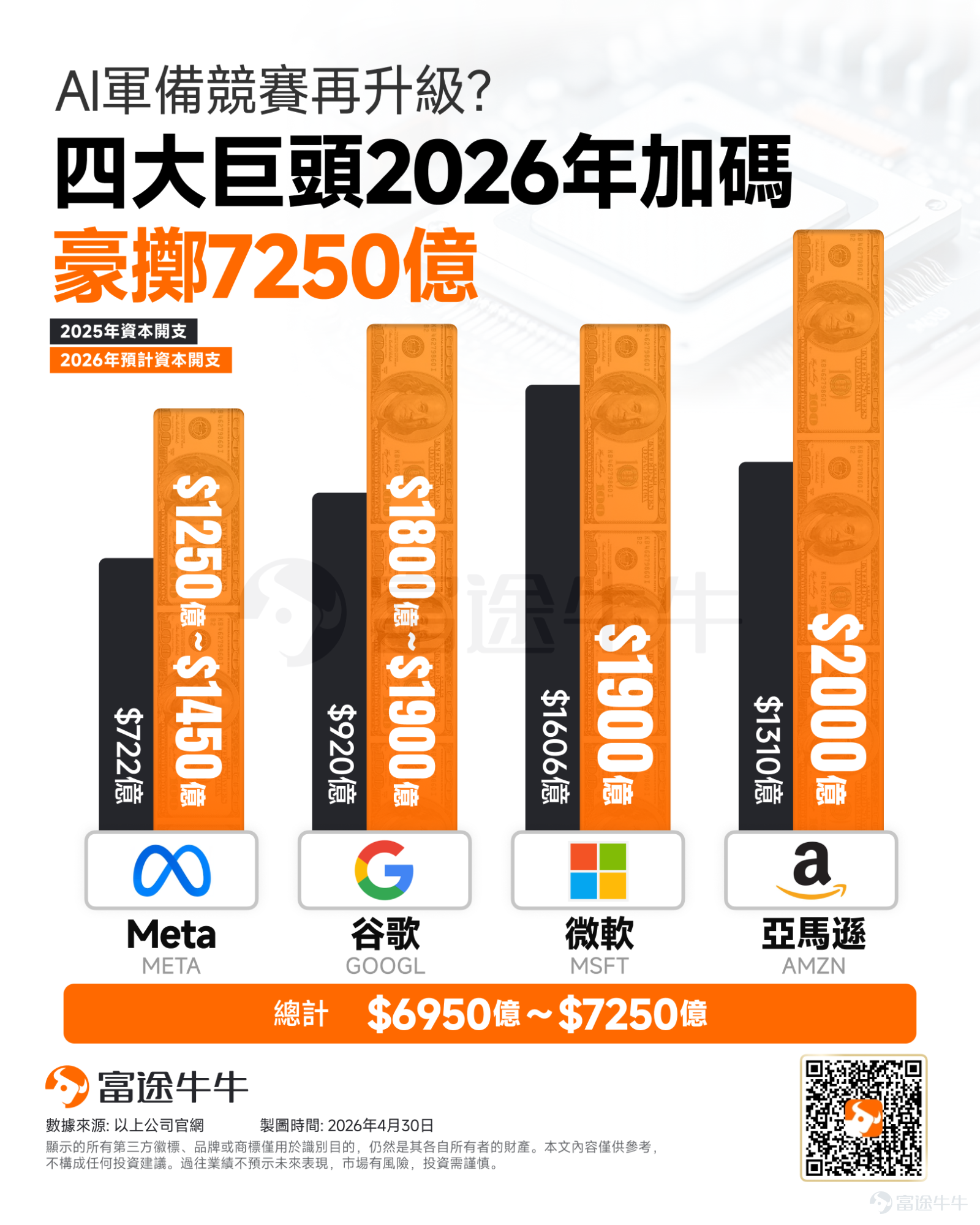
As the AI boom continues to heat up, the 'cash-burning' war among US tech giants is intensifying. In the latest earnings reports, the Big Four tech giants have once again raised their capital expenditure forecasts for 2026, further increasing the overall scale from the previously estimated 'epic' level of approximately $650 billion.
On Wednesday Eastern Time, four of the 'Mag 7' released their latest quarterly reports on the same day. Except for Amazon, which kept its forecast unchanged, both Google and Meta raised their capital expenditure expectations, while Microsoft's guidance significantly exceeded market expectations. Specifically:
$Alphabet-C (GOOG.US)$ Raised its capital expenditure guidance for the fiscal year 2026 to $180-190 billion, higher than the previous estimate of $175-185 billion.
$Meta Platforms (META.US)$ Capital expenditure for 2026 is expected to be between $125 billion and $145 billion, higher than the previous range of $115 billion to $135 billion.
$Microsoft (MSFT.US)$ Capital expenditure for 2026 is expected to be around $190 billion, higher than analysts’ expectations of $150 billion.
$Amazon (AMZN.US)$ Maintained its forecast for 2026 capital expenditure at $200 billion unchanged.

This means that, if calculated based on the high end of the range, the combined capital expenditures of the four tech giants have already broken through the $700 billion threshold, reaching $725 billion.
The continued increase in capital spending by these giants is not only a reflection of the tech arms race but also represents a super-deterministic trend within the industry. Beneath this torrent of capital, where will funds accelerate to flow into niche sectors? What quality assets in the market are likely to benefit first?
Where will the giants direct their capital expenditures?
Behind the aggressive push on capital expenditures, tech giants are facing severe hardware infrastructure bottlenecks and inflationary pressures across the entire supply chain.
Based on the latest statements from various companies,"Cost inflation" and "capacity constraints"have become high-frequency terms, according to JPMorgan's research report:
$Alphabet-C (GOOG.US)$ : Raised the full-year capital expenditure forecast for 2026, while hinting at significant growth in 2027. Capital expenditure in the first quarter of 2026 increased by 28% sequentially and 107% year-over-year to $36 billion,mainly reflecting investments in technological infrastructure, with approximately 60% allocated to servers and the rest for data centers and network equipment.
Looking ahead, Google raised its 2026 full-year capital expenditure guidance to $180-$190 billion (previously expected $175-$185 billion), implying a year-over-year increase of over 100%, or an absolute increase of nearly $95 billion.
Importantly, Google also provided an initial outlook, expecting that 2027 capital expenditures will significantly exceed those in 2026.Additionally, Google noted that this year it will begin recognizing a small portion of TPU hardware revenue, with the majority expected to be realized in 2027; it also emphasized that benefiting from strong demand for enterprise AI products and including TPU hardware sales, its cloud business backlog nearly doubled sequentially to $462 billion.

$Microsoft (MSFT.US)$ : Anticipates more than 60% growth in capital expenditures for 2026. Capital expenditure in the first quarter of 2026 decreased by 15% sequentially but increased by 49% year-over-year to $32 billion (including leases), with two-thirds of spending concentrated in short-term assets (such as GPUs and CPUs) and the remainder on long-term assets. Microsoft noted that it added 1GW (gigawatt) of computing capacity in the first quarter and aims to double the total scale within two years.
Looking ahead, capital expenditure is expected to increase to over $40 billion in the second quarter of 2026 (a sequential increase of over 30% and a year-over-year increase of over 70%), reaching $190 billion for the 2026 calendar year (CY26), representing a 60% year-over-year increase or an additional $70 billion year-over-year., including an impact of $5 billion (quarterly) and $25 billion (annually) driven by rising component prices.Additionally, Microsoft revealed it is modernizing its server fleet using in-house chips as well as products from NVIDIA and AMD.

$Meta Platforms (META.US)$ : Raised the 2026 capital expenditure growth forecast to over 85% year-over-year. Capital expenditure for Q1 2026 fell 10% quarter-over-quarter but rose 45% year-over-year to $20 billion.Mainly driven by investments in data centers, servers, and network infrastructure.
Looking ahead, Meta has raised its full-year 2026 capital expenditure guidance to between $125 billion and $145 billion (previously $115 billion to $135 billion), implying a year-over-year increase of over 85%, or an absolute increase of nearly $60 billion.The company noted that the upward revision reflects rising component prices, along with additional data center costs (to a lesser extent) to support capacity needs in the coming years.
Meta also emphasized a focus on improving efficiency, revealing plans to deploy over 1 GW of in-house chips and a significant amount of AMD products to complement new NVIDIA systems. It also highlighted upcoming cloud agreements rolling out this year and into 2027.

$Amazon (AMZN.US)$ : The full-year 2026 capital expenditure forecast remains largely unchanged. Capital expenditure for Q1 2026 grew 12% quarter-over-quarter and 77% year-over-year to $44 billion, primarily driven by investments in AWS and generative AI.
Looking ahead, Amazon stated that its full-year 2026 capital expenditure forecast remains around $200 billion, indicating a year-over-year growth of nearly 52%, or an absolute increase of $68 billion.
Amazon also emphasized that its in-house chips are expected to save tens of billions in capital expenditures annually. It was noted that annualized revenue from third-party chip sales in Q1 exceeded $20 billion (up 40% quarter-over-quarter and triple-digit year-over-year growth; or $50 billion when including internal consumption). Additionally, Amazon’s Trainium chips have secured over $225 billion in revenue commitments from clients including Anthropic, OpenAI, and Uber. Amazon did not rule out the possibility of selling Trainium server racks in the future.

Which companies are expected to benefit?
As seen from the above, in the past, when the market discussed the capital expenditures of Silicon Valley giants, the focus was often only on computational chips. However, the current situation is thatThe costs behind AI infrastructure are soaring across the board—from the skyrocketing prices of advanced memory chips (such as HBM), to the demand for fiber optic cable upgrades, and further to the indispensable power supply, cooling water resources, and undeveloped land for data center operations. Every aspect of AI infrastructure has hit a demand-driven capacity ceiling.
previouslyThe 'Inflation Era' of AI computing power has arrived! Unveiling how to capture price increases across the entire industrial chain and investment opportunities?A previous article outlined the chain of computational inflation, as follows:

The first wave: The absolutely scarce 'core computing engines' and 'contract manufacturing/packaging'
Since GPU computing power directly determines the upper limit of Token supply,Core computing engine - chipsExploded first.
Computing brain:Dominating here are oligarchs with absolute pricing power, such as $NVIDIA (NVDA.US)$、 $Advanced Micro Devices (AMD.US)$、 $Broadcom (AVGO.US)$ 。
Capacity lifeline:Once a chip is designed, it must rely on“Wafer fabrication” and “advanced packaging and testing”. Taiwan Semiconductoroccupies a core position here, while companies like $SMIC (00981.HK)$ 、 $ASE Technology (ASX.US)$ 、 $Amkor Technology (AMKR.US)$and $ASMPT (00522.HK)$ are also experiencing a revaluation due to tight capacity.
The second wave: Expansion extends into 'storage' and 'communication networks'
As the demand for AI agents with ultra-long context memory surges, price hikes are spreading rapidly.
Storage price hikes: It's a foregone conclusion that storage chip prices will rise in 2026. DRAM is expected to increase by 60%-88% for the year, while NAND could see increases of 38%-74%. Related companies such as $CSOP Samsung Electronics Daily (2x) Leveraged Product (07747.HK)$、 $CSOP SK Hynix Daily (2x) Leveraged Product (07709.HK)$、 $Micron Technology (MU.US)$、 $SanDisk (SNDK.US)$have seen astonishing gains this year.
Optical communication infrastructure: The larger the computing cluster, the higher the communication requirements between nodes. This has spurred a massive 'optical communication network'sector rally. From silicon photonics manufacturers $Marvell Technology (MRVL.US)$ 、 $Fabrinet (FN.US)$, to optical module leaders $Lumentum (LITE.US)$ 、 $Coherent (COHR.US)$, to fiber-optic segment players $Corning (GLW.US)$and $YOFC (06869.HK)$ , indium phosphide $AXT Inc (AXTI.US)$ The entire supply chain is benefiting from the spillover of demand.
Notably, Prices for mainstream fiber optic varieties, particularly bulk fiber, continue to rise,especially for high-end bend-insensitive fiber G.657A2, with high-priced orders surpassing 250 yuan/core kilometer, and order volumes remaining consistently strong. Regular varieties such as G.652D also maintain a robust upward trend, reflecting an industry pattern of 'rising volume and price.'
Additionally, compared to prices at the beginning of 2025,the price of indium phosphide substrates has recently increased,with domestic market increases of around 15%, while international markets have seen rises of about 60%.
Third wave: Spreading to surrounding 'infrastructure' and 'cloud/model' sectors
The enormous computational power beast requires massive energy and extreme cooling to sustain operations.
Energy and cooling: basic infrastructure and key components,” as well as “power management and analog chips” in the middle have started to gain momentum. $Texas Instruments (TXN.US)$ 、 $Monolithic Power Systems (MPWR.US)$ Analog chip and power management giants, as well as those specializing in liquid cooling solutions, $Vertiv Holdings (VRT.US)$ are becoming the "water carriers" of the market. Meanwhile, underlying materials like CCL copper-clad laminates (e.g., $KINGBOARD HLDG (00148.HK)$ ) and MLCCs (such as $Vishay Intertechnology (VSH.US)$ ) have also seen both volume and price rise due to surging high-end demand.
Additionally, the indispensable power supply, cooling, and undeveloped land behind data center operations have also emerged as winners. PreviouslyTech Giants 'Burn Cash' to Boost AI! These Two Industries May Be the Hidden Winners?》A previous article also mentioned,The biggest bottleneck in the current construction of AI data centers lies in 'electricity' and 'cooling'.

1. Electricity
According to Goldman Sachs data,AI deployment has driven a 160% surge in electricity demand for data centers,Moreover, the International Energy Agency (IEA) predicts that global data center electricity consumption will double from 460 terawatt-hours in 2022 to 2026. From the demand side, every aspect of AI is actually a major consumer of electricity.
Looking at the entire power industry chain, including independent power producers, electrical equipment, vertically integrated utilities, nuclear power, and other sectors, all are expected to become big winners in the AI boom.
Independent power producers include $Vistra Energy (VST.US)$、 $Talen Energy (TLN.US)$; Electrical equipment can focus on$GE Vernova (GEV.US)$ 、 $Eaton (ETN.US)$ 、 $Bloom Energy (BE.US)$ 、 $SIEMENS AG (SIEGY.US)$ 、 $Honeywell (HON.US)$ 、 $Emerson Electric (EMR.US)$ 、 $Graham (GHM.US)$ ; nuclear power includes $Oklo Inc (OKLO.US)$、 $NuScale Power (SMR.US)$ 、 $NANO Nuclear Energy (NNE.US)$、 $BWX Technologies (BWXT.US)$ 、 $X-Energy (XE.US)$Wait.
Moreover, due to the surge in AI-driven electricity demand, utility stocks have become beneficiaries of AI, such as the American energy giant $Constellation Energy (CEG.US)$ 、 $PG&E Corp (PCG.US)$ 、 $Dominion Resources (D.US)$ 、$Exelon (EXC.US)$ 、 $Southern (SO.US)$ 、 $Sempra Energy (SRE.US)$ 、 $The AES Corp (AES.US)$ 、 $American Electric Power (AEP.US)$ 、 $Duke Energy (DUK.US)$ 、 $NextEra Energy (NEE.US)$Wait.
2. Cooling
The global liquid cooling systems market is expected to broadly benefit from the growth of data centers driven by AI, machine learning, and edge computing. Traditional data center cooling solutions involve air-based methods like fans and air conditioners, but these still result in power losses during operation. Amid the overarching trend of reducing PUE (Power Usage Effectiveness) metrics,liquid cooling solutions are gradually becoming the mainstream choice.Liquid cooling technology achieves system heat exchange through external chilled water or refrigeration systems.
Among these, suppliers of liquid cooling solutions and related industry chains include $Vertiv Holdings (VRT.US)$ 、 $nVent Electric (NVT.US)$ 、 $Super Micro Computer (SMCI.US)$ 、 $Dell Technologies (DELL.US)$ 、 $Hewlett Packard Enterprise (HPE.US)$ 、 $Amazon (AMZN.US)$ 、 $CoreWeave (CRWV.US)$ 。
Traditional temperature control/refrigeration companies include: $Trane Technologies (TT.US)$ 、 $Quanta Services (PWR.US)$ and $Carrier Global (CARR.US)$ 。
Summary
In this unprecedented AI arms race, the four giants' capital expenditure forecast of $725 billion has established the most certain industrial narrative in the current market. This massive influx of capital is clearly outlining a panoramic 'profit effect' roadmap: AI investment themes have expanded comprehensively from the early focus on single compute chips to encompass the entire AI infrastructure ecosystem.
However, the 'high certainty' of industrial trends does not necessarily equate to 'one-way rises' in short-term stock prices. While embracing this infrastructure boom, we must remain vigilant about the following three potential risks:
Landing verification of commercial returns (ROI):If massive capital expenditures fail to translate into matching revenue and profit growth within the next one to two years, market concerns over an "AI bubble" could trigger a revaluation of the sector.
Macroeconomic liquidity and policy dynamics:With the overall valuation of the technology sector currently at high levels, it is crucial to remain vigilant about the marginal changes in central bank monetary policies that could suppress market liquidity and high-valuation assets.
Cyclical reversal of supply and demand dynamics:As the entire industry chain accelerates production expansion to break the current "capacity bottleneck," some hardware segments may face the challenge of overcapacity in the future.
Risk Disclaimer: The above content only represents the author's view. It does not represent any position or investment advice of Futu. Futu makes no representation or warranty.Read more


Comments (12)
to post a comment
194
546