
The S&P 500 has risen for seven consecutive weeks—should you chase the rally or take profits?

Trump administration rakes in $30 billion! Intel soars to new highs—what’s the next 'White House Concept Stock'?
This month, amid the frenzied global wave of AI infrastructure construction, Intel has surged over 100%, with its stock price breaking through the historical high last seen during the dot-com bubble in 2000. This is not only a major milestone for tech stocks but also a capital feast perfectly woven together by geopolitics, the AI craze, and alliances with former rivals.
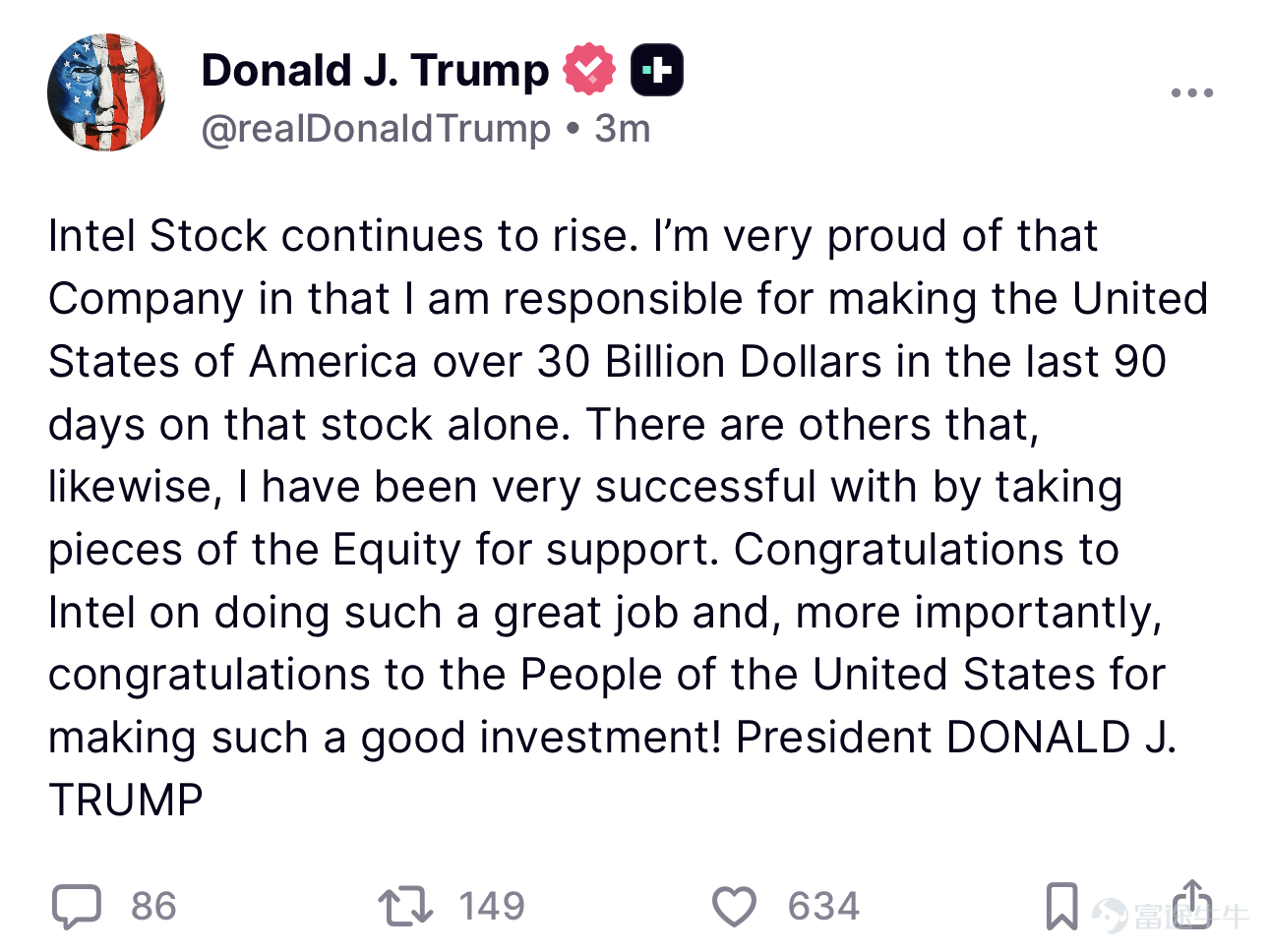
Even Trump personally endorsed it, praising Intel for its outstanding performance and emphasizing that in just 90 days, this single stock alone generated an astonishing $30 billion in gains for the US.

What underlying logic drove Intel's epic turnaround? Following this main thread, what profit opportunities can we uncover for early strategic positioning?
Why did Intel experience an epic reversal?
Intel's widely-discussed 'comeback' in the capital markets is, in fact, driven by a 'triple resonance' of policy, fundamentals, and business operations:
I. Davis Double Play: Trump’s Policy Support and NVIDIA’s Strategic Bet
$Intel (INTC.US)$ The primary driver behind this strong rebound lies in the grand narrative of America's 'Technology Sovereignty Repatriation.'TrumpPublic praise not only acted as a catalyst for sentiment but also signified tangible policy benefits and subsidy moats, making Intel the flagship target with the most strategic importance in this round of trading.
Reviewing the Trump administration’s investments, he initially purchased 433.3 million shares for approximately $8.9 billion at about $20.47 per share. As Intel’s stock price rose, the paper gains on the Trump administration’s investment surged by nearly 363%, earning roughly $32 billion.
If the White House’s endorsement provided a policy-driven confidence boost,then the chip giant $NVIDIA (NVDA.US)$ 's capital betprecisely filled Intel’s most urgent need for 'technical trust and market orders.' The synchronized efforts of this 'government-business dual-core' engine injected the strongest momentum into Intel’s stock price, leading to a perfect Davis Double Play.

II. Strong Realization of Fundamentals: Earnings Beat Market Expectations for Six Consecutive Quarters
Beyond sentiment, the direct trigger for this surge was impeccable earnings. Intel’s latest Q1 2026 performance report shows revenue, gross margin, and earnings per share all surpassing guidance ceilings, achieving the remarkable feat of beating financial expectations for six consecutive quarters.
Meanwhile, the company’s Q2 revenue guidance (in the range of $13.8 billion to $14.8 billion) continues to show robust growth. The certainty of the earnings report has completely ignited market enthusiasm, not only triggering the largest single-day percentage gain since October 1987, but also carrying historical significance that goes without saying.
III. Breakthrough in Foundry Business: Multiple Explosive Orders from Tech Giants
What has most restored market confidence in Intel's long-term valuation is that its foundry business is experiencing a historic turning point not seen in a long time.
According to key industry signals released by TrendForce, global tech giants are converging on Intel: Apple is reportedly evaluating the use of Intel's 18A-P advanced process to manufacture M-series chips; Google is considering leveraging Intel's EMIB advanced packaging technology for its TPU v8e project; meanwhile, Tesla has confirmed it will adopt Intel's next-generation 14A process for its Terafab AI complex in Austin.
The叠加of multiple giant orders has made Intel's 'foundry recovery narrative' in the AI infrastructure race clearer than ever before.
Which other companies are worth watching?
Intel's return to the forefront of the capital market once again verifies a hard truth for Wall Street: 'Never go against the White House.'
As previously‘Don’t Go Against the White House? Crushing the S&P: The “White House Concept Stocks” List Exposed: Intel, MP Included’discussed, the investment portfolio based on the concept of the 'White House Basket' has achieved an astonishing cumulative return of 75% since Trump's second term, far outpacing the approximately 20% rise in the S&P 500 index during the same period.
The stock-picking logic of this portfolio is extremely straightforward and offers strong profit potential:Capital is highly concentrated in companies that are deeply tied to the interests of the U.S. government or have absolute political backing from top leadership.
This list, which covers approximately 16 constituent stocks, accurately captures the main geopolitical themes under 'Trump Economics 2.0' (MAGA, America First, deregulation) and great power competition. Based on the degree of political-business connections and industry logic, these potential winners can be broken down into five core sectors:

1. Government Ownership and Strategic Support: Reinventing the Moat of 'Made in America'
The core logic of this group is'National Security' and 'De-sinicization of Supply Chains'. The Trump administration places a strong emphasis on bringing manufacturing back to the U.S., and for underlying technologies critical to national security, the government spares no expense (akin to implicit ownership) to ensure absolute U.S. control.
$Intel (INTC.US)$:As the only giant in the U.S. with advanced process wafer fabrication capabilities, Intel is no longer just a private company but rather 'the foundational infrastructure of America’s semiconductor strategy.' Under Trump’s push for 'Made in America' prioritization and ensuring that core chip supply chains remain uninterrupted, Intel is an entity the government must fully support, naturally resulting in massive subsidies and exclusive Department of Defense contracts.
Critical Mineral Reserves:Includes $Lithium Americas (LAC.US)$ 、 $USA Rare Earth (USAR.US)$ 、 $Trilogy Metals (TMQ.US)$as well as$MP Materials (MP.US)$ . Lithium and rare earth elements are the lifelines of electric vehicles and advanced weaponry. Promoting the development and refining systems for these resources within North America is the nation’s highest guiding principle. These companies naturally enjoy the fastest green channels for environmental approvals and substantial federal funding.
$General Motors (GM.US)$: The Trump administration supports this veteran automaker's transformation through massive federal loans, tax credits, or joint ventures. The deeper consideration behind this is to maintain the employment rate of the vast U.S. auto industry workforce and boost domestic manufacturing confidence.
2. Revenue Sharing and Strategic Monopoly: The 'National Team' of AI Computing Power
$NVIDIA (NVDA.US)$and$Advanced Micro Devices (AMD.US)$: These two AI chip giants were selected for their 'revenue sharing' rationale. In an era where AI has become the core of major power competition, top-tier AI chips are now considered 'strategic materials.' Not only does the U.S. government protect their technological monopoly through export bans, but it is also the super buyer behind these computing infrastructure projects (e.g., supercomputer procurements by the Department of Defense and national laboratories). This deep interest binding makes their revenue seem underwritten and 'shared' by national power.
3. Trump Endorsement and Inner Circle: The Pinnacle of Political-Business Alliances
This group of companies reflects Trump’s unique personal governing style:Binding loyalty with the core interest circle。
$Tesla (TSLA.US)$:The biggest driving force behind this is Elon Musk. Musk became Trump's most important financial backer and political ally during the 2024 election, even participating in the operations of the 'Department of Government Efficiency (DOGE).' This unprecedented political-business alliance gives Tesla unparalleled 'White House privileges' when facing regulatory easing for self-driving cars, AI infrastructure construction, or resisting lobbying from traditional automakers.
$Palantir (PLTR.US)$:Peter Thiel, the co-founder of this data analytics giant, has long been a core funder of the conservative and MAGA movement. More importantly, PLTR’s technology plays a deep role in the operations of the U.S. military and Immigration and Customs Enforcement. Trump’s promised large-scale deportation of illegal immigrants and tough border policies directly translate into substantial government software orders for PLTR. More notably, Trump recently publicly endorsed PLTR on social media platforms.

$American Bitcoin (ABTC.US)$: In his second term, Trump demonstrated a full embrace of the cryptocurrency industry. Infrastructure or mining companies directly bearing the name 'Bitcoin' are seen as direct beneficiaries of Trump’s promise to make the U.S. the 'global capital of cryptocurrency.'
4. Defense Industry ‘Golden Dome’: Military Expansion Based on Strength
Trump announced last year that the United States would build a missile defense system similar to Israel's 'Iron Dome' and name it the 'Golden Dome.'
$Boeing (BA.US)$、 $Lockheed Martin (LMT.US)$& $Northrop Grumman (NOC.US)$:These are the Pentagon's long-time top contractors (manufacturing F-35s, nuclear submarines, space weapons, etc.). Trump has demanded NATO countries increase their military spending while expanding the U.S.'s own Space Force and missile defense systems. Amid geopolitical tensions, the military-industrial complex remains the government’s single largest buyer, akin to a 'joint venture' between government and corporations, with profits highly secured.
5. Policy Benefits and Trends: The Deregulation Boom
After Trump took office, he significantly relaxed strict crackdowns and regulatory restrictions imposed by previous administrations on industries such as cryptocurrency and nuclear energy.
$Coinbase (COIN.US)$: As the largest cryptocurrency exchange in the U.S., COIN has suffered years of litigation torment from the U.S. Securities and Exchange Commission (SEC). Trump has pledged to remove hostile regulatory officials targeting cryptocurrencies and establish a strategic Bitcoin reserve. This means the Sword of Damocles hanging over Coinbase has been completely removed, ushering in a golden era of compliant expansion.
$Constellation Energy (CEG.US)$: AI data centers require an enormous amount of electricity, while tech giants need 'zero-carbon emission' energy. The Trump administration supports an 'all-of-the-above energy' policy, drastically cutting red tape at the Environmental Protection Agency (EPA), promoting the life extension of nuclear power plants, and advancing the construction of small modular reactors (SMRs). As the largest carbon-free nuclear energy producer in the U.S., CEG perfectly aligns with the dual trends of 'AI-driven power shortages' and 'government embracing nuclear energy.'
Conclusion
Intel's epic comeback is not just the luck of a single company but rather the capital market’s ultimate pricing of the 'America First' and 'tech sovereignty' strategies. The elephant has not only taken off but is also flying in the strongest wind tunnel.
In this new capital era crafted by political and business giants, 'Don't bet against the White House' is not just a Wall Street market adage but also the strongest compass guiding funds through macro uncertainties to lock in the next wave of excess alpha returns.
Risk Disclaimer: The above content only represents the author's view. It does not represent any position or investment advice of Futu. Futu makes no representation or warranty.Read more


Comments (26)
to post a comment
190
623