
AI Boom vs. Tight Liquidity: Will the US Stock Rally Continue?

Countdown to the Fed leadership change! The era of 'no forward guidance' is coming. How will Warsh impact the U.S. stock market?
Local time this Wednesday (early Thursday morning Beijing time), Powell will step up to the podium to conclude this meeting with an unsurprising decision — keeping interest rates unchanged.
The market's focus has long since shifted from this week’s decision to the successor following Powell’s term expiration on May 15. The probability of Warsh being officially confirmed has reached as high as 98%.This means the April 29 press conference is very likely to be Powell’s 'final performance' as Fed Chair.
At this juncture, many investors are likely wondering how to interpret this Fed interest rate meeting, how past transitions at the Fed have influenced the U.S. stock market, and what Warsh might bring to the market?
How should this Fed interest rate meeting be interpreted?
On April 21, Warsh’s remarks during the Senate Banking Committee hearing were akin to dropping a depth charge on the market: 'Too many Fed officials, both current and former, are pre-releasing teasers about the next meeting, the next quarter, or even next year’s interest rate path.' The impact of this statement far exceeds any single rate hike or cut decision.
Warsh’s policy stance is clear and radical.He explicitly called for abolishing the 'dot plot,' which unnerves global markets every quarter.; sharply criticized the core PCE as merely a "rough estimate"; and characterized the high inflation of 2021-22 as a policy mistake rather than an external shock, bluntly stating that "inflation is a choice."More disruptively, he refused to commit to retaining the routine press conference after each FOMC meeting,even hinting at reducing the number of annual interest rate meetings, with the rationale that: "Seeking truth is more important than repeating statements."
Since the Bernanke era in 2008, the Federal Reserve has established a communication system called "forward guidance." From calendar-based commitments to condition-based commitments, to dot plots and meticulously dissected statements, this mechanism has quietly become the "invisible foundation" for global asset pricing over the past 15 years.And now, Warsh has made it clear that he intends to dismantle it himself.
As expectations for this new framework come to the fore, the market’s pricing logic has undergone an irreversible shift. This means thatevery word Powell utters at press conferences will be forcibly re-examined by the market through the lens of the "Warsh Agenda"—the more Powell tries to defend the value of forward guidance, the more strongly the market will anticipate a "restart from scratch" under Warsh, triggering greater asset volatility.
How do successive changes in the Federal Reserve leadership affect the U.S. stock market?
The 'changing of the guard at the Fed' has always been the most closely watched tail risk and opportunity period for macro traders.
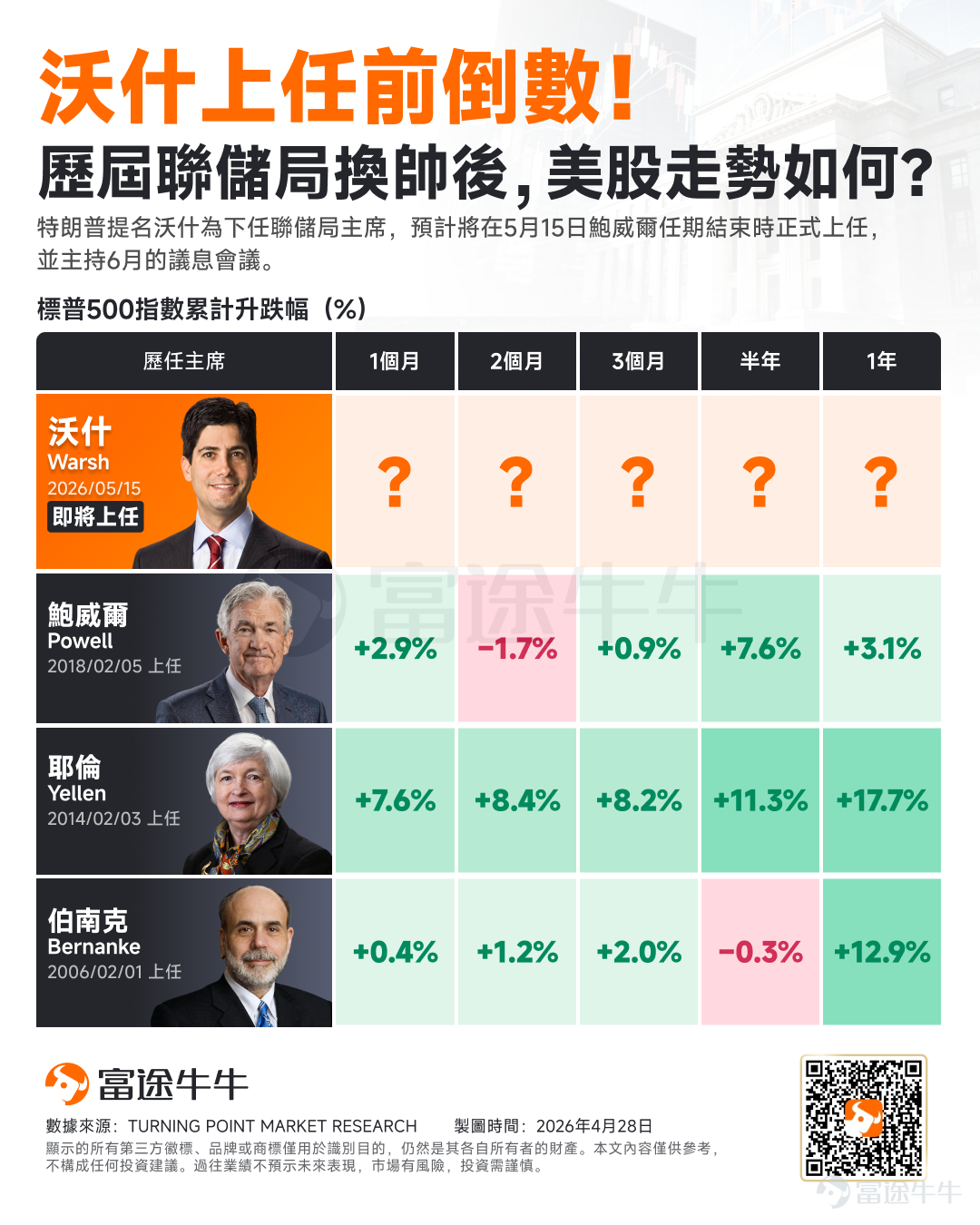
A review of the S&P 500 index following the appointments of the last three Fed chairs shows that the market’s adaptation period to a new chair is often accompanied by volatility, but over the long term, the U.S. stock market has demonstrated remarkable resilience:
Short-term game and stress test (1-3 months):In the early days of a new chairman's term, the market is accustomed to 'testing' their policy bottom lines through volatility. In the second month after Powell took office in 2018, the S&P 500 experienced a 1.7% pullback; during Bernanke’s first three months in 2006, gains were relatively sluggish (in the 1%-2% range).
Medium-term divergence (6 months): As the policy path gradually becomes clear, market performance begins to diverge. During Yellen's era, thanks to the continuation of ultra-loose policies, the market surged 11.3% over six months; whereas during Bernanke’s period, there was a slight decline of 0.3% at the six-month mark.
Long-term success (1 year):Notably, regardless of the initial turbulence at the start of their terms, the S&P 500 ended with positive returns for all three former chairs after one year: Yellen (+17.7%), Bernanke (+12.9%), and Powell (+3.1%).

What will Warsh bring to the market?
Historically,The short-term uncertainty brought by a change in leadership often creates a golden buying opportunity for long-term investors. However, this time around, the 'Warsh era' may require an entirely new trading logic.
Reviewing Wash's recent public statements, his core argument strikes at the heart of current market pricing:
1. Abolish "forward guidance" and the dot plot: He strongly opposes Fed officials frequently 'spoiling' future interest rate paths.
2. Reduce communication frequency: Refuse to commit to maintaining the routine press conference after each FOMC meeting.
3. Reshape the inflation narrative: He argues that inflation is a "policy choice" rather than an external shock, harshly criticizing core PCE as merely a "rough estimate."
The 'hidden base' for global asset pricing in the past was built on the Fed's 'expectation feeding' (dot plots, post-meeting statements). Wash’s potential rise means the Fed will cut off this 'supply of certainty.'The anchor for market pricing will be forced to shift from 'listening to what the Fed says' to 'looking at what the real macro data is.'
In the face of the upcoming regime change, the next phase of market competition will revolve around the following three nodes:
1. Certainty of the transition timeline (early May): If the Senate seamlessly confirms Warsh's appointment, the market’s panic pricing over the absence of forward guidance will likely peak in mid-May. If the transition is delayed and Powell remains as acting chair, it would give the market a period of volatile digestion.
2. Warsh's 'debut' setting the tone (transition management): Historically, no major central bank has ever exited forward guidance without a transition period. The market must closely watch whether Warsh introduces a 'data-dependent scenario-based guidance' as a buffer. If he truly opts for a 'complete severance of forward expectations management and silence,' markets will face severe repricing and sell-offs.
3. Ultimate test – Fed meeting on June 16-17 EST: This is likely Warsh's first rate-setting meeting. The focus of this meeting won’t be the rate decision itself butthe real implementation of the new regime. Investors will witness how Warsh handles his deeply disliked 'dot plot' during the press conference and the outcome of his interactions with existing FOMC members.
Summary
The arrival of the 'Warsh era' marks the end of the trading model that relied on the Fed’s 'nanny-style forward guidance' over the past decade. Investors need to abandon the historical analogy of 'initial drop after leadership change, always rebounding by year-end' and prepare for heightened volatility around macro data releases becoming the norm. Before the new pricing framework is fully established, controlling position sizes and increasing allocation to volatility hedging instruments will be key to navigating this paradigm shift.
Risk Disclaimer: The above content only represents the author's view. It does not represent any position or investment advice of Futu. Futu makes no representation or warranty.Read more


Comments (2)
to post a comment
25
65