
The S&P 500 has risen for seven consecutive weeks—should you chase the rally or take profits?

Why is Asia's semiconductor sector decoupling from the US software crisis?
The divergence between US software and Asian semiconductors is widening
Over the past few years, software and semiconductors have been the two main drivers of the global tech stock rally, with both showing a mutually reinforcing relationship: expansion in software sales drives investment in computing power and infrastructure, while improvements in chip capabilities provide support for more complex applications.
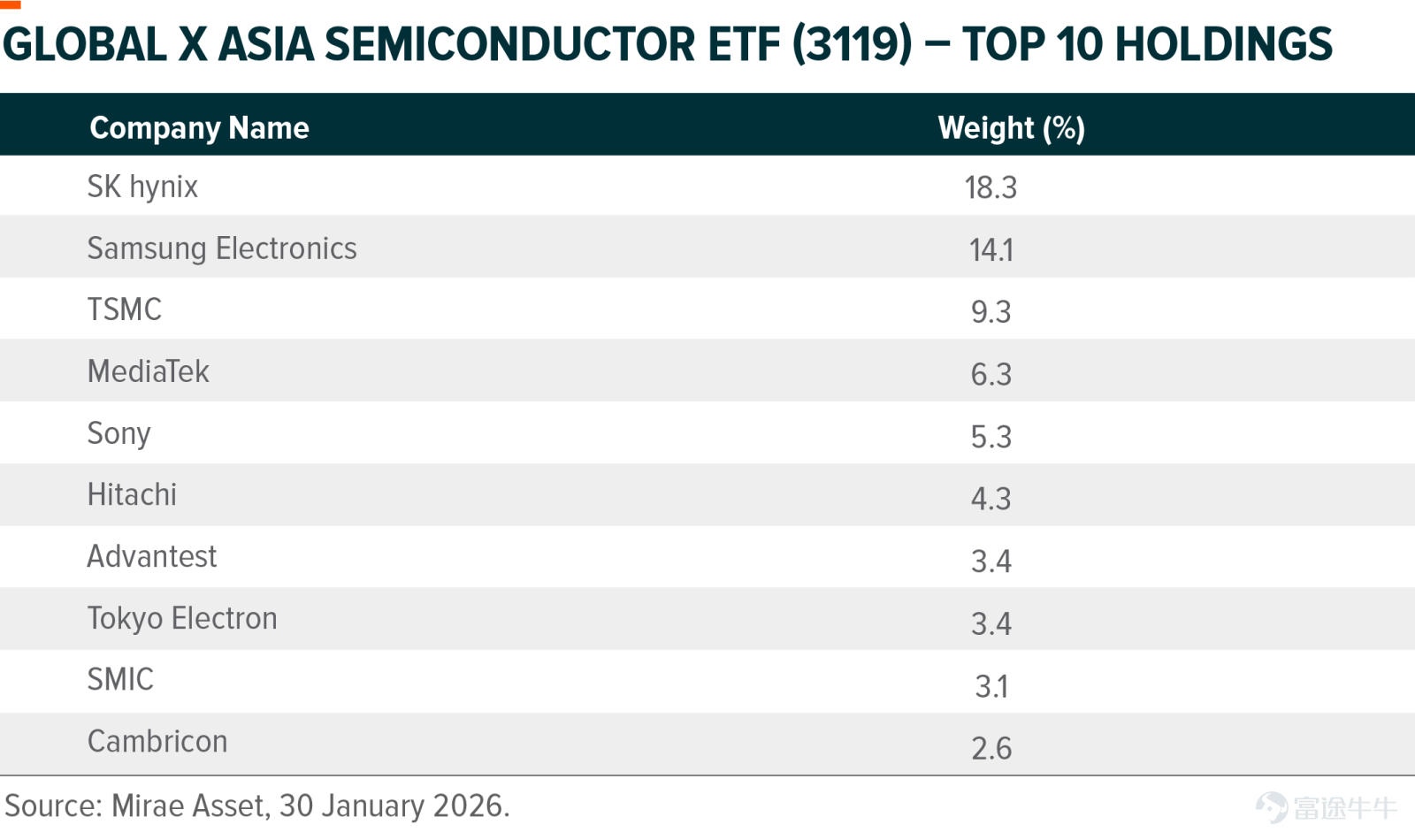
However, by February 2026, the relationship between the two had shown significant cracks. The US software index has continued to weaken, while Global X Asian Semiconductor ETF (3119) $Global X Asia Semiconductor ETF (03119.HK)$ keeps hitting new highs. The market is no longer broadly using 'technology' as the narrative, instead distinguishing between application adopters under cost pressure in the AI supply chain (software) and key infrastructure providers (Asian semiconductors).
Software Sector Crisis
The current US software sector, especially the SaaS segment, is under pressure, which is not limited to cyclical downturns but rather reflects structural issues.
– Internal cannibalization of AI agents:In the past, companies were willing to pay higher subscription fees for CRM, programming, financial systems, etc. However, as autonomous AIs from companies like Anthropic and OpenAI gradually gain the ability to directly complete tasks that originally relied on software, the demand for high-cost, patchwork software tools will gradually decline.
– AI lowers the entry barrier:AI democratizes software development, significantly shortening time-to-market. This is not good news for incumbent firms. New entrants are leveraging AI to offer the functionality of traditional software at a lower cost, turning what used to be monopolistic features into today’s commoditized products.
– The Monetization Paradox:Cloud service providers bear high infrastructure costs in driving AI implementation. However, their pricing power is limited, making it difficult to pass on related costs to customers accustomed to fixed subscription fees. As a result, the industry is entering a typical “margin squeeze” phase: R&D costs are skyrocketing while revenue remains under pressure.
Why the Asian semiconductor sector is a better choice
Despite poor performance in US software stocks, Asian semiconductor companies continue to strengthen their positions. The investment thesis for the Global X Asia Semiconductor ETF remains robust for the following reasons:
– An irreplaceable manufacturing moat:The software industry may be replaced by better algorithms, but a 3-nanometer wafer fab cannot be easily replicated in a short period of time with just capital. Taiwan Semiconductor $Taiwan Semiconductor (TSM.US)$The 3-nanometer process node, in essence, represents a deep moat built on long-term accumulation and tacit knowledge. Regardless of how the AI application landscape evolves, its implementation cannot bypass the Asian wafer manufacturing ecosystem.
– HBM has become a key bottleneck in the AI industry chain:AI performance is no longer just about computing power but increasingly depends on data transmission efficiency. High Bandwidth Memory (HBM), led by South Korea's SK Hynix and Samsung,$Samsung Electronics (005930.KR)$has become a core component of AI accelerators. Paradoxically, as competition intensifies on the software side, the demand for these high-performance memory components (and their bargaining power) grows even stronger.
– The rise of customized AI chips.Large technology companies (e.g., Google$Alphabet-C (GOOG.US)$, Amazon$Amazon (AMZN.US)$, Meta$Meta Platforms (META.US)$) are reducing their reliance on NVIDIA through in-house chip development. This trend benefits Asian foundries because, regardless of who designs the chips, large-scale mass production still relies on the Asian semiconductor manufacturing system. The 'silicon toll rights' remain firmly in Asian hands.$NVIDIA (NVDA.US)$dependence. This is a significant boon for Asian wafer foundries, because regardless of who designs the chip, large-scale mass production ultimately still relies on Asia's semiconductor manufacturing ecosystem, meaning that control over the "silicon rent" in the industry chain remains firmly in Asian hands.
AI Strategy
The current divergence in the technology market signifies a shift in focus from digital services to physical essentials. Despite increasing competition, pricing pressures, and shrinking profits for software applications, Asia's semiconductor industry chain remains an irreplaceable foundation for AI hardware.
Investment Global X Asia Semiconductor ETF (3119)This is not a bet on which software company will ultimately prevail, but rather based on an undeniable fact: regardless of how the future AI application landscape evolves, all winners will rely on the same type of foundational chips.


For risk disclosures related to the ETF, please visit:https://www.globalxetfs.com.hk/zh-hant//funds/asia-semiconductor-etf/
-
This content is for reference and illustrative purposes only, intended solely for Hong Kong investors, and does not constitute an invitation, offer, or recommendation to buy or sell any securities or other financial instruments. This document is provided as general market commentary only and does not constitute any form of regulated financial advice, legal, tax, or other regulated services.
The opinions and data discussed or mentioned in this content are as of the publication date. Certain statements in this content are our expectations and forward-looking statements. These expectations, opinions, and views are based on a large number of assumptions that may not necessarily occur or be correct, and any changes will not be notified separately. Investment involves risks. Past performance is not indicative of future results.
Investing in the relevant fund may involve potential risks (if applicable), including general investment risks, stock market risks, industry/market concentration risks, active/passive investment risks, tracking error risks, trading risks, financial derivatives risks, securities lending transaction risks, and risks associated with capital distributions. Past performance is not indicative of future results. There is no guarantee that the fund’s performance will yield returns, and it may result in no return or loss of investment. Investors should read the fund prospectus to obtain detailed information and risk factors before making any investment decisions. Investors should ensure they fully understand the risks involved in investing in the fund and consider their own investment objectives and risk tolerance levels. Investors are advised to seek independent professional advice before making any investment. Investors must decide for themselves whether to rely on the information contained herein. We assume no responsibility for the content or accuracy of third-party websites linked through hyperlinks in this content. You agree that we or any of our affiliates shall not be liable for any damages or losses caused by, allegedly caused by, or claimed to be related to the use or reliance on the content, products, or services of external websites or any use or reliance thereon. Therefore, we assume no liability for linked websites.
This content is published by Mirae Asset Global Investments (Hong Kong) Limited (licensed by the Securities and Futures Commission for Type 1, 4, and 9 regulated activities under the Securities and Futures Ordinance). This content has not been reviewed or approved by the Hong Kong Securities and Futures Commission or any applicable regulatory authority within the jurisdiction. Without the explicit written permission of Mirae Asset Global Investments (Hong Kong) Limited, no part of this publication may be reproduced in any form or quoted in any other publication.
Copyright ©️2026 Mirae Asset Global Investments (Hong Kong) Limited. All rights reserved.
Risk Disclaimer: The above content only represents the author's view. It does not represent any position or investment advice of Futu. Futu makes no representation or warranty.Read more

Comments (2)
to post a comment
1
5