

The S&P 500 has risen for seven consecutive weeks—should you chase the rally or take profits?

US stocks continue to hit new highs! Is NVIDIA's breakout just the beginning? These events this week are worth focusing on
In the overnight US stock market, $Nasdaq Composite Index (.IXIC.US)$ 、 $S&P 500 Index (.SPX.US)$ hit new highs again, and $NVIDIA (NVDA.US)$ And, $Alphabet-C (GOOG.US)$ both continued to set new records, undoubtedly becoming the most eye-catching highlights. Among them, Nvidia's share price surged by 4%, increasing its total market value to $5.26 trillion, firmly holding the top spot as the world’s largest market capitalization, surpassing the second-place Alphabet by over $1 trillion.
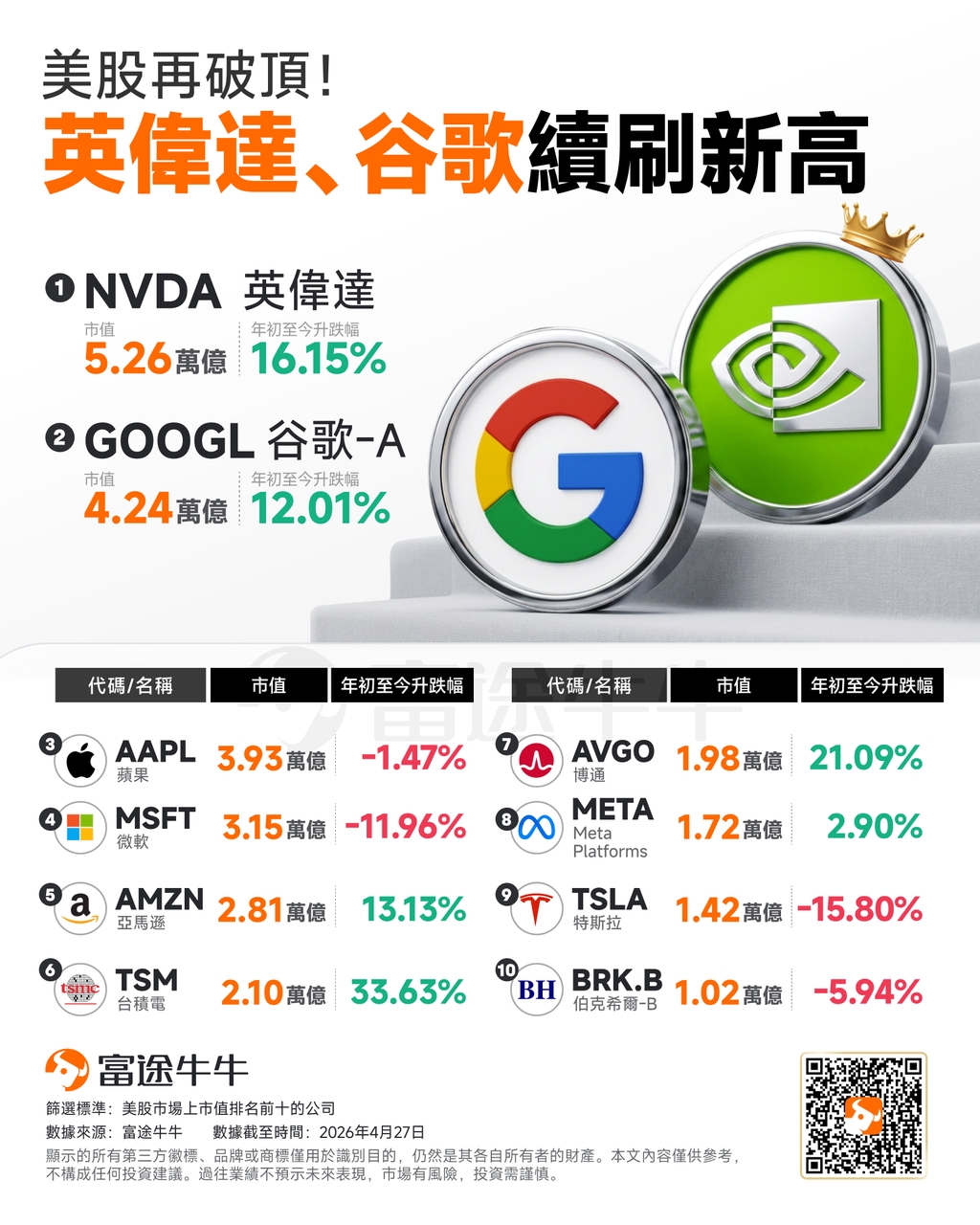
Looking back over the past year, $NVIDIA (NVDA.US)$ revenue has increased by 65% year-on-year, with its stock price rising 93%. Bank of America maintained its 'Buy' rating and assigned a target price of $300. The driving force behind this epic valuation is no longer simply 'selling computing power,' but rather Nvidia's strategic push to penetrate the entire industry through its AI initiatives. Specifically, Nvidia’s recent efforts in various fields have shown results:
Explosive demand on the application side:Nvidia’s partner $Qualcomm (QCOM.US)$ , along with key client OpenAI, has reached a deep collaboration agreement to jointly develop processors specifically for AI smartphones. This partnership confirms the structural growth in AI computing demand and Nvidia’s central role in it. Through such collaborations, Nvidia has successfully transcended the limitations of a traditional chipmaker, transforming itself into a foundational operating system and infrastructure provider for the global AI industry.
Deepening cloud infrastructure:Nvidia and $Alphabet-C (GOOG.US)$ Google Cloud is further expanding its AI infrastructure collaboration. The latest developments reveal that the two parties have jointly launched the A5X bare-metal instance powered by NVIDIA Vera Rubin architecture, which supports expansion to 80,000 GPUs at a single site and up to 960,000 GPUs in multi-site clusters. NVIDIA stated that compared to the previous generation, the cost per token for inference has been reduced to one-tenth, significantly facilitating the large-scale deployment of proxy-based AI.
Strategic extension into emerging scenarios:The reach of computing power is rapidly embedding itself in the physical world. NVIDIA announced a tripartite collaboration with $Oklo Inc (OKLO.US)$ and Los Alamos National Laboratory (LANL), leveraging NVIDIA’s AI infrastructure and digital twin technology for nuclear fuel verification. This project directly supports the U.S. Federal 'Genesis Mission'—a national scientific research initiative aimed at providing resilient energy systems for next-generation critical infrastructure, marking the extension of NVIDIA’s technology from the digital domain to foundational hardcore technologies like energy.
However, the frenzy over computational infrastructure is just the prelude,as market attention shifts toward whether AI capital expenditure can translate into tangible returns.
This week, $Alphabet-C (GOOG.US)$ the parent company Alphabet, $Microsoft (MSFT.US)$ 、 $Amazon (AMZN.US)$and$Meta Platforms (META.US)$ these four companies will announce their first-quarter earnings after the U.S. stock market closes on Wednesday, $Apple (AAPL.US)$ with another taking over on Thursday. These five tech giants collectively hold a market value of nearly $16 trillion, accounting for approximately 44% of the S&P 500’s total market cap. Their performance will largely determine whether the April rally can gain fundamental support and serve as a 'key validation window' for the entire market to assess the progress of AI commercialization.
The market currently expects the combined capital expenditure of these four companies in 2026 to exceed $600 billion. The previous crude logic of 'whoever buys more GPUs takes the lead' no longer applies, and now the market focuses on:Can the massive AI investments, amounting to hundreds of billions of dollars, effectively translate into revenue growth?
Core focus areas for each company’s earnings:
– $Microsoft (MSFT.US)$:Expected revenue of $81.4 billion. Key focus will be on whether Azure's cloud business can maintain a growth rate above 35% driven by AI, and the penetration conversion rate of Copilot in the enterprise sector.
– $Alphabet-C (GOOG.US)$: Whether Azure’s growth remains within 35%-38% . Focus on Google Cloud’s profit margins and the commercialization of Gemini to assess the justification of its $175-$185 billion excess annual capital expenditure.
– $Meta Platforms (META.US)$:Expected revenue of $55.5 billion (up 31% year-over-year). The core test will be the impact of AI ad tools (such as Andromeda) on revenue growth, and the extent to which $115-$135 billion in capital expenditures suppresses profitability.
– $Amazon (AMZN.US)$:Expected revenue of $177.2 billion. Attention will be on AWS’s growth momentum and progress in collaborations with large model firms such as Anthropic, while also keeping an eye on its $200 billion capital expenditure plan.
– $Apple (AAPL.US)$:Expected revenue of $98.5 billion. The focus is on the timeline for Apple Intelligence’s deployment on devices and its effect on driving the iPhone replacement cycle, assessing whether it can offset weak performance in Greater China.
The AI industry is transitioning from the infrastructure phase to the application phase, with market pricing returning to its profit-driven essence. Boosted by Intel's strong earnings, sector sentiment has improved, but the market’s tolerance for 'AI monetization falling short of expectations' remains pessimistic.
As Michael Rosen, Chief Investment Officer at Angeles Investments, said: 'What drives the stock market is corporate profits – nothing else matters.' After experiencing initial valuation bubbles and imagination premiums, this earnings season is a litmus test; only companies that can truly realize AI profits on their balance sheets will stand firm amid upcoming market differentiation and reshuffling.
Risk Disclaimer: The above content only represents the author's view. It does not represent any position or investment advice of Futu. Futu makes no representation or warranty.Read more


Comments (2)
to post a comment
7
5