
2026 Beijing Auto Show | Biwin Launches High-Bandwidth, High-Reliability Automotive-Grade UFS 3.1! Speeding Forward, Stability in Every Situation
To align with the comprehensive integration trend of large-scale AI models in vehicles, and to address higher requirements for storage performance and reliability posed by applications such as 8K cockpit entertainment, real-time high-definition map rendering, multi-modal AI interaction, and L3+ autonomous driving perception data concurrency, Biovision Storage unveiled its next-generation automotive-grade storage solution, UFS 3.1, on the first day of the 2026 Beijing International Automotive Exhibition.
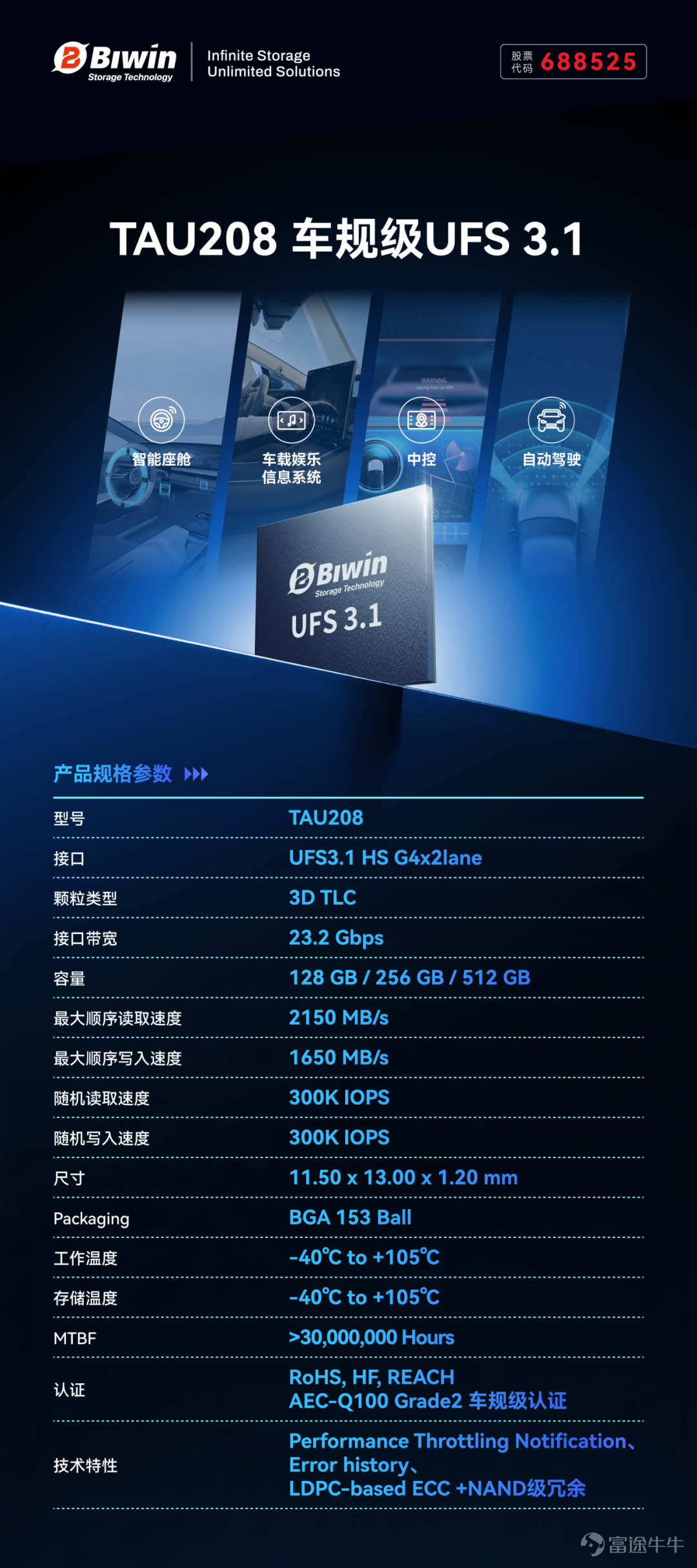
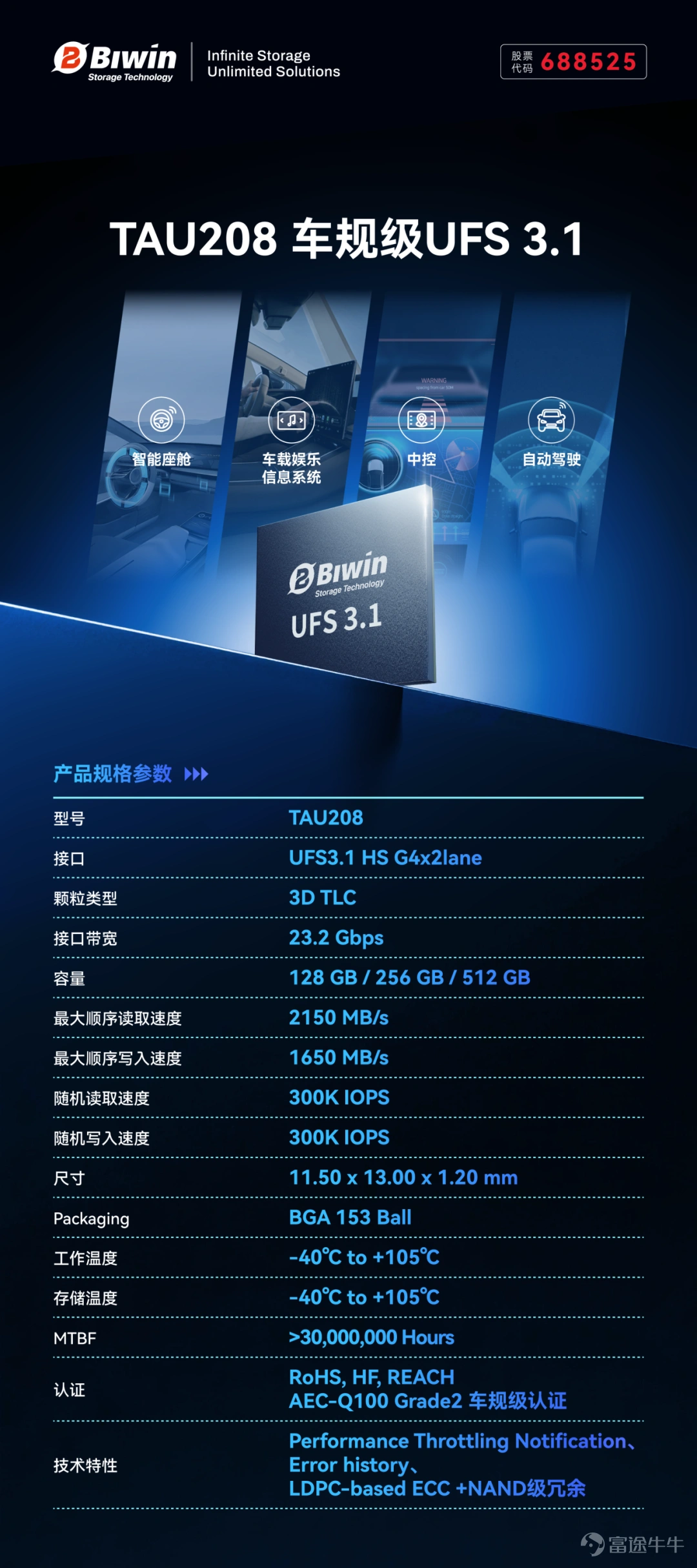
Biovision Storage's TAU208 automotive-grade UFS 3.1 storage product integrates the company's expertise inchip design and firmware algorithmsandPackaging and testing manufacturingfull industry chain technology advantages in the field, with23.2Gbpshigh bandwidth and automotive-gradeAEC-Q100 Grade 2stringent reliability, creating a 'fast and robust' data hub for smart vehicles that can be widely applied to core scenarios such assmart cockpits, autonomous driving, and in-vehicle infotainment systems,anddigital dashboards/center consoles,and more.
High bandwidth and low latency meet the high computing power demands of in-vehicle AI.
Currently, large AI models are rapidly being integrated into vehicles, driving the evolution of smart cars into 'super intelligent agents' capable of autonomous thinking and action. These models enable real-time integration of data and commands across multiple domains such as driving, cockpit, and chassis, establishing a complete closed loop of 'perception-decision-execution.' Within this loop, storage read-write performance directly determines the inference efficiency and decision-making latency of AI models, becoming a key benchmark for measuring the 'IQ' of smart cars.
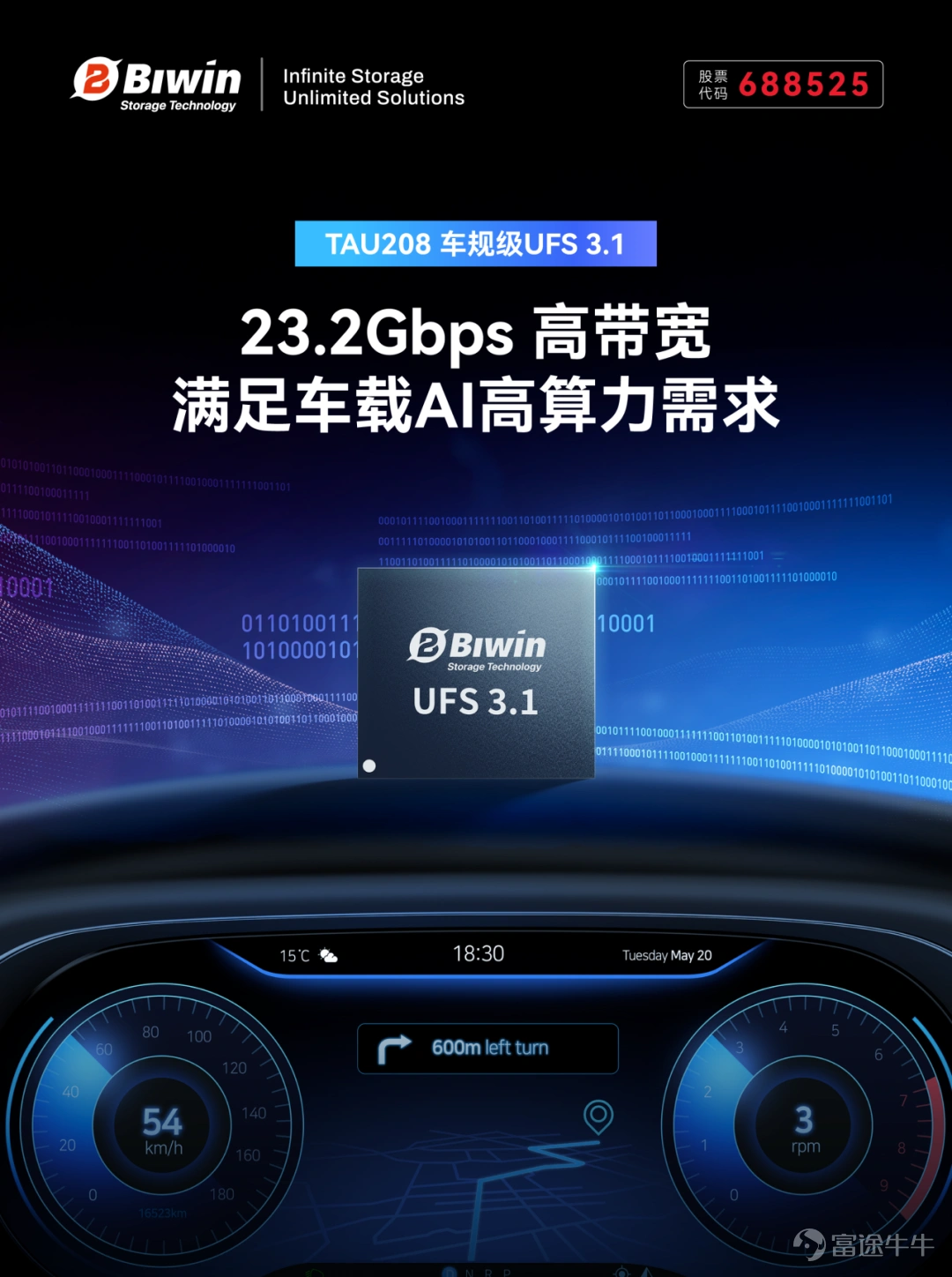
The Biwin TAU208 is based on the UFS 3.1 standard, utilizing the MPHY 4.1 physical layer and UniPro 1.8 protocol, and througha dual-channel (2-Lane) architecture design, pushes theoretical bandwidth up to23.2Gbps. Measured data from Biwin's lab shows that its sequential read and write speeds reach up to2150MB/s and 1650MB/s, while random read-write performance exceeds300K IOPS,with read-write performance showing significant improvement over traditional eMMC6 timesThe above can effectively reduce transmission latency, providing high-speed storage support for in-vehicle applications such as ADAS, domain controllers, and cockpit HMI systems. This means that whether it's real-time updates of high-definition maps, quick activation of AI voice assistants in smart cockpits, or loading large in-vehicle entertainment media files, a 'speak-and-respond' smooth interactive experience can be achieved.
Automotive standards from start to finish, independent research and development plus packaging and testing manufacturing
Reliable performance under extreme conditions with long service life
The variability and complexity of automotive-grade application scenarios determine that reliability and durability are the lifelines of chips. BIWIN UFS 3.1, with itsExcellent operational stabilitywithLong service life, strictly adheres toAutomotive-grade product design and production manufacturingandSupply chain management standards, jointly forming the cornerstone of absolute system reliability while the vehicle is traveling at high speeds.
During the R&D and design phase, Biwin's TAU208 automotive-grade UFS3.1 not only selects high-quality storage chips but also supports-40°C to +105°Can ultra-wide operating temperature range, significantly enhancing the product's durability and lifespan under extreme weather conditions and vibration impacts. The product has successfully passedAEC-Q100 Grade 2reliability certification.
InIn the packaging, testing, and manufacturing stages, Biwin has established dual quality defenses. The company’s self-built advanced memory packaging and testing manufacturing center has passedIATF16949 automotive quality management system certification, and it has mastered 16/32-layer stacked dies, 30μm to 40μm ultra-thin dies, and multi-chip heterogeneous integration.and other cutting-edge packaging technologies, balancing product advancement with manufacturing quality.
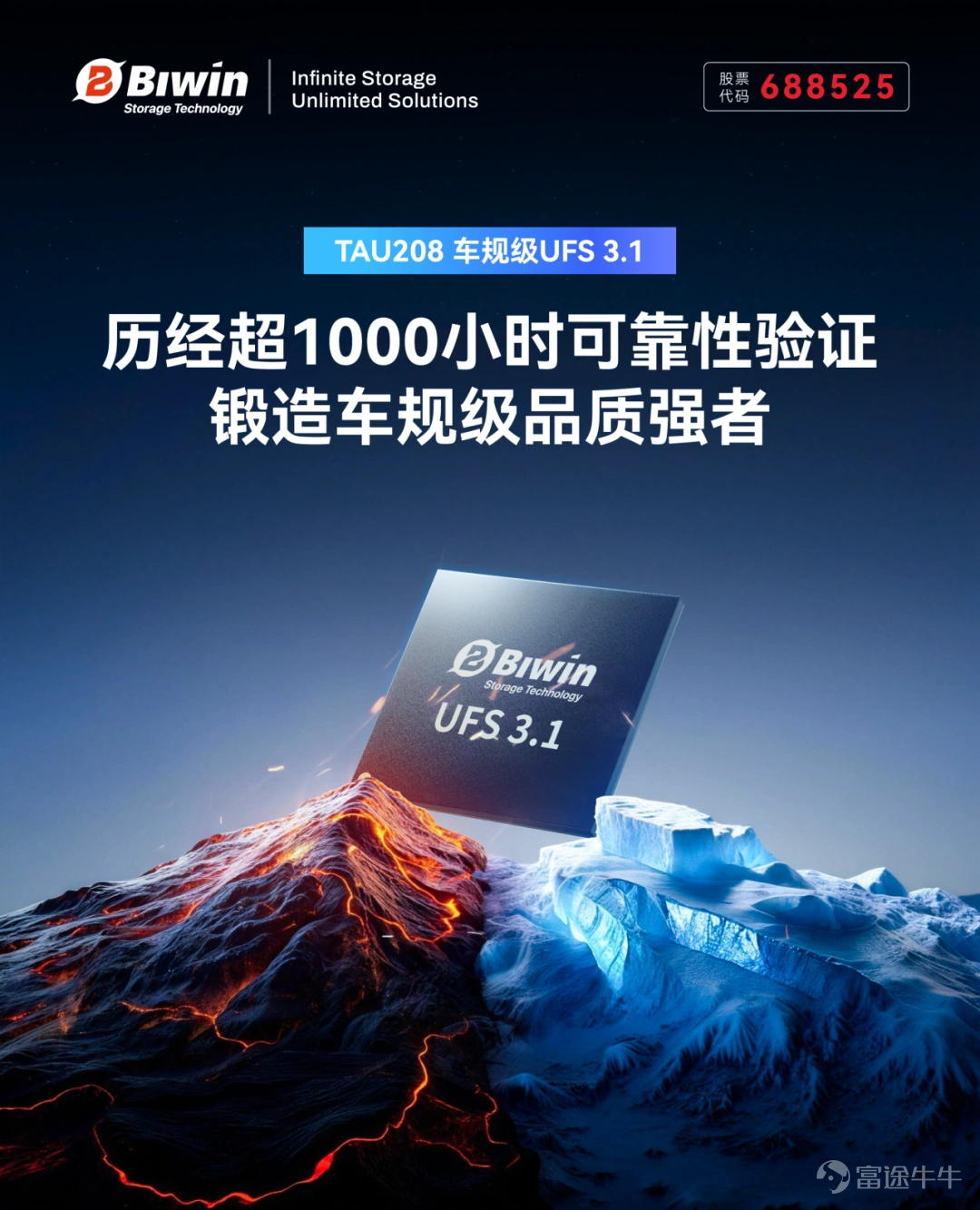
Biwin has established a professionalautomotive-grade product testing laboratory, utilizing a rigorous testing system that covers the entire product lifecycle. The TAU208 UFS 3.1 has undergone more than1,000 hoursof reliability validation, coveringthermal cycling, thermal shock, high-pressure steam, salt spray corrosion, mechanical impactandEMC electromagnetic compatibilityand various other international standard testing procedures. These tests verify its ability to maintain smooth operation under harsh conditions such as extreme temperatures, vibration, and humidity. Its mean time between failures (MTBF) exceeds30 million hours., with a service life of over five years. In addition, Biwin has signedLTA Agreementwith major global wafer manufacturers to ensure continuous and stable supply.
Advanced error correction and intelligent regulation mechanisms,
self-developed firmware ensures data security and stability
To strengthen the data security defenses of smart vehicles, Biwin has exclusively developed multiple protection features and technical strategies for automotive-grade application scenarios, safeguarding data flow security comprehensively from the underlying architecture to intelligent control.
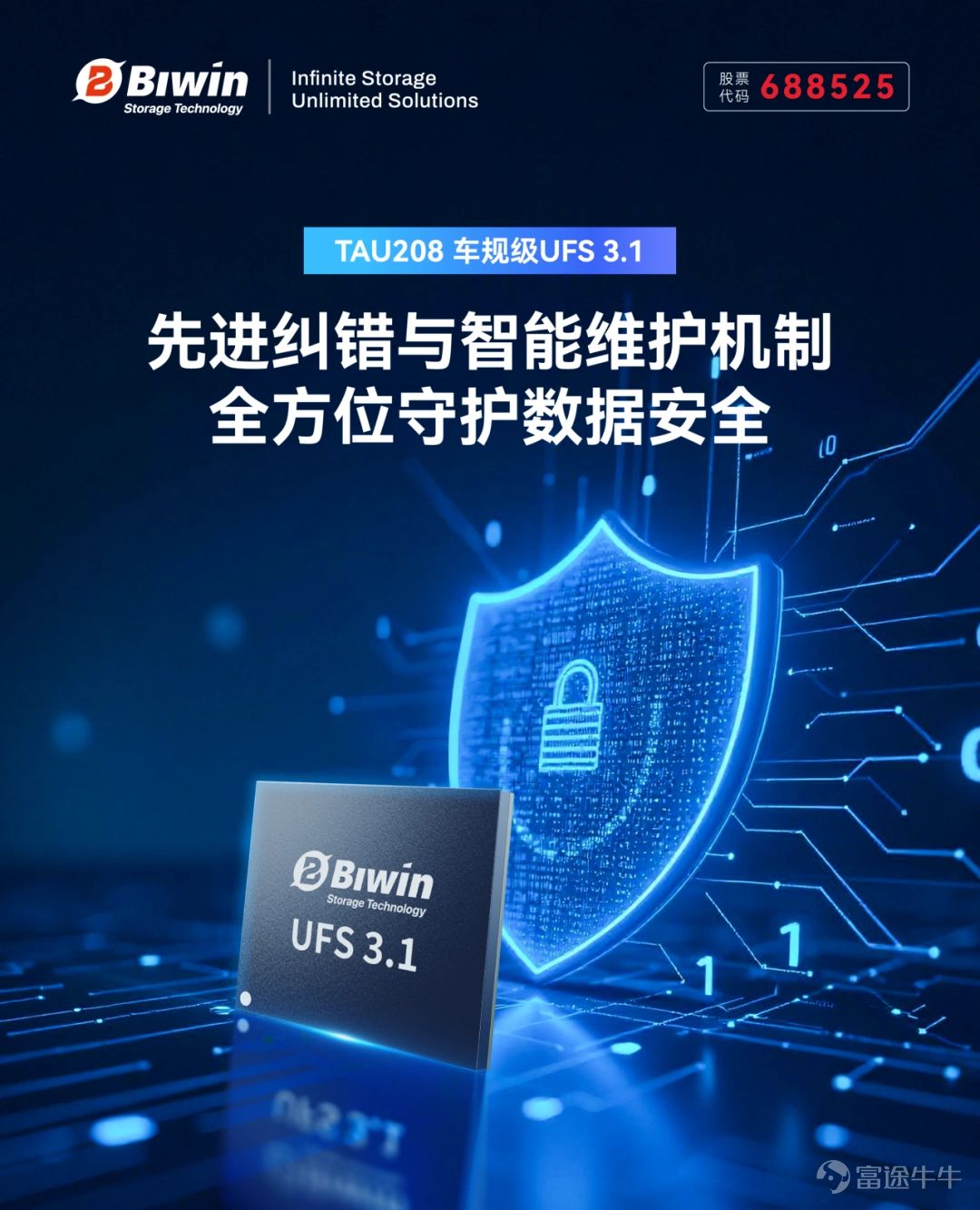
The product includes built-in integration ofLDPC-based ECC + NAND-level redundancy,a dual data protection technology that ensures data integrity at the foundational level, guaranteeing that even under long-term high-frequency read/write operations, driving data and user privacy remain completely intact. The uniquePerformance Throttling NotificationThe function intelligently and proactively adjusts performance based on temperature behavior, avoiding increased wear caused by higher error rates during flash memory data writing at high temperatures. This ensures safer and more reliable product data reading and writing while reducing the loss of service life.Error Historyprovides critical data support for fault diagnosis and preventive maintenance, achieving comprehensive protection from data storage to system health.
An innovative low-power consumption mode extends vehicle range.
In response to the extreme pursuit of energy efficiency in electric vehicles, Biwin's TAU208 automotive-grade UFS3.1 introduces a Deep Sleep hibernation mechanism.When the vehicle is turned off or in standby mode, power consumption can be reduced significantly,95%effectively minimizing dark current loss, thus lightening the load on the vehicle’s overall range.
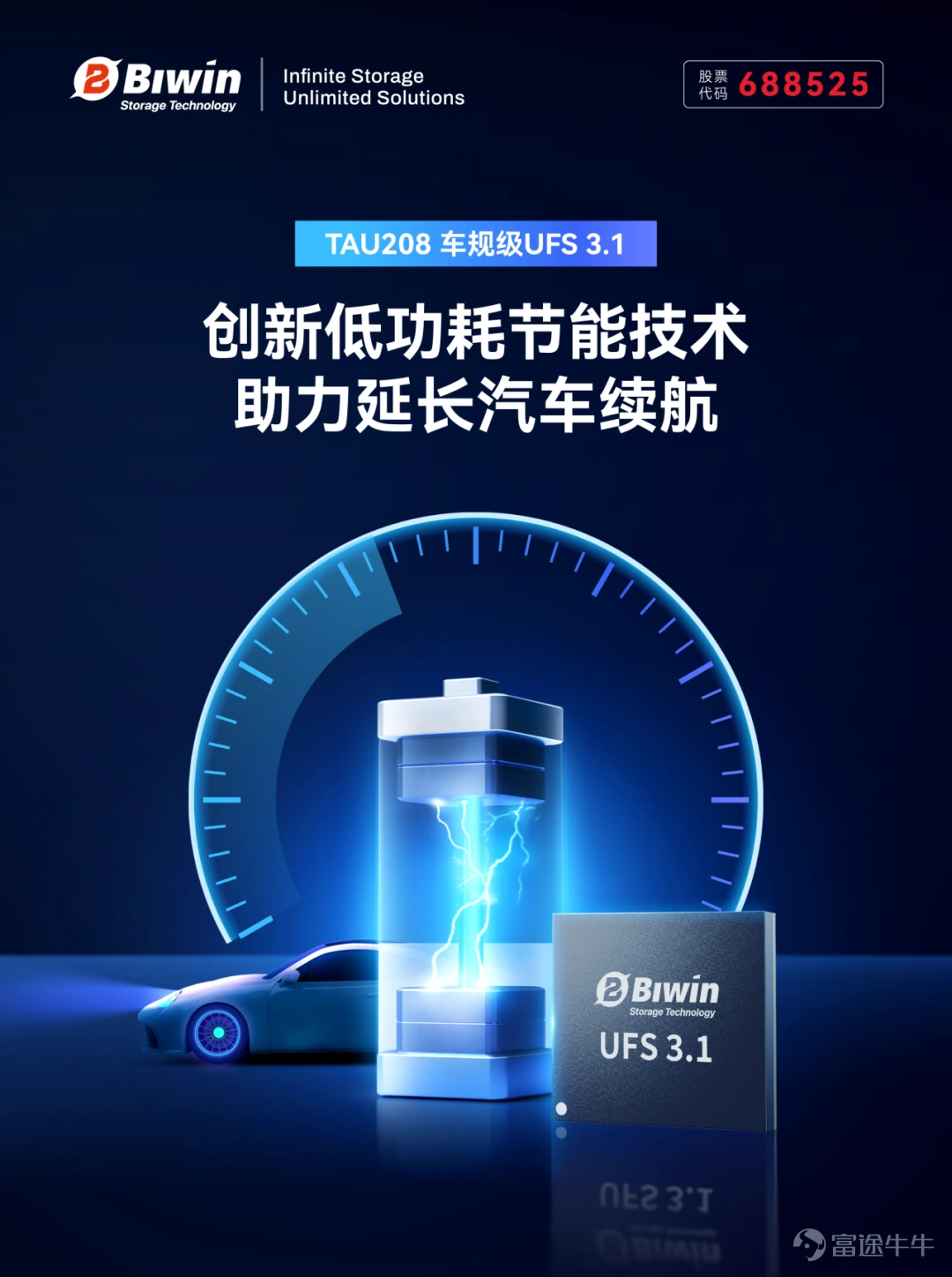
Additionally, the TAU208 features intelligent thermal control and health management functions. Its unique performance adjustment notification mechanism monitors chip temperature in real time and dynamically adjusts performance to prevent overheating and frequency reduction. The Error History function provides key data support for after-sales diagnostics, transitioning from 'reactive repair' to 'proactive prevention.'
Conclusion
The automotive-grade UFS 3.1, with its ultra-high bandwidth of 23.2Gbps, exclusive error correction algorithms, and innovative low-power consumption modes, delivers highly stable and secure data support for multi-scenario applications in smart cars. This not only reflects the company’s advancements in automotive-grade storage technology development but also represents the continuous improvement of its automotive market strategy.
In the smart automotive sector, the company boasts a comprehensive product portfolio coveringautomotive-grade LPDDR, eMMC, UFS, BGA SSD andmemory cardsand other product formats. The company's products have successfully entered the supply chains of over 20 mainstream domestic automakersandcore Tier 1 suppliersand achieved volume delivery and large-scale sales of automotive-grade memory products. Notably, the company’s eMMC automotive-grade memory chip has successfully passed the verification of the 'Automotive Chip Certification Review Technology System' organized by the Certification and Accreditation Technology Research Center of the State Administration for Market Regulation, with key technical indicators receiving a 'favorable pass' review result,making the company one of only two manufacturers in the storage field to enter this whitelist.
Looking ahead in the smart automotive sector, the company will further expand its product portfolio on the basis of achieving full coverage of top-tier domestic automakers. The focus will be on promoting the large-scale mass production of eMMC for vehicles and accelerating the adoption and application of UFS in mid-to-high-end scenarios, building benchmark solutions covering all scenarios from smart cockpits to autonomous driving. At the same time, the company will continue to deepen its self-developed ecosystem across the entire chain of 'main control + solutions + packaging and testing,' leveraging its highly independent and controllable technological advantages to provide customers with secure and reliable automotive-grade storage solutions.
Risk Disclaimer: The above content only represents the author's view. It does not represent any position or investment advice of Futu. Futu makes no representation or warranty.Read more
Comments
to post a comment