
The Big Four's performance diverges after results! Who is the real winner in AI?

Earnings and Options Strategy | Meta's 2026 AI Endgame: A Three-Minute Guide to Clarifying Key Focus Areas in the Latest Earnings
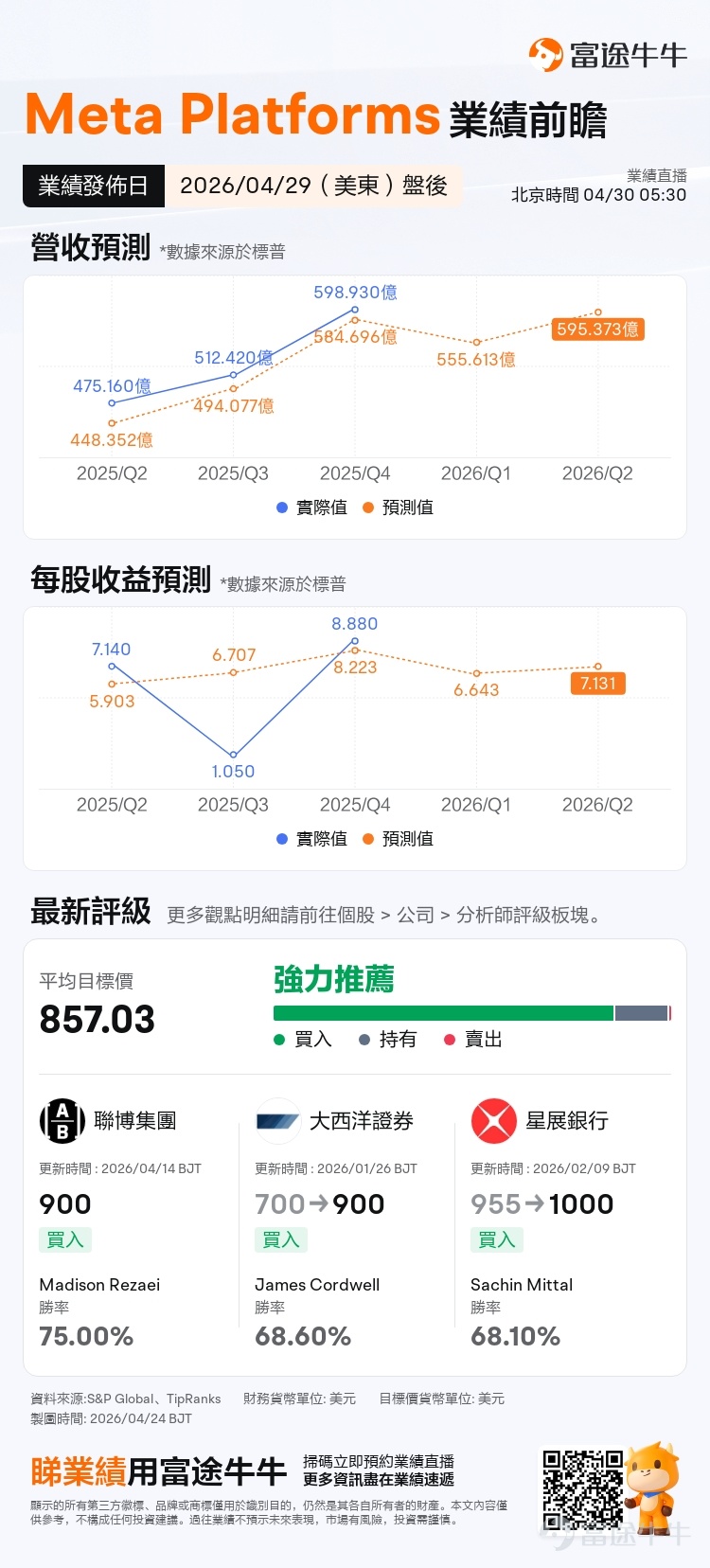
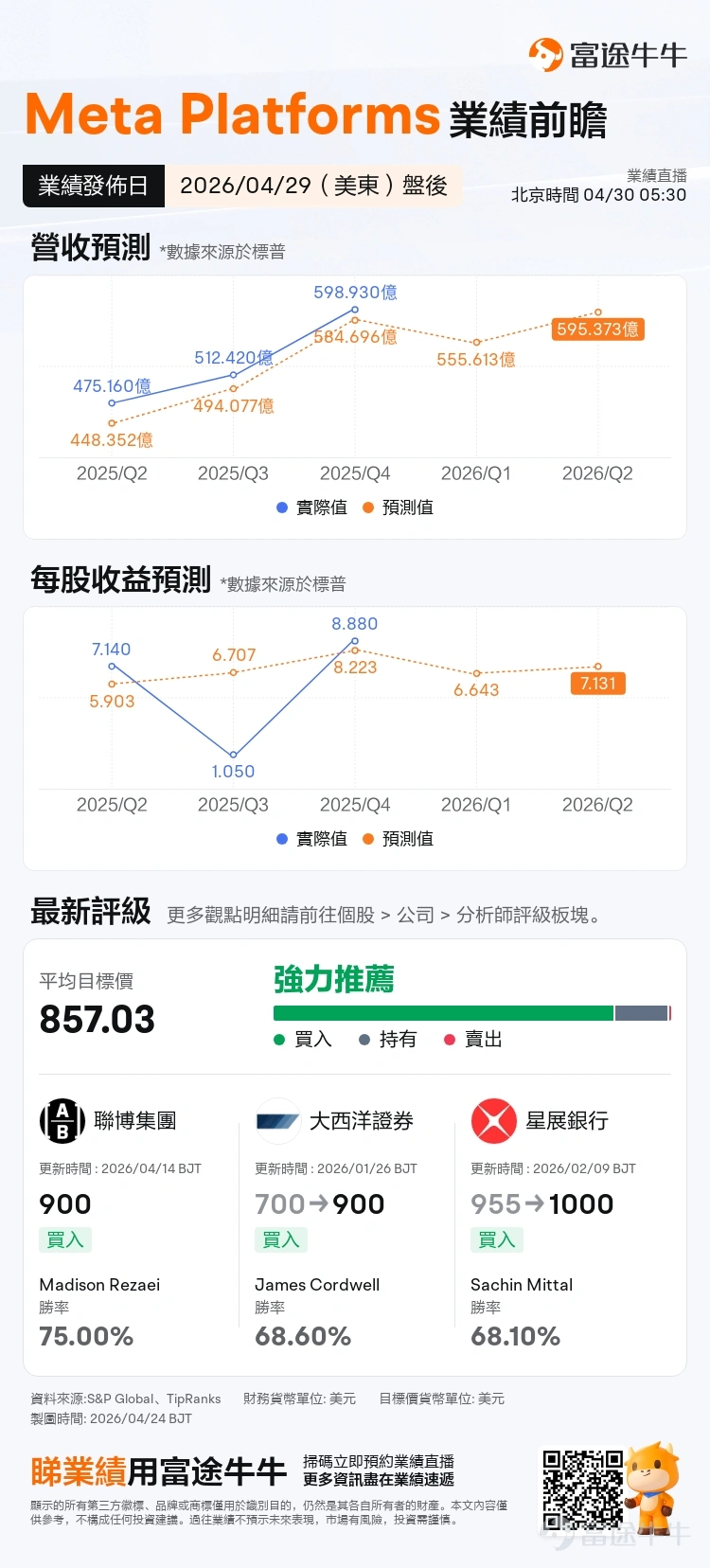
$Meta Platforms (META.US)$ Will release its Q1 2026 earnings after the market closes on April 29 (US Eastern Time).For this Q1 2026 earnings, Meta is expected to achieve revenue of $55.56 billion, a year-over-year increase of 31.29%; net profit is projected at $17.072 billion, up 2.57% year over year.(The above data follows the US-GAAP accounting standard).
Regardless of the outcome, one undeniable fact is that Meta has invested heavily in AI and infrastructure.But is this investment truly buying into the future, or is it eroding profits?
I. Core Contradiction of This Earnings Report: The Gap Between High Revenue Growth and Stagnant Profit Expectations
Currently, there is a notable contradiction in the financial market's expectations for Meta's Q1 2026 earnings. The market generally anticipates that the company’s total revenue this quarter will reach $55.56 billion, representing a significant year-over-year growth of 31.29%. However, expectations for net profit are only at $17.072 billion, with a mere 2.57% year-over-year increase.
This market projection of surging revenue without corresponding profit growth reflects Meta's most pressing challenge at present:The company is making massive investments in artificial intelligence (AI) and foundational hardware equipment, but investors urgently need to use this earnings report to confirm whether these huge expenditures are paving the way for future high returns or are simply consuming existing profits without purpose.
II. The truth behind the decline in profits
Many people see that Meta’s net profit for the full year 2025 fell by 3% year-over-year (from $62.36 billion to $60.458 billion) and mistakenly believe the company’s ability to generate profits has weakened. But is this really the case?

One-time profit impairment caused by tax policy
If you carefully read the footnote (1) below Meta's Q4 2025 and full-year financial report, you will discover that the fundamental reason for the decline in Meta's annual net profit is the 'One Big Beautiful Bill Act.' This caused Meta's effective tax rate to soar to 30% in 2025, compared to just 12% in 2024. Excluding this special tax event, the company's normal business tax rate should be around 13%. According to Meta's official forecast, the tax rate for 2026 will return to a normal range of 13% to 16%. This means that even if the company does nothing, the net profit figure for 2026 will naturally recover simply due to the tax rate normalization.
Core mobile app business: A strong 'cash cow'
In terms of core operations, the profitability of key application divisions represented by Facebook and Instagram remains very strong. In Q4 2025, this division generated $58.938 billion in revenue, with daily operating profits reaching $30.766 billion. In other words, for every $100 earned, this division generates over $52 in profit.
Virtual reality division: Peak losses and strategic shift
What truly dragged down overall profits was the metaverse and Reality Labs. In Q4 2025, this division incurred a loss of $6.021 billion, with total annual losses amounting to $19.193 billion. However, the company’s Chief Financial Officer explicitly promised that the scale of losses for this division in 2026 will remain flat compared to 2025 and will not worsen further. Additionally, there is a shift in the product focus of this division: the company has abandoned plans to launch a new generation of bulky Quest headsets, instead focusing on promoting lighter, AI-powered Ray-Ban smart glasses. This marks a strategic transition from heavy hardware towards lightweight wearable AI devices.
Three: Massive investment and workforce restructuring
In order to maintain its leading position in the artificial intelligence race, Meta is undergoing aggressive financial and personnel adjustments.
Doubling of hardware and equipment investment (CapEx)
The company plans to invest between $115 billion and $135 billion in 2026 on purchasing infrastructure and hardware equipment. This figure is almost double the amount spent in 2025 ($72.2 billion).These funds were mainly spent in three areas: leasing third-party cloud services, equipment depreciation due to aging, and providing support for the newly established 'Super Intelligence Lab' in 2026.
To raise funds, Meta borrowed an additional $29.906 billion in long-term debt in the fourth quarter of 2025, pushing its total long-term debt to $58.744 billion. At the same time, the company halted stock repurchases, channeling all saved funds into AI development. However, given that the company still holds $81.592 billion in cash and easily liquidated assets, the current debt repayment pressure remains fully manageable.
Surface-level layoffs versus internal restructuring
By the end of 2025, the company's total workforce reached 78,865 people, a 6% increase from the previous year. However, in 2026, the company announced a layoff of approximately 10% (around 7,800 employees) in May, with over a thousand already laid off in January. The increase in total headcount alongside new layoffs appears contradictory but is actually a 'major restructuring' of personnel. In 2025, Meta hired a large number of high-paid AI experts, and now it is cutting positions that have not met performance expectations. Therefore, although the total workforce is shrinking, overall labor costs may not significantly decline in 2026 due to the high salaries of newly recruited AI engineers.
Fourth, can AI deliver results?
Faced with such enormous spending, has the money been well spent? Data from the fourth quarter of 2025 provides some insights:
Improved ad monetization efficiency:With the help of AI-powered precision targeting, the number of ads users see increased by 18% compared to the same period last year, while the selling price per ad also rose by 6%.
New tools directly generate revenue:The company's newly launched video AI tool is expected to generate approximately $10 billion in advertising revenue annually, and the business messaging feature on WhatsApp is also projected to create around $2 billion in annual revenue.
User growth:The monthly active user count of Meta AI Assistant has reached approximately three times that of last year.
However, the past does not represent the future. Currently, a company’s performance, especially for large-cap firms, is evaluated not only on how well they performed in the previous quarter but also on whether their guidance for the next quarter can exceed expectations and satisfy the market.Therefore, Meta's guidance for various data points in Q2 2026 becomes particularly important and requires close attention.
Five: Potential risks to be wary of
Advertising restrictions in Europe:Meta has reached an agreement with the EU to begin reducing the delivery of 'tailored' personalized ads in Europe starting from the first quarter of this year. Due to less targeted advertising, this could lead to a decline in ad pricing in the European region. The specific impact of this policy will become evident in this earnings report.
Six: Market sentiment in the financial sector: What are investors betting on
Based on options trading data right before the earnings release (April 24), the market sentiment leans optimistic overall, with relatively rational expectations.
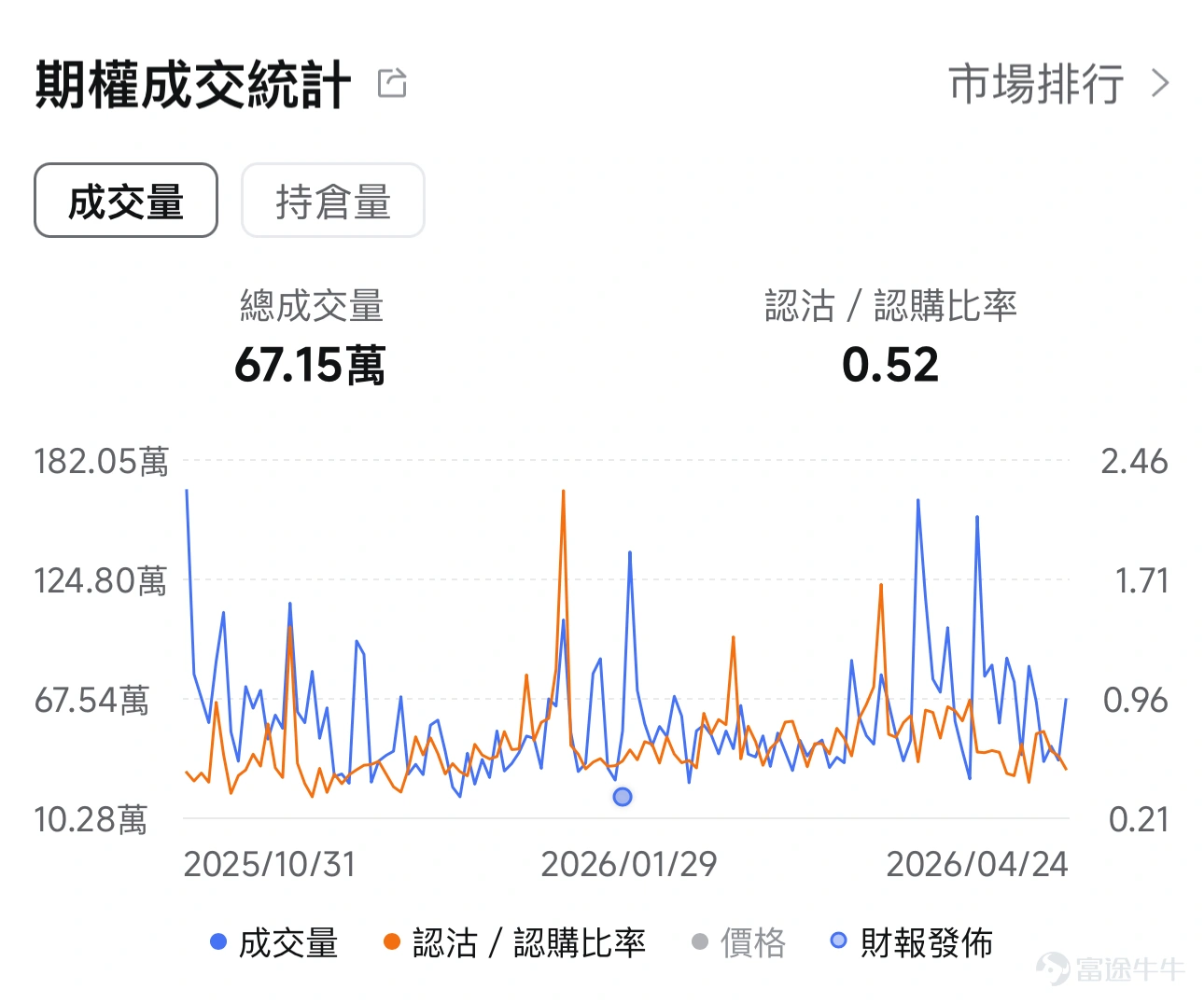
Strong bullish sentiment:The Put/Call Ratio currently stands at 0.52. This indicates that significantly more people are buying Meta call options compared to those buying put options.

Expectations for sharp volatility are relatively high:Although Meta's implied volatility (IV) currently stands at only 44.77%, its IV percentile has reached as high as 87% — meaning that only 13% of the days in a year see Meta's IV higher than its present level. While it is not yet at an extreme value, considering there are still a few days before the actual earnings release, fellow investors looking to trade options during Meta’s earnings period should exercise caution to guard against IV Crush.
In response to the current situation, the market typically offers several rational strategies for fellow investors to consider:
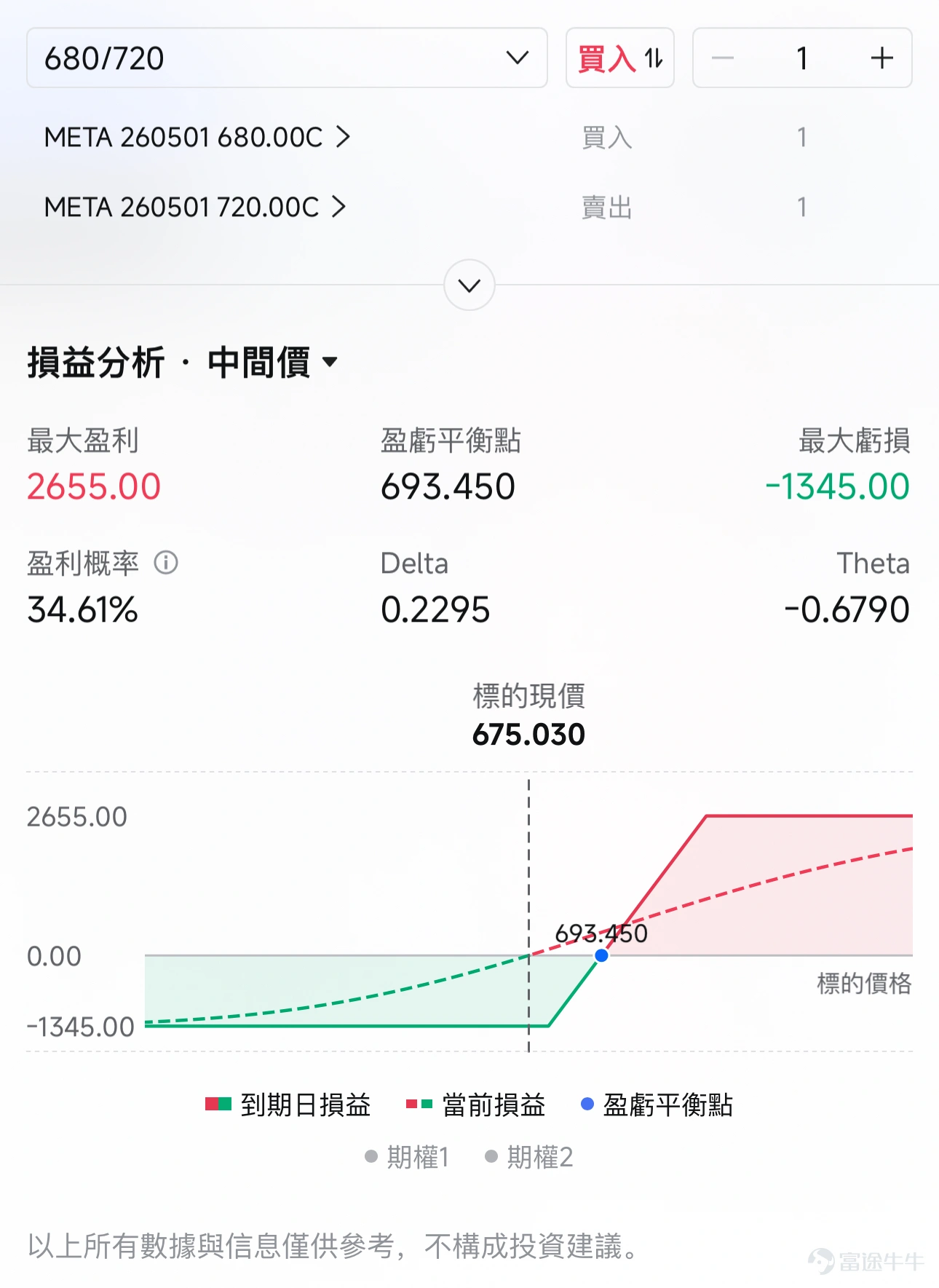
Mildly bullish strategy — Bull Call Spread
Suitable for:Investors who expect Meta’s Q1 data to beat expectations but want to hedge against the high IV environment
Simultaneously buying and selling call options with different strike prices not only caps the profit potential but also reduces the entry cost of options trading while mitigating time decay and volatility risks.
(The figure below illustrates the simulated profit and loss scenario of this strategy on the expiration date. The design image displayed on the screen is for demonstration purposes only and does not constitute any investment advice or guarantee; market conditions fluctuate frequently, and the prices shown do not represent actual values.)
Conservative protection strategy — Collar
Suitable for:Investors who already hold Meta shares, are optimistic about Meta’s long-term stock performance, but fear unexpected events leading to a sharp decline in stock price.
Sell deeply out-of-the-money call options and use the premium received to purchase a 'downside insurance.' This is a very conservative way to hedge risks.
(The figure below illustrates the simulated profit and loss scenario of this strategy on the expiration date. The design image displayed on the screen is for demonstration purposes only and does not constitute any investment advice or guarantee; market conditions fluctuate frequently, and the prices shown do not represent actual values.)
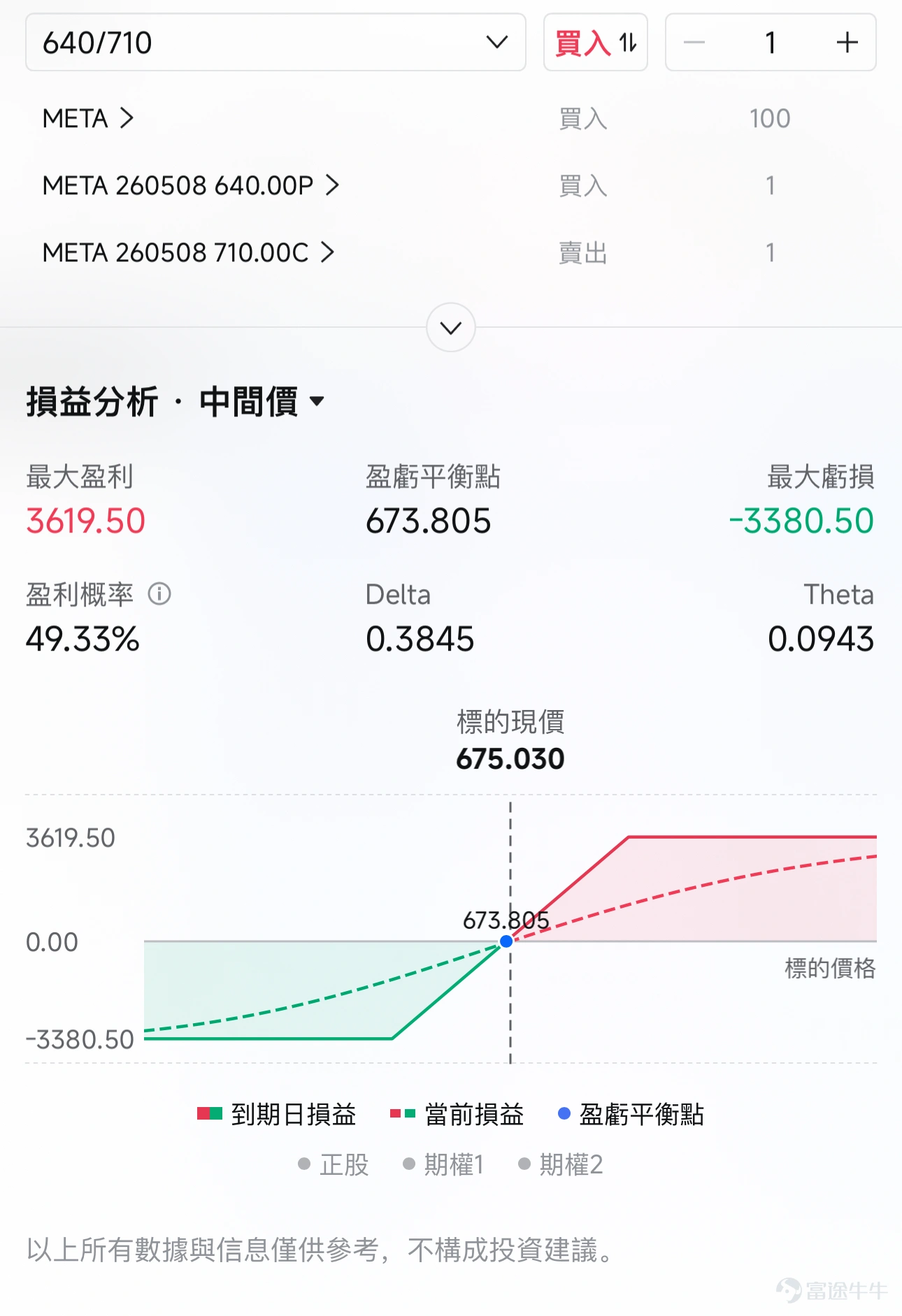
Cash-Secured Put
Suitable for:Investors who are optimistic about Meta's long-term development but think the current stock price is too high and are willing to buy the stock at a specified lower price while collecting a premium.
If the stock price does not fall, these investors, although not having bought the shares, still earn a premium. If it falls, they can purchase the shares at their desired low price.
(The figure below illustrates the simulated profit and loss scenario of this strategy on the expiration date. The design image displayed on the screen is for demonstration purposes only and does not constitute any investment advice or guarantee; market conditions fluctuate frequently, and the prices shown do not represent actual values.)

Finally, here's a small perk for fellow Futubull investors, welcome to claim it.Options Beginner Pack
*This event is exclusive to invited HK users. Click to learn more.Detailed event rules>>

Disclaimer
This content does not constitute any offer, solicitation, recommendation, opinion, or guarantee for any securities, financial products, or instruments. The risk of loss in trading options can be substantial. In some cases, your losses may exceed the initial margin amount deposited. Even if you have set contingent orders, such as 'stop-loss' or 'limit' orders, they may not necessarily prevent losses. Market conditions may render these orders unexecutable. You may be required to deposit additional margin within a short period. If you fail to provide the required amount within the specified time, your open positions may be liquidated. However, you will still be responsible for any deficit balance in your account. Therefore, before trading, you should study and understand options and carefully consider whether such trading is suitable for you based on your financial situation and investment objectives. If you trade options, you should be familiar with the procedures upon exercising options and at expiration, as well as your rights and obligations when exercising options and at expiration.
Risk Disclaimer: The above content only represents the author's view. It does not represent any position or investment advice of Futu. Futu makes no representation or warranty.Read more

Comment (1)
to post a comment
28
17