The Big Four's performance diverges after results! Who is the real winner in AI?

Earnings Options Strategy | Super Thursday! Four Giants Release Results, Can AI Become the Driving Force for Microsoft's Growth?
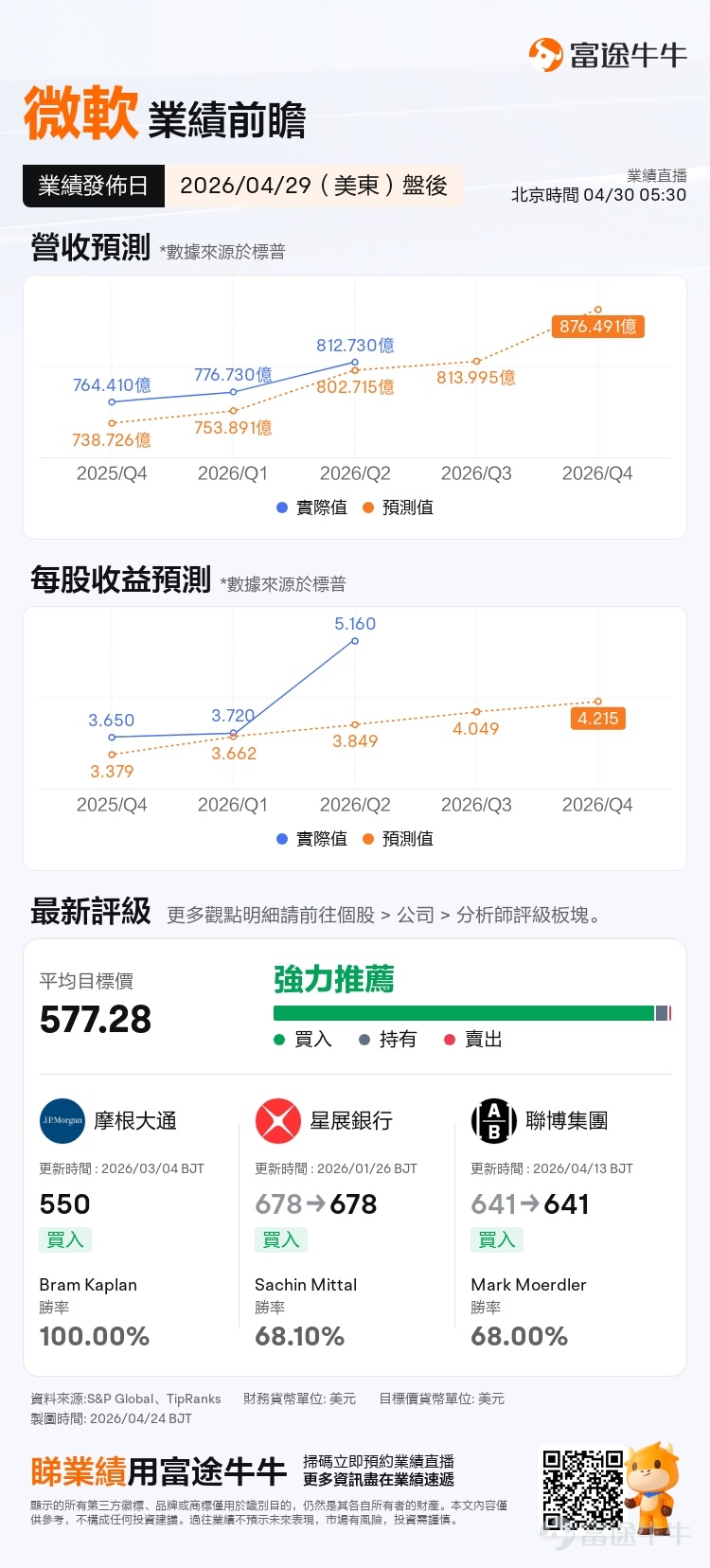
$Microsoft (MSFT.US)$ Coming soonThis Thursday after market close (4:00 AM Beijing Time on April 30) to release the Q3 FY2026 earnings report (covering the natural months of January to March 2026)Institutional forecasts expect revenue of $81.4 billion for Q3 2026, an increase of 16.2% year-on-year; expected earnings per ADS at $4.049, up 17.02% year-on-year.

Looking back at Microsoft’s performance over the past four years, it can be seen that its recent valuation expectations have been significantly influenced by earnings reports.In the last six earnings reports, post-results volatility exceeded options market valuation expectations five times.Following the release of the last earnings report, market concerns arose over a potential turning point due to slower-than-expected growth in AI-related businesses and increased capital expenditures. On the day of the report's release, the stock price closed down 9.99%.

Let’s first break down Microsoft’s current primary revenue composition. Based on the results from the last earnings report, the company's main sources of revenue were cloud services (37.98%) and Microsoft 365 subscriptions and related services (30.17%), followed by gaming (7.33%) and LinkedIn (6.25%). The key to this earnings performance still lies inwhether Microsoft's financial report can provide stronger guidance at a time when all the major tech giants are aggressively investing in AI.

Intelligent Cloud Services: Positive Outlook, Driven Mainly by Supply-Side Growth
The Intelligent Cloud division is currently Microsoft’s primary revenue driver and the business segment most closely watched by investors. This division encompasses Azure public cloud services, server products, and enterprise services. In the past few quarters, the Intelligent Cloud division has accounted for more than 40% of Microsoft's total revenue and has been the absolute main force driving the company's performance growth. The performance of Azure and other cloud services directly determines the market’s valuation logic for Microsoft.
In its latest in-depth research report, Morgan Stanley pointed out that it expects Azure’s Q3 growth rate to reach 39% (compared to 31% growth in the previous quarter, which is 1% higher than the market consensus for this quarter), supported by two key factors:
1. Continuous improvement in GPU computing power supply, soon providing larger computing power quotas
In addition to the upcoming large-scale deployment of Microsoft's self-developed GPU Maia 200 next quarter, as NVIDIA's GB200/300 NVL72 rack shipments continued to rise from January to March, the total production of GB200/300 racks is expected to reach approximately 20,800 units, up from 15,500 units in October to December last year. It is expected to further increase to 24,400 units from April to June this year, which will provide Microsoft with a larger computing power quota.

2. Continued market share capture, positive CIO survey results
In surveys of downstream CIO manufacturers, the majority of respondents believe that Microsoft will capture the largest share of AI consumption services, and most believe this share will continue to grow, taking market share from Oracle, offering a positive outlook for Azure’s business development.


Although demand is strong, supply constraints have indeed limited the further growth of Azure. Microsoft CFO Amy Hood also explicitly mentioned: 'The essence of Azure's guidance isthe guidance for deliverable computing power capacity.If all newly launched GPUs were allocated to Azure, the growth rate would exceed 40%. However, the purchased computing infrastructure must not only supply the Azure business but also be distributed to external Azure customers, first-party applications like M365/Copilot, and internal model R&D training, etc. Coupled with several consecutive quarters of high Azure business growth, this has dampened expectations for further growth increases.
Capital Expenditure (CapEx): A burden on enterprises, or does it imply strong upward expectations?
Looking back at the previous quarter, total capital expenditure for the quarter reached $37.5 billion, far exceeding expectations, with a year-over-year increase of 66%, raising market concerns about costs dragging down profit growth.
With storage and server hardware prices doubling at the beginning of the year, Morgan Stanley expects corresponding capital expenditures to increase accordingly, and the total capital expenditure for the fiscal year 2026 will reach $144.9 billion.

The key question is: Is an increase in capital expenditure necessarily a bad thing?
Let's not forget that the current growth of Azure's cloud business is mainly driven by the supply side, meaning that the hundreds of billions spent on computing power won't be wasted but will instead become fixed assets generating real income! Of the total CapEx, approximately 62% is allocated to monetizable expenses for Azure AI and M365 Copilot, and these investments can be reflected in revenue within the same quarter.According to Morgan Stanley's calculations, as long as the gross margin of the AI business is above 20%, the revenue growth brought by these additional expenditures will exceed previous consistent expectations, showing strong elasticity, which is also the core reason why Microsoft is undervalued.

Forward-looking for other business divisions
Aside from AI Cloud, the 'Productivity and Business Processes' segment remains a cash cow and primary revenue contributor. This segment includes Office Commercial, LinkedIn, and Dynamics 365.The growth rationale mainly benefits from the natural increase in subscription numbers and an upward shift in subscription pricing tiers, with expectations of steady growth in the mid-to-high single digits to low double digits.
Moreover, within the More Personal Computing (MPC) segment (accounting for approximately 17% of revenue), the Windows MPC business is affected by rising memory prices, and the gaming division lacks first-party game content, which is expected to lead to sluggish or even declining growth.
Options market signal: High volatility is still anticipated, with significant bullish positioning.
From the perspective of the options market,Currently, the ratio of put to call options traded for Microsoft stands at 0.39, with an open interest ratio of 0.48, indicating that most investors are betting on call options expecting a post-earnings stock price rise.Simultaneously, the implied volatility (IV) is at 40%, with IV percentile at 98%, reaching historically high levels, suggesting the market anticipates that Microsoft's post-earnings movement will exceed expectations as it has in previous instances.

 If you believe Microsoft will provide positive earnings guidance and its stock price will surge after the earnings release, then you canBuy call optionsleverage limited potential losses to pursue substantial gains from stock price increases.
The design images displayed on the screen are for demonstration purposes only and do not constitute any investment advice or guarantee; market conditions fluctuate frequently, and the illustrated option prices do not represent real-world scenarios.
If you're uncertain about the stock price movement but believe that Microsoft's post-earnings volatility is likely to increase, you canbuy one Call and one Put to form a Long Straddle/Strangle combination, where the intrinsic value of the call and put options can offset each other as the stock price fluctuates. This strategy primarily profits from the time value premium brought by increased post-earnings volatility.
The design images displayed on the screen are for demonstration purposes only and do not constitute any investment advice or guarantee; market conditions change frequently, and the option prices shown in the illustration do not represent actual scenarios.
Conversely, if you think that the implied volatility of options will drop significantly after earnings, you canact as an option seller. For example, you can sell Puts to collect premiums while holding sufficient cash. If the stock price does not reach the strike price in the end, you pocket the entire option premium; if the stock price reaches the strike price, the Put will be exercised, allowing you to acquire the underlying stock at a favorable price at the strike price and wait for its long-term appreciation.
The design images displayed on the screen are for demonstration purposes only and do not constitute any investment advice or guarantee; market conditions change frequently, and the option prices shown in the illustration do not represent actual scenarios.
Finally, here's a small perk for fellow Futubull investors, welcome to claim it.Options Beginner Pack
*This event is exclusive to invited HK users. Click to learn more.Detailed event rules>>

Disclaimer
This content does not constitute any offer, solicitation, recommendation, opinion, or guarantee for any securities, financial products, or instruments. The risk of loss in trading options can be substantial. In some cases, your losses may exceed the initial margin amount deposited. Even if you have set contingent orders, such as 'stop-loss' or 'limit' orders, they may not necessarily prevent losses. Market conditions may render these orders unexecutable. You may be required to deposit additional margin within a short period. If you fail to provide the required amount within the specified time, your open positions may be liquidated. However, you will still be responsible for any deficit balance in your account. Therefore, before trading, you should study and understand options and carefully consider whether such trading is suitable for you based on your financial situation and investment objectives. If you trade options, you should be familiar with the procedures upon exercising options and at expiration, as well as your rights and obligations when exercising options and at expiration.
Risk Disclaimer: The above content only represents the author's view. It does not represent any position or investment advice of Futu. Futu makes no representation or warranty.Read more


Comments
to post a comment
36
47