
The S&P 500 has risen for seven consecutive weeks—should you chase the rally or take profits?

Hundred-Dollar Options Opportunity Pool | Big Short Bets Against Semiconductors, Four Giants Report Earnings on the Same Day, 'Crazy Thursday' Set to Shock!
Hello fellow investors, welcome to this week's 'Hundred-Dollar Options Play' opportunity pool!
Each week we focus on clear market themes and highlight low-barrier options opportunities worth watching. We don't talk about overnight thousand-fold gains; instead, we analyze the logic, whether it's worth your attention, and where the risks lie.
Market focus this week
This week, two extremely clear storylines are intertwined in the US stock market, which can be described as having an 'annual level of event density'.
The first storyline: Has the semiconductor rally peaked?
The Philadelphia Semiconductor Index has just set a historical record of 18 consecutive trading days of gains, with year-to-date cumulative growth exceeding 48%, reaching the highest degree of overbought conditions in history.At the peak of market euphoria, Michael Burry, known for his precise shorting during the subprime mortgage crisis, publicly announced that he purchased put options on semiconductor ETFs, stating, 'The current rally lacks fundamental support; if holding long positions, now would be the time to sell.'This move poured cold water on the red-hot chip sector.
The second storyline: Super earnings reports collide with the Federal Reserve.
In the early hours of this Thursday, Beijing time, four major giants - Microsoft, Google, Meta, and Amazon - will release their earnings reports on the same day. Additionally, the Fed's FOMC interest rate decision will also be announced on the same day.With these two core catalysts coinciding, market volatility is almost a 'certainty' - and high volatility is precisely where options traders thrive.
Based on the above two main themes, we are focusing on three targets this week.
Target One: $Direxion Daily Semiconductor Bull 3x Shares ETF (SOXL.US)$ —— What is the logic behind the big short?
Burry's original trade was to buy $iShares Semiconductor ETF (SOXX.US)$ put options with a strike price of $330 expiring in January 2027.However, the stock price of SOXX is relatively high, and the corresponding option contracts cost hundreds or even thousands of dollars each, making it unsuitable for small positions at the 'hundred-dollar' level.
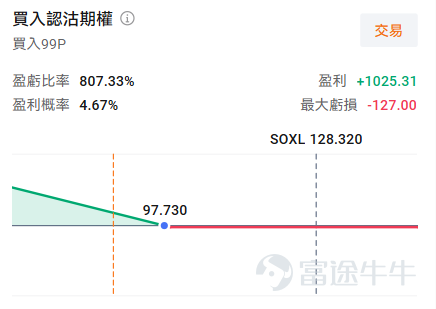
Therefore, we propose an alternative approach: puts on SOXL.
SOXL is a triple-leveraged semiconductor ETF issued by Direxion, tracking the same group of core semiconductor stocks.The absolute share price of SOXL is much lower than that of SOXX, and the corresponding option premiums are cheaper, making it easier to find contracts under a hundred dollars.The logic is the same – both are betting on a pullback in the semiconductor sector – only the vehicle has changed to a more "lightweight" tool.
Special reminder about leveraged ETFs: SOXL is a daily-resetting 3x leveraged ETF, and its long-term performance will deviate from three times the underlying index due to "volatility drag" (volatility decay). Simply put: if the semiconductor index drops 5% and then rises 5% back to the starting point, SOXL will not return to the starting point but will instead incur a small loss.This means that options on SOXL are more suitable for short-term (1-3 weeks) directional bets and are not appropriate for long-term holding. If your view on semiconductors is "long-term bearish," the original Burry-style long-term put on SOXX would be a more appropriate tool.

(The design images displayed on the screen are for demonstration purposes only and do not constitute any investment advice or guarantee; market conditions fluctuate frequently, and the option prices shown in the illustration do not represent actual situations. The filtering criterion is options with a unit price around 1 dollar.)
Bearish logic (i.e., the conditions under which this trade will profit):
The Philadelphia Semiconductor Index has risen for 18 consecutive sessions, with technical indicators showing the highest overbought levels ever recorded. Burry famously shorted subprime mortgages in 2008, and this time he has not only shorted SOXX but also established a put option position on NVIDIA. His core argument is that while the narrative of a chip shortage is compelling, it is largely driven by market sentiment and lacks sustainable fundamental support.
Additionally, this week's earnings reports are the "moment of truth."。Microsoft, Amazon, Google, and Meta are all releasing their earnings reports this week, and their AI capital expenditure guidance will directly impact market expectations for chip demand. If any of these tech giants signal a "slowdown in capital expenditure growth," the valuation ceiling for semiconductors will quickly be lowered.
Bullish risks (i.e., scenarios where this trade could lose money):
In a market with 18 consecutive gains, shorting is going against the wind. Intel surged 23% last week to hit a record high, while NVIDIA's market cap stabilized above $5 trillion. If earnings reports continue to exceed expectations this week and AI spending keeps being revised upwards, semiconductors may rise for another wave before any correction.
Burry has been correct in his directional calls multiple times in the past but was early on timing, experiencing significant unrealized losses in between. For short-term options, 'right direction but not enough time' equals losing money.
Let’s break down what will happen in the early hours of this Thursday (Beijing time):
2 PM Eastern Time on Wednesday (April 29) → FOMC announces interest rate decision + Powell's press conference; After the market closes on Wednesday Eastern Time → Microsoft, Alphabet, Meta, and Amazon all release earnings reports simultaneously.
Within a single day, both monetary policy decisions and the earnings of four major tech giants will be released.This is not an ordinary earnings day; it's an annual-level event overlap.。SPY, as the ETF covering the entire S&P 500 and offering options expiring every trading day, is the most direct tool to express a 'market-level volatility view.'

(The design images displayed on the screen are for demonstration purposes only and do not constitute any investment advice or guarantee; market conditions fluctuate frequently, and the option prices shown in the illustration do not represent actual situations. The filtering criterion is options with a unit price around 1 dollar.)
0DTE = Zero Days to Expiration, meaning options that expire at market close on the same day. Its characteristics include:Extremely cheap (due to almost zero time value), extremely high leverage, highly sensitive to underlying price changes, but also potentially becoming worthless within hours.
Here are two deployment strategies:
Strategy A: Directional bias. If you expect the FOMC to lean dovish (dovish = easing bias) and earnings to exceed expectations → buy SPY Call; if you expect Powell to lean hawkish and earnings to fall short of expectations → buy SPY Put. Single-leg operation, low cost, but requires you to get the direction right.
Strategy B: Betting only on 'big volatility,' not direction. Simultaneously buy a Call and a Put with the same expiration date and near-the-money strike prices (this is called a 'straddle'). As long as SPY moves significantly up or down on the day exceeding the total cost of both options, you will profit. The advantage of this approach is that you don’t need to guess the direction, but the downside is that the cost doubles — you have to pay for both legs.
The FOMC decision will be announced at 2 p.m. on Wednesday (Eastern Time). If you’re usingWednesday’s 0DTE, then you’re betting on the immediate reaction to the FOMC outcome, but not on after-hours earnings reactions. If you want to cover the earnings impact, considercontracts expiring on Thursday (April 30) or Friday (May 1)— spending a little more on premiums in exchange for a more complete event window.
If SPY is a tool for 'market volatility,' then QQQ is an amplifier of 'tech stock volatility.' In the Nasdaq 100 Index, Microsoft, Alphabet, Meta, and Amazon collectively account for over 25% of the weight.The simultaneous release of these four companies’ reports will have a much greater impact on QQQ than on SPY.
Simply put: for the same event, QQQ will 'react more strongly.' This is a double-edged sword for options buyers — they could make more or lose faster. If you don’t have a strong directional view and just want to 'bet on a big move,' SPY’s straddle may be more stable (with more diversified sources of volatility). If you are clearly bullish or bearish on tech earnings, QQQ’s directional single-leg strategy can express your view more 'sharply.'

(The design images displayed on the screen are for demonstration purposes only and do not constitute any investment advice or guarantee; market conditions fluctuate frequently, and the option prices shown in the illustration do not represent actual situations. The filtering criterion is options with a unit price around 1 dollar.)
Bullish logic (Call direction):
The four giants are projected to spend approximately $645 billion on AI capital expenditures in 2026, a year-over-year increase of 56%. If their earnings reports confirm that these expenditures are translating into revenue growth (for example, $Microsoft (MSFT.US)$ Azure growing at 38%, $Alphabet-C (GOOG.US)$ Cloud growing at over 50%, $Meta Platforms (META.US)$ advertising revenue growing at 31%), the market has reason to continue buying tech stocks.
Both the S&P 500 and Nasdaq hit new all-time highs last week, with momentum still favoring the bulls. In a trending market, positive earnings often lead to 'new highs after new highs.'
The FOMC is likely to keep interest rates unchanged. If Powell's tone leans neutral, it will not exert additional pressure on tech stocks.
Bearish logic (Put direction):
The risk of "good news being priced in too early." Analysis points out that the current valuations of semiconductor and tech stocks have already factored in several years' worth of AI demand at once. Ordinary beats may no longer suffice; the market demands 'beats upon beats.'
If any tech giant shows a marginal slowdown in its AI spending guidance, the valuation logic for the entire tech sector will be reassessed. Moreover, if the FOMC sends hawkish signals, high-valuation growth stocks could face further pressure.
Important Reminder
Options may expire worthless.For all contracts mentioned in this article, the maximum loss is the full premium you paid when buying. A hundred-dollar purchase can result in a maximum loss of a hundred dollars — which is why we call it 'Hundred-Dollar Options Play,' a small-position trial with controllable risks. However, 'controllable' does not mean 'no losses.'
0DTE options carry higher risks.Same-day expiry options are unsuitable for heavy positions and certainly not for using living expenses to trade. It is recommended to limit 0DTE investments to a very small proportion of your total options portfolio — treat them as 'tuition' or 'experience tickets,' not 'wealth-building tools.'
Leveraged ETF options (SOXL) carry additional volatility drag risks.Do not use short-term trading tools for long-term investments.
Burry is not your investment advisor.His position information is publicly disclosed with delays, and his capital size, risk tolerance, and hedging portfolio are completely different from yours. You can refer to his thinking, but copying his actions is not advisable.
This week has an immense amount of information and a very fast pace. Manage your positions well, control your expectations, and see you on Friday for the recap ~
Finally, here's a small perk for fellow Futubull investors, welcome to claim it.Options Beginner Pack~ *This event is only open to invited HK users, click to learn moreDetailed event rules>>
DisclaimerThis content does not constitute any offer, solicitation, recommendation, opinion, or any guarantee of any securities, financial products, or tools. The risk of loss in trading options can be substantial. In some cases, losses may exceed the initial margin deposited. Even if stop-loss or limit orders such as "stop-loss" or "limit" are set, they may not prevent losses. Market conditions may cause these instructions to be unexecuted. You may be required to deposit additional margin within a short period. If you fail to provide the required amount within the specified time, your open positions may be liquidated. However, you will still be responsible for any shortfall in your account. Therefore, before trading, you should study and understand options and carefully consider whether such trading is suitable for you based on your financial situation and investment objectives. If you trade options, you should be familiar with the procedures for exercising options and the rights and obligations upon expiration, as well as your rights and responsibilities when exercising options and at expiration.
Risk Disclaimer: The above content only represents the author's view. It does not represent any position or investment advice of Futu. Futu makes no representation or warranty.Read more


Comments (2)
to post a comment
15
50