
The S&P 500 has risen for seven consecutive weeks—should you chase the rally or take profits?

Option Sir Breaks Down Hot Topics | Semiconductor Index Hits New High After 18 Consecutive Gains, Big Bear Burry Strikes Again! How Should Ordinary Investors Handle the 'Most Crowded Trade'?
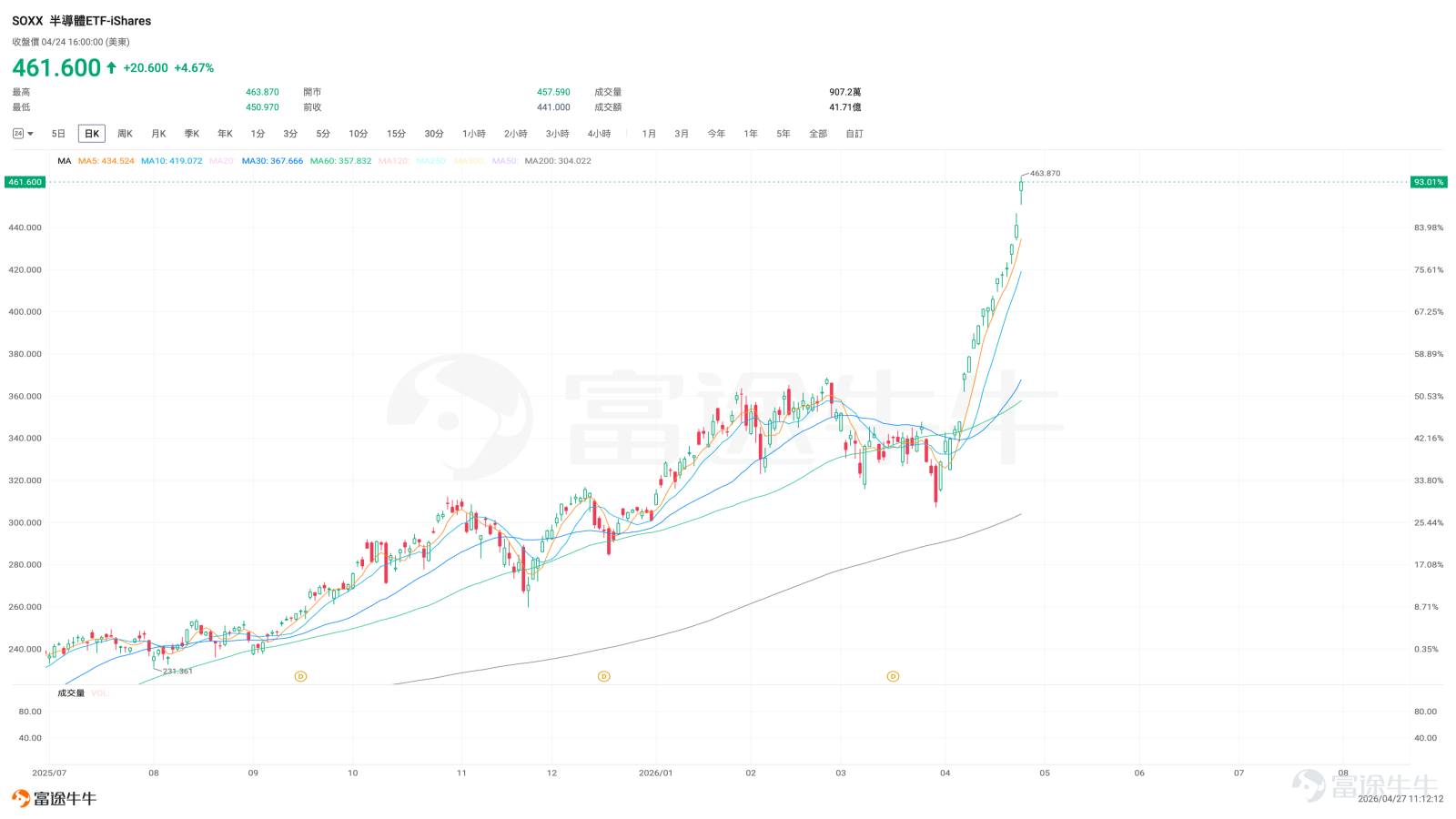
Last Friday, the US stock AI rally continued, but Michael Burry, known as the real-life 'Big Short' investor, disclosed on Substack a set of significant bets: buying long-term put options $iShares Semiconductor ETF (SOXX.US)$ 、 $NVIDIA (NVDA.US)$ 、 $Invesco QQQ Trust (QQQ.US)$ with a strike price of $330 for SOXX put options, expiring in January 2027, betting on a drop of more than 28% from its current price of approximately $461. For NVIDIA, it would need to fall back to around $110 to approach the strike price cost line.
And just as Burry disclosed his positions, $PHLX Semiconductor Index (.SOX.US)$it was in the midst of an all-time record of 18 consecutive trading days of gains, $iShares Semiconductor ETF (SOXX.US)$ with year-to-date gains reaching 53%. April alone saw a record-breaking monthly surge, with a premium over the 200-day moving average as high as 52%, pushing market enthusiasm for AI computing power to its peak.

Burry himself made no secret of his skepticism about this rally: 'This rally is entirely driven by technical factors, not fundamentals. If I were holding long positions in semiconductor stocks right now, I would sell without hesitation.'
This is not the first time Burry has taken a contrarian position against market consensus. However, looking back at history, while Burry did accurately predict the 2008 financial crisis, his calls have often been premature. This time, he has set his sights on the highly popular semiconductor sector.
First, it’s not simply shorting but pairing it with bottom-fishing software stocks as part of a paired trade strategy.
Many interpret Burry's actions as simply 'betting against AI,' but examining his portfolio positioning reveals a classic 'Burry-style' paired trade:shorting AI hardware and indices while simultaneously increasing exposure to undervalued software stocks that have been unjustly punished by the market.
On April 23rd, when software stocks collectively plummeted, Burry simultaneously bought targets such as $Adobe (ADBE.US)$ 、 $PayPal (PYPL.US)$Waiting for the target.
His core argument points to the expectation gap in fund rotation: valuations of software stocks represented by SaaS have fallen to extreme lows within the past 5-10 years, while semiconductor stocks like NVIDIA have already priced in future growth.$Adobe (ADBE.US)$ The recent announcement of a record $250 billion buyback has fueled momentum for value recovery in software stocks. He rejects the narrative that 'AI will kill SaaS,' arguing that the market overstates AI's impact on software companies while ignoring the bubble risk on the hardware side.
Simply put, Burry is not betting on the collapse of the AI narrative but rather on a rotation of capital within a year from overvalued hardware to battered software stocks.If expectations are met, a downturn in hardware combined with an upturn in software would allow him to profit on both his long and short positions simultaneously.
Even if the AI hardware rally continues, the valuation recovery in software stocks could cover the cost of options premiums.This creates a 'tail hedge,' avoiding the prolonged suffering of floating losses during a long wait, as was the case when he shorted subprime mortgages in 2008.
Even in the worst-case scenario where software valuations fail to recover, the long-term demand for AI remains real, and Substack’s subscription fee revenue would be sufficient to cover the cost of its option premiums.
Secondly, what is the logic behind Burry's skepticism? Does the expectation gap truly exist?
Burry’s short-selling logic directly targets three core contradictions in the current AI semiconductor boom:
1. The choice of GPU depreciation methods inflates tech giants' profits.
The prevailing market view is that the sustained growth in AI computing demand will support high profit growth for giants like NVIDIA. However, Burry’s core质疑 centers on the 'authenticity of profits.' He points out that major firms are extending GPU depreciation periods from the industry standard of 3-4 years to 5-6 years. This is not based on engineering facts but rather an accounting choice. NVIDIA’s chips have an iteration cycle of just 18 months, and the true economic lifespan of older GPUs is only 2-3 years. Extending depreciation periods artificially inflates current profits.
According to his calculations, if depreciation is adjusted based on actual lifespan, the operating profits of the tech giants from 2026 to 2028 may be overestimated by more than 20%.Once the true lifespan of one company’s GPU becomes exposed, the valuation logic of the entire market will collapse like a row of dominoes.
2. Circular financing in the AI supply chain
Burry does not deny the authenticity of AI computing power demand, but he emphasizes that the current revenue and profits of the supply chain are “inflated by supplier-financed funding.”The giants have formed a complex network of circular financing: cloud providers purchase GPUs from semiconductor companies, semiconductor companies invest in AI startups, and AI startups then buy computing power from cloud providers, creating what appears to be a prosperous closed loop.
However, this model heavily relies on a loose funding environment. Once interest rates rise or financing tightens, the cash flow across the entire chain will break, causing the high-valuation bubble to burst instantly.
3. Historic overvaluation with growth expectations no giant has ever been able to digest
Burry believes thatNVIDIA's market capitalization has now broken through $5 trillion,and its valuation requires compounded operating profit growth of 50% sustained over 10 years to justify. Burry cited Cisco during the internet bubble as an example: from 1995 to 2000, Cisco’s stock price surged over 3800%, but after the bubble burst, its market value plummeted by 80%. Even though there was real demand for its business, the process of valuation correction was still brutal.
Third, what should ordinary investors do?
Faced with Burry's warning, most investors holding semiconductor ETFs or tech stocks find themselves in a dilemma:Selling all holdings might lead to missing out on the long-term AI trend, while doing nothing risks short-term pullbacks.
For investors with different risk appetites, there are three strategies to consider:
1. Aggressive traders: Take small positions to short against the trend, but beware of short squeeze risks.
Suitable for investors with extremely high risk tolerance and strict trading discipline, but beware of two major risks:First, current AI computing demand is still growing, and going against the trend before it is clearly broken may result in sustained floating losses, which could be amplified by the daily rebalancing of leveraged ETFs.
Second, under heated market sentiment,short squeezes may cause significant damage to short positions.Strict stop-loss lines must be set to avoid going all-in.
2. Long-term technology stock holders: 'Insure' technology stocks
Long-term holders who do not want to fully exit their technology stock positions may refer to Burry's strategy and buy $NVIDIA (NVDA.US)$ 、 $iShares Semiconductor ETF (SOXX.US)$'s long-dated put optionsto hedge the risk of their holdings.
The cost of such instruments is only the premium, with maximum losses controllable, effectively hedging against short-term pullback risks; however,attention should be paid to the time value decay of options. The expiration date must align with the forecasted pullback period. Burry’s choice of contracts expiring in January 2027 aims to allow sufficient time for mean reversion.

3. Conservative investors: Structurally adjust positions and wait for confirmation signals
Investors highly sensitive to risks can first partially take profits from semiconductor ETFs and technology stock holdings in phases, reducing their positions to a level that they can tolerate in terms of volatility, avoiding significant erosion of unrealized gains.
At the same time, focus on tracking two key data points:First, the growth rate of AI capital expenditure in upcoming tech company earnings reports; second, evidence of orders being secured without profit spiraling out of control.Wait for these earnings reports to confirm signals of expectation divergence before deciding on subsequent actions.
Summary:
Burry's short-selling is not a bet on industry destruction, but rather a wager on valuations returning to rational levels.
For ordinary investors, blindly following Burry's moves may result in facing different opportunity costs compared to Burry. However, his bets also serve as a mirror, reminding investors to rebalance their portfolios by considering their own risk tolerance and investment horizon amidst the AI semiconductor boom.
 Fellow investors, do you think the semiconductor index will continue to rise?
Finally, here's a small perk for fellow Futubull investors, welcome to claim it.Options Beginner Pack
*This event is exclusive to invited HK users. Click to learn more.Detailed event rules>>
Risk Disclosure: This content does not constitute a research report and is for reference only. It should not be used as the basis for any investment decision. The information involved in this article is not a comprehensive description of the mentioned securities, markets, or developments. Although the source of the information is considered reliable, no guarantee is provided regarding its accuracy or completeness. Additionally, no assurance is given regarding the accuracy of any statements, opinions, or forecasts provided herein.
Editor/Doris
Risk Disclaimer: The above content only represents the author's view. It does not represent any position or investment advice of Futu. Futu makes no representation or warranty.Read more


Comments (18)
to post a comment
59
121