
English
Back
Open Account
牛牛名人追蹤
wrote a column · ·

Learn investing from the experts | 24x returns in 1 year! Former OpenAI executive moves to Wall Street, what's in the $5.5 billion portfolio?

Imagine if someone had all these incredible 'god-level tags':
OpenAI Chief Scientist Ilya's coreConfidant
After warning about AGI safety flaws,The whistleblower who was ousted from OpenAI
Urged the US to launchthe 'AI Manhattan Project'A geek believer;
The prophet who wrote a 165-page hardcore long article asserting that AGI will inevitably arrive in 2027
After leaving OpenAI, what did he do?
The first reaction of the vast majority of people would be: this must follow the Silicon Valley script! Leverage your fame to start an AI company, raise massive funding in the venture capital circle, and finally either go public with a bell-ringing ceremony or get acquired by a big tech company for an astronomical price.
But Leopold Aschenbrenner gave a counterintuitive answer:He turned towards Wall Street to 'trade stocks' instead.
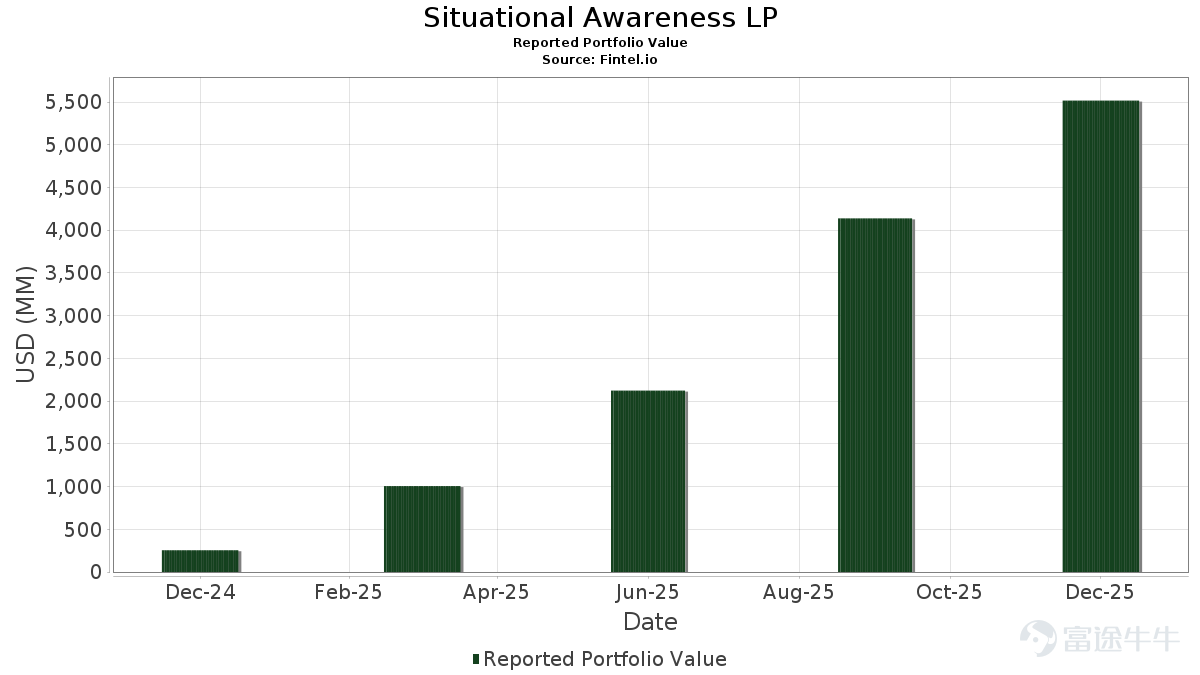
And delivered an incredibly impressive performance: betting $225 million on his judgment, he grew it to $5.5 billion within a year, meaning a 24x return in just one year. While others were still competing over large model parameters, he had already switched tracks to mint money like crazy.
Imagine if someone had all these incredible 'god-level tags': OpenAI Chief Scientist Ilya's coreConfidant; After warning about AGI safety flaws,The whistleblower who was ousted from OpenAI; Urged the US to launchthe 'AI Manhattan Project'A geek believer; The prophet who wrote a 165-page hardcore long article asserting that AGI will inevitably arrive in 2027。 After leaving OpenAI, what did he do? The first reaction of the vast majority of people would be: this must follow the Silicon Valley script! Leverage your fame to start an AI company, raise massive funding in the venture capital circle, and finally either go public with a bell-ringing ceremony or get acquired by a big tech company for an astronomical price. But Leopold Aschenbrenner gave a counterintuitive answer:He turned towards Wall Street to 'trade stocks' instead. And delivered an incredibly impressive performance: betting $225 million on his judgment, he grew it to $5.5 billion within a year, meaning a 24x return in just one year. While others were still competing over large model parameters, he had already switched tracks to mint money like crazy. Reading this, many fellow investors probably want to know about Leopold Aschenbrenner’s background and what exactly he invested in. Today, we will unravel layer by layer this"AI Treasure Map"。 I. A deep dive from the 165-page thesis ...
Reading this, many fellow investors probably want to know about Leopold Aschenbrenner’s background and what exactly he invested in. Today, we will unravel layer by layer this"AI Treasure Map"
I. Understanding Aschenbrenner's investment philosophy through his 165-page paper
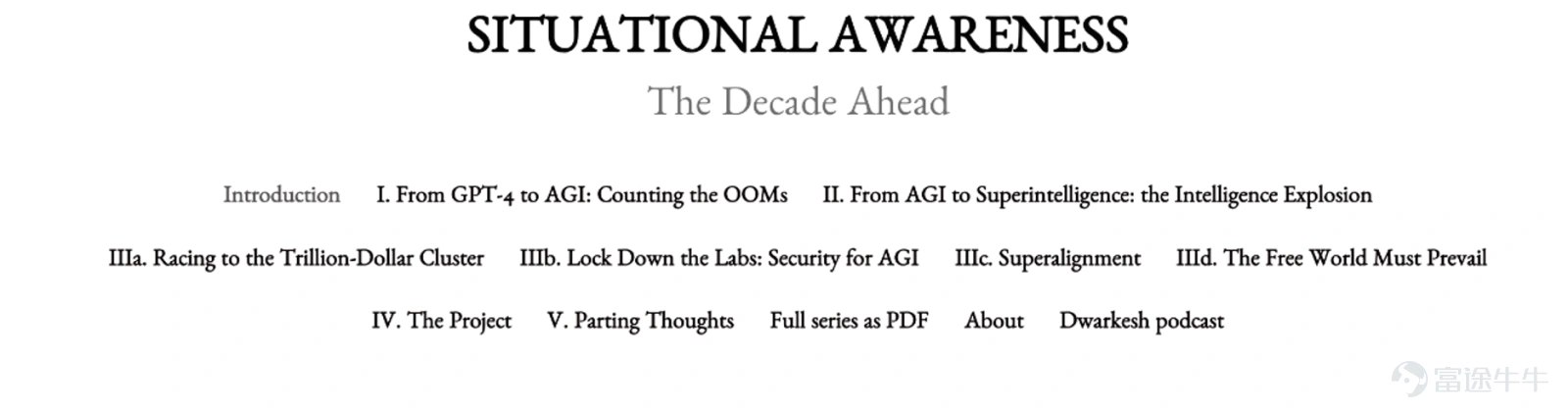
To understand his portfolio, one must first understand the 165-page paper he wrote in2024,which shook Silicon Valley — "Situational Awareness: The Decade Ahead"
Imagine if someone had all these incredible 'god-level tags': OpenAI Chief Scientist Ilya's coreConfidant; After warning about AGI safety flaws,The whistleblower who was ousted from OpenAI; Urged the US to launchthe 'AI Manhattan Project'A geek believer; The prophet who wrote a 165-page hardcore long article asserting that AGI will inevitably arrive in 2027。 After leaving OpenAI, what did he do? The first reaction of the vast majority of people would be: this must follow the Silicon Valley script! Leverage your fame to start an AI company, raise massive funding in the venture capital circle, and finally either go public with a bell-ringing ceremony or get acquired by a big tech company for an astronomical price. But Leopold Aschenbrenner gave a counterintuitive answer:He turned towards Wall Street to 'trade stocks' instead. And delivered an incredibly impressive performance: betting $225 million on his judgment, he grew it to $5.5 billion within a year, meaning a 24x return in just one year. While others were still competing over large model parameters, he had already switched tracks to mint money like crazy. Reading this, many fellow investors probably want to know about Leopold Aschenbrenner’s background and what exactly he invested in. Today, we will unravel layer by layer this"AI Treasure Map"。 I. A deep dive from the 165-page thesis ...
In this lengthy article, Aschenbrenner makes a core argument:The trajectory of AGI (Artificial General Intelligence) explosion is highly predictable, and the only obstacle at present is the infrastructure bottleneck in the physical world.
He predicts that the scale of AI computing power clusters will rapidly increase from 100MW (megawatts) to 1GW (gigawatts), or even 10GW.And the 'trillion-cluster' he wrote about became the White House's official plan just six months later.
Under this exponential 'compute power inflation,' the bottleneck is no longer about how to write code, but rather,Where do we find so much electricity? How do we solve cooling? How do we transfer data?
With this perspective of disruptive impact, he didn't buy any AI software application companies. Instead, he heavily invested $5.5 billion into the hardest-core, most traditional physical infrastructure.
II. In-depth Breakdown of SALP Fund’s $5.5 Billion Portfolio Matrix
According to the latest WhaleWisdom data, as of Q4 2025, the SALP fund's portfolio represents a textbook-level 'infrastructure maniac' allocation. We can summarize it into three main themes:
Imagine if someone had all these incredible 'god-level tags': OpenAI Chief Scientist Ilya's coreConfidant; After warning about AGI safety flaws,The whistleblower who was ousted from OpenAI; Urged the US to launchthe 'AI Manhattan Project'A geek believer; The prophet who wrote a 165-page hardcore long article asserting that AGI will inevitably arrive in 2027。 After leaving OpenAI, what did he do? The first reaction of the vast majority of people would be: this must follow the Silicon Valley script! Leverage your fame to start an AI company, raise massive funding in the venture capital circle, and finally either go public with a bell-ringing ceremony or get acquired by a big tech company for an astronomical price. But Leopold Aschenbrenner gave a counterintuitive answer:He turned towards Wall Street to 'trade stocks' instead. And delivered an incredibly impressive performance: betting $225 million on his judgment, he grew it to $5.5 billion within a year, meaning a 24x return in just one year. While others were still competing over large model parameters, he had already switched tracks to mint money like crazy. Reading this, many fellow investors probably want to know about Leopold Aschenbrenner’s background and what exactly he invested in. Today, we will unravel layer by layer this"AI Treasure Map"。 I. A deep dive from the 165-page thesis ...
1. The endgame of compute power is electricity — heavy investment in fuel cells
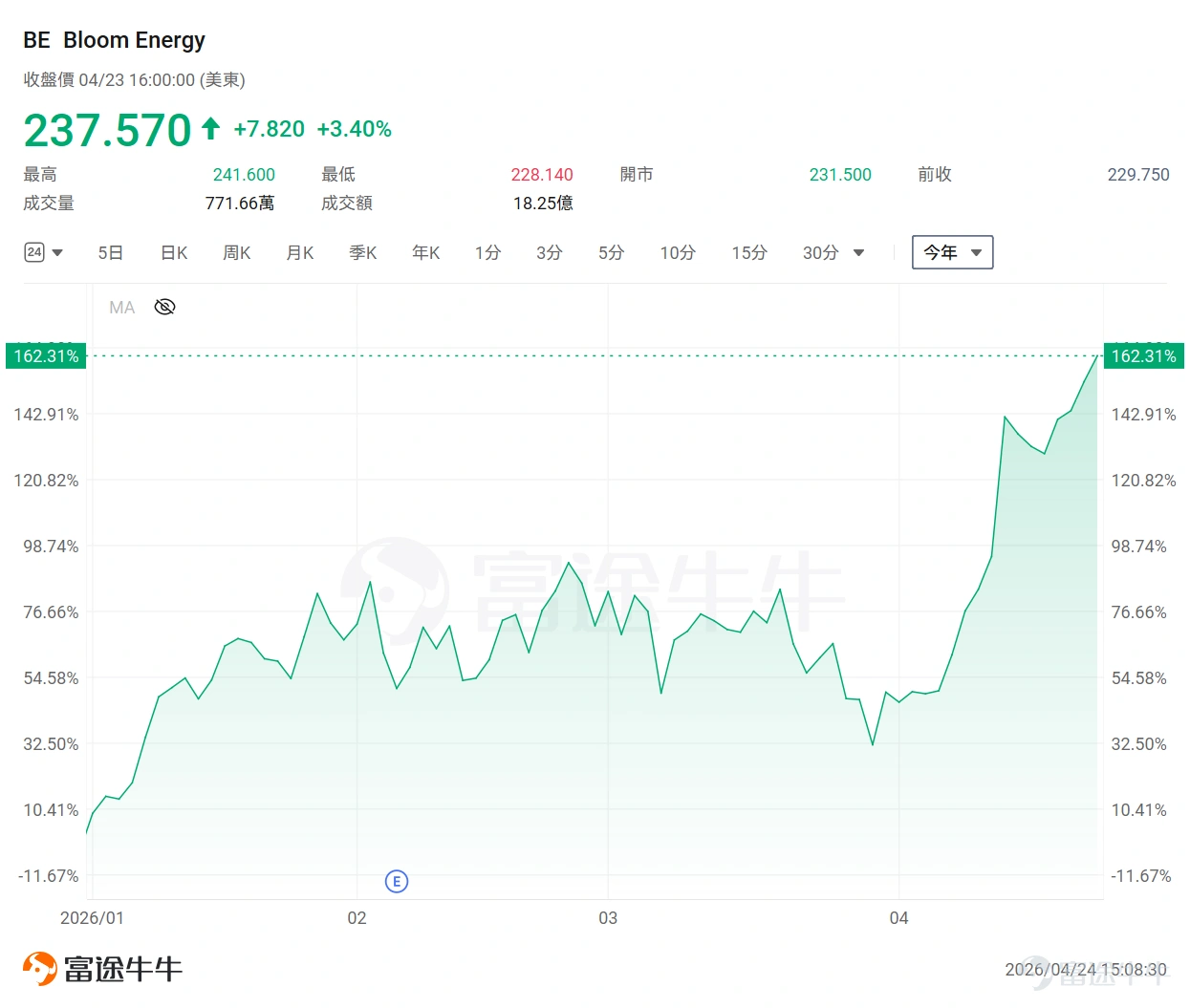
Why concentrate so heavily in a single position? $Bloom Energy (BE.US)$ As high as 15.87%? The logic is very clear. Approval for capacity expansion of the U.S. traditional power grid can take 3 to 5 years, which simply cannot keep up with the construction speed of AI data centers.
Bloom Energy's core technology, Solid Oxide Fuel Cells (SOFC), provides data centers withan 'Off-grid' microgrid solution.Buying BE stock essentially means purchasing the rights to 'immediate power supply unrestricted by the traditional grid.' In the AI arms race, whoever gets power first will have their GPUs running ahead of others.
It can be seen that Bloom Energy’s share price has surged over 160% year-to-date, hitting a new all-time high. On April 13, the company and Oracle officially announced an expanded strategic partnership where Oracle plans to procure up to 2.8 GW of Bloom fuel cell systems, with the initial 1.2 GW already contracted and currently being deployed.
This deal reaffirms the core logic that 'the real bottleneck for AI computing power is electricity'—U.S. power grid expansion cycles typically last 6 to 10 years, and mainstream overseas manufacturers' heavy gas turbine production capacity is already booked through 2029-2030. In contrast, Bloom’s fuel cell system completed deployment of Oracle's initial project in just 55 days, showcasing its superior deployment efficiency.
Imagine if someone had all these incredible 'god-level tags': OpenAI Chief Scientist Ilya's coreConfidant; After warning about AGI safety flaws,The whistleblower who was ousted from OpenAI; Urged the US to launchthe 'AI Manhattan Project'A geek believer; The prophet who wrote a 165-page hardcore long article asserting that AGI will inevitably arrive in 2027。 After leaving OpenAI, what did he do? The first reaction of the vast majority of people would be: this must follow the Silicon Valley script! Leverage your fame to start an AI company, raise massive funding in the venture capital circle, and finally either go public with a bell-ringing ceremony or get acquired by a big tech company for an astronomical price. But Leopold Aschenbrenner gave a counterintuitive answer:He turned towards Wall Street to 'trade stocks' instead. And delivered an incredibly impressive performance: betting $225 million on his judgment, he grew it to $5.5 billion within a year, meaning a 24x return in just one year. While others were still competing over large model parameters, he had already switched tracks to mint money like crazy. Reading this, many fellow investors probably want to know about Leopold Aschenbrenner’s background and what exactly he invested in. Today, we will unravel layer by layer this"AI Treasure Map"。 I. A deep dive from the 165-page thesis ...
2. New Powerhouses in Computing and 'Mining Arbitrage' – Dimensional Disruption in Data Centers
This is the most aggressive and knowledgeable setup in the entire portfolio:
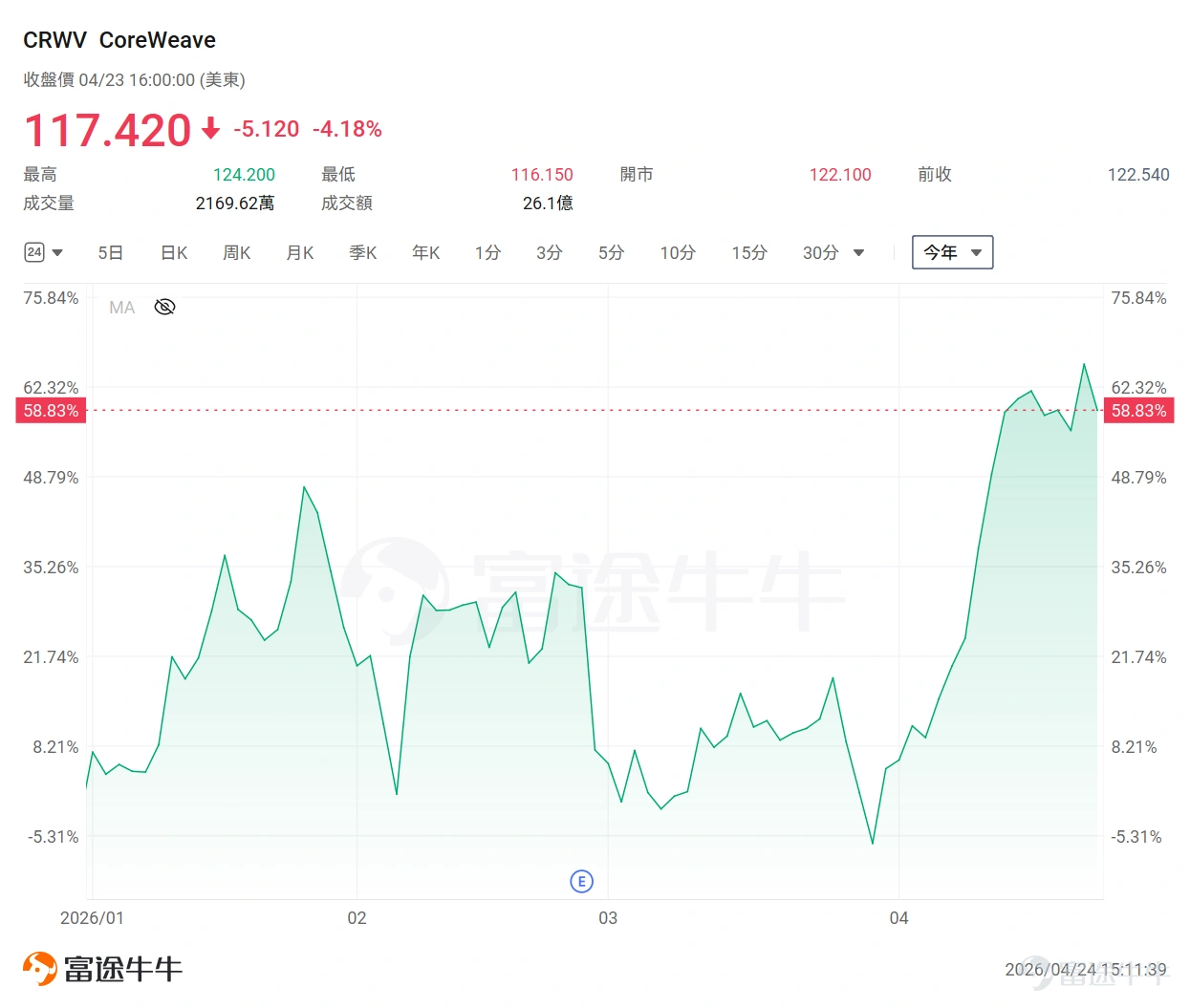
Cloud Computing Dark Horse: $CoreWeave (CRWV.US)$  He not only holds 7.92% of the common stock,but has also aggressively allocated 14.04% to CALL (call options),bringing the total risk exposure to over 21%.
CoreWeave is a GPU cloud service provider deeply tied to NVIDIA, perfectly bypassing the historical burdens of traditional cloud giants like AWS and Azure, and is purpose-built for AI training. This indicates that Aschenbrenner is extremely bullish on the pure AI compute rental model.
Particularly noteworthy is the fact that,On April 10, Anthropic officially announced the leasing of CoreWeave’s AI computing power to support Claude,the two parties have reached a multi-year data center leasing agreement to address the rising demand pressure from AI services. Although CoreWeave is still some distance from its previous high, its year-to-date increase has been as high as 59%.
Imagine if someone had all these incredible 'god-level tags': OpenAI Chief Scientist Ilya's coreConfidant; After warning about AGI safety flaws,The whistleblower who was ousted from OpenAI; Urged the US to launchthe 'AI Manhattan Project'A geek believer; The prophet who wrote a 165-page hardcore long article asserting that AGI will inevitably arrive in 2027。 After leaving OpenAI, what did he do? The first reaction of the vast majority of people would be: this must follow the Silicon Valley script! Leverage your fame to start an AI company, raise massive funding in the venture capital circle, and finally either go public with a bell-ringing ceremony or get acquired by a big tech company for an astronomical price. But Leopold Aschenbrenner gave a counterintuitive answer:He turned towards Wall Street to 'trade stocks' instead. And delivered an incredibly impressive performance: betting $225 million on his judgment, he grew it to $5.5 billion within a year, meaning a 24x return in just one year. While others were still competing over large model parameters, he had already switched tracks to mint money like crazy. Reading this, many fellow investors probably want to know about Leopold Aschenbrenner’s background and what exactly he invested in. Today, we will unravel layer by layer this"AI Treasure Map"。 I. A deep dive from the 165-page thesis ...
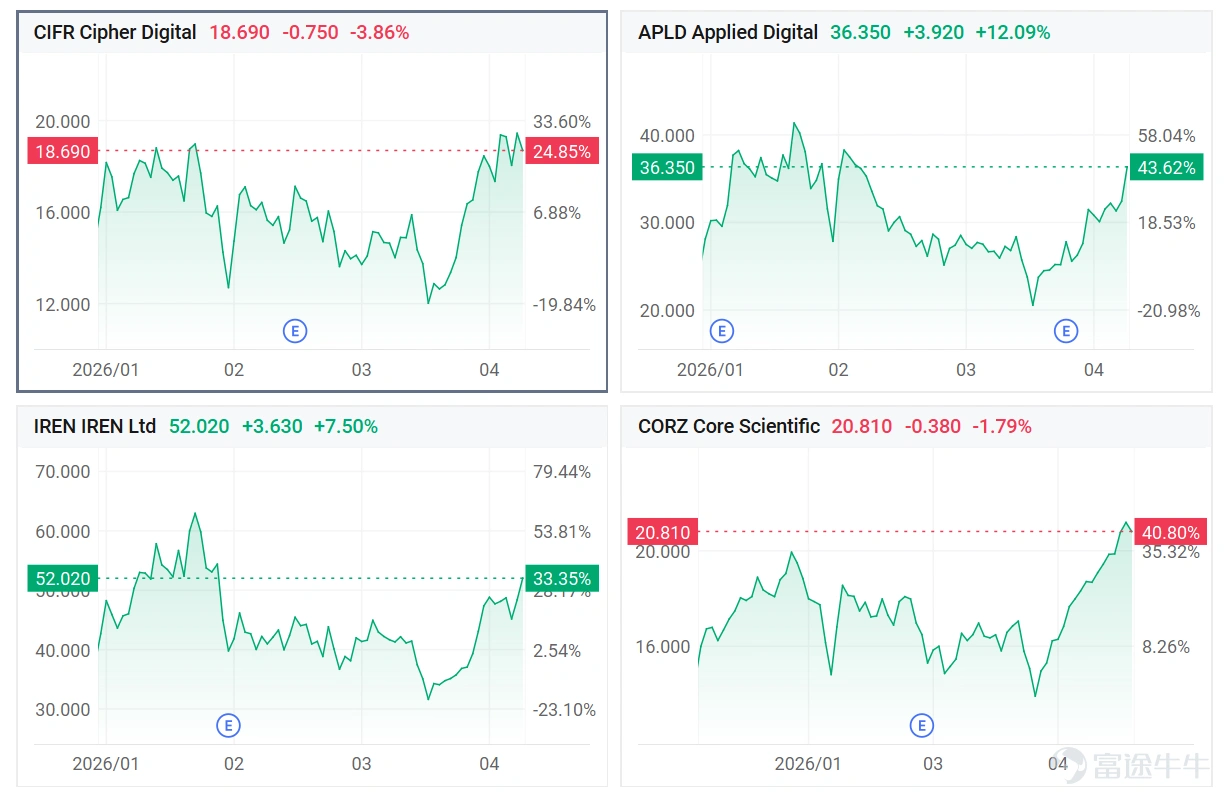
The Bitcoin mining companies’ remarkable transformation: $Core Scientific (CORZ.US)$$IREN Ltd (IREN.US)$$Applied Digital (APLD.US)$$Cipher Digital (CIFR.US)$
These four companies share a common characteristic: they were all once cryptocurrency mining enterprises. Why buy them? Because mining companies hold the scarcest assets in the AI era —ready-made land, mature liquid cooling/air cooling facilities, and long-signed large-capacity power contracts. By clearing out mining equipment and replacing it with Nvidia’s GPUs, they transform into HPC (high-performance computing) data centers. This is an extremely clever game of 'asset revaluation and arbitrage'.
In terms of year-to-date gains, these four companies have recorded increases of 25%-44%. Notably, Applied Digital announced overnight the finalization of a $7.5 billion lease for a 300-megawatt AI industrial park. This is not only a major operational milestone for APLD itself but also a strong 'bellwether' for the entire AI infrastructure and hardware supply chain.
Imagine if someone had all these incredible 'god-level tags': OpenAI Chief Scientist Ilya's coreConfidant; After warning about AGI safety flaws,The whistleblower who was ousted from OpenAI; Urged the US to launchthe 'AI Manhattan Project'A geek believer; The prophet who wrote a 165-page hardcore long article asserting that AGI will inevitably arrive in 2027。 After leaving OpenAI, what did he do? The first reaction of the vast majority of people would be: this must follow the Silicon Valley script! Leverage your fame to start an AI company, raise massive funding in the venture capital circle, and finally either go public with a bell-ringing ceremony or get acquired by a big tech company for an astronomical price. But Leopold Aschenbrenner gave a counterintuitive answer:He turned towards Wall Street to 'trade stocks' instead. And delivered an incredibly impressive performance: betting $225 million on his judgment, he grew it to $5.5 billion within a year, meaning a 24x return in just one year. While others were still competing over large model parameters, he had already switched tracks to mint money like crazy. Reading this, many fellow investors probably want to know about Leopold Aschenbrenner’s background and what exactly he invested in. Today, we will unravel layer by layer this"AI Treasure Map"。 I. A deep dive from the 165-page thesis ...
3. Breaking Physical Limits - Key Nodes in the Hardware Supply Chain
On the hardware side, he avoided the crowded NVIDIA and turned to key suppliers addressing the 'weakest link in the barrel':
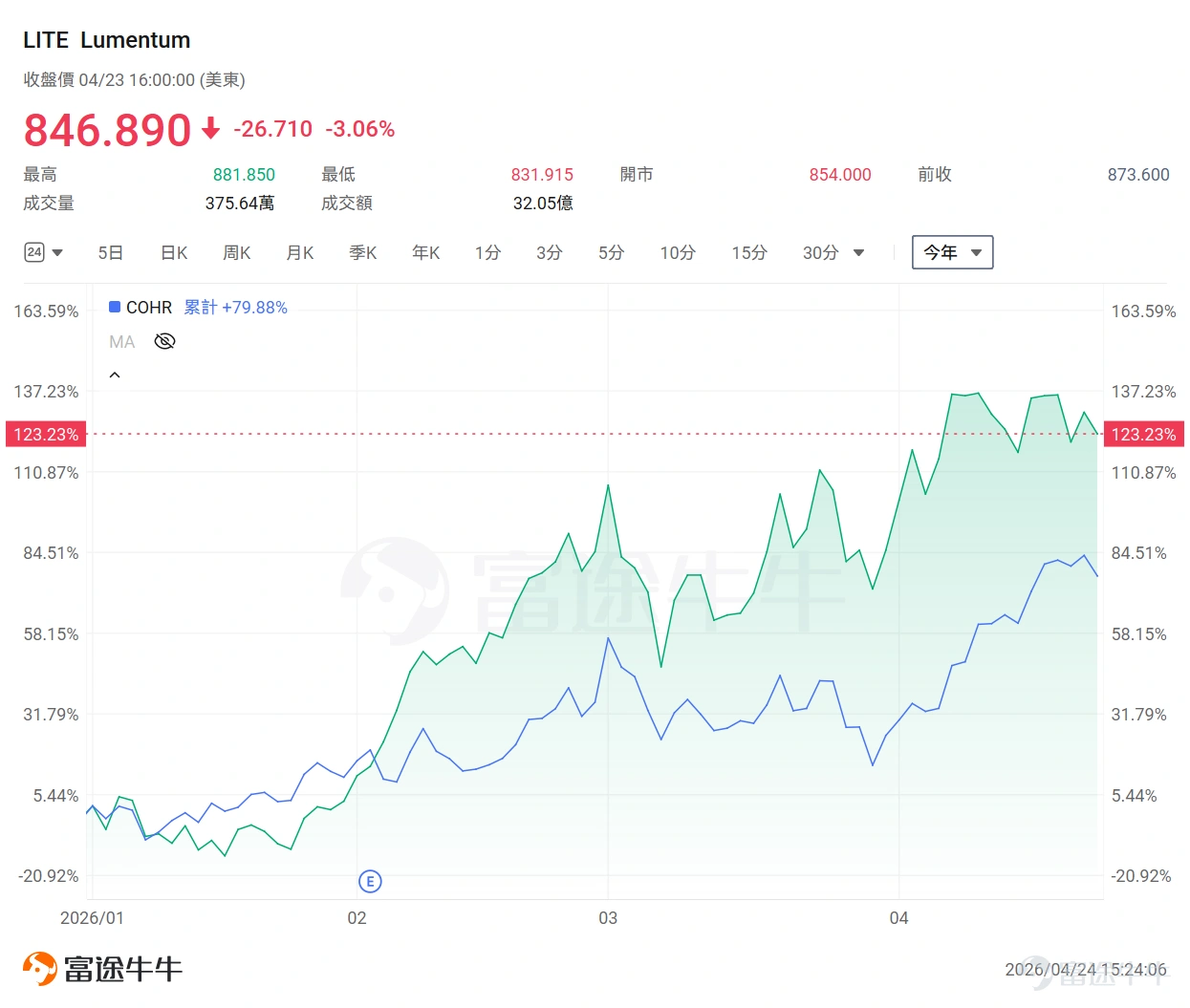
Optical Communication:$Lumentum (LITE.US)$ Fellow investors who have been following the AI supply chain will know that when GPU clusters grow to a certain size, copper wires can no longer meet data transmission needs. Lumentum, as a core supplier of optical modules and components (involving silicon photonics technology), addresses the essential demand for interconnecting hundreds of thousands of network cards.
In addition, he also purchased $Coherent (COHR.US)$ (accounting for 1.61% of the portfolio). These two giants in optical communications have become highly sought-after in the capital markets this year, with $Lumentum (LITE.US)$ gaining nearly 130% year-to-date, $Coherent (COHR.US)$ reaching as high as 83%.
Imagine if someone had all these incredible 'god-level tags': OpenAI Chief Scientist Ilya's coreConfidant; After warning about AGI safety flaws,The whistleblower who was ousted from OpenAI; Urged the US to launchthe 'AI Manhattan Project'A geek believer; The prophet who wrote a 165-page hardcore long article asserting that AGI will inevitably arrive in 2027。 After leaving OpenAI, what did he do? The first reaction of the vast majority of people would be: this must follow the Silicon Valley script! Leverage your fame to start an AI company, raise massive funding in the venture capital circle, and finally either go public with a bell-ringing ceremony or get acquired by a big tech company for an astronomical price. But Leopold Aschenbrenner gave a counterintuitive answer:He turned towards Wall Street to 'trade stocks' instead. And delivered an incredibly impressive performance: betting $225 million on his judgment, he grew it to $5.5 billion within a year, meaning a 24x return in just one year. While others were still competing over large model parameters, he had already switched tracks to mint money like crazy. Reading this, many fellow investors probably want to know about Leopold Aschenbrenner’s background and what exactly he invested in. Today, we will unravel layer by layer this"AI Treasure Map"。 I. A deep dive from the 165-page thesis ...
Betting on American manufacturing: $Intel (INTC.US)$  
Heavily investing in Intel call options is a very bold move. This likely bets on its capacity in the 'advanced packaging' field or reflects optimism about Intel, the only US-based company capable of large-scale wafer foundry production, benefiting from policy tailwinds amid the US government's strong push for the 'AI Manhattan Project.'
Notably, Intel's Q1 2026 revenue of $13.6 billion far exceeded guidance. Thanks to the strong recovery in server CPU demand driven by AI infrastructure construction, the CPU/GPU deployment ratio rebounded from 1:8 to 1:4. Its custom chip (ASIC) annualized revenue has surpassed $1 billion. The foundry business achieved a landmark breakthrough, not only securing a long-term major order from Google but also announcing the establishment of the TeraFab strategic partnership with Musk to explore innovative foundry models.
Intel's year-to-date gain has reached as high as 80%, and following an earnings beat, its after-hours price surged nearly 20%. This means the company is set to hit a historic high tonight.
Imagine if someone had all these incredible 'god-level tags': OpenAI Chief Scientist Ilya's coreConfidant; After warning about AGI safety flaws,The whistleblower who was ousted from OpenAI; Urged the US to launchthe 'AI Manhattan Project'A geek believer; The prophet who wrote a 165-page hardcore long article asserting that AGI will inevitably arrive in 2027。 After leaving OpenAI, what did he do? The first reaction of the vast majority of people would be: this must follow the Silicon Valley script! Leverage your fame to start an AI company, raise massive funding in the venture capital circle, and finally either go public with a bell-ringing ceremony or get acquired by a big tech company for an astronomical price. But Leopold Aschenbrenner gave a counterintuitive answer:He turned towards Wall Street to 'trade stocks' instead. And delivered an incredibly impressive performance: betting $225 million on his judgment, he grew it to $5.5 billion within a year, meaning a 24x return in just one year. While others were still competing over large model parameters, he had already switched tracks to mint money like crazy. Reading this, many fellow investors probably want to know about Leopold Aschenbrenner’s background and what exactly he invested in. Today, we will unravel layer by layer this"AI Treasure Map"。 I. A deep dive from the 165-page thesis ...
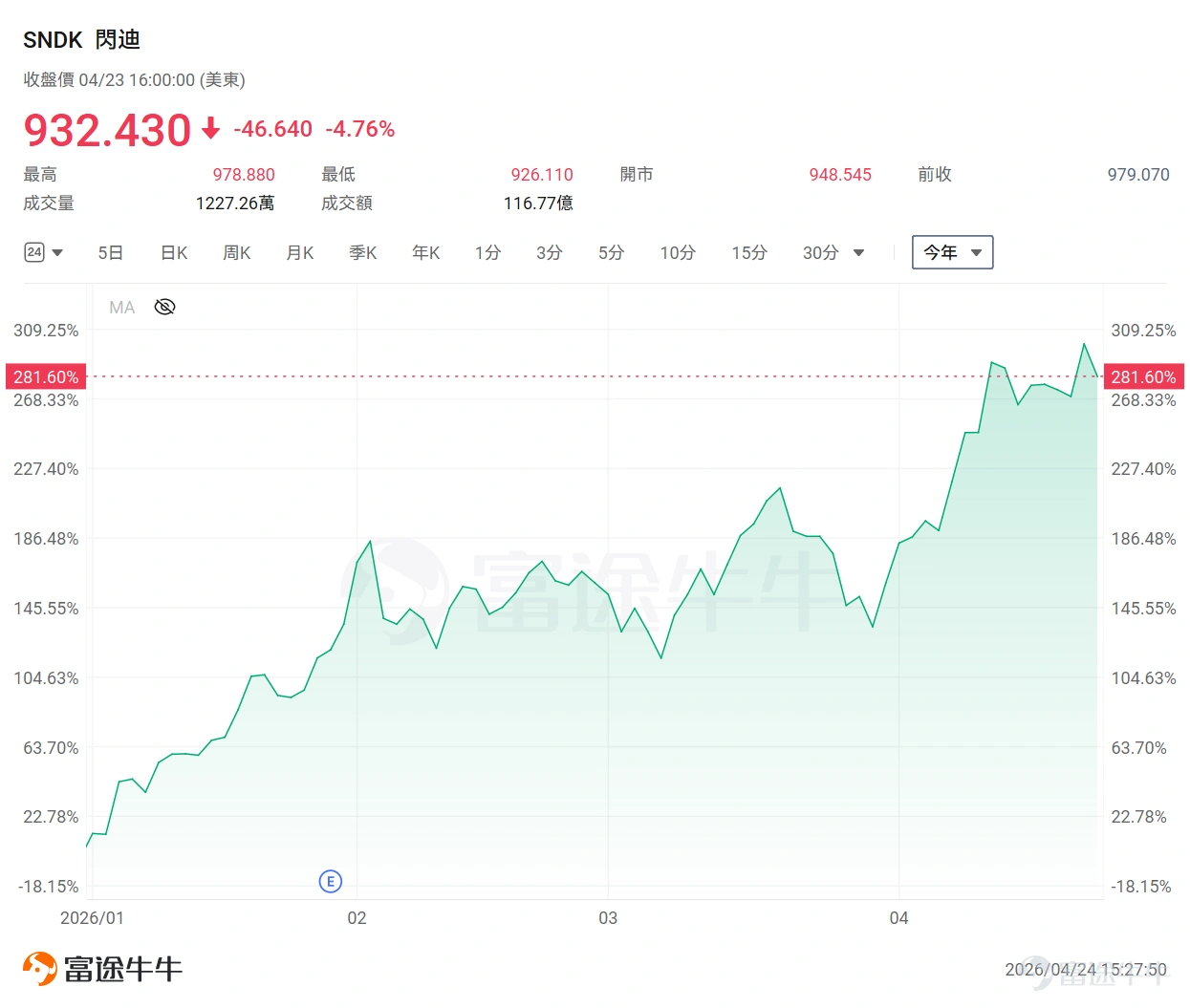
Large models don’t just need to compute faster; they also need to store more and read faster. High-bandwidth memory and enterprise-grade large-capacity storage are indispensable parts of AI infrastructure. SanDisk’s stock price has risen nearly 300% year-to-date, and over the past 12 months, it has soared approximately 2800%, making it one of the best-performing individual stocks in the market.
Imagine if someone had all these incredible 'god-level tags': OpenAI Chief Scientist Ilya's coreConfidant; After warning about AGI safety flaws,The whistleblower who was ousted from OpenAI; Urged the US to launchthe 'AI Manhattan Project'A geek believer; The prophet who wrote a 165-page hardcore long article asserting that AGI will inevitably arrive in 2027。 After leaving OpenAI, what did he do? The first reaction of the vast majority of people would be: this must follow the Silicon Valley script! Leverage your fame to start an AI company, raise massive funding in the venture capital circle, and finally either go public with a bell-ringing ceremony or get acquired by a big tech company for an astronomical price. But Leopold Aschenbrenner gave a counterintuitive answer:He turned towards Wall Street to 'trade stocks' instead. And delivered an incredibly impressive performance: betting $225 million on his judgment, he grew it to $5.5 billion within a year, meaning a 24x return in just one year. While others were still competing over large model parameters, he had already switched tracks to mint money like crazy. Reading this, many fellow investors probably want to know about Leopold Aschenbrenner’s background and what exactly he invested in. Today, we will unravel layer by layer this"AI Treasure Map"。 I. A deep dive from the 165-page thesis ...
III. Investment Insights
Leopold Aschenbrenner’s 24x return in a year has given us a vivid lesson in investment research.
Ninety percent of the market is focused on which large model has achieved higher benchmark scores or which AI application has seen MAU growth. However, the true 'industry experts' are quietly accumulating shares in fuel cells, optical communication components, memory, AI computing infrastructure, and data centers.
His investment logic proves one point: In the early stages of a super technological revolution, rather than guessing which prospector will strike the largest gold mine, buy up all the toll booths along the necessary routes to those mines.
For us ordinary investors, this list is not just a collection of codes; it’s a clear 'AGI investment treasure map.' As the AI revolution starts demanding resources from the physical world beyond software, these 'water carriers'—who control power, cooling, and optical transmission channels—are poised for their Davis Double Play.
Risk Disclaimer: The above content only represents the author's view. It does not represent any position or investment advice of Futu. Futu makes no representation or warranty.Read more
Thumbs Up
92
Thumbs Up
1
Heart
11
Respect
3
Emm
3
Sob
2
Lol
2
508K Views
Report
Comments (8)
Write a Comment...
8
114
376