
The S&P 500 has risen for seven consecutive weeks—should you chase the rally or take profits?

Options Sir Breaks Down Hot Topics | Options Strategy in the AI Shakeout: 17 Consecutive Gains for Semiconductor Index vs. Continued Decline in Software Stocks, How to Ride the Trend?
The divergence in the US stock market in April has become increasingly clear.Chips, as the 'water carriers' of the AI industry, have become the darlings of the capital market with their overwhelming orders and explosive performance; in contrast, traditional software, particularly in the SaaS sector, is mired in anxiety over AI substitution, with declining orders and underwhelming earnings triggering sharp declines in stock prices.
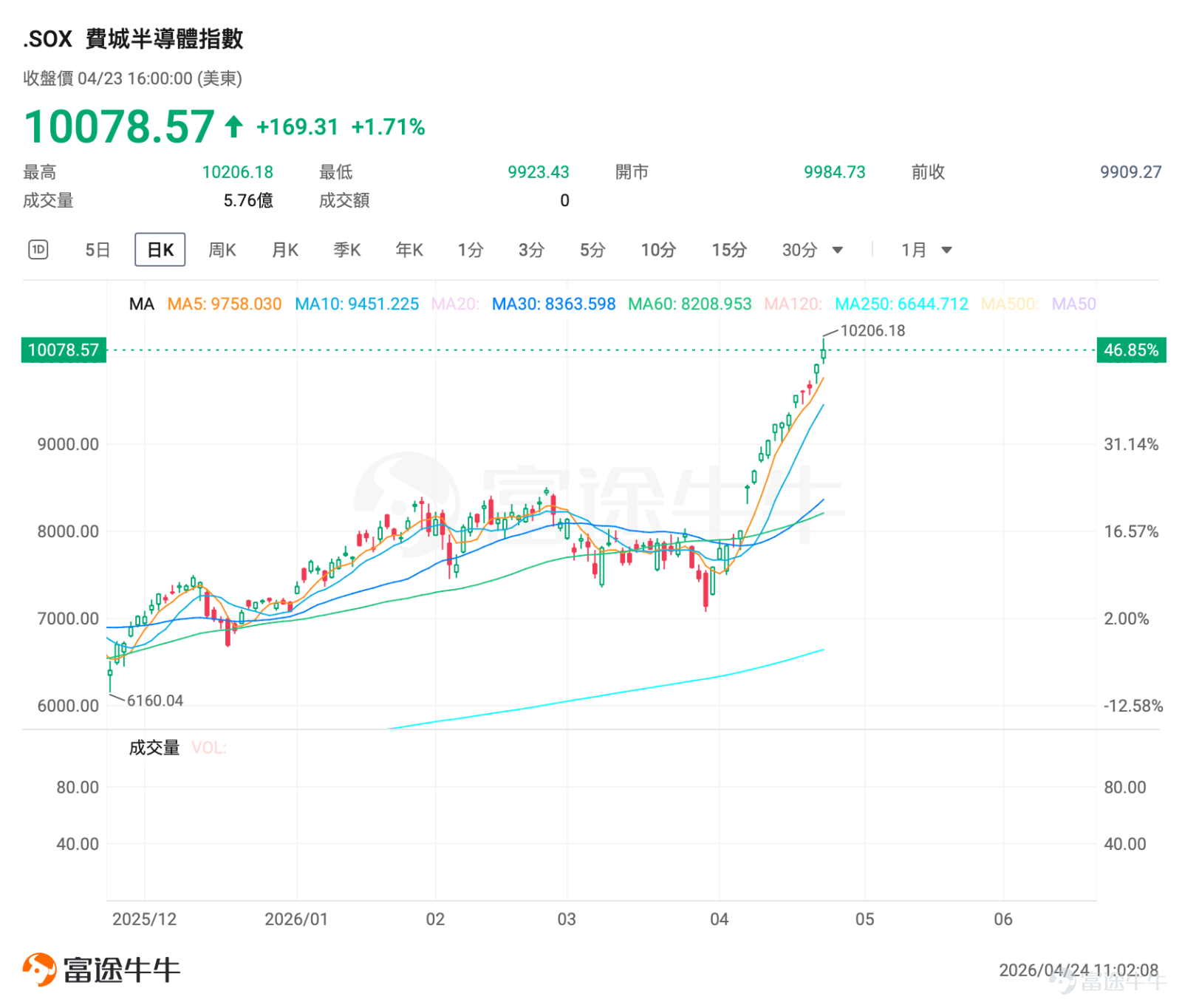
In the previous trading session, investors witnessed two starkly different worlds: in the semiconductor sector, $PHLX Semiconductor Index (.SOX.US)$ the index broke through the 10,000-point mark during trading hours, achieving an epic 17 consecutive gains.

while in the software field,the SaaS sector suffered a 'bloodbath', $iShares Expanded Tech-Software Sector ETF (IGV.US)$plunging more than 5%,, $ServiceNow (NOW.US)$ collapsing over 17%, $IBM Corp (IBM.US)$ falling more than 8%.

When hardware and software driven by AI performed so differently for the first time during earnings season,How should investors use options strategies to accurately follow the trend?
Hardware VS Software: Why is this earnings season so polarized?
The current market logic is very clear, just like the 'Gold Rush' back in the day—The people selling shovels always make the most money, while the gold diggers face intense competition.。
The explosive rally in the chip sector has become the brightest spot in the AI elimination race.As the core foundation of AI hardware, chips are a prerequisite for all AI applications. With the iteration of large models and the explosive growth in computing power demand, global chip companies have seen a dual explosion in orders and performance.
Recently, stocks of chip companies like Intel and Texas Instruments have performed explosively. $Intel (INTC.US)$ The stock price surged nearly 20% after-hours, with year-to-date gains exceeding 80%. Its after-hours earnings report showed key metrics far exceeding market expectations: Q1 revenue of $13.6 billion, significantly surpassing the expected $12.4 billion, and Q1 EPS$0.29, far exceedingthe expected $0.01.

$Texas Instruments (TXN.US)$ The stock price surged over 19% on the previous trading day, marking the largest single-day gain since 2000, while also hitting an all-time high. The company's earnings indicated that its core analog chip division saw a 22% increase in revenue, reflecting strong recovery momentum. The company forecasts Q2 revenue to reach up to $5.4 billion, again far surpassing analyst expectations.

$Marvell Technology (MRVL.US)$ 、 $Arm Holdings (ARM.US)$ Other semiconductor companies also posted significant year-to-date gains. As of the close of the previous trading day, $Marvell Technology (MRVL.US)$ up over 95% since the beginning of the year, $STMicroelectronics (STM.US)$ up over 90% since the beginning of the year, $Arm Holdings (ARM.US)$ Up more than 87% year-to-date.
This actually reflects the same underlying logic: AI investment is expanding from core computing power to the broader computing ecosystem.The market is no longer solely focused on NVIDIA; there is growing belief that the entire semiconductor supply chain will benefit from the large-scale construction of AI data centers. Beyond GPUs, strategic values of components such as CPUs, analog chips, and memory chips are being reassessed.
Related Reading:
In sharp contrast is the collapse of faith in software stocks (SaaS).Investors fear that the rapid penetration of AI technology is reshaping the competitive landscape of the software industry, with the narrative of AI disrupting SaaS entering a challenging pricing phase.
Earnings report data has heightened investor concerns, $IBM Corp (IBM.US)$ The latest earnings report revealed that its software business growth was only at the lower end of expectations, while its consulting business was almost stagnant. The market widely worries that clients are either adopting a wait-and-see attitude or postponing purchasing decisions. $ServiceNow (NOW.US)$ In its latest earnings report, the company forecasted a full-year subscription gross margin of 81.5% for 2026, down from the previous expectation of 82.1%. Additionally, it disclosed that ongoing conflicts in the Middle East have delayed the signing of several major on-premise deployment contracts. Despite slightly beating market expectations for Q1 revenue and earnings per share, concerns about its profitability remain unaddressed.
The market generally believes that AI tools are undermining the traditional SaaS business model, which charges by seat or module, further amplifying uncertainties within the industry.
Second, the logic of options positioning: Semiconductor stocks utilize high implied volatility (IV) to sell puts, while software stocks use call options for hedging and betting on a rebound.
In response to the polarized market conditions where semiconductor stocks soar while software stocks continue to fall, options strategies must adapt accordingly and adopt differentiated approaches. Strategies should be flexibly adjusted based on changes in implied volatility (IV).
Semiconductor stocks utilize high IV to 'sell puts.'
As share prices surge, the implied volatility (IV) of semiconductor stock options has reached historical highs. For example, $Direxion Daily Semiconductor Bull 3x Shares ETF (SOXL.US)$ since April, gains have exceeded 135%, with an influx of capital making option premiums relatively expensive.
In the context of extremely high IV and an upward trend, buying call options poses two problems: firstly, the option premium is too costly, with time value eroding quickly; secondly, there’s fear of a pullback. In this scenario,“selling options” represents a more prudent strategy.
For example:
(1) If the investor does not hold shares of $Intel (INTC.US)$ and wishes to buy Intel at a lower price but the overnight price has risen above $80 with IV percentile reaching a historical high of 100%, the investor could consider selling out-of-the-money put options.

– If the stock price continues to rise: Can earn high premiums and improve capital utilization.
– If the stock price pulls back: Shares can be purchased at a price lower than the current market price, with the premium reducing the holding cost.
– Subsequent strategy: If the market later enters a consolidation phase or implied volatility (IV) starts to decline, one canShift from a seller strategy to a buyer strategy, leveraging the low cost after IV returns to rational levels, and buy call options to position for the next breakout.
(2) If an investor holds Intel stock and is concerned about a pullback, but selling now may risk missing further gains, they can sell out-of-the-money Calls.

– If the stock price continues to rise: Existing holdings can be sold at the target price to lock in profits.
– If the stock price pulls back: The premium reduces the holding cost, providing a higher margin of safety.
Software stocks utilize 'put' options for hedging and rebound speculation
Currently, panic sentiment is spreading across the SaaS sector, $iShares Expanded Tech-Software Sector ETF (IGV.US)$ A major breakdown has occurred, with software stocks in a continuous downward trend.
(1) Investors holding software stocks who are concerned about further declines may consider buying put options (Put options)which can hedge against downside risk at a relatively low cost while also generating profits if the stock continues to fall. The maximum loss for the buyer is the premium paid, making the risk relatively controllable and serving as a hedge against losses from unexpected poor performance or sharp stock price drops.
For example, investors holding $Figma Inc (FIG.US)$ software stocks may consider purchasing corresponding in-the-money put options (holding 100 shares, buy 1 contract) for hedging. Subsequently, when the stock price falls further and the implied volatility (IV) of the Put option becomes extremely high, the Put option should be closed for profit-taking.

(2) For investors who believe that software stocks have already fallen significantly, and think that short-term panic is excessive, and want to profit from a rebound in software stocks,At this point, if you directly buy stocks, they may still fall. Consider purchasing a Call option expiring in 6 months to 1 year,to capitalize on potential gains from a stock price rebound.,Use low time-value decay to counteract market pessimism.

Build a cross-sector hedging matrix.
If investors believe institutional funds will continue to shift from software stocks to the semiconductor hardware industry chain, trading volatility spreads could be considered,building a cross-sector hedging matrix.Sell options on chip stocks (to collect high implied volatility premiums), and use these premiums to purchase put options on software stocks (betting on further declines) or buy call options (speculating on a rebound).
The risk lies in the large fluctuations of chip stocks; selling options requires strict stop-loss measures. Additionally, some software stocks have high implied volatility, and the premiums collected from selling options might not fully cover the costs incurred.
 Fellow investors, do you think the trend of hardware rising while software falls will continue?
Finally, here's a small perk for fellow Futubull investors, welcome to claim it.Options Beginner Pack
*This event is exclusive to invited HK users. Click to learn more.Detailed event rules>>
Risk Disclosure: This content does not constitute a research report and is for reference only. It should not be used as the basis for any investment decision. The information involved in this article is not a comprehensive description of the mentioned securities, markets, or developments. Although the source of the information is considered reliable, no guarantee is provided regarding its accuracy or completeness. Additionally, no assurance is given regarding the accuracy of any statements, opinions, or forecasts provided herein.
Editor/Doris
Risk Disclaimer: The above content only represents the author's view. It does not represent any position or investment advice of Futu. Futu makes no representation or warranty.Read more


Comments (3)
to post a comment
56
106