Simultaneous pressure on the Red Sea and the Strait of Hormuz drives international oil prices higher

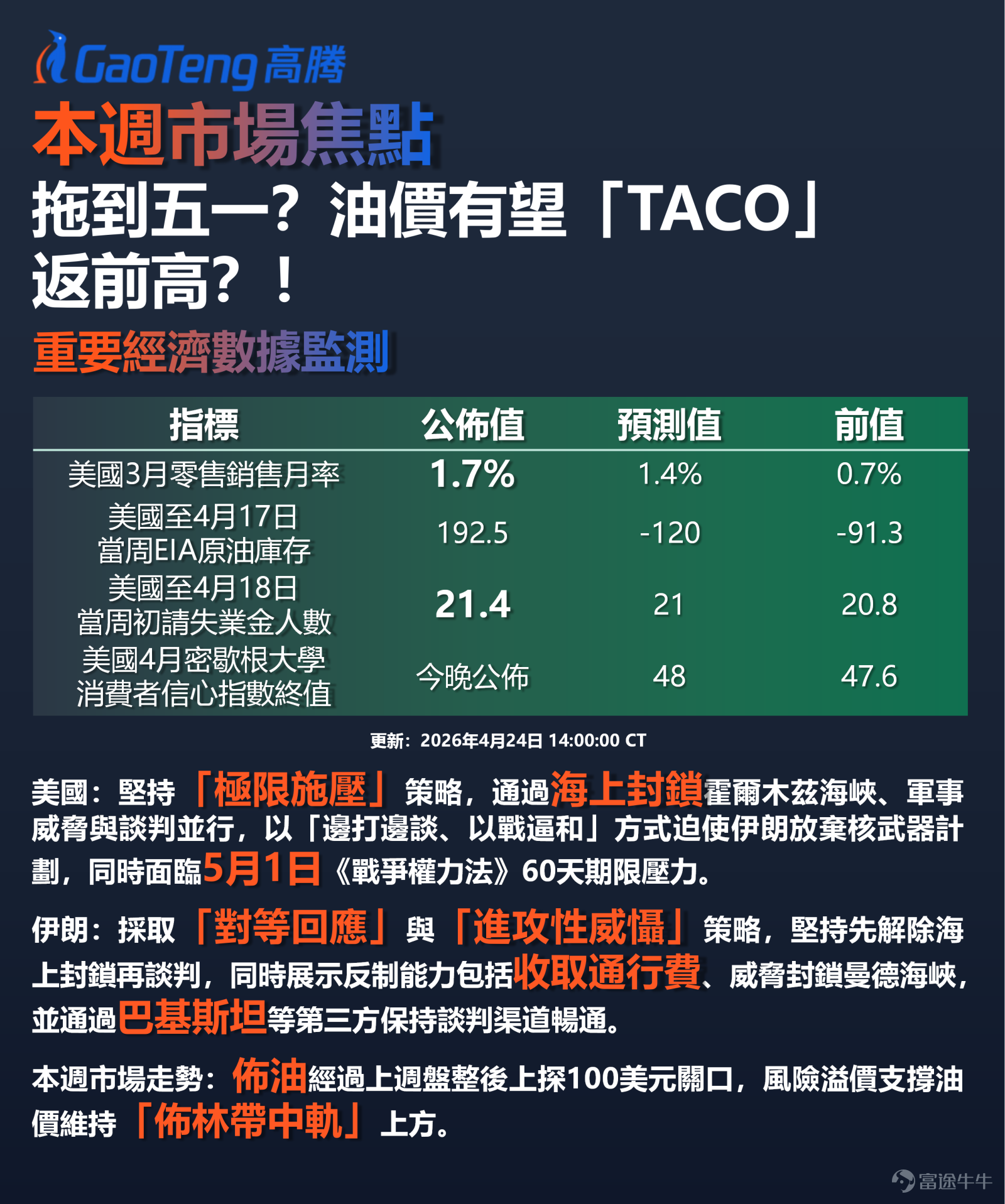
Tense · Market Focus This Week | Delayed Until May Day? Oil Prices May "TACO" Back to Previous Highs?!

The US persists in its routine of exerting maximum pressure
TrumpThis week, the US has continued to apply maximum pressure on Iran while advancing negotiations through multiple channels, including Pakistan. Trump previously confirmed to the New York Post that the US negotiator 'is arriving tonight,' led byUS Vice President Vance, with members includingUS Envoy WittkovandUS Envoy Kushner. The Pakistani side has deployednearly 20,000security personnel in the capital to prepare for the negotiations.
Trump stated that he is willing to meet with Iran’s top leaders if a breakthrough in negotiations is achieved. He emphasized that the core of the negotiation is a strict requirement: Iran must abandon any plans to develop nuclear weapons.Dismantle nuclear weapons. It's as simple as that," he said, "There will be no more nuclear weapons." Trump also added that if Iran complies with the regulations, it has the potential to thrive.
On the issue of a ceasefire, Trump adopted a tough stance, clearly stating his unwillingness to extend the ceasefire period, referring to Iran as “seemingly bloodthirsty” and insisting they must “apply reason and common sense.” He further noted that the U.S. expects to bomb Iran, stating that the U.S. forces are “ready,” and pointed out that targeting infrastructure could inflict military damage on Iran. Trump also emphasized thatThe U.S. is in a strong negotiating position, leaving Iran with “no choice.”
Regarding the maritime blockade, Trump stated that the U.S. hasStrait of Hormuzfull control. “No ships can enter or leave without the approval of the U.S. Navy. It is ‘completely sealed off’ until Iran is able to reach an agreement!” Trump also ordered the Navy to target any vessels inStrait of Hormuzlaying mines, and tripled the mine-sweeping forces to 'three times' their normal level. He admitted that he's 'not in a rush,' and said thata blockade scares them more than bombing.。
Iran's response and countermeasures
In response to the US'sMaximum pressure, Iran has shown a tough stance while leaving some room for negotiations.Iranian Foreign Ministry spokesperson BaghaeiThey indicated that Washington is not seriously advancing the diplomatic process, and Tehran will not change its existing demands nor accept any deadlines or ultimatums. According to Iran's Tasnim News Agency, currentlyIran has not changed its decision not to participate in the negotiations.。
Member of the Parliamentary Presidium, Nadriclearly stated that before the issue of the maritime blockade is resolved, 'we will not hold a second round of negotiations.' Iran believes that the US military's current blockade of maritime traffic entering and exiting Iranian ports seriously violates the ceasefire agreement previously reached.
Amir-Saeid Iravani, Iran's Permanent Representative to the United Nationsrevealed that signals have been received from the US indicating preparation tolift the maritime blockade: 'We have received some signalsindicating they are prepared to remove the blockade. Once they lift the blockade, I believe the next round of negotiations will be held in Islamabad.' He also stated, 'If they are willing to sit down for negotiations and seek a political solution, we are prepared. If they insist on starting a war, Iran is also prepared.'
At the military level, Iran continues to demonstrate counteraction capabilities.Ejei, the Chief Justice of Iranstated that 'The United States does not dare to approach'Strait of Hormuz. The 'swarm' fleet of Iran's Islamic Revolutionary Guard Corps is on high alert, ready to destroy U.S. defenses through 'saturation' attacks. Iran's central bank confirmed that the first payment forStrait of Hormuzship tolls has been credited in the form of 'cash foreign exchange'.
Based on the principles of 'reciprocal response' and 'offensive deterrence,' Iran has developed a counterattack plan for possible military actions by the U.S. and its allies. This plan outlines response measures under various scenarios: if Iran’s power plants or oil and gas facilities are attacked, critical infrastructure of Israel and U.S. allies will be targeted; if maritime blockades persist or escalate, they will blockadeBab el-Mandeb, and if necessary, completely blockade through large-scale mining operationsStrait of Hormuz。
International Community's Mediation and Concerns
Pakistan played a key role in mediation. Trump responded toPakistani Prime Minister Anwaar-ul-Haq Kakarandand Pakistani Army Chief General Asim Munir's request and decided to postpone the military strike against Iran. Pakistani officials remain optimistic, believing it is still possible to bring the U.S. and Iran back to the negotiating table, with the second round of talks potentially taking place in the near future.36 to 72 hoursto be held.
Geopolitical analyst Imran Khalidstated that the potential Islamabad negotiations could truly work. He pointed out that this round of talks adopts a highly pragmatic approach of 'compartmentalization' strategy: discussions strictly focus on U.S.-Iran bilateral friction points, decisively bypassing complex 'deadlocks' like Israel, Gaza, and Lebanon. Through indirect technical communications, both sides have reached a consensus on a 'transitional framework' with the core logic being that the U.S. eases economic constraints in exchange for Iran scaling back its nuclear activities.
On the nuclear issue, the gap between the two sides is narrowing. It is believed that indirect negotiations have reached a compromise on the duration of suspending uranium enrichment, reducing Washington's initial demand from20 yearsa longer period to a more feasible timeframe.10 yearsThe key terms also include Iran downgrading approximately440 kilogramsof highly enriched uranium for conversion into civilian nuclear fuel such as for power generation.
The conflict between Israel and Lebanon continues.Israeli Defense Minister Katzstated that Israel is prepared to resume military action against Iran and is awaiting 'a green light from the US.' Trump announced that the ceasefire between Israel and Lebanon will be extended by three weeks.
May 1 — Key deadline under the War Powers Act
May 1, a legal deadline crucial both to the U.S. constitutional order and global energy markets is approaching. According to the 1973 War Powers ActThe President’s use of armed forces without congressional authorization must terminate military action within60 daysTrump officially notified Congress about the military action in Iran on March 2, starting the60 daysfrom that date, with the actual deadline beingMay 1。
The costs from the escalating conflict are staggering: crude oil prices have surged pastUSD 100 per barrel, with estimated losses to global energy infrastructure exceedingUSD 50 billionAs of now, the U.S. Congress has not passed any Authorization for Use of Military Force (AUMF) against Iran, leaving the legality of the war unresolved.
IfMay 1If the conflict has not eased byAuthorization for Use of Military Force(AUMF), which, if approved, would allow military operations to continue without time constraints; the second is withdrawal, which means handing over the initiative, allowing Iran to claim both practical and moral victories; the third is to continue fighting but refuse to seek authorization, which would be an open violation of the law.
Cracks within the Republican Party are beginning to show.Senator James Lankford of Oklahomahas made his stance clear: 'This is the law, and Congress should (authorize).'Senator Thom Tillis of North Carolinasaid,60 dayslater, either the President proposes an exit plan, or must apply for AUMF authorization.Don Bacon, Republican Representative from Nebraskastated: 'Legally, we either have to approve continued operations or call them off. If not approved, by law, actions must be stopped.'
Key time node
– May 1:《War Powers Act》60 daysThe deadline is approaching — Trump must decide whether to authorize, withdraw troops, or continue illegally — only 7 days remain
– This weekend: Trump’s message to Iran3 to 5 daysCeasefire extension window may end
- Future36 to 72 hours: Pakistan estimates second round of talks may be held
$S&P 500 Index (.SPX.US)$ $Nasdaq Composite Index (.IXIC.US)$ $Dow Jones Industrial Average (.DJI.US)$ $Hang Seng Index (800000.HK)$ $Hang Seng TECH Index (800700.HK)$ $Crude Oil Futures (NOV6) (CLmain.US)$ $Gold Futures (DEC6) (GCmain.US)$ $Brent Last Day Financial Futures Current Contract (NOV6) (BZcurrent.US)$

Risk Disclaimer: The above content only represents the author's view. It does not represent any position or investment advice of Futu. Futu makes no representation or warranty.Read more

Comments
to post a comment
2
1