
Global storage giants surge collectively! How to interpret the storage market trend?

Earnings Options Strategy | Sandisk: SK Hynix Delivers Strong Results First, but With High Expectations Pressing, Will Earnings Night Bring a Surprise or Disappointment?
$SanDisk (SNDK.US)$ SanDisk will announce its third-quarter fiscal 2026 results after the market closes on April 30.
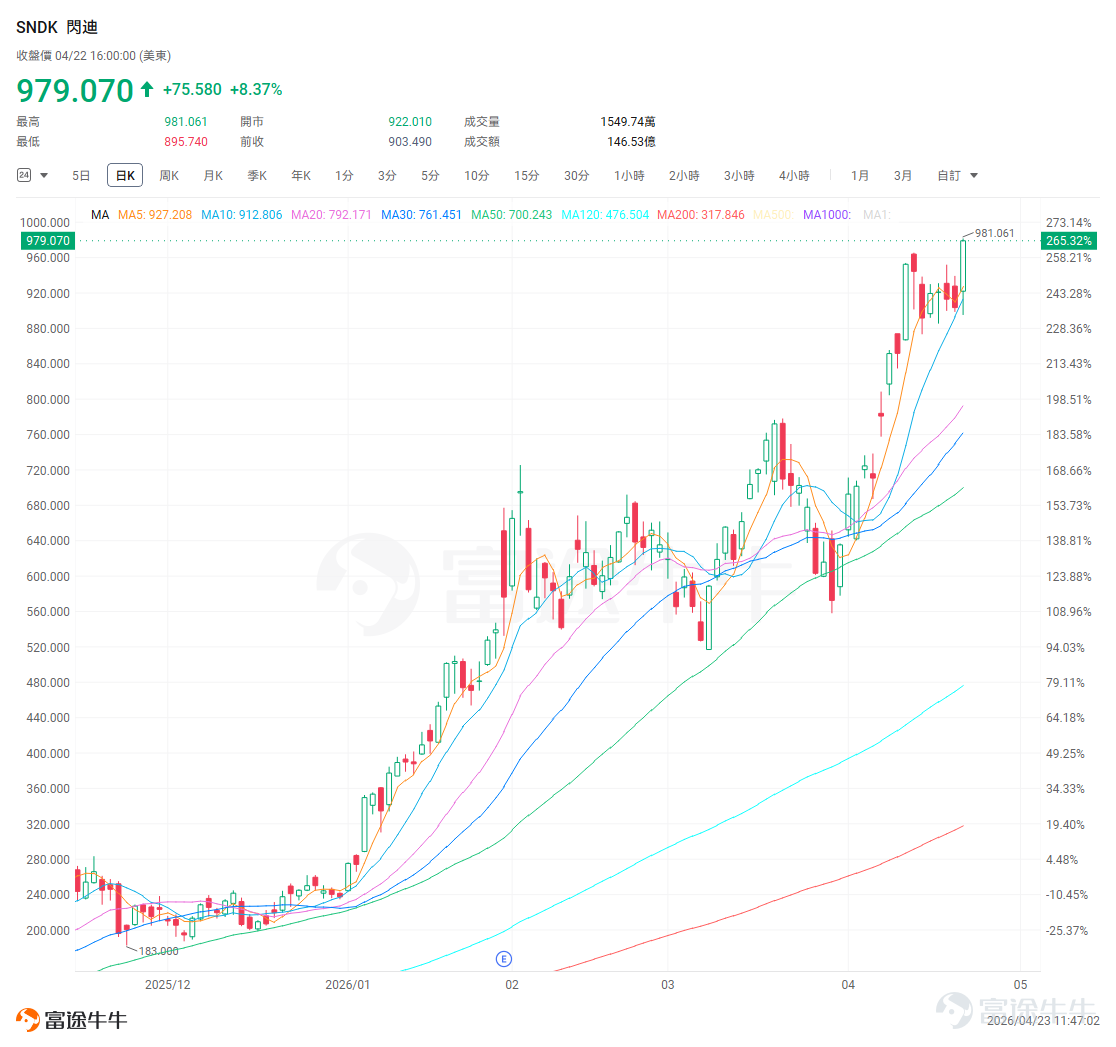
As ofApril 22, SNDK shares were priced at903.49 US dollars, and have alreadyApril 20Officially included in the Nasdaq 100 Index, it has surged over 300% year-to-date.Timing-wise, this earnings report lands at a time when market sentiment toward the memory sector is at its peak and after the company's own expectations have been significantly raised.

Looking at market expectations first, the guidance provided by management this quarter has already been quite aggressive.
SanDisk became independent from Western Digital Corporation in February 2025. Based on its main business structure, SanDisk’s revenue is now divided into three segments:Datacenter, Edge, Consumer。The Datacenter segment is not the largest yet; according to the latest disclosed data for the second fiscal quarter of the 2026 fiscal year, it accounts for approximately 14.5%. However, it has the fastest growth rate and is also the most critical area driving this round of valuation increase.

Over the past few quarters, SanDisk's stock performance has been strong, driven by two factors. The first is the recovery of industry conditions, with NAND prices rebounding, inventory pressure easing, and profit elasticity beginning to be released. The second, more crucial factor is that the market has gradually started to view it as part of the AI infrastructure chain, shifting the focus from traditional consumer storage to enterprise SSDs, data center demand, and an increasing share of high-value products.
The guidance provided by management for this quarter is quite aggressive.Expected revenueUSD 4.4 billion to USD 4.8 billion, non-GAAP earnings per shareUSD 12 to 14, non-GAAP gross margin65% to 67%。The market has already assumed that it will deliver another solid quarterly performance. Judging from the consensus expectations in the open market,The revenue expectation for this earnings report of Western Digital is approximately USD 4.66 billion, with a non-GAAP EPS of approximately USD 14.3, which is already at the mid-to-high end of the company's previous guidance range.
Simply meeting expectations may not be enough to drive the stock price significantly higher; what truly matters is whether Western Digital can demonstrate that the current round of profit growth is still in its middle phase rather than nearing its peak.
SK Hynix’s earnings report further strengthened Western Digital’s already optimistic expectations.
On April 23, SK Hynix announced its Q1 2026 performance, with quarterly revenue reaching KRW 52.58 trillion, operating profit 37.61 trillion Korean won, both hitting new record highs.
The company noted in its earnings report that the ongoing expansion of AI infrastructure investment is driving an increase in sales of high value-added products; more crucially, management clearly stated that as AI transitions from training to higher-frequency inferencing scenarios, memory demand is expanding across both DRAM and NAND segments, and they anticipate a favorable pricing environment for both product categories will persist for some time.
Turning to SanDisk,SK Hynix's earnings report further strengthened market expectations that were already leaning bullish on SanDisk’s performance this quarter.It indicates that the industry's pricing environment remains robust, which will support SanDisk’s revenue realization, gross margin improvement, and management’s tone in the April 30 earnings report.
Of course, this transmission effect should not be viewed too directly. The core driver behind SK Hynix’s explosive performance this time remains HBM, server DRAM, and high-value storage products, while SanDisk is a purer NAND and storage solutions company. Last quarter, its data center business accounted for less than 20% of total revenue, which is still insufficient to replace the validation found within SanDisk’s own financial reports.
Earnings Report Highlights: Growth Rate of Data Center Business, Gross Margin, and Guidance for the Second Half of the Year
1. The data center business remains the most noteworthy aspect of this earnings report.
In the previous quarter, Western Digital's data center revenue grew rapidly, with data center business revenue increasing by 64% from the first fiscal quarter. In its earnings statement, the company mentioned that the growth came from AI infrastructure builders, semi-customized customers, and tech companies deploying AI on a large scale. This description itself indicates thatthe significance of the data center business is not just about revenue growth but also about how it has changed Western Digital’s growth dynamics.
Traditional storage companies are often valued using a cyclical framework, focusing on supply and demand, pricing, inventory, and capital expenditures. However, once enterprise SSDs and AI-related demand become the main growth drivers, the market shifts its valuation approach. This shift reflects higher product requirements, longer customer validation cycles, and implies stronger customer stickiness and greater profit margins.
Therefore, in this earnings report, while data center revenue is important, what matters more is whether management will continue to send positive signals.Has progress been made in customer certifications? Have hyperscale customer projects started entering a clearer phase of volume ramp-up? Has order visibility continued to improve?These factors carry more weight than single-quarter numbers. As long as this narrative continues to develop, the market will be willing to keep positioning Western Digital as a key beneficiary of AI storage.
2. Gross margin is another, more solid indicator.
Revenue can be affected by the timing of recognition, but gross margin better reflects the true quality of this round of profit improvement.
Western Digital's non-GAAP gross margin in the previous quarter reached 51.1%,while the guidance range provided by the company for the third fiscal quarter is 65% to 67%. This increase is significant, indicating that management is highly confident about both product mix and pricing trends.
Behind this point, two layers of logic can be observed. The first is that industry prices are still on the rise, and the supply-demand relationship for NAND has not eased significantly.According to TrendForce data, contract prices for some NAND products surged approximately 160% in the first quarter, and there is an expectation that prices will continue to rise in the second quarter.The second layer is that SanDisk's own business structure is improving, with a higher proportion of high-value products, accelerated deployment of enterprise SSDs, driving up unit profits. External reports also mention that one of the key supports for SanDisk's recent sharp rise in stock price is the market's belief that profit growth driven by AI demand and rising memory prices has not yet ended.
If the gross margin in this earnings report can remain stable at a high level, or even if management maintains an optimistic tone regarding next quarter’s profitability, the market will more readily accept the view that SanDisk's current upward revision in profits is still in its middle phase. Conversely, if revenues are good but the gross margin does not continue to rise, or if the company becomes conservative in its description of profitability, post-earnings trading will become much more complicated. At this stage, the market is very sensitive, and marginal changes will be magnified.
3. Management guidance for the second half
From the perspective of market dynamics, while the strength of single-quarter performance is important, what is even more critical isHow management will describe the future supply-demand relationship: Current supply remains tight, enterprise SSD deployment is accelerating, and the business structure continues to tilt toward higher value areas. The rapid upward revision of the market’s valuation of this company relies precisely on this logic.
For such companies,What the market usually fears most is not that quarterly figures are weak, but rather that management begins to hint that 'the strongest phase may have already passed.'How long will this upward momentum last? Can prices remain strong? Has the supply constraint eased? Are customers still ramping up their orders? Are there any signs of cooling in the second-half demand?
Once expectations have been raised to this level, even if the company delivers a solid earnings report, any more cautious commentary on the second-half outlook during the conference call compared to the previous one may not lead to an easy stock reaction.
Earnings Season Strategy
From a technical perspective, SanDisk (SNDK.US) is currently in astate of contradiction: On one hand, price momentum remains robust with continued inflows and an upward trend; on the other hand, technical indicators are showing overbought conditions across the board, while reverse hedging/speculative signals have emerged in the options market, and implied volatility (IV) has reached 116.97%, with its historical percentile (IV Percentile) hitting 94%, warning of potentially extreme future volatility. This combination often suggests thatthe short-term trend could become highly volatile。

Regarding this earnings result,The implied volatility for earnings day in the options market is around ±20.72%, indicating extremely high volatility.. The put-call ratio on April 22 was 0.82, and although the ratio is less than 1 (indicating slightly more bullish sentiment than bearish), a significant proportion of puts remain, suggesting thatthe market is not entirely optimistic, with a considerable portion of trades hedging against downside risk or betting on short-term declines.For conservative investors, chasing highs at current levels carries substantial risk. Close attention should be paid to whether prices can stabilize in new high territory, and whether overbought indicators might correct through consolidation or a pullback.

Options premiums ahead of the earnings report have become extremely expensive. The difficulty in trading lies not only in predicting direction but also in managing costs and avoiding being negatively impacted by a post-earnings drop in volatility. In this context, several strategies can be considered based on different holding statuses and risk preferences.
(1) For investors who already hold shares of Sandisk, aiming to navigate through the earnings report while controlling drawdowns,
a collar strategy could be considered. For clients who already own the underlying asset, the core value of this strategy is to predefine the hardest-to-manage risks on earnings night at a relatively low additional cost.
For investors who already hold the stock and have accumulated some paper profits, the most pressing issue before the earnings release is not how to maximize gains, but rather how to protect existing profits while mitigating tail-risk volatility from the earnings event.
In such cases, consider implementing a collar strategy by purchasing a protective Put option while selling an upside Call option, using the premium collected from the Call to partially offset the cost of the Put. The strike price of the Put can be set near the maximum acceptable drawdown level, while the strike price of the Call can be placed at a level where one is willing to partially realize gains.
The result of this approach is that if the earnings report significantly misses expectations, the drawdown can be controlled; if the earnings continue to show strong upward momentum, although some upside potential will be sacrificed, the overall portfolio volatility will be more stable.
(The figure below illustrates the simulated profit and loss scenario of this strategy on the expiration date. The design image displayed on the screen is for demonstration purposes only and does not constitute any investment advice or guarantee; market conditions fluctuate frequently, and the prices shown do not represent actual values.)

(2) For investors who are holding no positions or light positions and wish to participate in the pre-earnings upward movement
They may consider: a Bull Call Spread. This type of strategy is more suitable for the following assessment: the earnings results are likely to be decent, with the stock price still having the potential to continue rising, but it is not advisable to pay the full cost for high volatility.
If these investors are optimistic about a generally positive direction for the earnings report but are unwilling to directly buy uncovered Calls in the current high implied volatility (IV) environment, a Bull Call Spread would be more appropriate. They can buy an at-the-money or slightly in-the-money Call while selling another Call with a higher strike price to reduce the net premium expenditure. The strike price for the sold Call above can prioritize referencing the upper boundary of the current implied volatility range to leave some room for a possible post-earnings rally.
The core issue with the current situation lies in the fact that while the trend and fundamental expectations are not weak, the market has already priced in significant optimism. If one were to directly buy a single-leg Call at this point, although the theoretical profit potential could be larger if the directional judgment is correct, they would have to bear the dual pressures of high premiums and a post-earnings IV decline. Even if the stock price rises, insufficient gains may still compress actual profits.
(The figure below illustrates the simulated profit and loss scenario of this strategy on the expiration date. The design image displayed on the screen is for demonstration purposes only and does not constitute any investment advice or guarantee; market conditions fluctuate frequently, and the prices shown do not represent actual values.)

(3) For investors who believe in the medium to long-term fundamentals, want to accumulate the underlying stock at a lower price, and simultaneously collect premiums by leveraging high IV
They may consider: selling Cash-Secured Puts. This strategy suits investors who are not pessimistic about the medium-term logic and believe that even if there is a pullback after the earnings report, they are willing to acquire the underlying stock at a lower price. Additionally, they aim to capitalize on the currently elevated option premiums to secure time value upfront.
In terms of specific implementation, one may choose to sell aPut option expiring after the earnings report, out-of-the-money below the current price,while ensuring sufficient cash is reserved in the account to buy the underlying stock at the agreed price if exercised. The essence of this approach is:If the stock price remains above the strike price after the earnings report, the Put will most likely expire worthless, allowing the premium to be fully retained; if the stock price falls below the strike price and is exercised, it would effectively allow acquiring the underlying stock at a lower actual cost of 'strike price minus the received premium'.
(The figure below illustrates the simulated profit and loss scenario of this strategy on the expiration date. The design image displayed on the screen is for demonstration purposes only and does not constitute any investment advice or guarantee; market conditions fluctuate frequently, and the prices shown do not represent actual values.)

Finally, Option Sir brings a small perk for fellow investors, welcome to claim it.Options Beginner Pack
*This event is exclusive to invited HK users. Click to learn more.Detailed event rules>>
Make the most of the earnings season opportunities hub to view all key metrics at a glance and uncover pre- and post-earnings options trading opportunities.

Risk Disclaimer: The above content only represents the author's view. It does not represent any position or investment advice of Futu. Futu makes no representation or warranty.Read more


Comments (7)
to post a comment
58
156