
Storage giants launch collective buybacks: Where does the supercycle stand?

Daily Options Outlook | Semiconductor Earnings Ignite Pre-Market Sentiment, Texas Instruments Surges 10%; Nokia's Transformation Shows Results; Tesla Enters Post-Earnings Digestion Phase
Today's Options Opportunity Preview
Tesla retreats in pre-market trading: Earnings report didn't disappoint, but high expectations begin to face reality check
As of this writing, $Tesla (TSLA.US)$ Tesla is down 2.7% in pre-market trading.Tesla's Q1 earnings report was not a 'bad report' in the conventional sense. The company’s free cash flow for the quarter significantly outperformed market expectations, and its profit was stronger than the most pessimistic forecasts; however, Tesla also increased its 2026 capital expenditure plan from an initial $20 billion to over $25 billion, with continued focus on autonomous driving, robotics, and chips. The company also cautioned that as investments accelerate, free cash flow may turn negative for the remainder of the year.
The market will not just focus on whether 'profits exceeded expectations' in the short term but will pay more attention to how long the long-term narrative will take to materialize into stable returns. The pre-market pullback reflects more of a digestion of expectations following the earnings release for high-flying stocks. Looking ahead, Tesla’s core variables are no longer just about electric vehicle sales themselves, but rather whether the Robotaxi, Cybercab, and robotics businesses can provide quicker validation signals after the increase in capital expenditures.
Options signals: Low volatility expectation, active bearish trading. Implied Volatility (IV) stands at 49.44%, which is historically low (IV percentile at 15%); the Put/Call Ratio is 0.8, with put options trading volume accounting for 44.5%, indicating active hedging or speculative trading in puts.
2. Semiconductor sector remains robust, with AI computing power expanding from core chips to broader segments
SK Hynix reported a fivefold increase in Q1 profits to 37.6 trillion Korean won, with revenue rising to 52.6 trillion Korean won, setting a new record. The company clearly stated that demand for AI chips still far exceeds current production capacity. Meanwhile, $Texas Instruments (TXN.US)$ Q1 revenue reached $4.83 billion, surpassing market expectations of $4.53 billion, and Texas Instruments rose over 10% in pre-market trading.
From memory to analog chips, performance metrics are showing relatively consistent validation, indicating that demand has not slowed significantly. For Texas Instruments, today’s strong performance is closer to a repricing of sector-wide strength rather than just an emotional boost from a single quarter’s better-than-expected results.
On the options signals, extreme volatility is expected, with a significant rise in stock price. The implied volatility (IV) stands at 52.00%, with an IV percentile as high as 99%. This signal is directly related to the company's better-than-expected Q1 earnings report, which caused the pre-market stock price to surge nearly 11%, hitting a record high.
3. Nokia’s AI transformation begins to bear fruit: Optical Networks business starts to become a new growth driver.
$Nokia Oyj (NOK.US)$ The performance in Q1 is also worth noting, with pre-market prices rising over 12%. Comparable operating profit for the quarter increased by 54% year-over-year to EUR 281 million, surpassing analysts' expectations of EUR 250 million. Sales from AI and cloud customers grew by 49% year-over-year, with EUR 1 billion in new orders secured. In its earnings report, the company further disclosed that revenue in the network infrastructure segment grew by 12% year-over-year, with Optical Networks revenue increasing from EUR 525 million to EUR 821 million. On a reported basis, this represents a year-over-year increase of 56%, or 20% on a constant currency and portfolio basis. This indicates that Nokia's AI-driven growth logic is no longer just conceptual but is beginning to reflect in its financials through optical transmission and network infrastructure businesses.
Traditional telecommunications equipment providers are not entirely absent from this round of the AI cycle; if their business structure is closely aligned with the construction of hyperscale data centers, they have the opportunity to achieve new profitability. Of course, it remains important to observe the continuity of orders, the progress of Infinera integration, and whether AI-related business growth can continue to offset the weakness in traditional telecom equipment demand.
On options signals: High volatility expectations, with bullish trading dominating.Texas Instruments’ implied volatility (IV) has reached 74.66%, a historically high level (with an IV percentile of 93%), indicating that the market expects its price to experience sharp fluctuations. The put-to-call ratio is only 0.45, with call option trading volumes far exceeding those of put options, reflecting an overall bullish sentiment in the market.
Review of yesterday’s options
Index Options
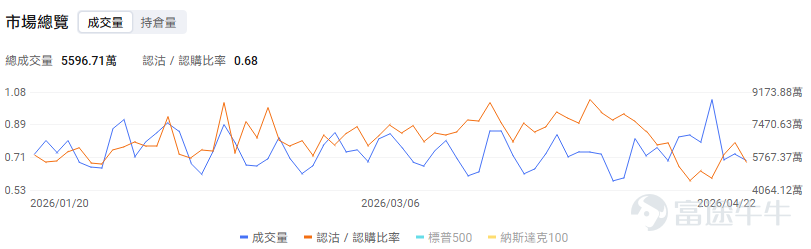
On April 22 Eastern Time, trading volume in the U.S. stock index options market declined, with a total of 4.72 million contracts traded. The put-to-call volume ratio fell to 1.09.
As the upcoming expiration date approaches,$S&P 500 Index (.SPX.US)$ The distribution of options trading volume showed the following characteristics: peak put option volume was at 7,100 points, while peak call option volume occurred at 7,285 points.

Single Stock Options
$Strategy (MSTR.US)$The stock closed up 9.39%, with 757,000 options contracts traded, and the put-to-call volume ratio dropped to 0.37. Strategy shares surged more than 9%, driven by Bitcoin’s rise to USD 79,000, leading gains among cryptocurrency-related stocks.

$Tesla (TSLA.US)$Closing up 0.28%, with 1.45 million options contracts traded, the put/call volume ratio fell to 0.80. Tesla's Q1 adjusted earnings per share of $0.41 exceeded expectations, revenue reached $22.387 billion, a year-over-year increase of 16%, and the company announced an increase in capital expenditure to over $25 billion.

Top list of options trading volume
Among the top 10 stocks by options trading volume,$Tesla (TSLA.US)$The put/call volume ratio reached a high of 0.80.

The highest put/call open interest ratio is$Micron Technology (MU.US)$, reaching 1.15. Micron Technology shares hit a record high, benefiting from surging demand for AI memory chips and a 16-day winning streak for the Philadelphia Semiconductor Index.

Implied volatility rankings (underlying market cap > $10 billion and options trading volume > 100,000)
$Avis Budget (CAR.US)$Implied VolatilityThe highest increase was 222.09%, down 9.38% from the previous trading day. Avis shares plummeted 38%, ending a four-day rally, after having surged 390% cumulatively within the month.Short squeezeThe market saw a pullback.

$Navitas Semiconductor (NVTS.US)$Implied volatility increased the most, reaching 162.05%, up 19.92% from the previous trading day. Navitas Semiconductor appointed former Broadcom executive Gregory Fischer as an independent director, and its stock soared over 20% due to suspected short squeeze.

Risk Warning
An option is a contract that gives the holder the right, but not the obligation, to buy or sell an asset at a fixed price on a specific date or before that date. The price of an option is influenced by various factors, including the current price of the underlying asset, the strike price, time to expiration, and implied volatility.
Implied volatility reflects the market's expectation of the option's volatility over a certain period in the future. It is derived inversely from the BS pricing model of options and is generally considered an indicator of market sentiment. When investors anticipate greater volatility, they may be more willing to pay higher prices for options to hedge risks, resulting in higher implied volatility.
Traders and investors use implied volatility to assessOption priceattractiveness, identify potential mispricings, and manage risk exposure.Disclaimer
This content does not constitute any offer, solicitation, recommendation, opinion, or guarantee of any securities, financial products, or tools. The risk of loss in trading options can be substantial. In some cases, losses may exceed the initial margin deposited. Even if you set contingent orders such as 'stop-loss' or 'limit' orders, these may not prevent losses. Market conditions may make such orders unexecutable. You may be required to deposit additional margin within a short period. If you fail to provide the required amount within the specified time, your open positions may be liquidated. However, you will still be responsible for any shortfall in your account. Therefore, before trading, you should study and understand options and carefully consider whether such trading is suitable for you based on your financial situation and investment objectives. If you trade options, you should be familiar with the procedures for exercising options and the rights and obligations upon exercise and expiration. Options trading carries extremely high risks and is not suitable for all investors. Investors should carefully readCharacteristics and Risks of Standardized Options。
This content does not constitute any offer, solicitation, recommendation, opinion, or guarantee of any securities, financial products, or tools. The risk of loss in trading options can be substantial. In some cases, losses may exceed the initial margin deposited. Even if you set contingent orders such as 'stop-loss' or 'limit' orders, these may not prevent losses. Market conditions may make such orders unexecutable. You may be required to deposit additional margin within a short period. If you fail to provide the required amount within the specified time, your open positions may be liquidated. However, you will still be responsible for any shortfall in your account. Therefore, before trading, you should study and understand options and carefully consider whether such trading is suitable for you based on your financial situation and investment objectives. If you trade options, you should be familiar with the procedures for exercising options and the rights and obligations upon exercise and expiration. Options trading carries extremely high risks and is not suitable for all investors. Investors should carefully readCharacteristics and Risks of Standardized Options。
Risk Disclaimer: The above content only represents the author's view. It does not represent any position or investment advice of Futu. Futu makes no representation or warranty.Read more

Comments
to post a comment
10
10