
[Publishing orders] The market is ups and downs, did your options make or lose?

Daily Options Selling Strategy | Shareholder Lock-up Triggers Epic Short Squeeze! Avis Plummets 37% After Hitting Record High, Practical Analysis of Options in High IV Environment
I. Market Barometer: Major Indices Close Higher Collectively, Avis Surges Then Crashes
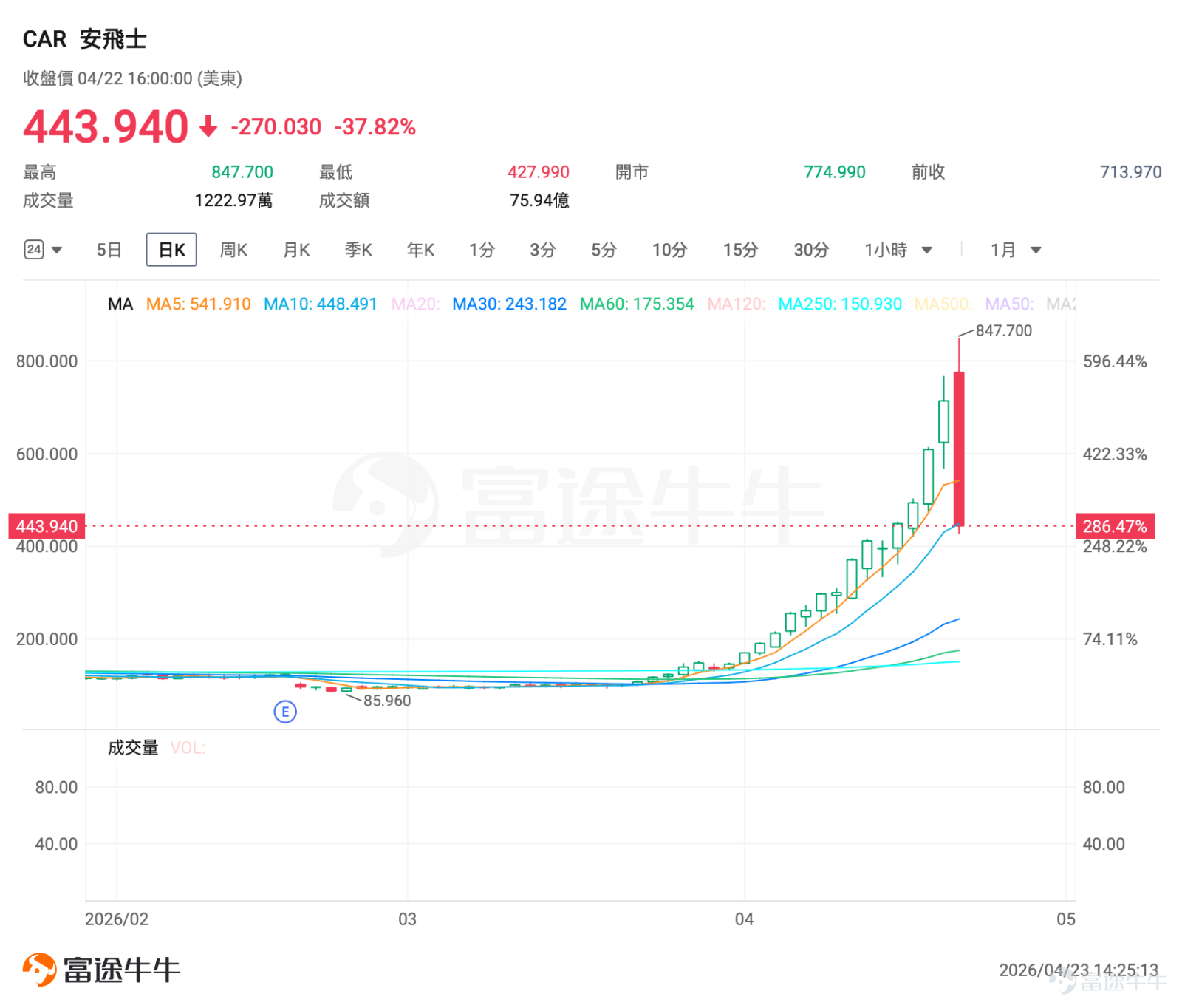
In the previous trading session, the three major U.S. indices closed higher collectively, aside from the sharply rising semiconductor sector,Recently, the car rental sector experienced a heart-stopping roller-coaster ride – $Avis Budget (CAR.US)$ Yesterday morning, it surged to an all-time high of $847.7 before plummeting sharply, closing down 37.82%. Why did this stock soar over 700% within a month and then experience a cliff-like drop after hitting a new high? How should investors use options strategies to participate?
II. Focus on Popular Stocks: Avis
$Avis Budget (CAR.US)$ : Single-day price swing exceeding 100%, both record intraday high and flash crash occurred on the same day
Avis Budget Group closed down 37.82% in the previous trading session at $443.94, with a trading volume as high as $7.594 billion.Trading activity has surged to the 8th most active position within Futu's platform, just behind large-cap tech stocks and popular optical communication shares.
The stock soared to an intraday all-time high of $847.70 in early trading, with gains reaching over 18% at one point, before experiencing a 'roller-coaster reversal,' closing with the largest single-day loss since its IPO.
Root cause of the surge: Major shareholder lock-up triggers epic short squeeze
The trigger for Avis Budget Group's recent surge began at the end of March when hedge fund Pentwater Capital suddenly announced it had taken a position in Avis, rapidly increasing its stake to 22%. Adding to this, long-term major shareholder SRS Investment Management already held nearly 50% of the shares,Together, they locked up about 71% of the tradable shares.This sudden accumulation led to a severe compression of tradable shares available in the market.
In the meantime,Given Avis Budget Group's weak fundamentals, numerous short sellers had already positioned themselves for short trades.As the stock price rose driven by major shareholders' purchases, short sellers faced massive losses and were forced to buy shares to cover their positions, creating the classic 'short squeeze' positive feedback loop:Rising stock prices → short covering → further rise in stock prices.During the one-month period from March 23 to April 22, Avis' share price hit a low of $101.65 and surged to a high of $847.7, with the stock price increasing by over 700% at its peak.

Flash crash trigger: Technical rebound to fill the price gap
Danger signals were already flashing on the technical charts before the new highs were reached. BTIG technical analyst Jonathan Krinsky pointed out that there were two "true price gaps" in this short squeeze — where the opening price was higher than the previous day's intraday high — occurring on April 21 (opening at $624, above the prior high of $612.58) and April 22 (opening at $774.99, above the prior high of $765.94). Krinsky believes such gaps typically signal an 'emotional acceleration,' often suggesting that the rally is nearing exhaustion after a sustained rise.
More critically, on April 22, the stock formed a classic "key reversal day" pattern: The stock not only opened with a gap up but also hit an intraday high ($847.70), then reversed course and closed below the previous day’s low.This pattern is considered a clear warning signal of a trend reversal in technical analysis.Short sellers successfully launched a counterattack.
During the sharp rise in stock price, Avis's fundamentals did not improve in tandem, and major Wall Street firms also remained bearish.Revenue for the fourth quarter of 2025 was $2.664 billion, below market expectations, with huge losses due to asset impairment of the electric vehicle fleet. On April 21, Barclays downgraded Avis to 'Sell,' stating that this surge was essentially due to a 'supply-demand mismatch,' and the current stock price still lacks reasonable support.The average analyst target price is only $121.5, implying significant downside potential from the current level.
III. Seller Options Strategy

Opportunity filtering logic:
Avis plummeted 37.82% in the previous trading session, confirming that rallies without fundamental support are unsustainable.Currently, the company's option IV stands at 222.09%, basically within the highest historical percentile range. Selling options at this time allows for collecting higher option premiums.
However, given that the stock’s free float has been highly locked by major shareholders and short interest remains elevated, short-term long-short battles will remain intense.Investors should avoid selling near-term expiring options and strictly control position sizes. Investors with lower risk tolerance may consider selling out-of-the-money Calls with a higher degree of being unexercised.

IV. Risk Control Reminder
Although the seller strategy has a high probability of success, investors must still manage risks effectively:
– Position management is key:The biggest risk for sellers lies in black swan events. It is recommended thatthe margin requirement for any single underlying should not exceed 20% of total capital. Never sell options beyond your capacity to handle them just for the sake of greedy premium collection.
– Covered call options should be rolled over in a timely manner.(Rolling): When a covered call option becomes deeply in-the-money (stock price far exceeds the strike price),if you remain bullish on the underlying stock, you should decisively 'roll' the position— that is, buy to close the current option while simultaneously selling an option with a further expiration date and a higher strike price, avoiding the forced liquidation of the underlying stock at a low price.
– Cash-secured put options should beware of 'left-tail risk':For cash-secured puts,if the stock price collapses due to deteriorating fundamentals (rather than normal pullbacks), don’t hold on stubbornly.At this point, it's advisable to cut losses or 'roll down' to gain time, waiting for volatility to normalize.
Make the most of the options seller zone to understand income strategies for selling options,Earn option premiums!

Options Risk Warning
An option is a contract that grants the holder the right, but not the obligation, to buy or sell an asset at a fixed price on a specific date or at any time before that date. The price of an option is influenced by various factors, including the current price of the underlying asset, the strike price, time to expiration, and implied volatility. Implied volatility reflects the market’s expectations for the level of volatility in the option over a future period. It is a data point derived inversely from the Black-Scholes option pricing model and is generally regarded as an indicator of market sentiment. When investors anticipate greater volatility, they may be more willing to pay a higher price for options to hedge risks, resulting in higher implied volatility. Traders and investors use implied volatility to assess the attractiveness of option prices, identify potential mispricings, and manage risk exposure.
Disclaimer
This content does not constitute any offer, solicitation, recommendation, opinion, or guarantee of any securities, financial products, or tools. The risk of loss in trading options can be substantial. In some cases, losses may exceed the initial margin deposited. Even if you set contingent orders such as 'stop-loss' or 'limit' orders, these may not prevent losses. Market conditions may make such orders unexecutable. You may be required to deposit additional margin within a short period. If you fail to provide the required amount within the specified time, your open positions may be liquidated. However, you will still be responsible for any shortfall in your account. Therefore, before trading, you should study and understand options and carefully consider whether such trading is suitable for you based on your financial situation and investment objectives. If you trade options, you should be familiar with the procedures for exercising options and the rights and obligations upon exercise and expiration. Options trading carries extremely high risks and is not suitable for all investors. Investors should carefully readCharacteristics and Risks of Standardized Options。
Risk Disclaimer: The above content only represents the author's view. It does not represent any position or investment advice of Futu. Futu makes no representation or warranty.Read more


Comments
to post a comment
32
103