
2026 IPO bonanza! Over 90% of new stocks rose on their debut

Chagee's Net Profit Halved in First Year After IPO: Stock Plummets, 'Bo Ya Absolute String' Targeted Amid Food Delivery Wars
"Over the past year, the market has experienced significant volatility, and the competitive landscape has become more complex. As a newly listed young company, we have indeed faced some ups and downs on our journey in 2025, made some detours, and at certain moments encountered high uncertainty in decision-making," said Zhang Junjie, CEO of Chagee Holdings Limited (referred to as Chagee, NASDAQ:CHA) during the earnings call.
On March 31, 2026, Chagee, which wears the crown of 'the first new tea beverage stock in the US market,' submitted its first full annual report nearly a year after its IPO. The financial report showed that the company’s total net revenue increased slightly by 4% to RMB 12.907 billion for the year, but the net profit attributable to shareholders plummeted by 53.5% to RMB 1.171 billion. In the fourth quarter, it turned from profit to loss, with an operating profit recorded at -RMB 35.5 million, compared to RMB 640 million in the same period in 2024.
The once-growth myth has sharply reversed under the impact of multiple factors such as industry price wars, product dependency, and pressures on the franchise ecosystem. Although overseas markets have become the only bright spot, the sluggishness of domestic core operations and the growing pains of strategic transformation are pushing this star company into a severe test period.
Earnings 'plummeted,' and Q4 turned from profit to loss
As the 'first new tea drink stock in the US market,' Chagee (NASDAQ:CHA) disclosed its full-year and Q4 2025 earnings nearly a year after its IPO. The financial report released on March 31, 2026, showed that the company experienced revenue growth without corresponding profit growth for the full year. Net revenue reached 12.907 billion yuan, increasing by 4% year-over-year, but the growth rate slowed significantly compared to previous periods; operating profit was 1.347 billion yuan, down 53.33% year-over-year; net profit attributable to shareholders was 1.171 billion yuan, a decline of 52.4% year-over-year; non-GAAP net profit excluding share-based compensation expenses was 1.91 billion yuan, also showing a double-digit decrease.
The Q4 performance faced even more significant pressure, with quarterly revenue reaching 2.974 billion yuan, a year-over-year decrease of 10.8%; operating profit incurred a loss of 35.5 million yuan, turning from profit to loss year-over-year; net profit attributable to shareholders was 28.538 million yuan, plunging 95.3% year-over-year. Affected by weaker-than-expected performance, the company's stock price fluctuated.
In terms of revenue structure, the franchise business remained the primary source. For the full year 2025, net revenue from franchise stores amounted to 11.417 billion yuan, accounting for 88.5% of total net revenue; net revenue from directly operated stores was 1.49 billion yuan, making up 11.5%.
However, as the backbone of revenue growth, Chagee's franchise business weakened. In Q4 2025, this structural change became more pronounced, with the number of franchise stores at 6,838, representing 91.7% of global stores, but franchise revenue plummeted 21.3% year-over-year to 2.435 billion yuan, accounting for 81.9% of total revenue; in contrast, the number of directly operated stores surged from 169 in 2024 to 615, increasing their share to 8.3%, while direct-operated revenue rose 126.2% year-over-year to 540 million yuan, accounting for 18.1% of total revenue.
Chagee CFO Huang Hongfei explained during the conference call that this change was mainly due to the company converting some franchise stores into directly operated models in the Chinese market.
Over 90% of the company’s stores are franchises. Under the traditional 'supply chain model,' headquarters generates profits by selling raw materials to franchisees, resulting in weak alignment with store interests. When the industry cools and per-store GMV declines, franchisees bear the brunt, caught in the dual squeeze of 'falling sales and rising costs.'
Data confirmed the deterioration of the franchise ecosystem, with average monthly GMV per domestic store halving from a peak of about 575,000 yuan to 337,400 yuan; insiders believe that the payback period for franchisees extended dramatically from an early range of 5.5 to 9 months to 18 to 24 months in 2025, surpassing psychological thresholds. On secondary markets, transfers of Chagee store equipment have surged, with many new stores being sold off at low prices within less than a year of opening, pushing franchisee confidence to the brink of collapse.
To improve the franchise system, Chagee implemented a 'shock-style' reform starting January 1, 2026, transitioning fully from the 'supply chain sales model' to a 'GMV commission model.' The brand significantly reduced material margins and subsidized discounts, directly taking a percentage of store revenue, forming a partnership with franchisees based on 'shared risks and shared benefits.'
However, under the new model, headquarters’ income is directly tied to store revenue, with material concessions and subsidy support substantially compressing profit margins. To stabilize the franchise ecosystem,In 2025, subsidies for company-owned stores and franchise support fees increased by 35% and 42%, respectively, becoming the main reasons for the sharp drop in profits. At the same time, the company accelerated the conversion of franchised stores to directly operated ones, with the number of directly operated stores surging from 169 to 615, resulting in a 130.8% spike in operating costs. Although this 'self-amputation for survival' transformation is focused on long-term goals, it will continue to intensify profit pressure in the short term. Whether the new model can truly boost franchisee confidence and improve single-store efficiency remains to be tested by the market.
In terms of scale expansion, the company's global store count reached 7,453 in 2025, marking a year-on-year increase of 15.7%. Among these, domestic stores numbered 7,108, accounting for 95.4% of the total, covering 33 provinces and 355 cities nationwide, with an overall store survival rate of 94.76%; overseas stores totaled 345, representing 4.6% of the total, spread across seven international markets.
Despite the continuous expansion of its store network, ranking fifth in the industry for store count and eighth for net growth, GMV growth did not keep pace. Total GMV for the year grew by only 7.2%, while GMV for the fourth quarter alone fell by 10.5% year-on-year, indicating a significant divergence between store count growth and transaction volume growth.
The decline in store operational efficiency directly impacted profitability. Financial data shows that in 2025, the average monthly GMV per store in Chagee's Greater China region was 337,400 yuan, down 26% year-on-year, reflecting a continued weakening in store profitability.
The stock price plummeted 60% within a year; the 2026 target focuses overseas.
Regarding the current state of the domestic market, Zhang Junjie stated in the earnings call that in 2026, the company would appropriately slow down the pace of domestic expansion, focusing instead on boosting same-store sales and improving the health of existing stores. Poor-performing stores will undergo continuous location optimization and brand upgrades, with plans to add 300 new stores at core strategic locations throughout the year.
The overseas market has become one of the few growth highlights, with full-year overseas GMV reaching 1.969 billion yuan in 2025, achieving over 75% year-on-year growth for three consecutive quarters. Zhang Junjie noted that overseas mature stores outperformed domestic ones in terms of average monthly GMV per store. In 2026, the company plans to add approximately 200 new overseas stores.
However, market analysts pointed out that overseas high growth still faces three major concerns: First, the relatively small scale, with overseas GMV accounting for only about 3.8% of the total, making it difficult to offset declines in the domestic market; second, profitability uncertainty, as overseas expansion involves higher costs related to supply chain setup, localization operations, and compliance, with direct overseas store counts rising rapidly from 30 to 207 in 2025, driving up direct operation costs by 130.8% year-on-year to 377 million yuan; third, concentrated regional risks, with 75% of overseas stores located in Malaysia, facing multiple risks such as food inspections, labor regulations, and intellectual property protection.
Particularly in terms of overseas brand intellectual property protection, vigilance is still required. On April 1, 2026, a netizen in Japan posted online, revealing a newly opened tea shop named CHARMING in Osaka's Nakazaki area. The brand logo, packaging design, menu layout, and store decoration style highly resemble those of Chagee.
In terms of financial operational metrics, some turnover efficiencies have declined. Accounts receivable rose from 122 million yuan to 146 million yuan in 2025, with the accounts receivable turnover rate dropping from 115.54 times to 96.37 times. Inventory size increased from 132 million yuan to 228 million yuan, and inventory turnover rate fell from 84.08 times to 43.03 times, reflecting to some extent a slowdown in market sales.
On the cash flow front, net cash flow from operating activities decreased from RMB 2.838 billion to RMB 1.644 billion, while net cash flow from investing activities stood at -RMB 825 million, with expenditures further expanding compared to the previous year.
Fortunately, the company's cash reserves remained relatively abundant, with the closing balance of cash and cash equivalents increasing from RMB 4.769 billion to RMB 7.633 billion. Including restricted cash and term deposits, the total reached RMB 7.892 billion.
On April 2, 2026, CICC maintained an 'outperform' rating for Chagee (CHA.O) with a target price of USD 13.0. The company faced earnings pressure in Q4 2025 primarily due to higher-than-expected expense ratios, with same-store GMV declining by 25.5% year-over-year. Organizational adjustments were largely completed, focusing on restoring same-store performance and reinforcing its high-value brand positioning. Early successes were seen in new product launches and member re-engagement initiatives. Overseas expansion remained robust, with GMV growing 85% year-over-year in Q4. The forecast for 2026/2027 net profits was revised downward to RMB 1.86 billion/RMB 2.14 billion, but current valuations suggest upside potential.
On April 8, JPMorgan released a research report upgrading its rating from neutral to overweight, with the target price raised from USD 11.5 to USD 16. It noted that the worst period of same-store sales decline had passed, with a clear path toward stabilization and recovery. Domestic same-store sales declines narrowed by more than 10 percentage points from 25.5% in Q4 2025 to Q1 2026. The bank expects a recovery in same-store sales, overseas store expansion, and strict cost controls to drive gradual re-rating of the stock.

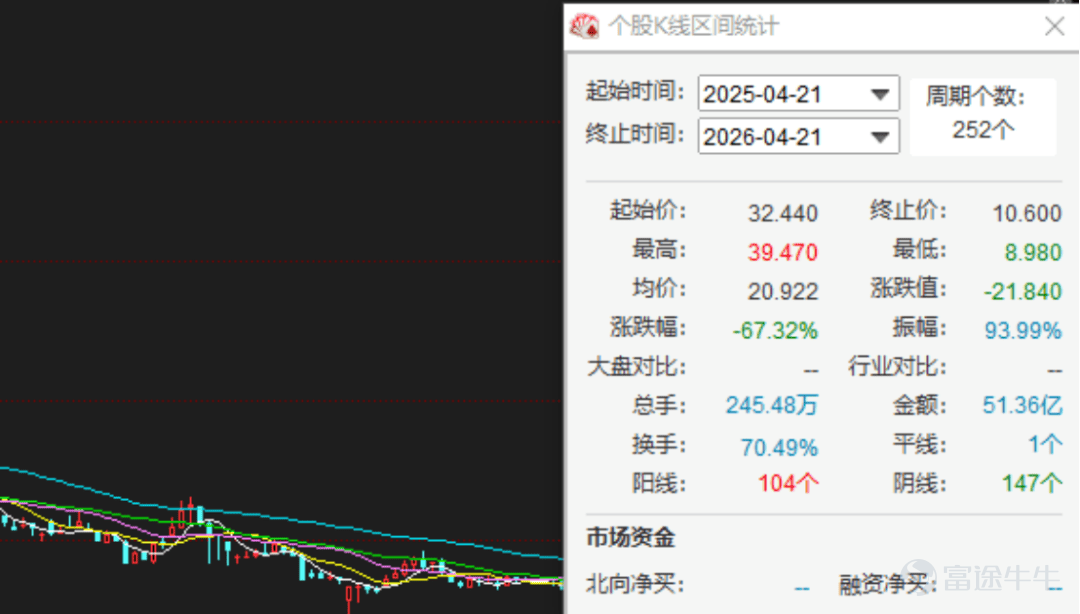
In terms of capital market performance,Over the one-year period from April 21, 2025, to April 21, 2026, Chagee's share price plummeted by 67.32%.
Core product Boya Absolute Strings may be falling out of favor; how will the business strategy win over consumers?
As the absolute core of the brand, the 'Boya Absolute Strings' product once contributed over 40% of sales, with cumulative sales exceeding 600 million cups. Together with two other core products, these three items consistently accounted for about half of the company's GMV. In 2024, the broader category of original leaf fresh milk tea contributed as much as 91% of domestic GMV, reflecting a highly concentrated product portfolio.
However, in 2025, a full-scale price war erupted across the industry. Competitors like Luckin Coffee’s 'Gently Jasmine' and Mixue Ice City entered the light milk tea market with ultra-low prices of RMB 9.9, directly siphoning off Chagee's core customer base through superior cost-performance.
More critically, Chagee has maintained a conservative product strategy for a long time, with only 19 items on its core menu. From 2022 to 2024, the company launched fewer than 20 new products annually, significantly lower than competitors such as Mixue Ice City. This lack of differentiation diluted its competitive edge, eroded consumer perception of premium pricing for 'original leaf fresh milk tea,' and triggered a concentrated outbreak of risks associated with product homogeneity.
Despite the company's emergency acceleration of new product launches starting from Q4 2025, introducing nearly 10 new products such as the 'Return to Yunnan' series, matcha, and Da Hong Pao in an attempt to break dependency, it remains highly uncertain whether hastily launched new products in the short term can cultivate new hits or rebuild consumer perceptions.
By 2025, the nationwide price war in food delivery became a key external factor dragging down Chagee's performance. Starting from April 2025, major internet platforms and tea beverage brands initiated subsidy wars, with milk teas priced at 9.9 yuan, 6.9 yuan, or even lower becoming the norm. Luckin Coffee, Guming, and other brands joined the battle, aggressively capturing market share through low prices.
Notably,At Chagee's analyst conference call, Zhang Junjie stated that internal adjustments have been largely completed, and operational rhythm and order have returned to stability. Looking ahead to 2026, Chagee will continue to adhere to its strategy of being a 'high-value brand with high-quality products.' Specifically, this includes launching new store formats; targeting a young customer base for multi-category innovations like tea cocktails and tea lattes; enhancing penetration into morning and evening scenarios, as well as diverse settings such as workplaces, major life events, birthdays, campuses, and weddings; improving user experience through environment and service upgrades; and internally focusing on systematic capability building. 'Entering 2026, recent domestic same-store sales data has shown a month-over-month improvement trend, giving us confidence in the full-year pace of stabilization in the first half and recovery in the second half.'
CICC's latest research report suggests that Chagee plans to continue driving same-store improvements in 2026 with a focus on maintaining its high-value brand positioning. Specific measures include category innovation, extending time periods, and upgrading experiences and branding, which have already shown initial success (e.g., the 'Return to Yunnan' series achieved a 51% reactivation rate for dormant members and drove a 16.2% week-on-week increase in overall GMV during its first week, both surpassing previous averages for new products). The company forecasts gradual stabilization and recovery in same-store sales in 2026 (with same-store sales showing month-over-month improvement since the beginning of the year) and recommends monitoring the results of these adjustments.
Amidst fierce industry competition, Chagee made a bold announcement in August declaring its firm stance against blindly engaging in price wars. Founder Zhang Junjie believes that while price wars may drive short-term traffic, they harm the brand in the long run.
However, in a market environment where consumers have been conditioned to be 'price-sensitive,' this 'aloof' strategy came at a heavy cost. Chagee, adhering to mid-to-high-end pricing, was excluded from platform subsidy campaigns, resulting in significant order diversions to competing brands participating in the price wars. Its food delivery business suffered a severe blow, directly causing a nearly 30% plunge in third-quarter single-store revenue.
Even more troubling, the price war reshaped the entire consumption ecosystem and pricing structure of the new tea beverage sector. After consumers became accustomed to light milk teas priced at 9.9 yuan, it became difficult for them to accept Chagee's traditional pricing of 15-20 yuan. By not participating in the price wars, the company maintained short-term gross margins but permanently lost a large portion of its price-sensitive customer base, leading to persistently low single-store sales. This 'strategic abandonment' is difficult to rectify in the short term and has become a core obstacle to the domestic business's inability to recover.

In terms of consumer reputation, as of April 22, 2026, there were 3,256 complaints against Chagee on the Black Cat Complaints platform, with 2,595 resolved. Complaints were concentrated around issues such as mini-program malfunctions, disputes over promotional activities, store service quality, and foreign objects in food. The high frequency of complaints reflects notable shortcomings in store management, quality control systems, and customer service amid rapid expansion, which could damage brand reputation and customer loyalty in the long term.
Notably, in November 2025, amidst intensifying industry competition and mounting pressure on company performance, Chagee announced a shareholder dividend distribution of approximately 1.25 billion yuan. According to its equity structure, founder Zhang Junjie received about 670 million yuan of this dividend. This arrangement also sparked some market discussion. (Report by Harbor Finance)
Harbor Business Observer, Xiao Xiuni
Risk Disclaimer: The above content only represents the author's view. It does not represent any position or investment advice of Futu. Futu makes no representation or warranty.Read more
Comments
to post a comment
1