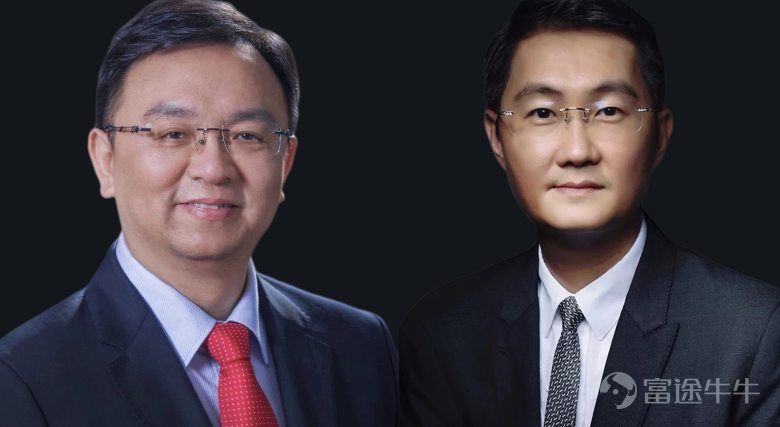

This common trait between Wang Chuanfu and Ma Huateng is worth learning for all entrepreneurs
Introduction:To many entrepreneurs, we suggest talking less about ideals and significance, and instead focusing more on fulfilling basic duties and following ethical paths.

Lishi / Author Lishi Business Review / Produced by
1
Not long ago, Li Qian, Secretary of the Board and Chief Investment Officer of BYD, conducted an in-depth interview with Charlie Munger and renowned investor Li Lu. During the interview, Li Lu reviewed in detail his 23-year relationship with BYD and his journey as a major investor accompanying its growth. Among other things, Li Lu highlighted three distinct qualities that impressed him most about Wang Chuanfu, the founder of BYD.
The first is Wang Chuanfu’s"Originality,"which refers to first-principles thinking. Wang Chuanfu always solves problems using scientific, physics-based, and engineering-oriented thinking, ensuring effective implementation and execution.
The second is Wang Chuanfu’s"Strong willpower." He always manages toface any difficulties in the development process without fear, persisting with unyielding determination and never giving up until success is achieved.
The last one, and the one that left the deepest impression on me, is Wang Chuanfu's"Trustee spirit."The so-called "trustee spirit" refers to Wang Chuanfu’s approach toward shareholders, employees, customers, distributors, and society. He demonstrates a high level of responsibility in fulfilling his commitments to these stakeholders, fully ensuring their interests.
For example, before BYD went public as a whole company, it did not accept any external institutional investments. He promised that all shares for employees would be directly provided by him, which caused his ownership stake in BYD to continually decrease. Outside of BYD, Wang Chuanfu has not made any other business arrangements. He has focused all his operations, energy, and wisdom on BYD, allowing shareholders like Li Lu to have great confidence in the company, with no worries that major shareholders might harm the interests of smaller investors for personal gain. This is also an important reason why Li Lu chose to invest in BYD long-term, holding the stock for 23 years without selling a single share.
2
Wang Chuanfu’s trustee spirit reminds me of another famous entrepreneur in China’s internet sector, Tencent's founder Ma Huateng. In an interview, Ma Huateng once said, "We deeply respect our investors. From the first day I accepted investment, I vowed not to disappoint them, and I am committed to doing my best. That’s why you see that we put all our businesses in one place. We don’t use financial tricks to manipulate the company up and down, left and right, leaving investors unaware of potential loopholes, which is what they fear most."
In addition to being trustworthy to investors, Ma Huateng also follows the same commitment when it comes to employee stock incentives. During the company’s growth, he strictly fulfilled his promises regarding equity allocation for employees, creating hundreds of millionaires and even several top executives at Tencent who are multi-billionaires. Ma Huateng believes, "We need strong contractual integrity—whatever was originally agreed upon must be strictly adhered to, regardless of what happens in between. This kind of contractual integrity is a value shared throughout our company." It is precisely this strict adherence to commitments to shareholders, employees, and other stakeholders that has earned Ma Huateng the trust of both investors and employees, leading to Tencent’s long-term sustainable development.
In the real business world, however, many entrepreneurs lack the “trustee spirit” exemplified by Wang Chuanfu and Ma Huateng. They often view their companies as private property and treat investors and employees merely as tools to achieve personal gains rather than as partners. Consequently, they frequently exploit their position as majority shareholders to infringe on the interests of small and medium investors and employees. As the interests of small investors and employees are repeatedly violated, they gradually lose confidence in the major shareholder and support for the company, making the decline of the enterprise inevitable.
3
Using capital market and corporate governance terminology, Li Lu refers to the characteristic of Wang Chuanfu and Ma Huateng strictly keeping their commitments to stakeholders as the “trustee spirit.” In layman’s terms, this reflects the basic decency and integrity that every person should possess.
A company is by no means the personal property of its founder, but rather a 'community of shared destiny.'First and foremost, its existence is premised on the ability to create real value for users. If it cannot generate genuine user value but still seeks to profit, it is tantamount to fraud.
Moreover, a business is the product of collaboration among shareholders, management, employees, suppliers, distributors, and society as a whole. Therefore, it must uphold commitments to the interests of all these stakeholders. For instance, it should not delay employee salaries, evade taxes, default on supplier payments, harm distributor interests, mislead investors, or bring environmental pollution and cutthroat competition to society...
As the holder of the greatest authority within the company, entrepreneurs can only be said to have fulfilled their duty and adhered to integrity when they correctly understand and practice the essence of a business as a 'community of shared destiny,' strictly honoring promises to stakeholders.
However, there are currently too many entrepreneurs who frequently talk about grand ideals and significance in the media without fulfilling even the most basic duties and integrity expected of an ordinary person. Towards users, they view them merely as objects for profit generation, instead of considering what would benefit users most from a value creation perspective; towards employees, they treat them as emotionless tools rather than living, breathing individuals deserving respect and trust; towards investors, they see them only as financial backers for their ventures, never contemplating how to give back; towards society, they think solely about extraction, never considering how to give back to the community...
For such entrepreneurs, I suggest they talk less about lofty ideals and significance, and instead focus more on fulfilling basic responsibilities and walking the righteous path. If one only talks about ideals and meaning without fulfilling their duties, they will ultimately only harm society and contribute nothing. If one fully fulfills their responsibilities, even without discussing ideals, those ideals will naturally come to fruition; without talking about social significance, contributions to society will naturally follow.
Risk Disclaimer: The above content only represents the author's view. It does not represent any position or investment advice of Futu. Futu makes no representation or warranty.Read more
Comments
to post a comment