
CPU returns to the core of AI! Who are the big winners?

CPU prices are on the rise! Morgan Stanley: Don't just focus on GPUs; in the AI Agent era, these key hardware components are being comprehensively reassessed.
With AI computing power demand continuing to surge, a new wave of price increases is sweeping the CPU market.
According to Taiwan's 'Industrial and Commercial Times' report on April 22, industry insiders from ODMs (Original Design Manufacturers) stated,Since March this year, consumer-grade CPU prices have increased by 5% to 10%, while server CPU prices have risen by 10% to 20%.Supply chain sources revealed that major international manufacturers are planning a new round of price hikes in the third quarter.
The core drivers of this round of price increases are twofold: First, the rapidly growing demand for AI servers is boosting procurement of core computing components. Second, advanced process capacity is highly concentrated, making it difficult for suppliers to respond immediately to demand growth.
Morgan Stanley’s latest research report also noted that this wave of price increases is not merely a short-term supply-demand imbalance,but rather an inevitable result of a 'structural transformation' in the underlying architecture of AI infrastructure. This article will analyze for fellow investors why CPUs are becoming increasingly important, which companies in the current CPU space are worth watching, and what other companies merit attention.
Why is the CPU becoming increasingly important? — The CPU is transitioning from a supporting role to a central one.
Morgan Stanley believes that as AI moves from mere 'generation' towards 'autonomous action' (also known as Agentic AI), the real computational bottleneck has shifted from computing power itself to 'coordination of computing power'.In this process, the key player responsible for taking on the tasks of coordination and scheduling is not the GPU, but the CPU.
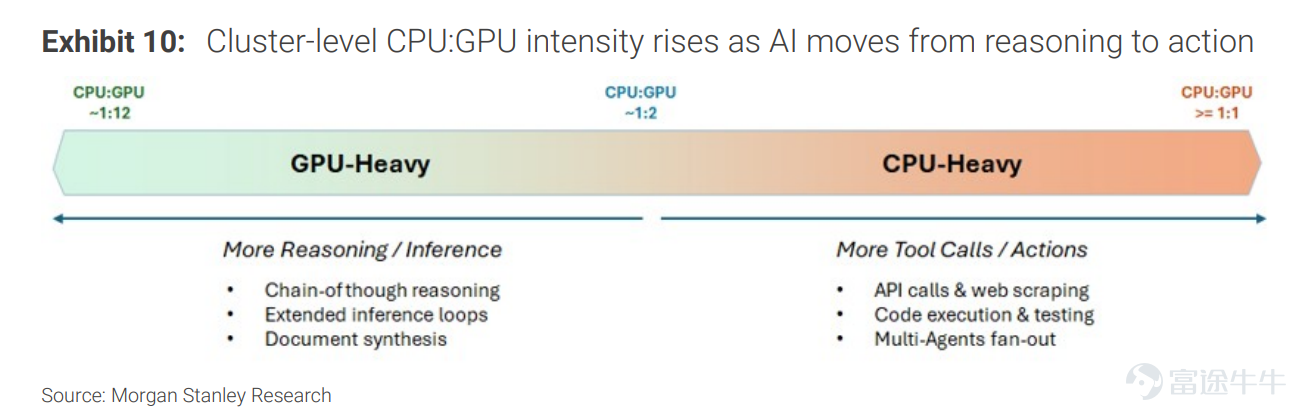
As AI progresses from 'inference' to 'execution,' system bottlenecks are also shifting from GPUs to CPUs and memory. Previously, one CPU could serve about 12 GPUs, but in the future, this ratio may increase to 1:2 or even reach a structure where two CPUs correspond to one GPU.

Source: Morgan Stanley
To quantify the impact of AI Agents on computing architecture, Morgan Stanley has introduced a new framework for data center CPU calculations, clearly dividing it into three categories:
First is the 'Head Node CPU',which refers to processors directly mounted on GPU racks (such as NVIDIA's Grace and Vera). Morgan Stanley estimates that if 5 million AI accelerators are deployed globally by 2030, with each GPU board equipped with two high-end CPUs priced at $5,000, the potential market size (TAM) for this segment will be as high as $50 billion.
Next is the 'Orchestration CPU',a massive 'pure incremental' market driven by agent-based AI. As AI tasks become more complex, Morgan Stanley assumes that each GPU will require an additional 2 to 3 'CPU-heavy nodes.' The specifications of these CPUs will surge from the current 136 cores to between 200 and 300 cores by 2030. At an average unit price of $3,000, this will create an additional market worth $30 billion to $45 billion.
Finally, there are infrastructure CPUs used for 'storage and network nodes',Its TAM is estimated to be between $2.5 billion and $15 billion.

Overall, driven by these three major engines, Morgan Stanley estimates that the total addressable market (TAM) for data center CPUs will reach$82.5 billion to $110 billion. Most notably, of this,an increase of $32.5 billion to $60 billion will be directly contributed by the explosion of agentic AI.
Which companies in the CPU sector are worth watching?
In the CPU space, AMD, with its leading position in the data center market, is expected to benefit first from the growth in demand; ARM architecture, relying on its energy efficiency advantages, has become an important choice for cloud providers' self-developed chips; Intel is still catching up through incremental upgrades. Specifically:
$Advanced Micro Devices (AMD.US)$:Morgan Stanley believes that AMD is in the most advantageous position to benefit from the growth of cloud CPU workloads driven by agentic AI. AMD has already surpassed Intel in x86 cloud market share,Morgan Stanley frankly stated that this incremental market 'mainly belongs to AMD,'because competitors are struggling with supply constraints and weaker product lines. However, despite its dominance in the CPU market, Morgan Stanley rates AMD as 'Neutral' because they prefer to capture AI infrastructure investment opportunities through NVIDIA and memory manufacturers, believing their price-to-earnings ratio to be more attractive.
$Intel (INTC.US)$:Morgan Stanley pointed out that before Intel's expected launch of 'Coral Rapids' equipped with SMT technology in 2028-2029 to narrow the performance gap, its competitiveness in certain highly specialized AI systems may be limited. To counter fierce competition from AMD in the data center CPU sector, Morgan Stanley expects Intel to outsource server CPU production to Taiwan Semiconductor (TSMC) in the second half of 2027 to ensure better time-to-market and chip quality.
Despite challenges, Intel’s vast ecosystem and installed base remain significant advantages. Additionally, its collaboration with NVIDIA on NVLink-compatible CPUs will be a key driver for Intel to capture market share in the 'head node' segment.
$Arm Holdings (ARM.US)$:Arm has launched its first mass-produced data center CPU, marking a bold step from being a mere 'IP enabler' to becoming a direct competitor to the x86 camp (Intel, AMD). The partnership with Meta significantly reduces product launch risks and demonstrates the cloud giant’s demand for highly vertically integrated AI computing platforms. However, Morgan Stanley downgraded its rating to 'Neutral' due to the time needed for commercial ramp-up, near-term DRAM shortages, margin pressures caused by R&D costs, and potential conflicts of interest with existing IP licensing customers as it ventures into chip manufacturing.
$NVIDIA (NVDA.US)$:NVIDIA introduced the 'Vera CPU,' designed specifically for Agentic AI, at the GTC conference—marking the company’s first foray into the standalone CPU market and intensifying direct competition with Intel and AMD.Morgan Stanley expects this standalone CPU business to grow into a multi-billion-dollar operation in the future.
Which other companies are worth watching?
As AI crosses boundaries to start 'AI Agents,' the nature of computational challenges has changed: Who will oversee and coordinate the overall system? Who will maintain vast contextual memory? And who will be responsible for seamlessly transferring states among thousands of intelligent agents?
The solution lies not in a single chip but in a massive and intricate 'systems engineering' approach. Components like CPUs, DRAM, ABF substrates, baseboards, MLCCs, BMCs, CPU sockets, power management modules, and cooling systems—once considered 'supporting actors' under the spotlight of GPUs—are now gaining new strategic importance thanks to agentic AI, leading to a comprehensive and aggressive revaluation of their value.
Morgan Stanley emphasized that as system complexity rises, enablers operating in 'supply-constrained' areas will gain asymmetric pricing power and excess economic profits. Morgan Stanley outlined core beneficiaries under AI Agents as follows:

1. CPU
In agent-based AI, the CPU becomes the absolute central hub for system coordination and control, managing workflows and API calls. Each additional call to an AI model requires more system coordination and resource allocation, driving structural growth in the CPU market. Whether it’s NVIDIA's Vera CPU or ARM’s new architecture, all are aimed at this massive business opportunity.
Related stocks: $Intel (INTC.US)$ 、 $NVIDIA (NVDA.US)$ 、 $Advanced Micro Devices (AMD.US)$ 、 $Arm Holdings (ARM.US)$ 。
2. Memory
Agent-based AI heavily relies on vast and persistent memory to maintain long-term context, historical records, and continuous learning.
DRAM: $CSOP Samsung Electronics Daily (2x) Leveraged Product (07747.HK)$ 、 $CSOP SK Hynix Daily (2x) Leveraged Product (07709.HK)$ 、 $Micron Technology (MU.US)$ . The operation of AI systems will drive a huge demand for memory capacity and bandwidth in servers.
NAND Flash: $SanDisk (SNDK.US)$ 、 $Kioxia Holdings (285A.JP)$ . Benefiting from the massive high-speed storage needs generated by AI inference and agent applications.
HDD: $Western Digital (WDC.US)$ 、 $Seagate Technology (STX.US)$ . Against the backdrop of a surge in overall cloud data volume, the demand for high-capacity cold data storage is also rising significantly.
3. Wafer fabrication
The rapid increase in system complexity has directly driven the demand for advanced process manufacturing and customized chip design.
Wafer foundry: $Taiwan Semiconductor (TSM.US)$ As CPUs and GPUs move toward advanced nodes such as 2nm/3nm, Taiwan Semiconductor will capture the greatest foundry economic value.
4. Baseboard management controller, CPU, and memory interface
As the number of internal server components increases and computing clusters grow larger, high-speed data transmission and system health monitoring have become crucial. The rise in server numbers is driving both market share and specification upgrades for BMCs (baseboard management controllers). Additionally, the intensive data exchange between CPUs and DRAM has significantly boosted the demand for memory interconnect chips.
5. PCB/substrate/copper-clad laminate and materials
To integrate powerful computing chips, the area and layers required for advanced packaging substrates have both increased, leading to a tight supply situation. Besides the simultaneous increase in volume and price of ABF substrates, suppliers of key materials supporting high-end packaging (such as low CTE glass fiber cloth and adhesion promoters) are also experiencing robust growth.
6. MLCC (multi-layer ceramic capacitors) and CPU sockets
High computing power requires extremely stable power supply and signal transmission, driving up the usage of high-end MLCCs and high-frequency CPU sockets.
7, SPE (Semiconductor Manufacturing Equipment)
The expansion of computing power infrastructure must ultimately be supported by larger semiconductor manufacturing capacity and automated production lines. Whether it’s lithography equipment for advanced logic chips, deposition tools, advanced packaging machines, or wiring harnesses and automated pneumatic components that support semiconductor plant operations, all will see significant capital expenditure growth.
Related stocks: $ASML Holding (ASML.US)$ 、 $Applied Materials (AMAT.US)$ 、 $KLA Corp (KLAC.US)$ 、 $Tokyo Electron (8035.JP)$ 、 $Ushio (6925.JP)$ 。
Summary
Overall, Morgan Stanley has outlined a clear blueprint for the next generation of AI data centers:The “weakest link effect” is becoming evident in AI hardware.When GPU computing power is no longer the sole bottleneck, addressing other parts of the barrel—such as CPUs responsible for scheduling, DRAM providing memory, and advanced packaging and substrates supporting physical interconnection—becomes the new value opportunity.
For the technology industry and capital markets, this means the investment focus on AI hardware is shifting—from searching for “the next NVIDIA” to positioning in full-stack infrastructure leaders that can resolve system-level coordination and communication bottlenecks. The rise of Agentic AI marks the end of indiscriminate expansion of single-point computing power; a fully balanced 'system-level computing power era' has arrived.
It should be noted that although Agentic AI outlines substantial infrastructure upgrade opportunities, investors must remain vigilant about slower-than-expected commercial adoption, supply chain constraints for advanced processes and high-end components, and geopolitical export controls. Additionally, the current capital market has already assigned extremely high valuation premiums to AI concept stocks. If cloud giants’ capital expenditures slow down or earnings reports fail to meet stringent market expectations, related stocks will face significant risks of valuation correction and volatility. Investment strategies must be carefully evaluated.
Risk Disclaimer: The above content only represents the author's view. It does not represent any position or investment advice of Futu. Futu makes no representation or warranty.Read more


Comments (12)
to post a comment
231
844