
The S&P 500 has risen for seven consecutive weeks—should you chase the rally or take profits?

Daily Options Seller Strategy | Capital floods into chip stocks! SOXL surges 104% this month to hit a new high. How can you use options to capitalize on the semiconductor trend?
I. Market Barometer: Major indexes consolidate at highs, while the semiconductor sector dances to its own beat
In the previous trading session, the three major US indices rallied before retreating, ending the Nasdaq's winning streak, with overall market sentiment leaning cautious. However, the semiconductor sector demonstrated exceptionally strong 'alpha' characteristics, $PHLX Semiconductor Index (.SOX.US)$ rising 0.5% against the trend, outperforming the broader market and continuing to reach new all-time highs.
The recent massive inflow of capital into chip stocks highlights the sector’s leading role in the current market environment.What is driving such a strong independent rally? How can one utilize an options selling strategy to position themselves in semiconductor ETFs?
II. Focus on Hot Targets: SOXL (Triple-Leveraged Semiconductor ETF)
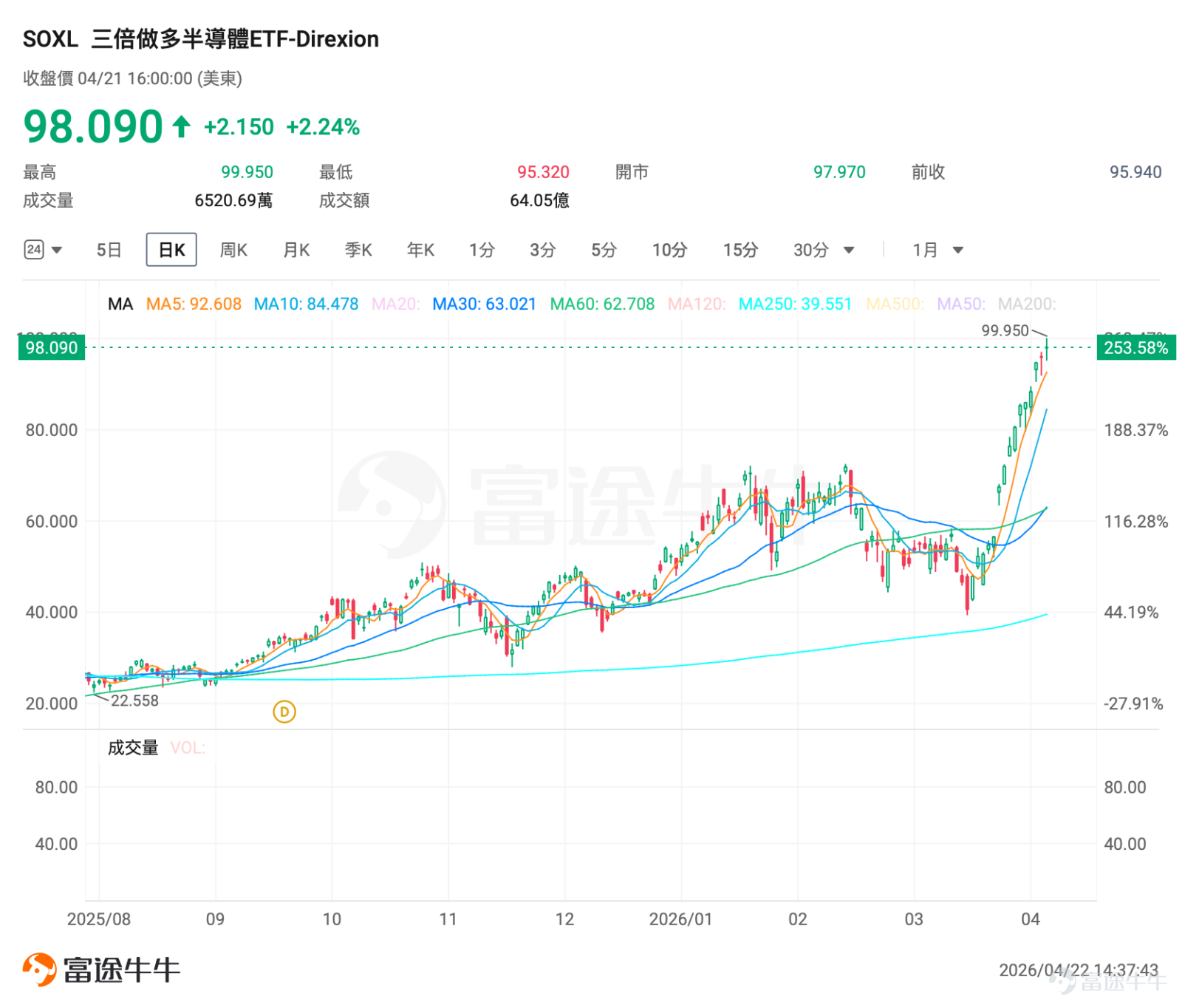
$Direxion Daily Semiconductor Bull 3x Shares ETF (SOXL.US)$ The previous trading day saw a 2.24% gain, hitting an intraday high of $99.95, setting a new record, with a closing price of $98.09.This ETF has recorded gains for 15 consecutive trading sessions, with cumulative gains reaching 104.74% since April, alongside increasing trading volumes, reflecting a typical capital rush.

Reversal of the macro 'geopolitical risk discount' leads to aggressive fund inflows
The record-breaking rise of SOXL this round stems from a reversal in macro pricing logic.Previously, the US-Iran conflict caused panic in the semiconductor supply chain, leading to relentless selling pressure on the sector. However, as geopolitical tensions showed signs of easing on April 7, market sentiment shifted from 'risk aversion' to 'aggressive recovery.' Institutions that were forced to reduce positions are now aggressively rebuilding their positions at historically rare levels to avoid missing out on potential gains.
As a triple-leveraged product, SOXL amplifies the elasticity of this macro sentiment reversal by three times.
In addition to the recovery of macro sentiment, the resilience of the semiconductor industry's fundamentals provides SOXL with strong support.AI demand remains robust. Despite significant market volatility, the dominant narrative around AI hardware has not changed. For example, $Alphabet-A (GOOGL.US)$ signed a 1.2 GW fuel cell power contract with $Marvell Technology (MRVL.US)$ the collaboration on developing AI inference chips directly pushed the latter's stock price up by over 50% within the month, further driving the entire Philadelphia Semiconductor Index.
III. Seller Options Strategy
1. Sell 1 contract $Direxion Daily Semiconductor Bull 3x Shares ETF (SOXL.US)$ 20260501 75P, estimated required margin (for reference only): $7,500 ($75 × 100)

Opportunity filtering logic:
Technically speaking, $Direxion Daily Semiconductor Bull 3x Shares ETF (SOXL.US)$ A strong upward movement has pushed the market into a technical bull phase. The continuous squeeze in short positions has caused significant deviation in short-term indicators. However, due to its triple-leverage attribute, as long as the Philadelphia Semiconductor Index maintains a slight increase, SOXL can achieve substantial gains. This positive feedback loop has attracted a large number of trend traders chasing the upward momentum.However, the high-level doji candlestick pattern after reaching new highs also warns investors that chasing the uptrend may carry considerable risks. At this point, entering via an options selling strategy represents a choice with controllable risk.
By selling put options, if the stock price continues to rise or remains volatile at high levels, the option premium can be collected, improving the annualized return on idle funds. If the stock price retraces to near the strike price, it also allows entry at a pullback price to position in semiconductor sector ETFs.
IV. Risk Control Reminder
Although the seller strategy has a high probability of success, investors must still manage risks effectively:
– Position management is key:The biggest risk for sellers lies in black swan events. It is recommended thatthe margin requirement for any single underlying should not exceed 20% of total capital. Never sell options beyond your capacity to handle them just for the sake of greedy premium collection.
– Covered call options should be rolled over in a timely manner.(Rolling): When a covered call option becomes deeply in-the-money (stock price far exceeds the strike price),if you remain bullish on the underlying stock, you should decisively 'roll' the position— that is, buy to close the current option while simultaneously selling an option with a further expiration date and a higher strike price, avoiding the forced liquidation of the underlying stock at a low price.
– Cash-secured put options should beware of 'left-tail risk':For cash-secured puts,if the stock price collapses due to deteriorating fundamentals (rather than normal pullbacks), don’t hold on stubbornly.At this point, it's advisable to cut losses or 'roll down' to gain time, waiting for volatility to normalize.
 Make the most of the options seller zone to understand income strategies for selling options,Earn option premiums!
Options Risk Warning
An option is a contract that grants the holder the right, but not the obligation, to buy or sell an asset at a fixed price on a specific date or at any time before that date. The price of an option is influenced by various factors, including the current price of the underlying asset, the strike price, time to expiration, and implied volatility. Implied volatility reflects the market’s expectations for the level of volatility in the option over a future period. It is a data point derived inversely from the Black-Scholes option pricing model and is generally regarded as an indicator of market sentiment. When investors anticipate greater volatility, they may be more willing to pay a higher price for options to hedge risks, resulting in higher implied volatility. Traders and investors use implied volatility to assess the attractiveness of option prices, identify potential mispricings, and manage risk exposure.
Disclaimer
This content does not constitute any offer, solicitation, recommendation, opinion, or guarantee of any securities, financial products, or tools. The risk of loss in trading options can be substantial. In some cases, losses may exceed the initial margin deposited. Even if you set contingent orders such as 'stop-loss' or 'limit' orders, these may not prevent losses. Market conditions may make such orders unexecutable. You may be required to deposit additional margin within a short period. If you fail to provide the required amount within the specified time, your open positions may be liquidated. However, you will still be responsible for any shortfall in your account. Therefore, before trading, you should study and understand options and carefully consider whether such trading is suitable for you based on your financial situation and investment objectives. If you trade options, you should be familiar with the procedures for exercising options and the rights and obligations upon exercise and expiration. Options trading carries extremely high risks and is not suitable for all investors. Investors should carefully readCharacteristics and Risks of Standardized Options。
Risk Disclaimer: The above content only represents the author's view. It does not represent any position or investment advice of Futu. Futu makes no representation or warranty.Read more


Comments
to post a comment
17
32